Page 237 of 297
06 Maintenance and specifications
Replacing bulbs06
}}
235
8.
Reconnect the wiring connector to the bulb
holder.
9. Put the cover back into position and rein- stall the headlight housing.
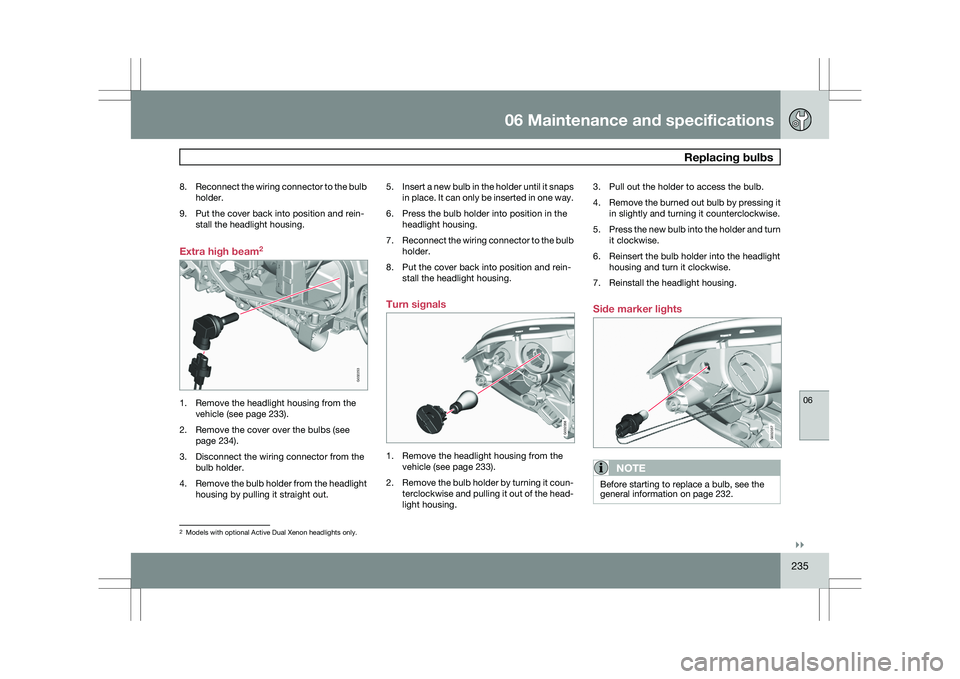
Extra high beam 21. Remove the headlight housing from the
vehicle (see page 233).
2. Remove the cover over the bulbs (see page 234).
3. Disconnect the wiring connector from the bulb holder.
4. Remove the bulb holder from the headlight
housing by pulling it straight out. 5.
Insert a new bulb in the holder until it snaps
in place. It can only be inserted in one way.
6. Press the bulb holder into position in the headlight housing.
7. Reconnect the wiring connector to the bulb
holder.
8. Put the cover back into position and rein- stall the headlight housing.
Turn signals 1. Remove the headlight housing from the
vehicle (see page 233).
2. Remove the bulb holder by turning it coun-
terclockwise and pulling it out of the head-
light housing. 3. Pull out the holder to access the bulb.
4.
Remove the burned out bulb by pressing it
in slightly and turning it counterclockwise.
5. Press the new bulb into the holder and turn
it clockwise.
6. Reinsert the bulb holder into the headlight housing and turn it clockwise.
7. Reinstall the headlight housing.
Side marker lights
NOTE Before starting to replace a bulb, see the
general information on page 232.
2
Models with optional Active Dual Xenon headlights only. G032253 G032358 G032357
Page 238 of 297
06 Maintenance and specificationsReplacing bulbs 06
236 1. Remove the headlight housing from the
vehicle (see page 233).
2. Remove the bulb holder by turning it coun-
terclockwise and pulling it out of the head-
light housing.
3. Pull out the burned out bulb and install a new one. It can only be inserted in one
position.
4. Reinsert the bulb holder into the headlight housing and turn it clockwise.
5. Reinstall the headlight housing.
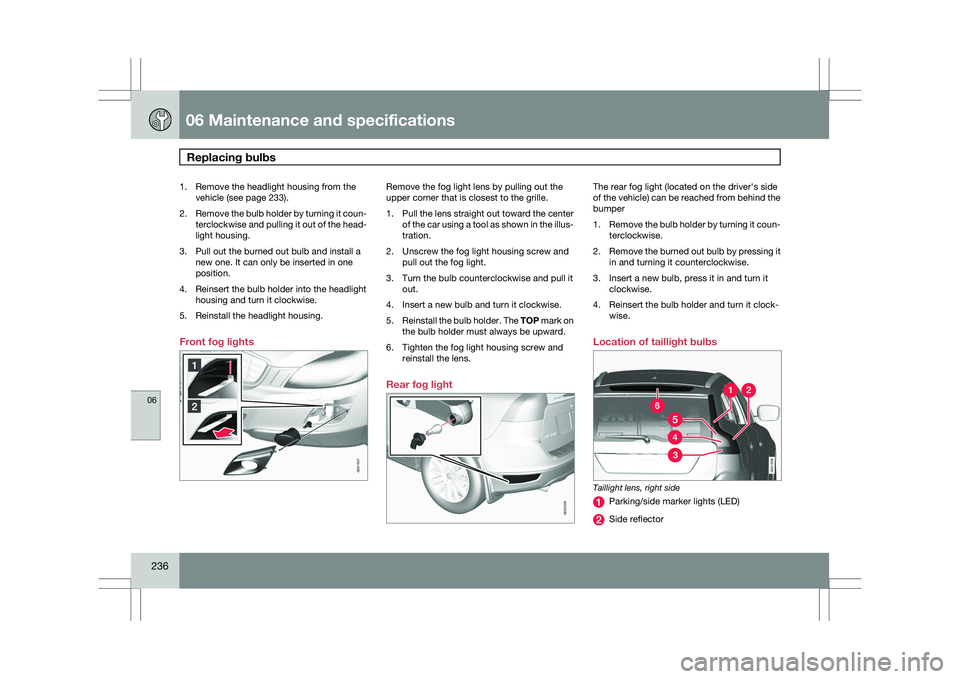
Front fog lights Remove the fog light lens by pulling out the
upper corner that is closest to the grille.
1.
Pull the lens straight out toward the center
of the car using a tool as shown in the illus-
tration.
2. Unscrew the fog light housing screw and pull out the fog light.
3. Turn the bulb counterclockwise and pull it out.
4. Insert a new bulb and turn it clockwise.
5. Reinstall the bulb holder. The TOP mark on
the bulb holder must always be upward.
6. Tighten the fog light housing screw and reinstall the lens.
Rear fog light The rear fog light (located on the driver\fs side
of the vehicle) can be reached from behind the
bumper
1.
Remove the bulb holder by turning it coun-
terclockwise.
2. Remove the burned out bulb by pressing it
in and turning it counterclockwise.
3. Insert a new bulb, press it in and turn it clockwise.
4. Reinsert the bulb holder and turn it clock- wise.
Location of taillight bulbs Taillight lens, right side
Parking/side marker lights (LED)
Side reflector G031937 G032359 G031939
Page 239 of 297

06 Maintenance and specifications
Replacing bulbs06
}}
237Brake light
Backup light
Turn signal
Brake lights (LED)
NOTE
If an error message remains in the display
after a faulty bulb has been replaced, con-
tact an authorized Volvo workshop.
Brake lights and Taillights
The brake lights and taillights are replaced from
inside the cargo area.
NOTE Before starting to replace a bulb, see the
general information on page 232.
1. Open the panel.
2.
Remove the bulb holder by turning it coun-
terclockwise.
3. Remove the burned out bulb by pressing it
in and turning it counterclockwise.
4. Insert a new bulb, press it in and turn it clockwise.
5. Reinsert the bulb holder and turn it clock- wise.
License plate lighting 1. Remove the screws with a screwdriver.2. Carefully detach the entire bulb housing
and pull it out.
3. Replace the bulb.
4. Reinsert the entire bulb housing and screw
it into place.
Footwell lighting 1.
Insert a screwdriver at the short end of the
lens closest to the tunnel console (the cen-
ter of the vehicle) and turn gently so that
the lens comes loose. (Applies to both
lights).
2. Turn carefully until the lens comes loose.
3. Replace the bulb.
4. Press the lens back into place. G032485 G031940 G031941
Page 240 of 297
06 Maintenance and specificationsReplacing bulbs 06
238 Cargo area lighting
NOTE
Before starting to replace a bulb, see the
general information on page 232.
1. Insert a screwdriver and turn it gently so
that the bulb housing comes loose.
2. Replace the bulb.
3. Check that the bulb illuminates and press it back into the bulb housing. Vanity mirror lighting
Removing the mirror glass
1. Insert a screwdriver underneath the lower
edge, in the center, turn and carefully pry
up the lug on the edge.
2. Insert the screwdriver underneath the edge
on the left and right sides (by the black
rubber sections), and pry carefully so that
the glass comes loose in the lower edge.
3. Carefully detach and lift aside the entire mirror glass and cover.
4. Replace the bulb.
Reinstalling the mirror glass1. Press the three lugs at top edge of the mir-
ror glass back into position. 2. Press the three lower lugs back into posi-
tion.
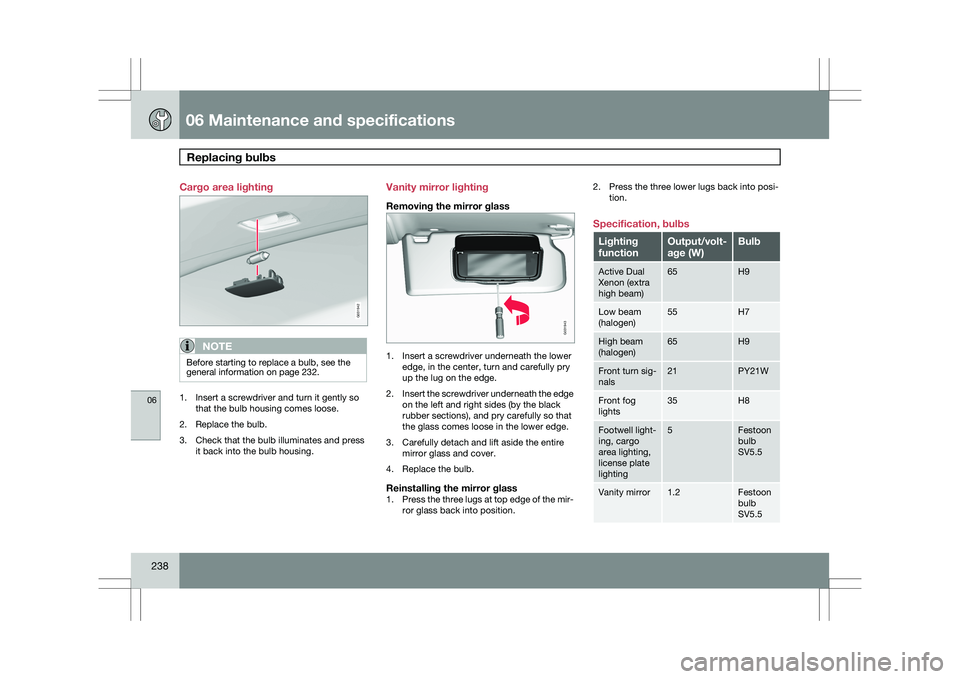
Specification, bulbs Lighting
function Output/volt-
age (W) Bulb
Active Dual
Xenon (extra
high beam) 65 H9
Low beam
(halogen) 55 H7
High beam
(halogen) 65 H9
Front turn sig-
nals 21 PY21W
Front fog
lights 35 H8
Footwell light-
ing, cargo
area lighting,
license plate
lighting 5 Festoon
bulb
SV5.5
Vanity mirror 1.2 Festoon
bulb
SV5.5 G031942 G031943
Page 241 of 297
06 Maintenance and specifications
Replacing bulbs06
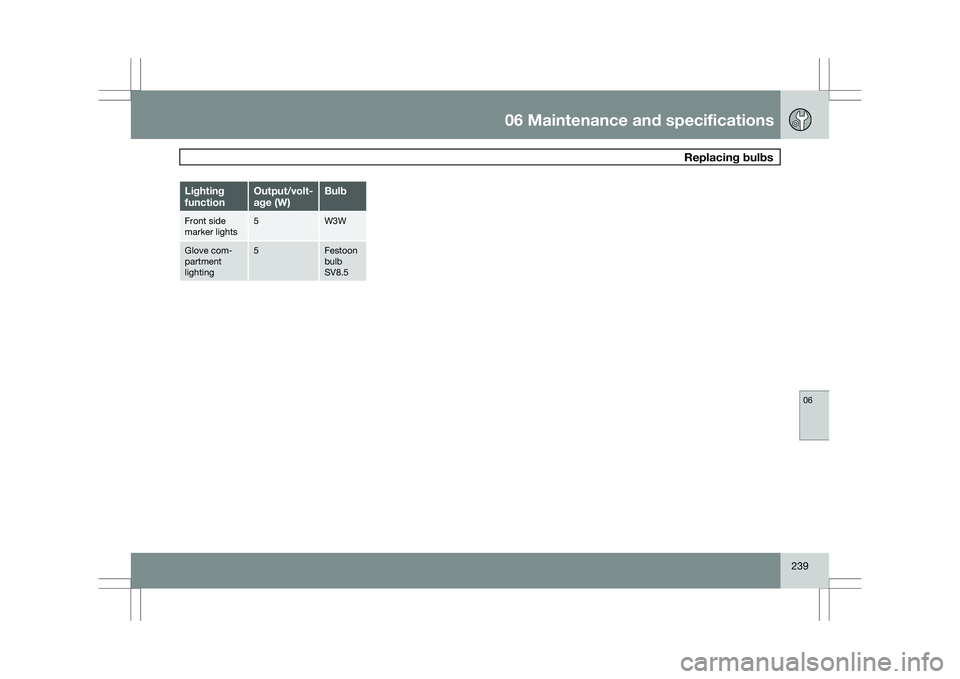
239Lighting
function Output/volt-
age (W) Bulb
Front side
marker lights 5 W3W
Glove com-
partment
lighting 5 Festoon
bulb
SV8.5
Page 249 of 297
06 Maintenance and specifications
Fuses06
}}
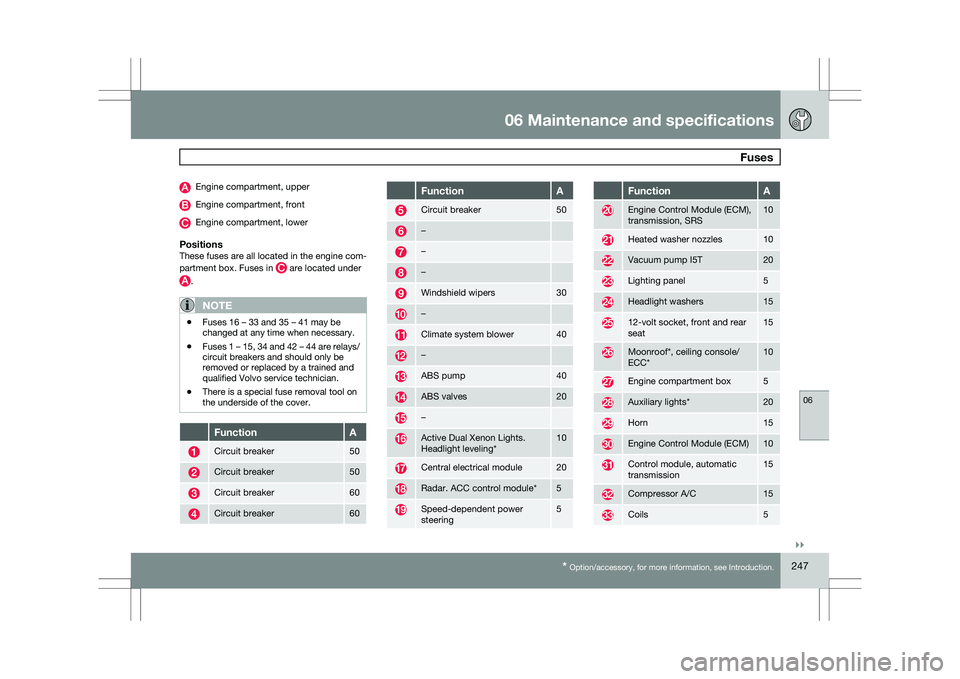
* Option/accessory, for more information, see Introduction. 247Engine compartment, upper
Engine compartment, front
Engine compartment, lower
PositionsThese fuses are all located in the engine com-
partment box. Fuses in
are located under
.
NOTE
\b
Fuses 16 – 33 and 35 – 41 may be
changed at any time when necessary.
\b Fuses 1 – 15, 34 and 42 – 44 are relays/
circuit breakers and should only be
removed or replaced by a trained and
qualified Volvo service technician.
\b There is a special fuse removal tool on
the underside of the cover. Function A
Circuit breaker 50
Circuit breaker 50
Circuit breaker 60
Circuit breaker 60 Function A
Circuit breaker 50
–
–
–
Windshield wipers 30
–
Climate system blower 40
–
ABS pump 40
ABS valves 20
–
Active Dual Xenon Lights.
Headlight leveling
* 10
Central electrical module 20
Radar. ACC control module* 5
Speed-dependent power
steering 5 Function A
Engine Control Module (ECM),
transmission, SRS 10
Heated washer nozzles 10
Vacuum pump I5T 20
Lighting panel 5
Headlight washers 15
12-volt socket, front and rear
seat 15
Moonroof*, ceiling console/
ECC* 10
Engine compartment box 5
Auxiliary lights* 20
Horn 15
Engine Control Module (ECM) 10
Control module, automatic
transmission 15
Compressor A/C 15
Coils 5
Page 251 of 297
06 Maintenance and specifications
Fuses06
}}
* Option/accessory, for more information, see Introduction. 249
Under the glove compartment
Fold aside the iupholstery covering the fuse
box.
1. Press the cover\fs lock and fold it up.
2. The fuses are accessible.
Positions
Function A
Rain sensor* 5
SRS system 10
ABS brakes. Electric parking
brake 5 Function A
Accelerator pedal, heated
seats* 7.5
–
ICM display, CD & Radio 15
Steering wheel module 7.5
–
High beam 15 Function A
Moonroof* 20
Backup lights 7.5
–
Front fog light* 15
Windshield washers 15
Adaptive cruise control ACC* 10
– 1011121314123456789
2322212019181716152425262728
G032918
Page 276 of 297
06 Maintenance and specificationsVehicle care 06
274 Washing the car
WARNING
Be sure that the compressor is not con-
nected to a 12-volt socket while replacing
the container.
The following points should be kept in mind
when washing and cleaning the car:
\b
The car should be washed at regular inter-
vals since dirt, dust, insects and tar spots
adhere to the paint and may cause dam-
age. To help prevent corrosion, it is partic-
ularly important to wash the car frequently
in the wintertime.
\b Avoid washing your car in direct sunlight.
Doing so may cause detergents and wax
to dry out and become abrasive. To avoid
scratching, use lukewarm water to soften
the dirt before you wash with a soft
sponge, and plenty of sudsy water.
\b Bird droppings: Remove from paintwork
as soon as possible. Otherwise the finish
may be permanently damaged.
\b A detergent can be used to facilitate the
softening of dirt and oil.
\b A water-soluble grease solvent may be
used in cases of sticky dirt. However, use
a wash place equipped with a drainage
separator. \b
Dry the car with a clean chamois and
remember to clean the drain holes in the
doors and rocker panels.
\b Tar spots can be removed with kerosene
or tar remover after the car has been
washed.
\b A stiff-bristle brush and lukewarm soapy
water can be used to clean the wiper
blades. Frequent cleaning of the wind-
shield and wiper blades improves visibility
considerably and also helps prolong the
service life of the wiper blades.
\b Wash off the dirt from the underside (wheel
housings, fenders, etc).
\b In areas of high industrial fallout, more fre-
quent washing is recommended.
\b After cleaning the engine, the spark plug
wells should be inspected for water and
blown dry if necessary.
NOTE When washing the car, remember to remove
dirt from the drain holes in the doors and
sills.
CAUTION \b
During high pressure washing, the
spray mouthpiece must never be closer
to the vehicle than 13" (30 cm). Do not
spray into the locks.
\b Dirt, snow, etc., on the headlights can
reduce lighting capacity considerably.
Clean the headlights regularly, for
example when refueling.
\b When washing or steam cleaning the
engine, avoid spraying water or steam
directly on the electrical components or
toward the rear side of the engine. Spe-
cial moonroof cautions:
\b Always close the moonroof and sun
shade before washing your vehicle.
\b Never use abrasive cleaning agents on
the moonroof.
\b Never use wax on the rubber seals
around the moonroof.
Exterior componentsVolvo recommends the use of special cleaning
products, available at your Volvo retailer, for
cleaning colored plastic, rubber, or ornamental
components such as chromed strips on the
exterior of your vehicle. The instructions for
using these products should be followed care-