2009 VOLVO XC60 fuel
[x] Cancel search: fuelPage 263 of 297
06 Maintenance and specifications
Wheels and tires06
}}
261
Vehicle loading
Properly loading your vehicle will provide maxi-
mum return of vehicle design performance.
Before loading your vehicle, familiarize yourself
with the following terms for determining your
vehicle\fs weight ratings, with or without a
trailer, from the vehicle\fs Federal/Canadian
Motor Vehicle Safety Standards (FMVSS/
CMVSS) label, and the vehicle\fs tire informa-
tion placard:
Curb weightThe weight of the vehicle including a full tank
of fuel and all standard equipment. It does not
include passengers, cargo, or optional equip-
ment.
Capacity weightAll weight added to the curb weight, including
cargo and optional equipment. When towing,
trailer hitch tongue load is also part of cargo
weight.
NOTE
For trailer towing information, please refer to
the section "Towing a trailer"
on page 217.
Permissible axle weightThe maximum allowable weight that can be
carried by a single axle (front or rear). These
numbers are shown on the Federal/Canadian
Motor Vehicle Safety Standards (FMVSS/
CMVSS) label. The total load on each axle must
never exceed its maximum permissible weight.
Gross vehicle weight (GVW)The vehicle\fs curb weight + cargo + passen-
gers.
NOTE \b
The location of the various labels in your
vehicle can be found on page 279
.
\b A table listing important weight limits for
your vehicle can be found on page
282.
Steps for Determining Correct Load
Limit
1. Locate the statement "the combined
weight of occupants and cargo should
never exceed XXX pounds" on your vehi-
cle\fs placard. 2. Determine the combined weight of the
driver and passengers that will be riding in
your vehicle.
3. Subtract the combined weight of the driver
and passengers from XXX kilograms or
XXX pounds.
4. The resulting figure equals the available amount of cargo and luggage load
capacity. For example, if the "XXX" amount
equals 1400 lbs. and there will be five
150 lb. passengers in your vehicle, the
amount of available cargo and luggage
load capacity is 650 lbs. (1400 – 750
(5 × 150) = 650 lbs.)
5. Determine the combined weight of luggage
and cargo being loaded on the vehicle.
That weight may not safely exceed the
available cargo and luggage load capacity
calculated in Step 4.
6. If your vehicle will be towing a trailer, load from your trailer will be transferred to your
vehicle. Consult this manual 1
to determine
how this reduces the available cargo and
luggage load capacity of your vehicle. 1
See the section "Trailer Towing on page
217.
Page 266 of 297

06 Maintenance and specificationsWheels and tires 06
264 Temporary Spare
The spare tire in your vehicle is called a "Tem-
porary Spare".
Recommended tire pressure (see the placard
on the B-pillar or on the fuel filler door) should
be maintained irrespective of which position on
the vehicle the temporary spare tire is used on.
In the event of damage to this tire, a new one
can be purchased from your Volvo retailer.
WARNING
Current legislation prohibits the use of the
"Temporary Spare" tire other than as a tem-
porary replacement for a punctured tire. It
must be replaced as soon as possible by a
standard tire. Road holding and handling
may be affected with the "Temporary
Spare" in use. Do not exceed 50 mph
(80 km/h).
CAUTION
The vehicle must not be driven with wheels
of different dimensions or with a spare tire
other than the one that came with the vehi-
cle. The use of different size wheels can
seriously damage your car\fs transmission. Changing a wheel
Location of jack and tools
Spare wheelThe spare wheel (Temporary spare) is only
intended for temporary use. Replace the spare
wheel with a normal wheel as soon as possible.
The car\fs handling may be altered by the use
of the spare wheel. The correct tire pressure for
the spare wheel is stated in the tire pressure
tables beginning on page 258.
WARNING Current legislation prohibits the use of the
“Temporary Spare” tire other than as a tem-
porary replacement for a punctured tire. It
must be replaced as soon as possible by a
standard tire. Road holding and handling
may be affected with the “Temporary
Spare” in use.
CAUTION
The vehicle must never be driven with more
than one temporary spare wheel.
The spare wheel is located in the spare wheel
well with the rim side down. There are two foam
blocks, one under the spare wheel and one
over/inside. The upper one contains all tools.
The same bolt runs through to secure the spare
wheel and the foam blocks.
Taking out the spare wheel1.
Fold the rear edge of the floor mat forward.
2. Open the floor hatch.
3. Undo the retaining bolt.
4. Lift out the foam block with tools.
5. Lift out the spare wheel.
The other two blocks can remain in the wheel
well. G031900
Page 274 of 297

06 Maintenance and specificationsWheels and tires 06
272 When low inflation pressure is detected, TPMS
will light up the tire pressure warning light
(
) (also referred to as a telltale) in the
instrument panel and will display one of the
following messages in the text window: LOW
TIRE PRESS. CHECK TIRES or VERY LOW
TIRE PRESSURE.
NOTE If a fault occurs in TPMS, the tire pressure
warning light will flash for approximately
1 minute and TIRE PRESS SYST
SERVICE REQUIRED will be displayed.
Each tire, including the spare (if provided),
should be checked monthly when cold and
inflated to the inflation pressure recommended
by the vehicle manufacturer on the vehicle
placard or tire inflation pressure label. (If your
vehicle has tires of a different size than the size
indicated on the vehicle placard or tire inflation
pressure label, you should determine the
proper tire inflation pressure for those tires.)
As an added safety feature, your vehicle has
been equipped with a tire pressure monitoring
system (TPMS) that illuminates a low tire pres-
sure telltale when one or more of your tires is
significantly under-inflated. Accordingly, when
the low tire pressure telltale illuminates, you
should stop and check your tires as soon as possible, and inflate them to the proper pres-
sure. Driving on a significantly under-inflated
tire causes the tire to overheat and can lead to
tire failure. Under-inflation also reduces fuel
efficiency and tire tread life, and may affect the
vehicle\fs handling and stopping ability.
Please note that the TPMS is not a substitute
for proper tire maintenance, and it is the driv-
er\fs responsibility to maintain correct tire pres-
sure, even if under-inflation has not reached
the level to trigger illumination of the TPMS low
tire pressure telltale.
Your vehicle has also been equipped with a
TPMS malfunction indicator to indicate when
the system is not operating properly. The
TPMS malfunction indicator is combined with
the low tire pressure telltale. When the system
detects a malfunction, the telltale will flash for
approximately one minute and then remain
continuously illuminated. This sequence will
continue upon subsequent vehicle start-ups as
long as the malfunction exists. When the mal-
function indicator is illuminated, the system
may not be able to detect or signal low tire
pressure as intended. TPMS malfunctions may
occur for a variety of reasons, including the
installation of replacement or alternate tires or
wheels on the vehicle that prevent the TPMS
from functioning properly. Always check the
TPMS malfunction telltale after replacing one
or more tires or wheels on your vehicle to
ensure that the replacement or alternate tires
and wheels allow the TPMS to continue to
function properly.
NOTE
TPMS indicates low tire pressure but does
not replace normal tire maintenance. For
information on correct tire pressure, please
refer to the Tire inflation pressure tables or
consult your Volvo retailer.
Erasing warning messagesWhen a low tire pressure warning message has
been displayed, and the tire pressure warning
light has come on:
1. Use a tire pressure gauge to check the
inflation pressure of all four tires.
2. Re-inflate the tire(s) to the correct pressure
(consult the tire pressure placard or the
tables beginning on page
258.
3. In certain cases, it may be necessary to drive the vehicle for several minutes at a
speed of 20 mph (30 km/h) or faster. This
will erase the warning text and the warning
light will go out.
Page 276 of 297
06 Maintenance and specificationsVehicle care 06
274 Washing the car
WARNING
Be sure that the compressor is not con-
nected to a 12-volt socket while replacing
the container.
The following points should be kept in mind
when washing and cleaning the car:
\b
The car should be washed at regular inter-
vals since dirt, dust, insects and tar spots
adhere to the paint and may cause dam-
age. To help prevent corrosion, it is partic-
ularly important to wash the car frequently
in the wintertime.
\b Avoid washing your car in direct sunlight.
Doing so may cause detergents and wax
to dry out and become abrasive. To avoid
scratching, use lukewarm water to soften
the dirt before you wash with a soft
sponge, and plenty of sudsy water.
\b Bird droppings: Remove from paintwork
as soon as possible. Otherwise the finish
may be permanently damaged.
\b A detergent can be used to facilitate the
softening of dirt and oil.
\b A water-soluble grease solvent may be
used in cases of sticky dirt. However, use
a wash place equipped with a drainage
separator. \b
Dry the car with a clean chamois and
remember to clean the drain holes in the
doors and rocker panels.
\b Tar spots can be removed with kerosene
or tar remover after the car has been
washed.
\b A stiff-bristle brush and lukewarm soapy
water can be used to clean the wiper
blades. Frequent cleaning of the wind-
shield and wiper blades improves visibility
considerably and also helps prolong the
service life of the wiper blades.
\b Wash off the dirt from the underside (wheel
housings, fenders, etc).
\b In areas of high industrial fallout, more fre-
quent washing is recommended.
\b After cleaning the engine, the spark plug
wells should be inspected for water and
blown dry if necessary.
NOTE When washing the car, remember to remove
dirt from the drain holes in the doors and
sills.
CAUTION \b
During high pressure washing, the
spray mouthpiece must never be closer
to the vehicle than 13" (30 cm). Do not
spray into the locks.
\b Dirt, snow, etc., on the headlights can
reduce lighting capacity considerably.
Clean the headlights regularly, for
example when refueling.
\b When washing or steam cleaning the
engine, avoid spraying water or steam
directly on the electrical components or
toward the rear side of the engine. Spe-
cial moonroof cautions:
\b Always close the moonroof and sun
shade before washing your vehicle.
\b Never use abrasive cleaning agents on
the moonroof.
\b Never use wax on the rubber seals
around the moonroof.
Exterior componentsVolvo recommends the use of special cleaning
products, available at your Volvo retailer, for
cleaning colored plastic, rubber, or ornamental
components such as chromed strips on the
exterior of your vehicle. The instructions for
using these products should be followed care-
Page 285 of 297

06 Maintenance and specifications
Specifications06
}}
283
Engine specifications
Specification/Model 3.0T
Engine designation B6304T2
Output (kW/rps) 210/93
Output (hp/rpm) 281/5600
Torque (Nm/rps) 400/25 – 80
Torque (ft. lbs./rpm) 295/1500 – 4800
No. of cylinders 6
Bore (in/mm) 3.23/82
Stroke (in/mm) 3.67/93.2
Displacement 2.95 liters (175 cu. in.)
Compression ratio 9.3:1
Engine oil
Engine oil must meet the minimum ILSAC
specification GF-4, API SL, or ACEA A1/B1.
Lower quality oils may not offer the same fuel
economy, engine performance, or engine pro-
tection.
Volvo recommends Castrol.
Depending on your driving habits, premium or
synthetic oils may provide superior fuel econ-
omy and engine protection. Consult your Volvo
retailer for recommendations on premium or
synthetic oils.
Oil additives must not be used.
Synthetic oil is not used when the oil is
changed at the normal maintenance services.
This oil is only used at customer request, at
additional charge. Please consult your Volvo
retailer.
Oil viscosityIncorrect viscosity oil can shorten engine life
under normal use. SAE 5W-30 will provide
good fuel economy and engine protection. See
the viscosity chart.
Page 287 of 297
06 Maintenance and specifications
Specifications06
}}
285
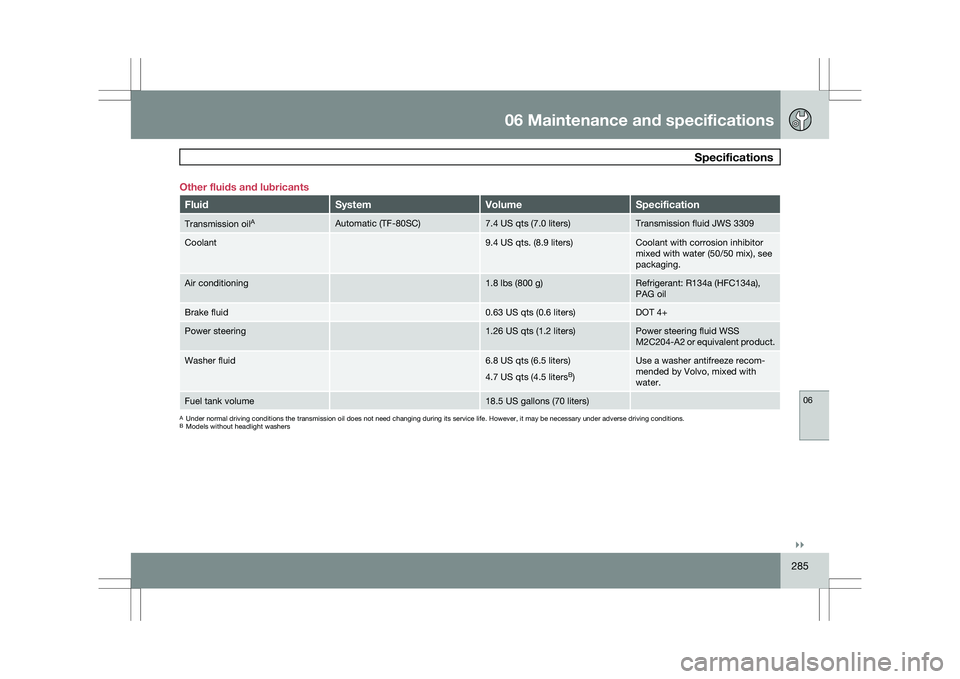
Other fluids and lubricants
Fluid System Volume Specification
Transmission oil
A Automatic (TF-80SC) 7.4 US qts (7.0 liters) Transmission fluid JWS 3309
Coolant 9.4 US qts. (8.9 liters) Coolant with corrosion inhibitor
mixed with water (50/50 mix), see
packaging.
Air conditioning 1.8 lbs (800 g) Refrigerant: R134a (HFC134a),
PAG oil
Brake fluid 0.63 US qts (0.6 liters) DOT 4+
Power steering 1.26 US qts (1.2 liters) Power steering fluid WSS
M2C204-A2 or equivalent product.
Washer fluid 6.8 US qts (6.5 liters)
4.7 US qts (4.5 liters
B
) Use a washer antifreeze recom-
mended by Volvo, mixed with
water.
Fuel tank volume 18.5 US gallons (70 liters)
A
Under normal driving conditions the transmission oil does not need chang\
ing during its service life. However, it may be necessary under adverse \
driving conditions.
B Models without headlight washers
Page 292 of 297

07 Index07
290 Dual Xenon headlights
...............................88
E ECC.................................................. 129, 130
Economical driving
.................................. 202
Electric parking brake ..............................116
Electronic Climate Control .......128, 129, 130
air distribution table ............................131
Interior Air Quality System.................. 130
Emergency brake lights .............................88
Emergency locking retractor
...................... 34
Emergency starting .................................. 107
Emergency towing ........................... 220, 221
Emission inspection readiness ................225
Engine overheating ........................................... 77
specifications ...................................... 283
starting ................................................ 105
starting with keyless drive ..................106
Engine compartment overview ................227
Engine oil checking ............................................. 228
low pressure warning light ....................75specifications
...................................... 283
volumes .............................................. 284
Environment ................................................. 9
Eyelets for anchoring loads .....................210
F Federal Clean Air Act
...............................224
Fluid specifications .................................. 285
Fog lights front...................................................... 75
front, changing bulbs ..........................236
front/rear............................................... 89
rear......................................................
236
Four C (active chassis system) ................157
Front airbags.................................. 18, 19, 20 disconnecting passenger’s side air-
bag.................................................. 22, 23
Front fog lights ..................................... 75, 89
changing bulbs ................................... 236
Front park assist.............................. 187, 189
Front seats ........................................... 81, 82
Fuel filler cap............................................ 208
Fuel filler door, opening ...........................208Fuel level warning light
..............................75
Fuel requirements ............................ 206, 207
Fuel tank volume
...................................... 285
Fuses............................... 245, 246, 249, 251
G Gasoline requirements
.............................207
Gas tank volume...................................... 285
Gauges...................................................... 73
Geartronic ................................................ 110
Geartronic automatic transmission
.. 109, 110
Generator warning light .............................76
Glossary of tire terminology .....................260
Grocery bag holder.................................. 211
Gross vehicle weight ............................... 261
H Hazard warning flashers
............................89
HD digital radio ........................................ 139
Page 293 of 297

07 Index07
291
Headlights
changing bulbs ................................... 234
Dual Xenon ........................................... 88
high/low beams .................................... 87
high beam flash .................................... 87
Headlight washers ..................................... 94
Head restraints, rear seat.......................... 84
Heartbeat sensor (alarm system)............... 53
Heated oxygen sensors ...........................209
Heated rear seats.................................... 129
High beams................................................
87
indicator light ........................................ 75
Hill Descent Control ................................. 114
Hoisting the vehicle ................................. 225
Home safe lighting ..................................... 91
Hood, opening/closing ............................227
Horn ........................................................... 86
I Ignition modes
........................................... 79
Immobilizer................................................ 50
Important information .................................. 6
Indicator lights ............................... 73, 74, 75Infant seats................................................
37
Inflatable Curtain........................................ 28
Inflation pressure ............................. 255, 256
Inflation pressure tables ..........................258
Information lights ........................... 73, 74, 75
Information symbol .................................... 75
Inspection readiness ................................ 225
Instrument lighting ..................................... 87
Instrument overview ............................72, 73
Instrument panel...................................... 123
Integrated two-stage booster cushion ......45
Interior Air Quality System....................... 127
Interior lighting ..................................... 90, 91
iPod® connector (audio system) .............134
ISOFIX anchors.......................................... 42
J Jack
attaching ............................................. 265
location of ........................................... 264
Jump starting........................................... 107K Key blade.............................................
50, 55
Keyless drive starting the engine .............................. 106
L Labels
list of................................................... 280
location of ........................................... 279
LATCH anchors ......................................... 42
Leather care ............................................. 276
Lighting panel ............................................ 87
Load anchoring eyelets ...........................210
Loading the vehicle ..........................210, 261
roof loads............................................ 211
Locking the vehicle .................................... 52
Locks, child safety..................................... 65
Low beams................................................ 87
Low fuel level warning light
........................ 75
Low oil pressure warning light ...................75