Page 537 of 612
5
When trouble arises
537
5-2. Steps to take in an emergency
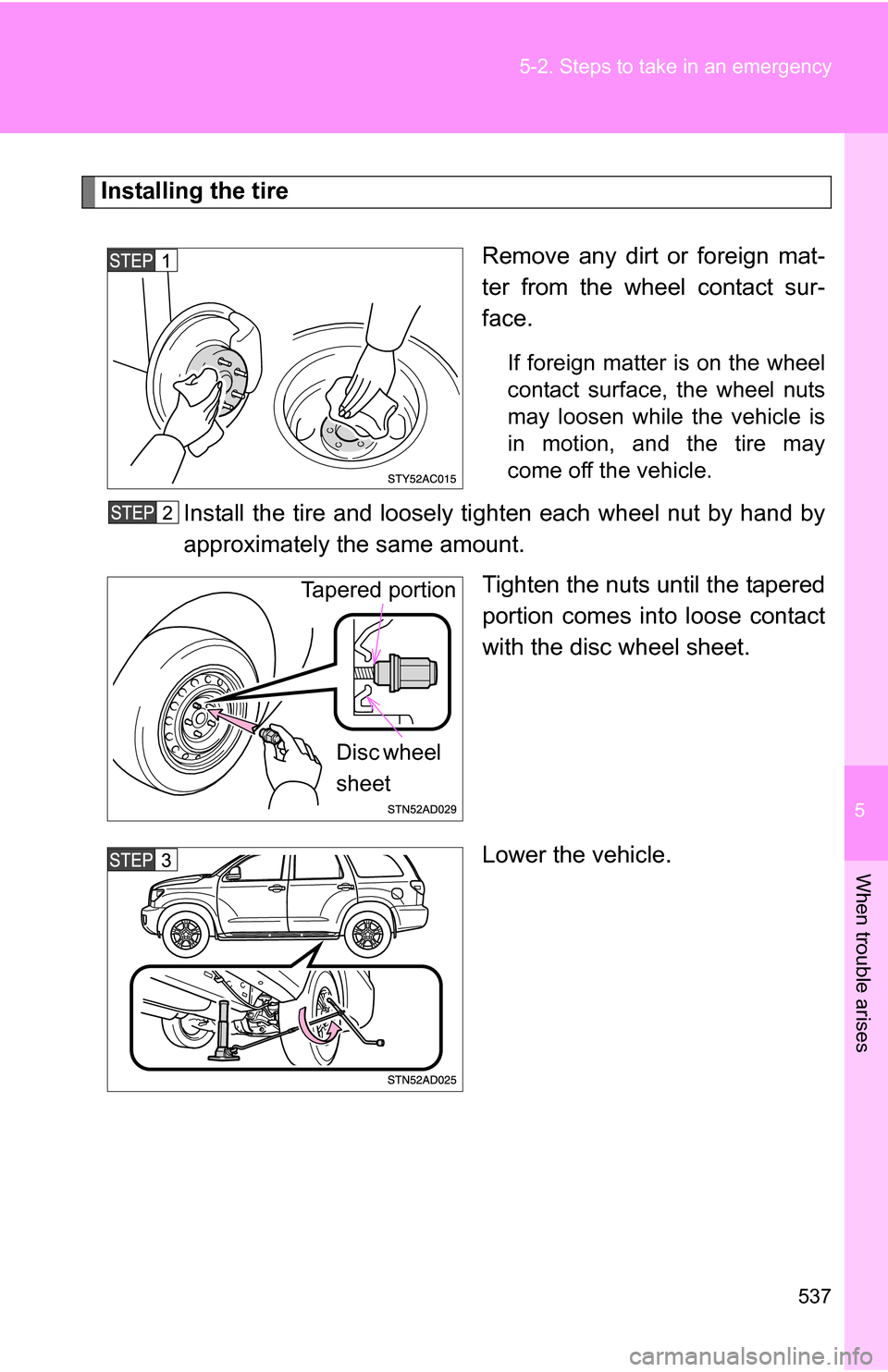
Installing the tire
Remove any dirt or foreign mat-
ter from the wheel contact sur-
face.
If foreign matter is on the wheel
contact surface, the wheel nuts
may loosen while the vehicle is
in motion, and the tire may
come off the vehicle.
Install the tire and loosely tighten each wheel nut by hand by
approximately the same amount.
Tighten the nuts until the tapered
portion comes into loose contact
with the disc wheel sheet.
Lower the vehicle.
Tapered portion
Disc wheel
sheet
Page 538 of 612
538 5-2. Steps to take in an emergency
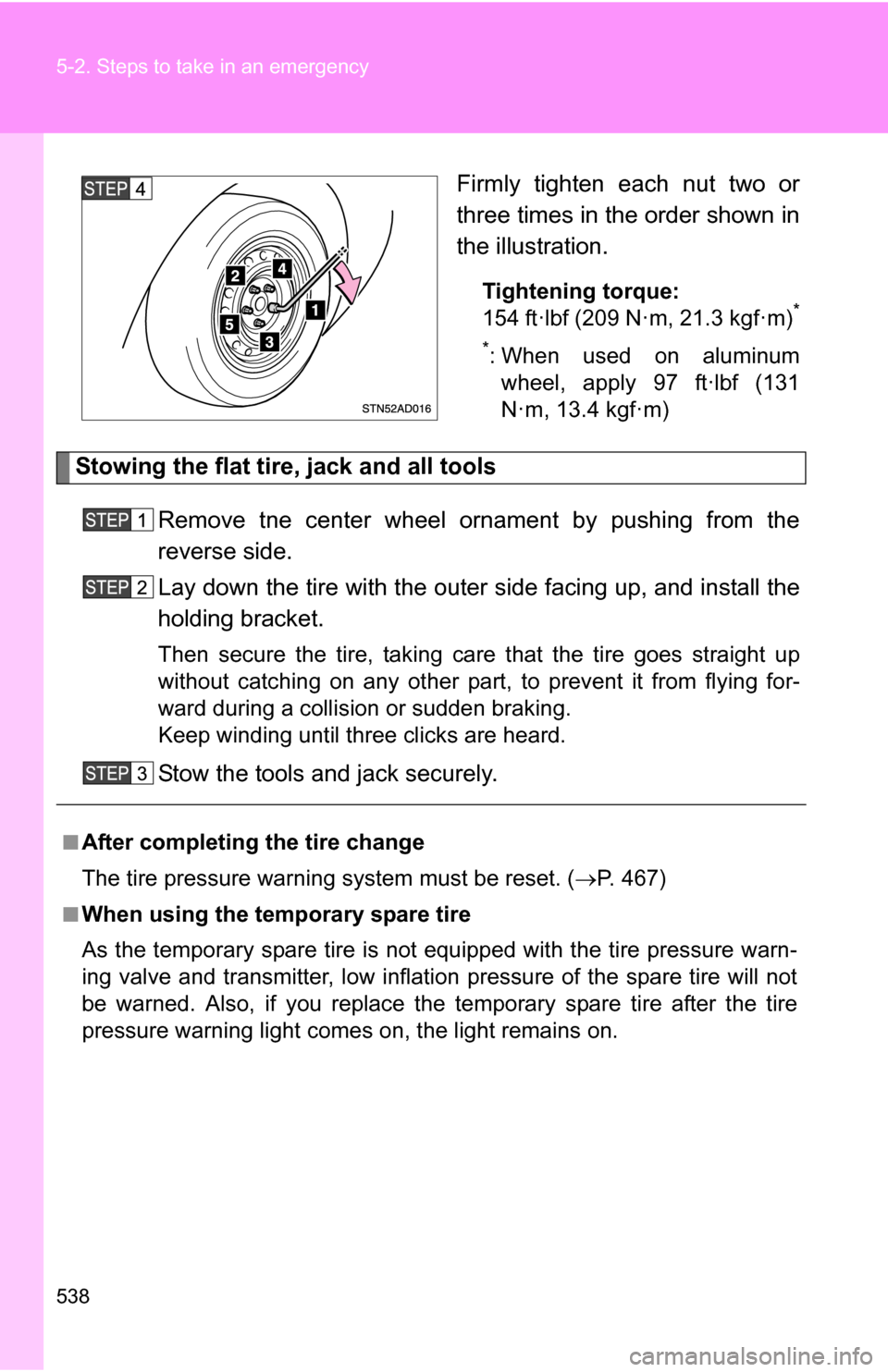
Firmly tighten each nut two or
three times in the order shown in
the illustration.
Tightening torque:
154 ft·lbf (209 N·m, 21.3 kgf·m)*
*
: When used on aluminum wheel, apply 97 ft·lbf (131
N·m, 13.4 kgf·m)
Stowing the flat tire, jack and all tools
Remove tne center wheel ornament by pushing from the
reverse side.
Lay down the tire with the outer side facing up, and install the
holding bracket.
Then secure the tire, taking care that the tire goes straight up
without catching on any other part, to prevent it from flying for-
ward during a collisi on or sudden braking.
Keep winding until three clicks are heard.
Stow the tools and jack securely.
■After completing the tire change
The tire pressure warnin g system must be reset. ( P. 467)
■When using the temporary spare tire
As the temporary spare tire is not equipped with the tire pressure warn-
ing valve and transmitter, low inflation pressure of the spare tire will not
be warned. Also, if you replace the temporary spare tire after the tire
pressure warning light comes on, the light remains on.
Page 539 of 612

5
When trouble arises
539
5-2. Steps to take in an emergency
CAUTION
■Using the jack
Improper use of the jack may lead to death or injuries due to the vehicle
suddenly falling off the jack.
●Do not use the jack for any purpose other than replacing tires or install-
ing and removing tire chains.
●Only use the jack that comes with this vehicle for replacing a flat tire.
Do not use it on other vehicles, an
d do not use other jacks for replac-
ing tires on this vehicle.
●Always check that the jack is securely set to the jack point.
●Do not put any part of your body under the vehicle supported by a jack.
●Do not start or run the engine while your vehicle is supported by the
jack.
●Do not raise the vehicle while someone is in it.
●When raising the vehicle, do not put an object on or under the jack.
●Do not raise the vehicle to a hei ght greater than that required to
replace the tire.
●Use a jack stand if it is necessary to get under the vehicle.
Take particular care when lowering the vehicle to ensure that no one
working on or near the vehicle will be injured.
■Using the jack handle
Insert the square head securely until you hear a click to prevent the
extension parts from coming apart unexpectedly.
■Replacing a flat tire
Observe the following precautions to reduce the risk of death or serious
injury.
●Retighten the wheel nuts within 100 m iles (160 km) of driving. Other-
wise, the nuts may loosen and the wheels may fall off, which could
cause a serious accident.
●Lower the spare tire completely to the ground before removing it from
under the vehicle.
●Do not try to remove the wheel ornament by hand. Take due care in
handling the ornament to avoid unexpected personal injury.
Page 540 of 612
540 5-2. Steps to take in an emergency
CAUTION
■Replacing a flat tire
●Never use oil or grease on the wheel bolts or wheel nuts.
The oil or grease can cause the wheel nuts to loosen, causing a seri-
ous accident. Remove any oil or grease on the wheel bolts or wheel
nuts.
●Have the wheel nuts tightened with a torque wrench as soon as possi-
ble after changing wheels.
Steel wheel: 154 ft·lbf (209 N·m, 21.3 kgf·m)
Aluminum wheel: 97 ft·lbf (131 N·m, 13.4 kgf·m)
Failure to follow these precautions could cause the nuts to loosen and
the wheels may fall off, which could lead to an accident causing death
or serious injury.
●Do not attach a heavily damaged wheel ornament, as it may fly off the
wheel while the vehicle is moving.
■When using the temporary spare tire
●Remember that your temporary spare tire is specifically designed for
use with your vehicle. Do not use your temporary spare tire on another
vehicle.
●Do not use two temporary spare tires simultaneously.
●Replace the temporary spare tire with a standard tire as soon as possi-
ble.
●Avoid sudden acceleration, deceleration and braking, as well as sharp
cornering.
■Speed limit when using the temporary spare tire
Do not drive at speeds in excess of 50 mph (80 km/h) when a temporary
spare tire is installed on the vehicle.
The temporary spare tire is not designed for driving at high speeds. Fail-
ing to observe this precaution may lead to an accident causing death or
serious injury.
■Driving with tire chains and the temporary spare tire
Do not fit tire chains to the temporary spare tire.
Tire chains may damage the vehicle body and adversely affect driving
performance.
Page 541 of 612

5
When trouble arises
541
5-2. Steps to take in an emergency
CAUTION
■When the spare tire is attached
The vehicle speed may not be correctly detected, and the following sys-
tems may not operate correctly:
●ABS & Brake assist
●VSC
●TRAC
●A-TRAC
●AUTO LSD
●Cruise control
●Navigation system
Also, not only can the following syste m not be utilized fully, it may actu-
ally negatively effect t he drive-train components:
●4WD system
NOTICE
■Do not drive the vehicle with a flat tire.
Do not continue driving with a flat tire.
Driving even a short distance with a flat tire can damage the tire and the
wheel beyond repair.
■When replacing the tires
●When removing or fitting the wheels, tires or the tire pressure warning
valve and transmitter, contact your Toyota dealer as the tire pressure
warning valve and transmitter may be damaged if not handled cor-
rectly.
●Replace the grommets for the tire pressure warning valves and trans-
mitters as well.
■To avoid damaging the tire pressure warning valves and transmit-
ters
Do not use liquid sealants on flat tires.
Page 553 of 612

5
When trouble arises
553
5-2. Steps to take in an emergency
If the vehicle becomes stuck
CAUTION
■When attempting to free a stuck vehicle
If you choose to rock the vehicle back and forth to free it, make sure the sur-
rounding area is clear, to avoid striking other vehicles, objects or persons.
The vehicle may also lunge forward or lunge back suddenly as it becomes
free. Use extreme caution.
■ When shifting the shift lever
Be careful not to shift the shift lever with the accelerator pedal depressed.
This may lead to unexpected rapid acceleration of the vehicle that may
cause an accident and result in death or serious injury.
NOTICE
■To avoid damaging the transmission and other components
●Avoid spinning the wheels and do not rev the engine.
● If the vehicle remains stuck after trying these procedures, the vehicle may
require towing to be freed.
Carry out the following procedures if the tires spin or the vehicle
becomes stuck in mud, dirt, or snow.
Stop the engine. Set the parking brake and put the shift
lever in P.
Remove the mud, snow, or sand from around the stuck tire.
Place wood, stones or some other material to help provide
traction under the tires.
Restart the engine.
Turn off the VSC. ( P. 222, 223)
Shift the shift lever to D or R and carefully apply the accel-
erator to free the vehicle.
Page 556 of 612
556
6-1. Specifications
Maintenance data (fuel, oil level, etc.)
Dimensions
*: Unladen vehicle
Overall length205.1 in. (5210 mm)
Overall width79.9 in. (2030 mm)
Overall height* Without roof rails
74.6 in. (1895 mm)
With roof rails
77.0 in. (1955 mm)
Wheelbase
122.0 in. (3100 mm)
Front tread 67.9 in. (1725 mm)
Rear tread69.1 in. (1755 mm)
Page 567 of 612
567
6-1. Specifications
6
Vehicle specifications
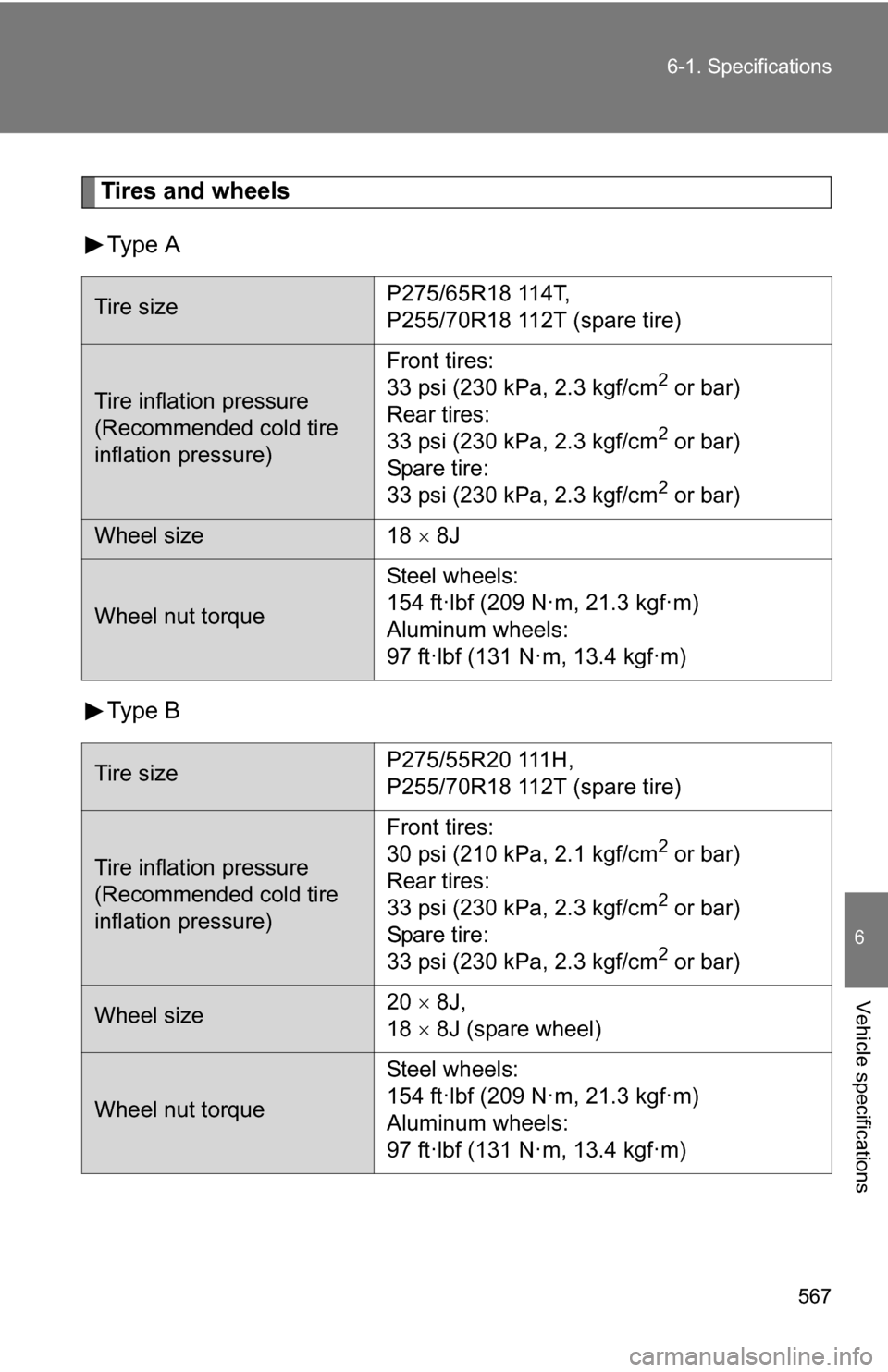
Tires and wheels
Type A
Type B
Tire size P275/65R18 114T,
P255/70R18 112T (spare tire)
Tire inflation pressure
(Recommended cold tire
inflation pressure)Front tires:
33 psi (230 kPa, 2.3 kgf/cm
2 or bar)
Rear tires:
33 psi (230 kPa, 2.3 kgf/cm
2 or bar)
Spare tire:
33 psi (230 kPa, 2.3 kgf/cm
2 or bar)
Wheel size 18 8J
Wheel nut torque Steel wheels:
154 ft·lbf (209 N·m, 21.3 kgf·m)
Aluminum wheels:
97 ft·lbf (131 N·m, 13.4 kgf·m)
Tire size
P275/55R20 111H,
P255/70R18 112T (spare tire)
Tire inflation pressure
(Recommended cold tire
inflation pressure)Front tires:
30 psi (210 kPa, 2.1 kgf/cm
2 or bar)
Rear tires:
33 psi (230 kPa, 2.3 kgf/cm
2 or bar)
Spare tire:
33 psi (230 kPa, 2.3 kgf/cm
2 or bar)
Wheel size 20
8J,
18 8J (spare wheel)
Wheel nut torque Steel wheels:
154 ft·lbf (209 N·m, 21.3 kgf·m)
Aluminum wheels:
97 ft·lbf (131 N·m, 13.4 kgf·m)