Page 507 of 608
5
When trouble arises
507
5-1. Essential information
Fuel pump shut off system
Follow the procedure below to restart the engine after the system is
activated.Vehicles without smart key systemTurn the engine switch to the “ACC” or “LOCK” position.
Restart the engine.
Vehicles with smart key system Turn the “ENGINE START STOP” switch OFF.
Restart the engine.
NOTICE
■Before starting the engine
Inspect the ground under the vehicle.
If you find that fuel has leaked onto the ground, the fuel system has been
damaged and is in need of repair. Do not restart the engine.
To minimize the risk of fuel leakage when the engine stalls or an air-
bag inflates upon collision, the fuel pump shut off system stops sup-
plying fuel to the engine.
STEP1
STEP2
STEP1
STEP2
Page 529 of 608
5
When trouble arises
529
5-2. Steps to take in an emergency
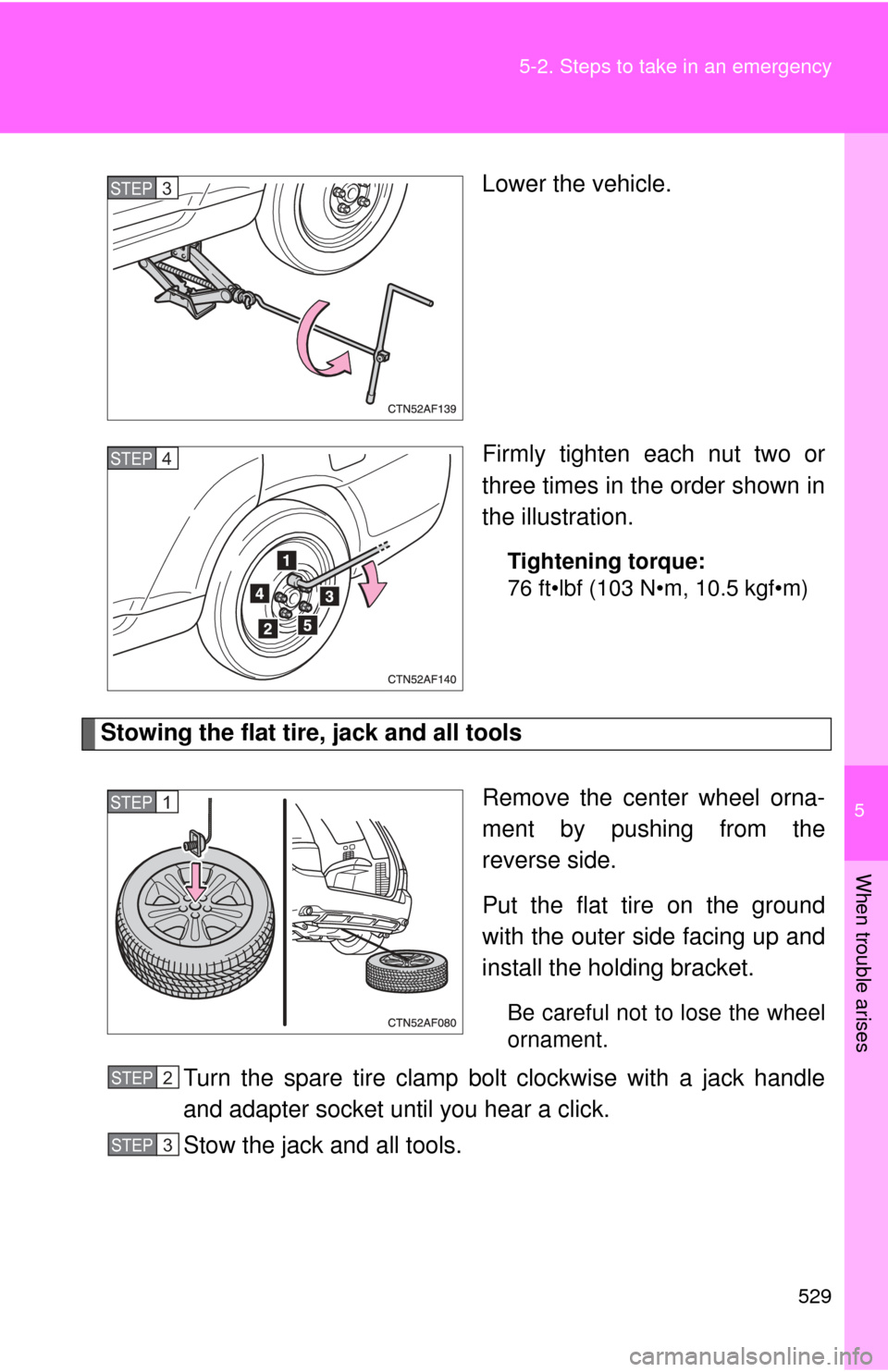
Lower the vehicle.
Firmly tighten each nut two or
three times in the order shown in
the illustration.
Tightening torque:
76 ft•lbf (103 N•m, 10.5 kgf•m)
Stowing the flat tire
, jack and all tools
Remove the center wheel orna-
ment by pushing from the
reverse side.
Put the flat tire on the ground
with the outer side facing up and
install the holding bracket.
Be careful not to lose the wheel
ornament.
Turn the spare tire clamp bolt clockwise with a jack handle
and adapter socket until you hear a click.
Stow the jack and all tools.
STEP3
STEP4
STEP1
STEP2
STEP3
Page 535 of 608
5
When trouble arises
535
5-2. Steps to take in an emergency
If the engine will not start
If the engine still does not start after following the correct starting
procedure (→P. 173, 177) or releasing the steering lock ( →P. 175,
178), confirm the fo llowing points.
■The engine will not start even when the starter motor oper-
ates normally.
One of the following may be the cause of the problem.
● There may not be sufficient fuel in the vehicle’s tank.
Refuel the vehicle.
● The engine may be flooded.
Try to restart the engine once more following correct starting
procedures. ( →P. 173, 177)
● There may be a malfunction in the engine immobilizer system.
(→ P. 1 1 5 )
■ The starter motor turns over slowly, the interior lights and
headlights are dim, or the hor n does not sound or sounds at
a low volume.
One of the following may be the cause of the problem.
● The battery may be discharged. ( →P. 541)
● The battery terminal connec tions may be loose or corroded.
■ The starter motor does not turn over (vehicles with smart
key system).
The engine starting system may be malfunctioning due to an
electrical problem such as an open circuit or a blown fuse. How-
ever, an interim measure is available to start the engine.
(→ P. 536)
Page 536 of 608

536 5-2. Steps to take in an emergency
Emergency start function (vehicles with smart key system)When the engine does not start, the following steps can be used as
an interim measure to start the engine if the “ENGINE START STOP”
switch is functioning normally. Set the parking brake.
Shift the shift lever to P.
Set the “ENGINE START STOP” switch to ACCESSORY
mode.
Push and hold the “ENGINE START STOP” switch about 15
seconds while depressing the brake pedal firmly.
Even if the engine can be started using the above steps, the system
may be malfunctioning. Have the vehicle checked by your Toyota
dealer.
■ The starter motor does not turn over, the interior lights and
headlights do not turn on, or the horn does not sound.
One of the following may be the cause of the problem.
● One or both of the battery terminals may be disconnected.
● The battery may be discharged. ( →P. 541)
● There may be a malfunction in the steering lock system (vehi-
cles with smart key system).
Contact your Toyota dealer if the problem cannot be repaired, or if
repair procedures are unknown.
STEP1
STEP2
STEP3
STEP4
Page 537 of 608
5
When trouble arises
537
5-2. Steps to take in an emergency
If the shift lever cannot be shifted from P
If the shift lever cannot be shifted with your foot on the brake, there
may be a problem with the shift lock system (a system to prevent
accidental operation of the shift l ever). Have the vehicle inspected by
your Toyota dealer immediately.
The following steps may be used as an emergency measure to
ensure that the shift lever can be shifted.
Set the parking brake.
Vehicles without smart key sy stem: Turn the engine switch
to the “ACC” position.
Vehicles with smart key system: Turn the “ENGINE START
STOP” switch to ACCESSORY mode.
Depress the brake pedal.
Pry the cover up with a flat-
head screwdriver or equiva-
lent.
Press the shift lock override
button.
The shift lever can be shifted
while the button is pressed.
STEP1
STEP2
STEP3
STEP4
STEP5
Page 539 of 608
5
When trouble arises
539
5-2. Steps to take in an emergency
If the electronic key does not operate properly (vehicles with smart key system)
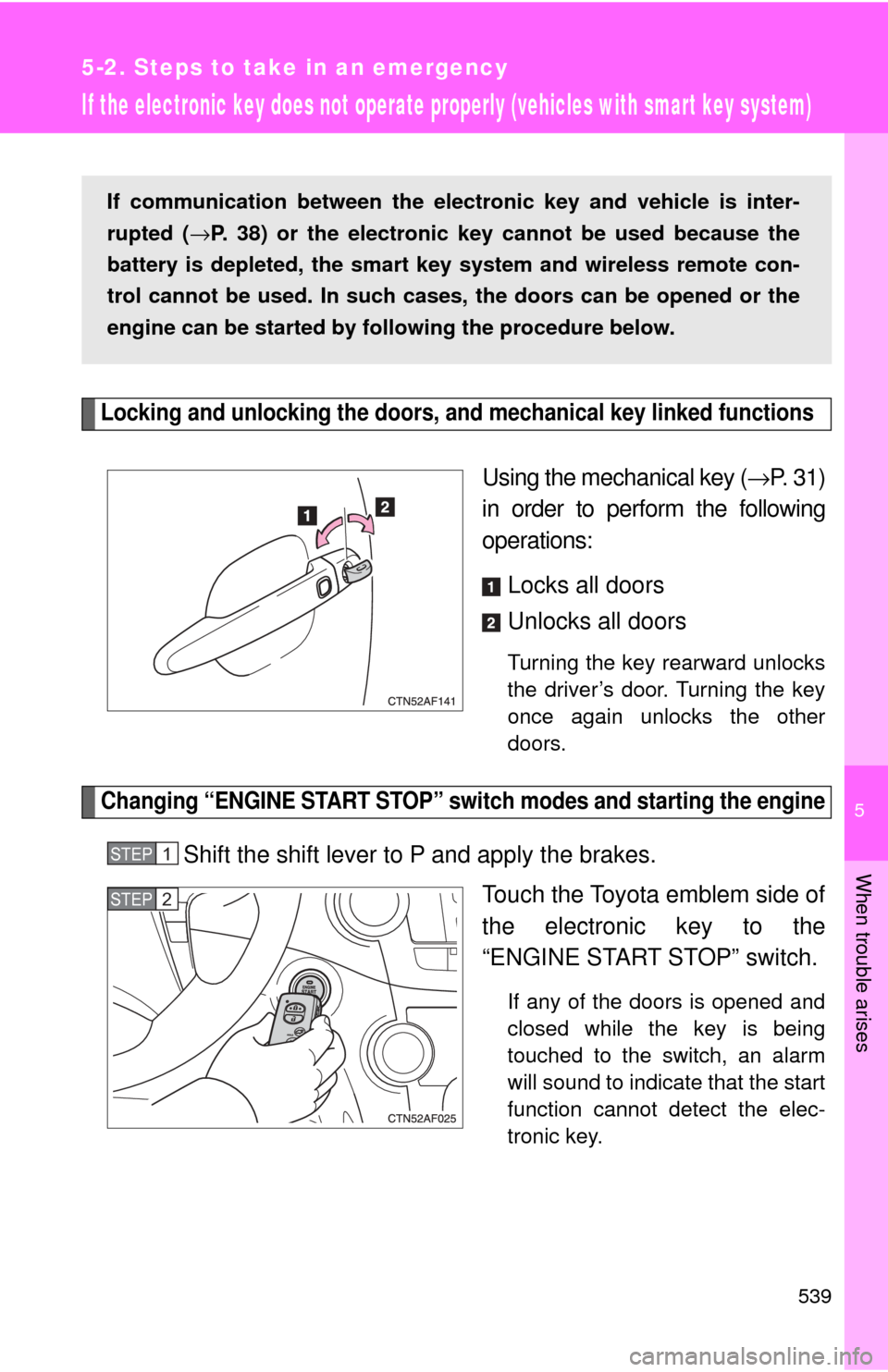
Locking and unlocking the doors, and mechanical key linked functions
Using the mechanical key (→P. 31)
in order to perform the following
operations:
Locks all doors
Unlocks all doors
Turning the key rearward unlocks
the driver’s door. Turning the key
once again unlocks the other
doors.
Changing “ENGINE START STOP” switch modes and starting the engine
Shift the shift lever to P and apply the brakes. Touch the Toyota emblem side of
the electronic key to the
“ENGINE START STOP” switch.
If any of the doors is opened and
closed while the key is being
touched to the switch, an alarm
will sound to indicate that the start
function cannot detect the elec-
tronic key.
If communication between the electronic key and vehicle is inter-
rupted (→P. 38) or the electronic key cannot be used because the
battery is depleted, the smart key system and wireless remote con-
trol cannot be used. In such cases, the doors can be opened or the
engine can be started by following the procedure below.
STEP1
STEP2
Page 554 of 608
554 6-1. Specifications
■Engine number
The engine number is stamped on the engine block as shown.
2.7 L 4-cylinder (1AR-FE) engine
3.5 L V6 (2GR-FE) engine
Page 560 of 608
560 6-1. Specifications
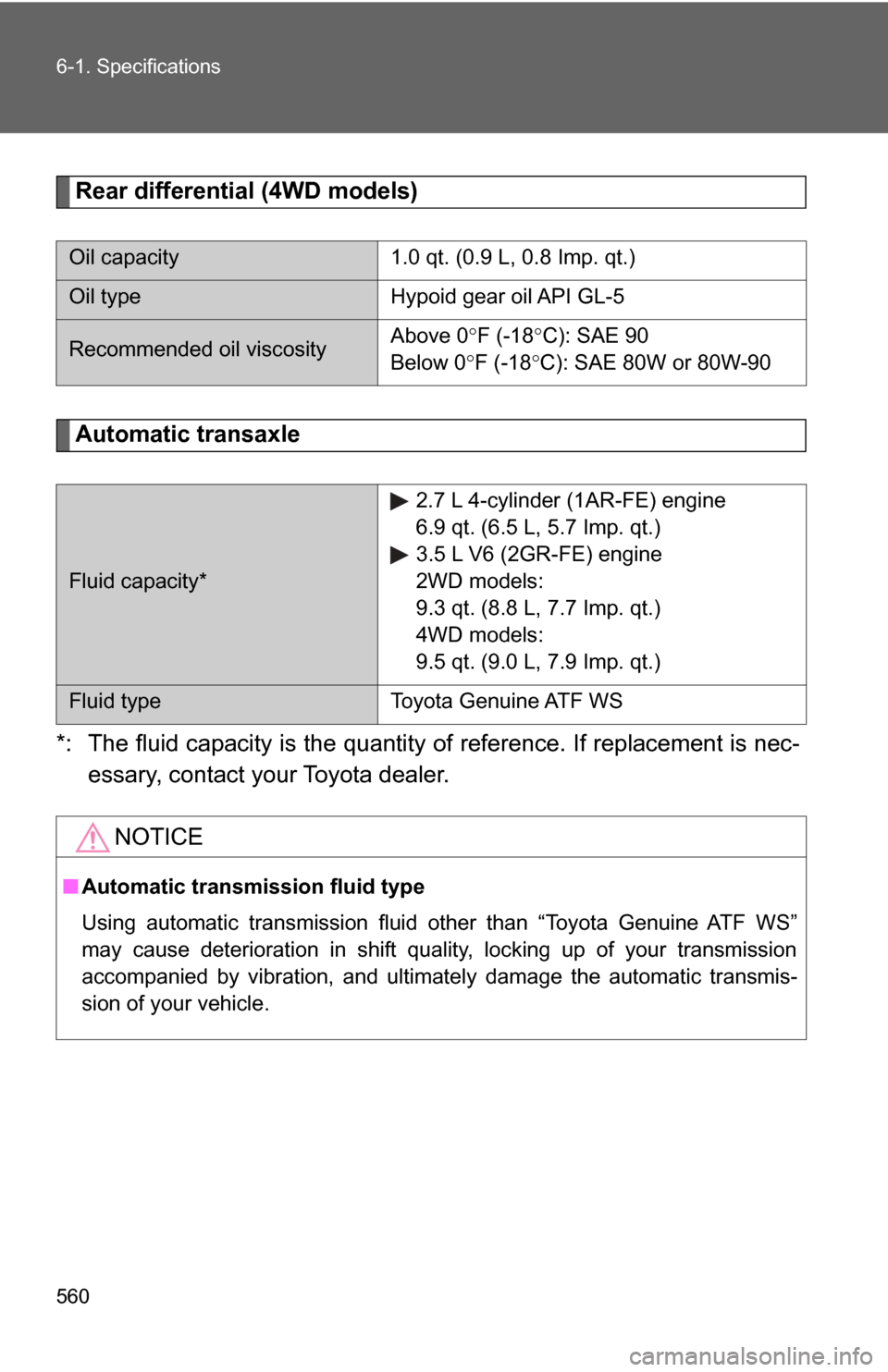
Rear differential (4WD models)
Automatic transaxle
*: The fluid capacity is the quantity of reference. If replacement is nec- essary, contact your Toyota dealer.
Oil capacity 1.0 qt. (0.9 L, 0.8 Imp. qt.)
Oil typeHypoid gear oil API GL-5
Recommended oil viscosityAbove 0
°F (-18 °C): SAE 90
Below 0 °F (-18 °C): SAE 80W or 80W-90
Fluid capacity* 2.7 L 4-cylinder (1AR-FE) engine
6.9 qt. (6.5 L, 5.7 Imp. qt.)
3.5 L V6 (2GR-FE) engine
2WD models:
9.3 qt. (8.8 L, 7.7 Imp. qt.)
4WD models:
9.5 qt. (9.0 L, 7.9 Imp. qt.)
Fluid type
Toyota Genuine ATF WS
NOTICE
■Automatic transmission fluid type
Using automatic transmission fluid other than “Toyota Genuine ATF WS”
may cause deterioration in shift quality, locking up of your transmission
accompanied by vibration, and ultimately damage the automatic transmis-
sion of your vehicle.