Page 361 of 468
361
4-3. Do-it-yourself maintenance
4
Maintenance and care
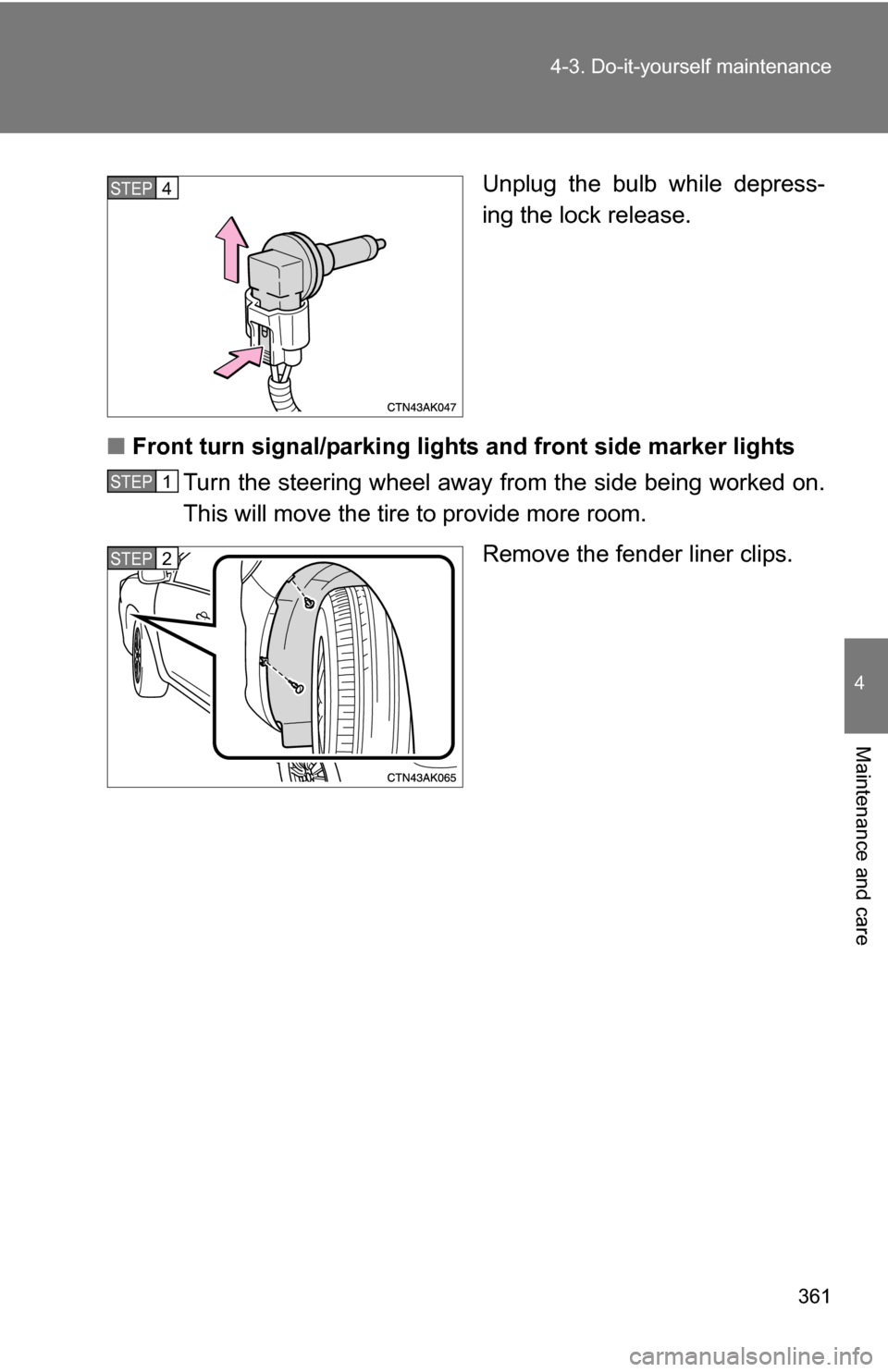
Unplug the bulb while depress-
ing the lock release.
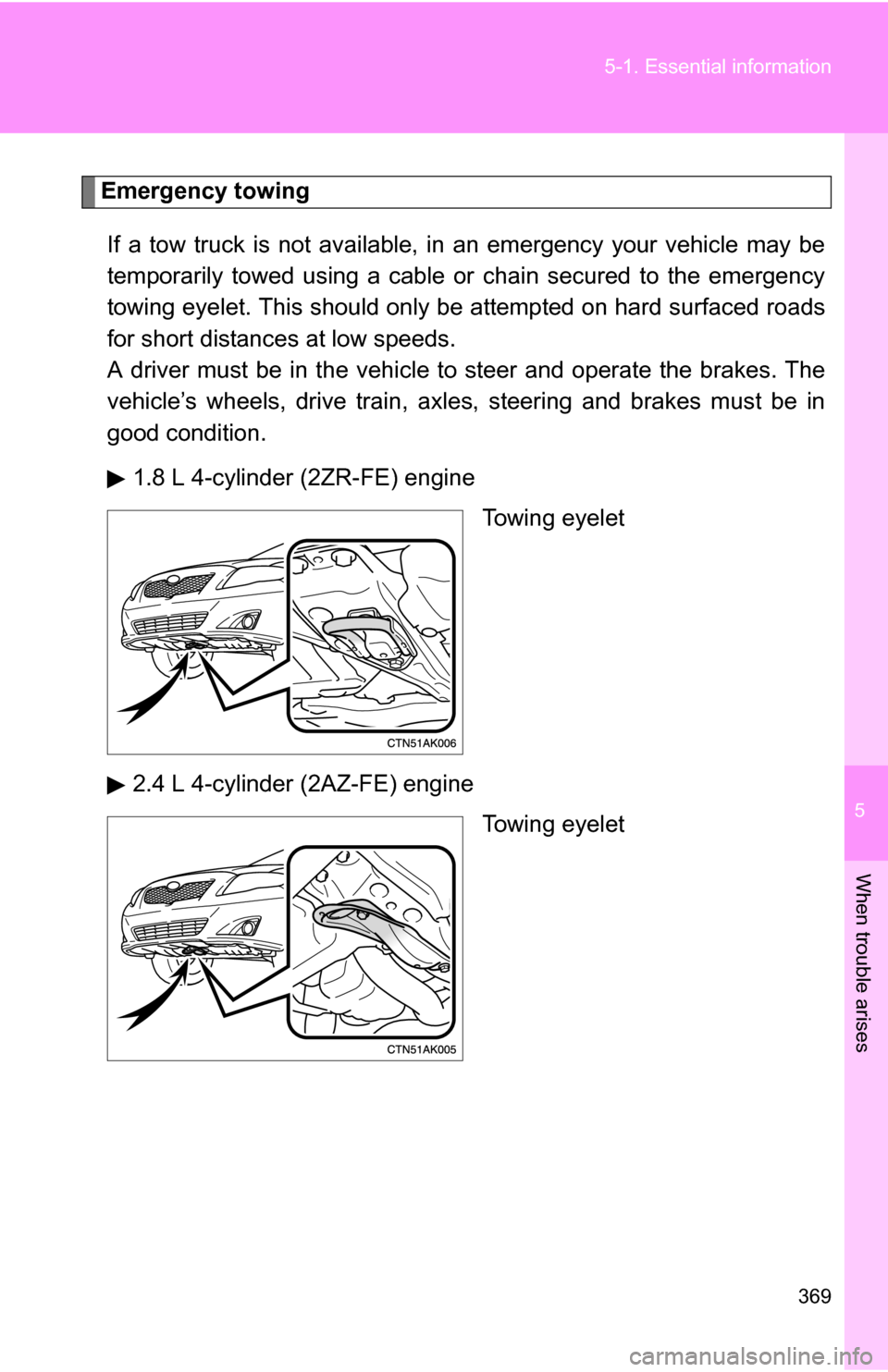
■ Front turn signal/parking lights and front side marker lights
Turn the steering wheel away from the side being worked on.
This will move the tire to provide more room.
Remove the fender liner clips.STEP4
STEP1
STEP2
Page 369 of 468
5
When trouble arises
369
5-1. Essential information
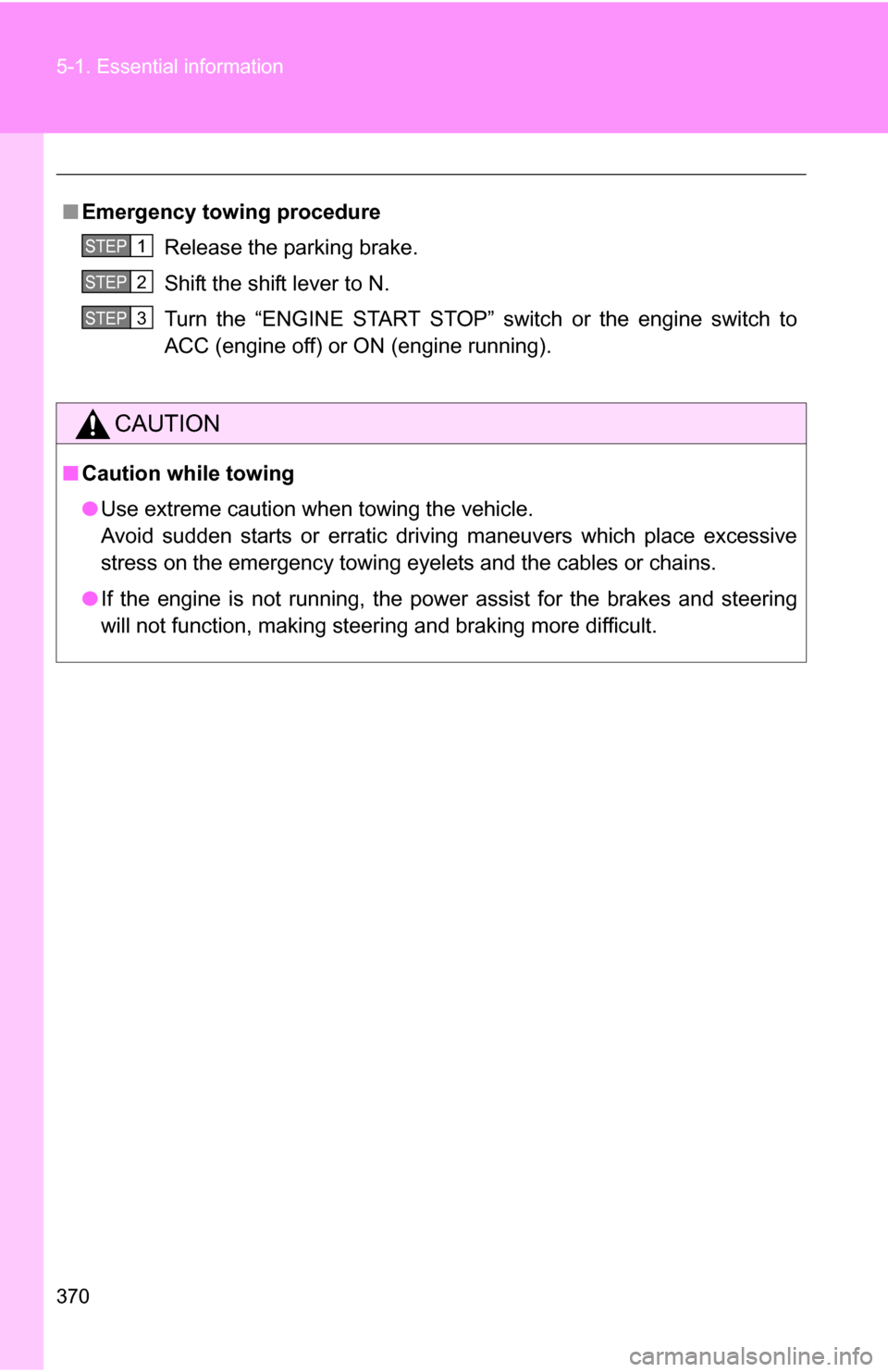
Emergency towing
If a tow truck is not available, in an emergency your vehicle may be
temporarily towed using a cable or chain secured to the emergency
towing eyelet. This should only be attempted on hard surfaced roads
for short distances at low speeds.
A driver must be in the vehicle to steer and operate the brakes. The
vehicle’s wheels, drive train, axles, steering and brakes must be in
good condition.
1.8 L 4-cylinder (2ZR-FE) engine Towing eyelet
2.4 L 4-cylinder (2AZ-FE) engine Towing eyelet
Page 370 of 468
370 5-1. Essential information
■Emergency towin g procedure
Release the parking brake.
Shift the shift lever to N.
Turn the “ENGINE START STOP” switch or the engine switch to
ACC (engine off) or ON (engine running).
CAUTION
■ Caution while towing
●Use extreme caution when towing the vehicle.
Avoid sudden starts or erratic driving maneuvers which place excessive
stress on the emergency towing eyelets and the cables or chains.
● If the engine is not running, the power assist for the brakes and steering
will not function, making steering and braking more difficult.
STEP1
STEP2
STEP3
Page 372 of 468
372 5-1. Essential information
Towing with a wheel-lift type truck from the rearAutomatic transmission: Use a
towing dolly under the front
wheels.
Manual transmission: We recom-
mend to use a towing dolly under
the front wheels.
When not using a towing dolly,
turn the engine switch to the
“ACC” position and shift the shift
lever to N.
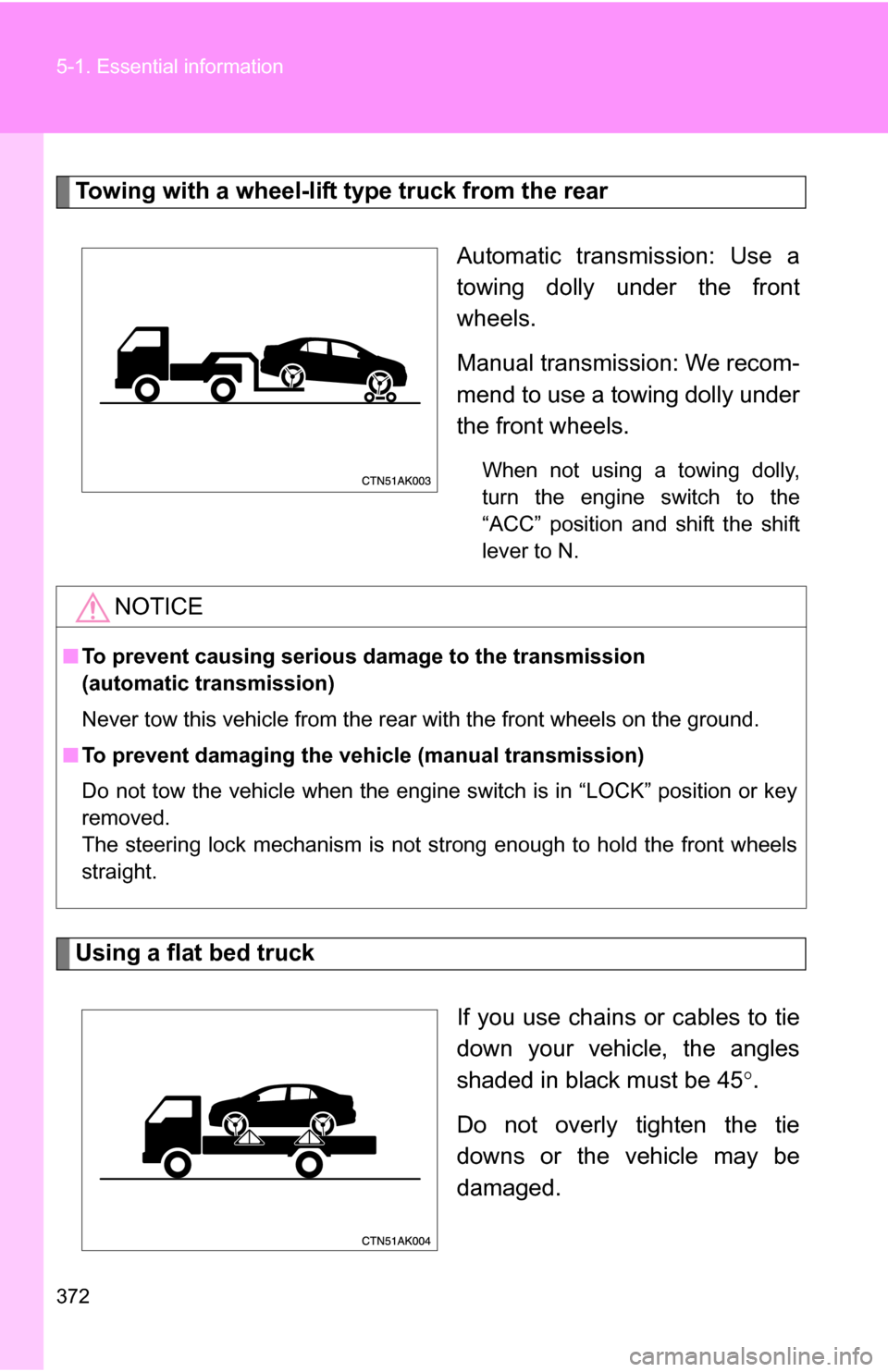
Using a flat bed truckIf you use chains or cables to tie
down your vehicle, the angles
shaded in black must be 45.
Do not overly tighten the tie
downs or the vehicle may be
damaged.
NOTICE
■ To prevent causing serious dama ge to the transmission
(automatic transmission)
Never tow this vehicle from the rear with the front wheels on the ground.
■ To prevent damaging the vehicle (manual transmission)
Do not tow the vehicle when the engine switch is in “LOCK” position or key
removed.
The steering lock mechanism is not strong enough to hold the front wheels
straight.
Page 378 of 468
378 5-2. Steps to take in an emergency
Have the vehicle inspected immediately.Failing to investigate the cause of the following warnings may lead to
the system operating abnormally and possibly cause an accident.
Have the vehicle inspected by your Toyota dealer immediately.
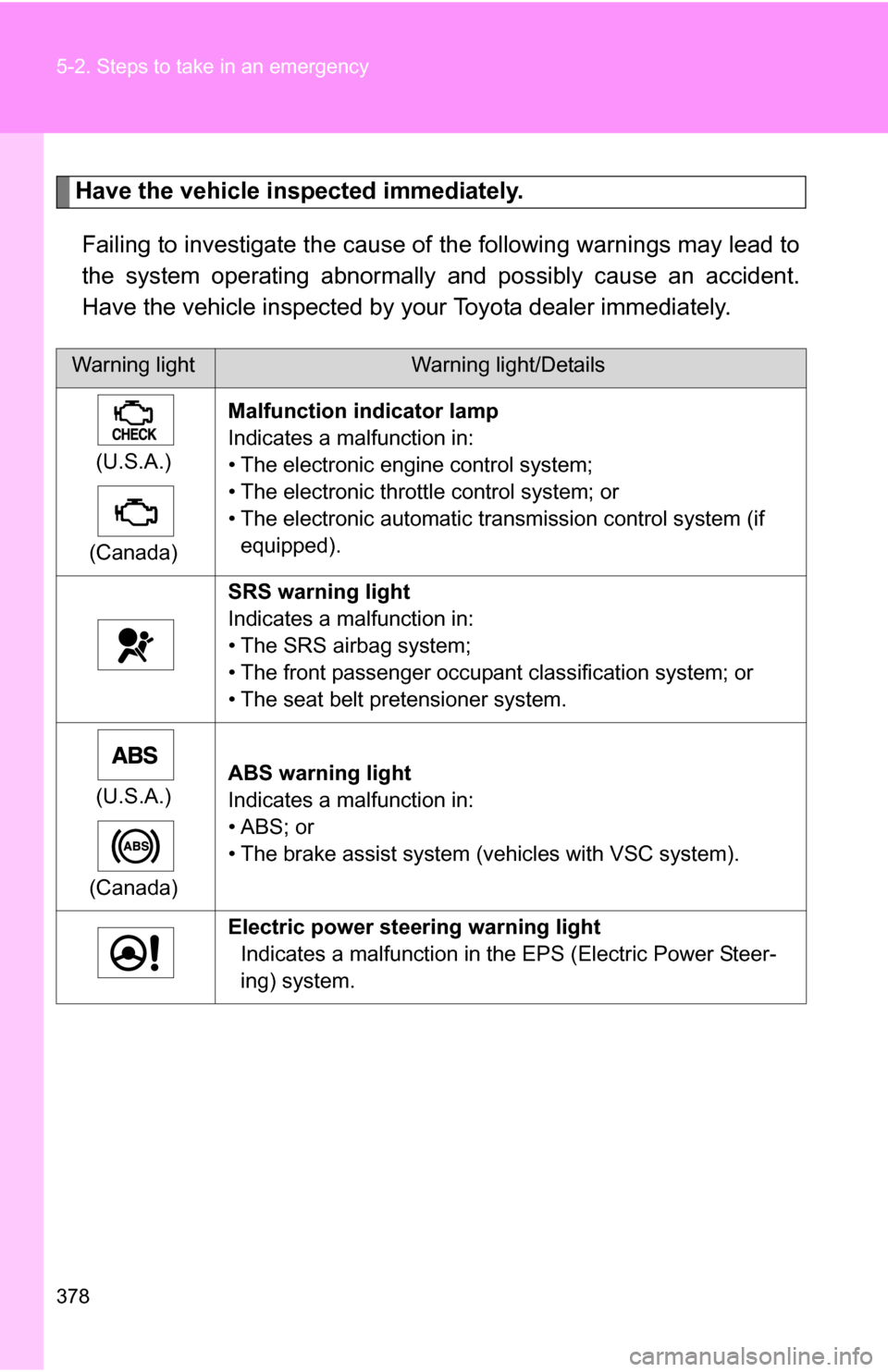
Warning lightWarning light/Details
(U.S.A.)
(Canada) Malfunction indicator lamp
Indicates a malfunction in:
• The electronic engine control system;
• The electronic throttle control system; or
• The electronic automatic transmission control system (if
equipped).
SRS warning light
Indicates a malfunction in:
• The SRS airbag system;
• The front passenger occupant classification system; or
• The seat belt pretensioner system.
(U.S.A.)
(Canada) ABS warning light
Indicates a malfunction in:
•ABS; or
• The brake assist system (vehicles with VSC system).
Electric power steering warning light
Indicates a malfunction in the EPS (Electric Power Steer-
ing) system.
Page 383 of 468
5
When trouble arises
383
5-2. Steps to take in an emergency
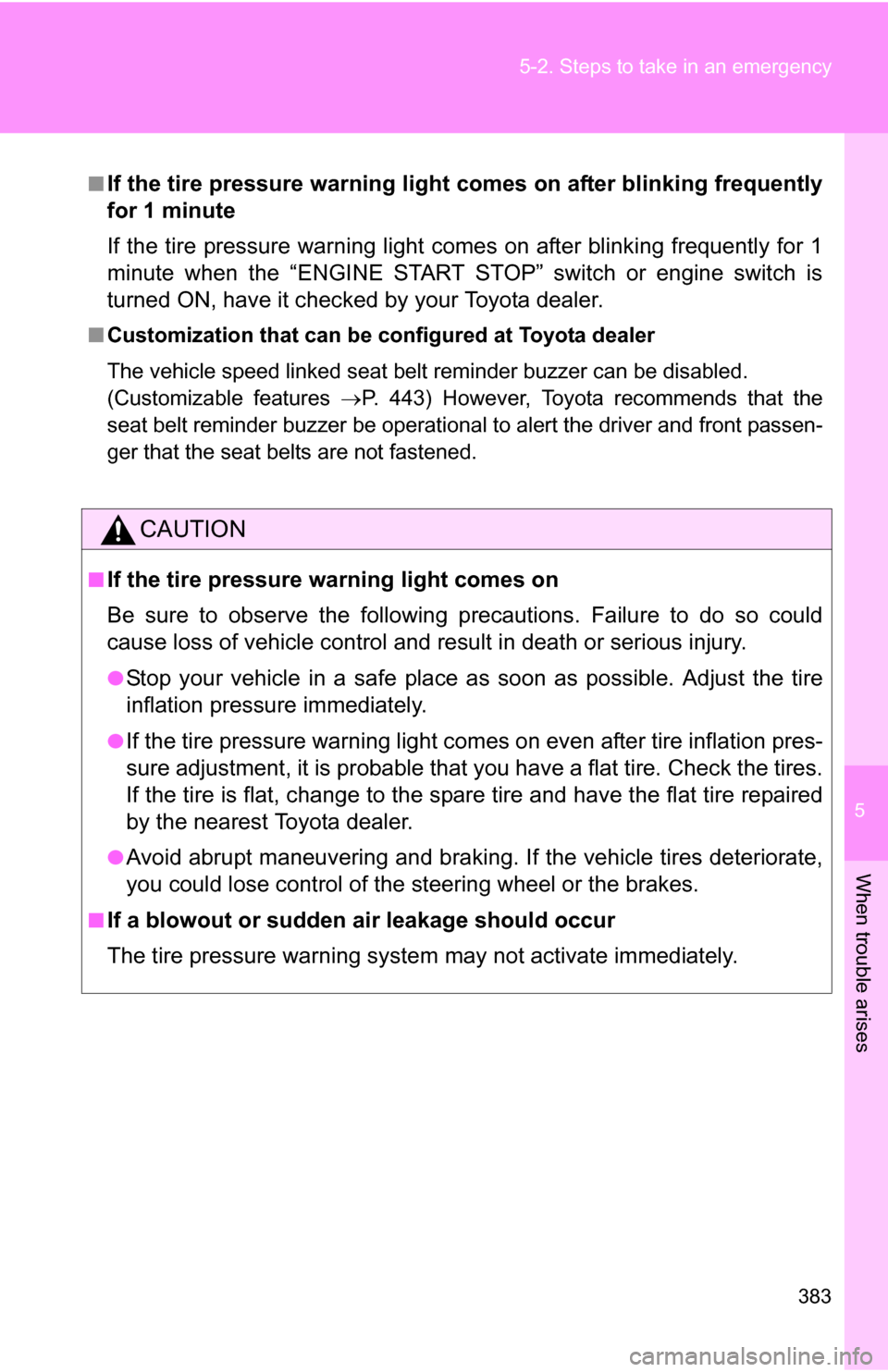
■If the tire pressure warning light comes on after blinking frequently
for 1 minute
If the tire pressure warning light comes on after blinking frequently for 1
minute when the “ENGINE START STOP” switch or engine switch is
turned ON, have it checked by your Toyota dealer.
■
Customization that can be co nfigured at Toyota dealer
The vehicle speed linked seat belt reminder buzzer can be disabled.
(Customizable features P. 443) However, Toyota recommends that the
seat belt reminder buzzer be operational to alert the driver and front passen-
ger that the seat belts are not fastened.
CAUTION
■If the tire pressure warning light comes on
Be sure to observe the following precautions. Failure to do so could
cause loss of vehicle control and result in death or serious injury.
●Stop your vehicle in a safe place as soon as possible. Adjust the tire
inflation pressure immediately.
●If the tire pressure warning light comes on even after tire inflation pres-
sure adjustment, it is pr obable that you have a flat tire. Check the tires.
If the tire is flat, change to the spare tire and have the flat tire repaired
by the nearest Toyota dealer.
●Avoid abrupt maneuvering and braking. If the vehicle tires deteriorate,
you could lose control of the steering wheel or the brakes.
■If a blowout or sudden air leakage should occur
The tire pressure warning syste m may not activate immediately.
Page 399 of 468
5
When trouble arises
399
5-2. Steps to take in an emergency
If the engine will not star t
If the engine still does not start after following the correct starting
procedure (P. 122, 126) or releasing the steering lock ( P. 124,
128), confirm the fo llowing points.
■The engine will not start even when the starter motor oper-
ates normally.
One of the following may be the cause of the problem.
●There may not be sufficient fuel in the vehicle’s tank.
Refuel the vehicle.
● The engine may be flooded.
Try to restart the engine once more following correct starting
procedures. ( P. 122, 126)
● There may be a malfunction in the engine immobilizer system.
( P. 7 5 )
■ The starter motor turns over slowly, the interior lights and
headlights are dim, or the horn does not sound or sounds at
a low volume.
One of the following may be the cause of the problem.
●The battery may be discharged. ( P. 405)
● The battery terminal connec tions may be loose or corroded.
■ The starter motor does not turn over (vehicles with smart
key system).
One of the following may be the cause of the problem.
●The engine starting system may be malfunctioning due to an
electrical problem such as an open circuit or a blown fuse.
However, an interim measure is available to start the engine.
( P. 400)
● The electronic key battery is depleted. However, an interim
measure is available to start the engine. ( P. 404)
Page 400 of 468
400 5-2. Steps to take in an emergency
Emergency start function (vehicles with smart key system)
When the engine does not start, the following steps can be used as
an interim measure to start the engine if the “ENGINE START STOP”
switch is functioning normally.Set the parking brake.
Shift the shift lever to P.
Set the “ENGINE START ST OP” switch to ACCESSORY
mode.
Press and hold the “ENGINE START STOP” switch for about
15 seconds while depressing the brake pedal firmly.
Even if the engine can be start ed using the above steps, the system
may be malfunctioning. Have the vehicle checked by your Toyota
dealer.
■ The starter motor does not turn over, the interior lights and
headlights do not turn on, or the horn does not sound.
One of the following may be the cause of the problem.
● One or both of the battery terminals may be disconnected.
● The battery may be discharged. ( P. 405)
● There may be a malfunction in the steering lock system (vehi-
cles with smart key system).
Contact your Toyota dealer if the problem cannot be repaired, or if
repair procedures are unknown.
STEP1
STEP2
STEP3
STEP4