Page 409 of 520
409
4-3. Do-it-yourself maintenance
4
Maintenance and care
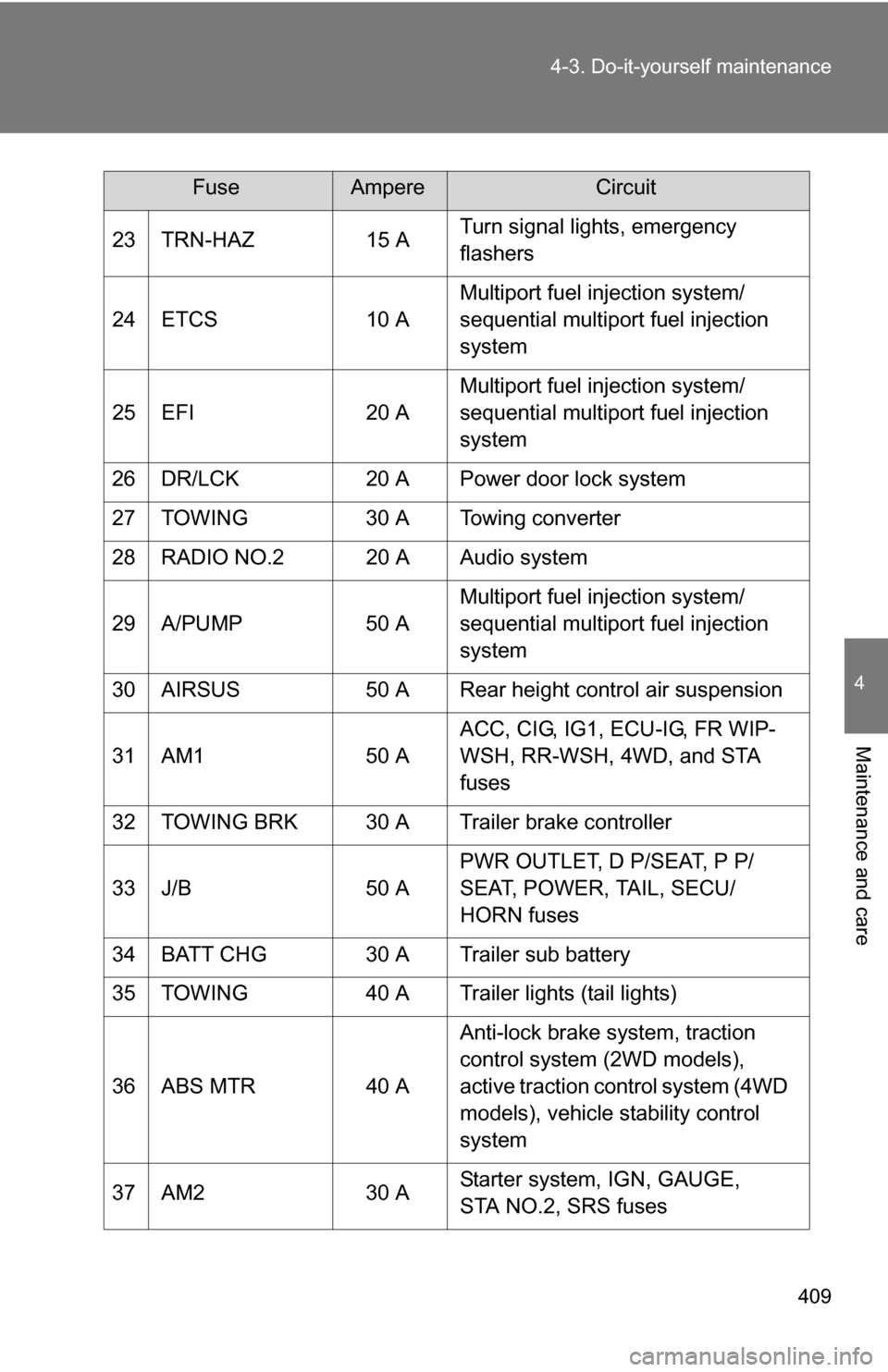
23 TRN-HAZ
15 ATurn signal lights, emergency
flashers
24 ETCS 10 AMultiport fuel injection system/
sequential multiport fuel injection
system
25 EFI 20 AMultiport fuel injection system/
sequential multiport fuel injection
system
26 DR/LCK 20 A Power door lock system
27 TOWING 30 A Towing converter
28 RADIO NO.2 20 A Audio system
29 A/PUMP 50 AMultiport fuel injection system/
sequential multiport fuel injection
system
30 AIRSUS 50 A Rear height control air suspension
31 AM1 50 AACC, CIG, IG1, ECU-IG, FR WIP-
WSH, RR-WSH, 4WD, and STA
fuses
32 TOWING BRK 30 A Trailer brake controller
33 J/B 50 APWR OUTLET, D P/SEAT, P P/
SEAT, POWER, TAIL, SECU/
HORN fuses
34 BATT CHG 30 A Trailer sub battery
35 TOWING 40 A Trailer lights (tail lights)
36 ABS MTR 40 AAnti-lock brake system, traction
control system (2WD models),
active traction control system (4WD
models), vehicle stability control
system
37 AM2 30 AStarter system, IGN, GAUGE,
STA NO.2, SRS fuses
FuseAmpereCircuit
Page 410 of 520
410 4-3. Do-it-yourself maintenance
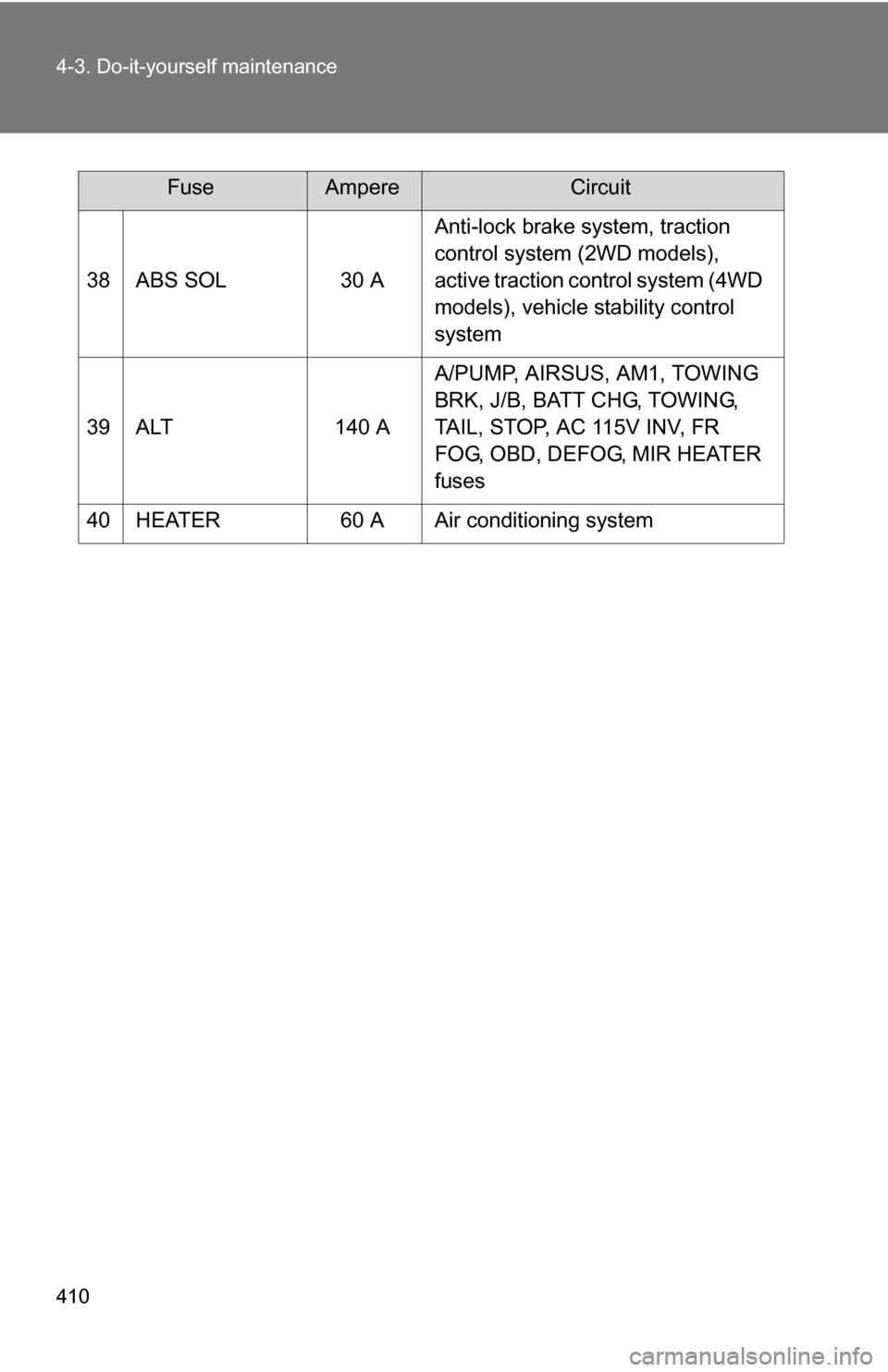
38 ABS SOL30 AAnti-lock brake system, traction
control system (2WD models),
active traction control system (4WD
models), vehicle stability control
system
39 ALT 140 AA/PUMP, AIRSUS, AM1, TOWING
BRK, J/B, BATT CHG, TOWING,
TAIL, STOP, AC 115V INV, FR
FOG, OBD, DEFOG, MIR HEATER
fuses
40 HEATER 60 A Air conditioning system
FuseAmpereCircuit
Page 425 of 520
When trouble arises5
425
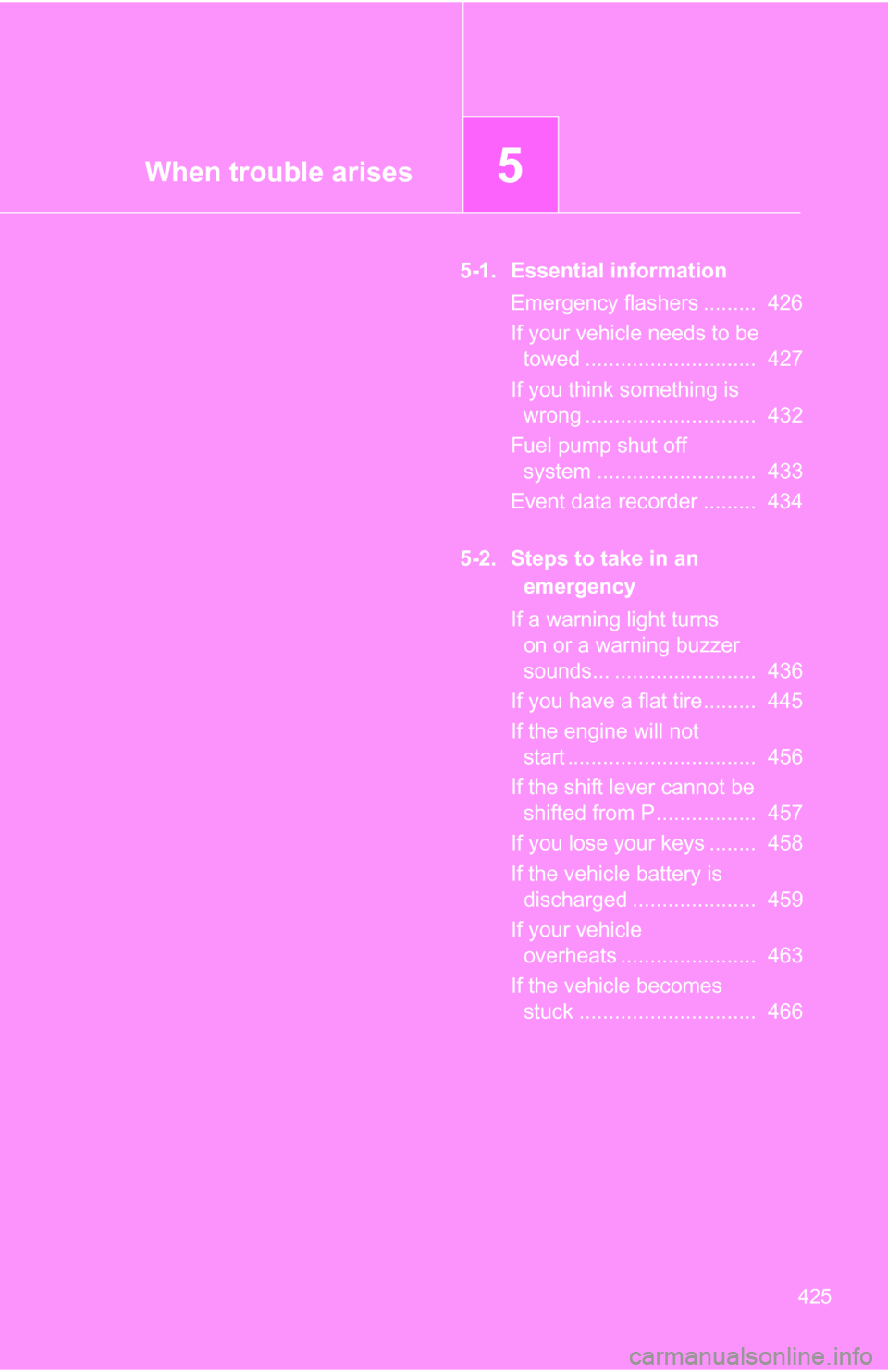
5-1. Essential informationEmergency flashers ......... 426
If your vehicle needs to be towed ............................. 427
If you think something is wrong ............................. 432
Fuel pump shut off system ........................... 433
Event data recorder ......... 434
5-2. Steps to take in an emergency
If a warning light turns on or a warning buzzer
sounds... ........................ 436
If you have a flat tire......... 445
If the engine will not start ................................ 456
If the shift lever cannot be shifted from P................. 457
If you lose your keys ........ 458
If the vehicle battery is discharged ..................... 459
If your vehicle overheats ....................... 463
If the vehicle becomes stuck .............................. 466
Page 427 of 520
5
When trouble arises
427
5-1. Essential information
If your vehicle needs to be towed
Before towingThe following may indicate a problem with your transmission. Contact
your Toyota dealer before towing.
● The engine is running, but the vehicle will not move.
● The vehicle makes an abnormal sound.
Emergency towing
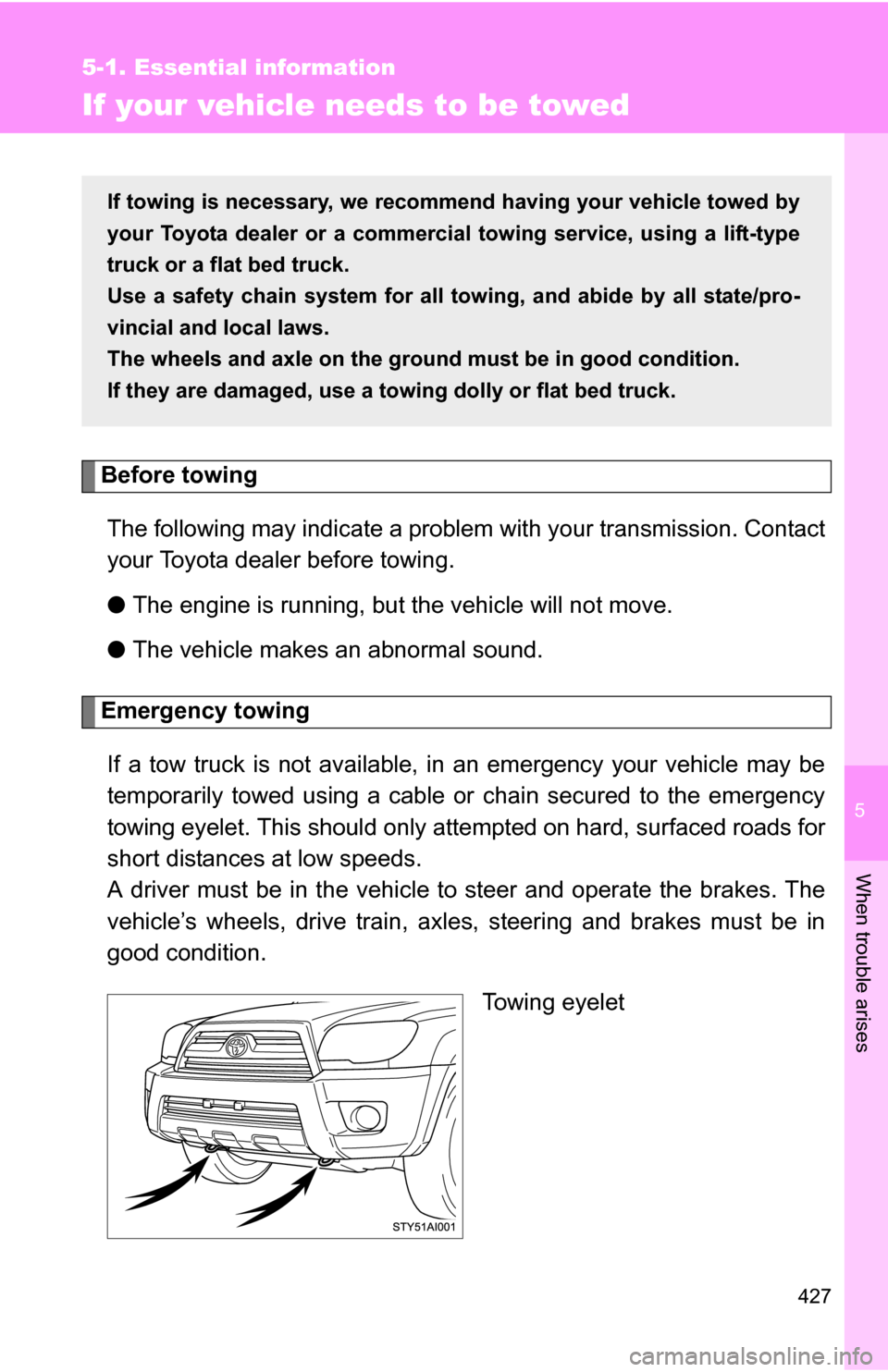
If a tow truck is not available, in an emergency your vehicle may be
temporarily towed using a cable or chain secured to the emergency
towing eyelet. This should only attempted on hard, surfaced roads for
short distances at low speeds.
A driver must be in the vehicle to steer and operate the brakes. The
vehicle’s wheels, drive train, axles, steering and brakes must be in
good condition.
Towing eyelet
If towing is necessary, we recommend having your vehicle towed by
your Toyota dealer or a commerci al towing service, using a lift-type
truck or a flat bed truck.
Use a safety chain system for all to wing, and abide by all state/pro-
vincial and local laws.
The wheels and axle on the groun d must be in good condition.
If they are damaged, use a towing dolly or flat bed truck.
Page 428 of 520
428 5-1. Essential information
■Emergency towin g procedure
The engine switch must be in the ACC (engine off) or the ON
(engine running) position.
4WD models:
On multi-mode 4WD models, put the four-wheel drive control switch
in H2.
On full-time 4WD models, unlock the center differential.
Put the shift lever in N.
Release the parking brake.
CAUTION
■ Caution while towing
●Use extreme caution when towing the vehicle.
Avoid sudden starts or erratic driving maneuvers which place excessive
stress on the emergency towing eyelet and the cables or chains.
● If the engine is not running, the power assist for the brakes and steering
will not function, making steering and braking more difficult.
NOTICE
■To prevent causing serious damage to the transmission
Never tow this vehicle from the rear with the four wheels on the ground.
This may cause serious damage to the transmission.
■ Emergency towing eyelet precautions
● Before emergency towing, check that the eyelet is not broken or damaged.
● Fasten the towing cable or chain securely to the eyelet.
● Do not jerk the eyelet. Apply steady and even force.
● To avoid damaging the eyelet, do not pull from the side or at a vertical
angle. Always pull straight ahead.
Page 429 of 520
5
When trouble arises
429
5-1. Essential information
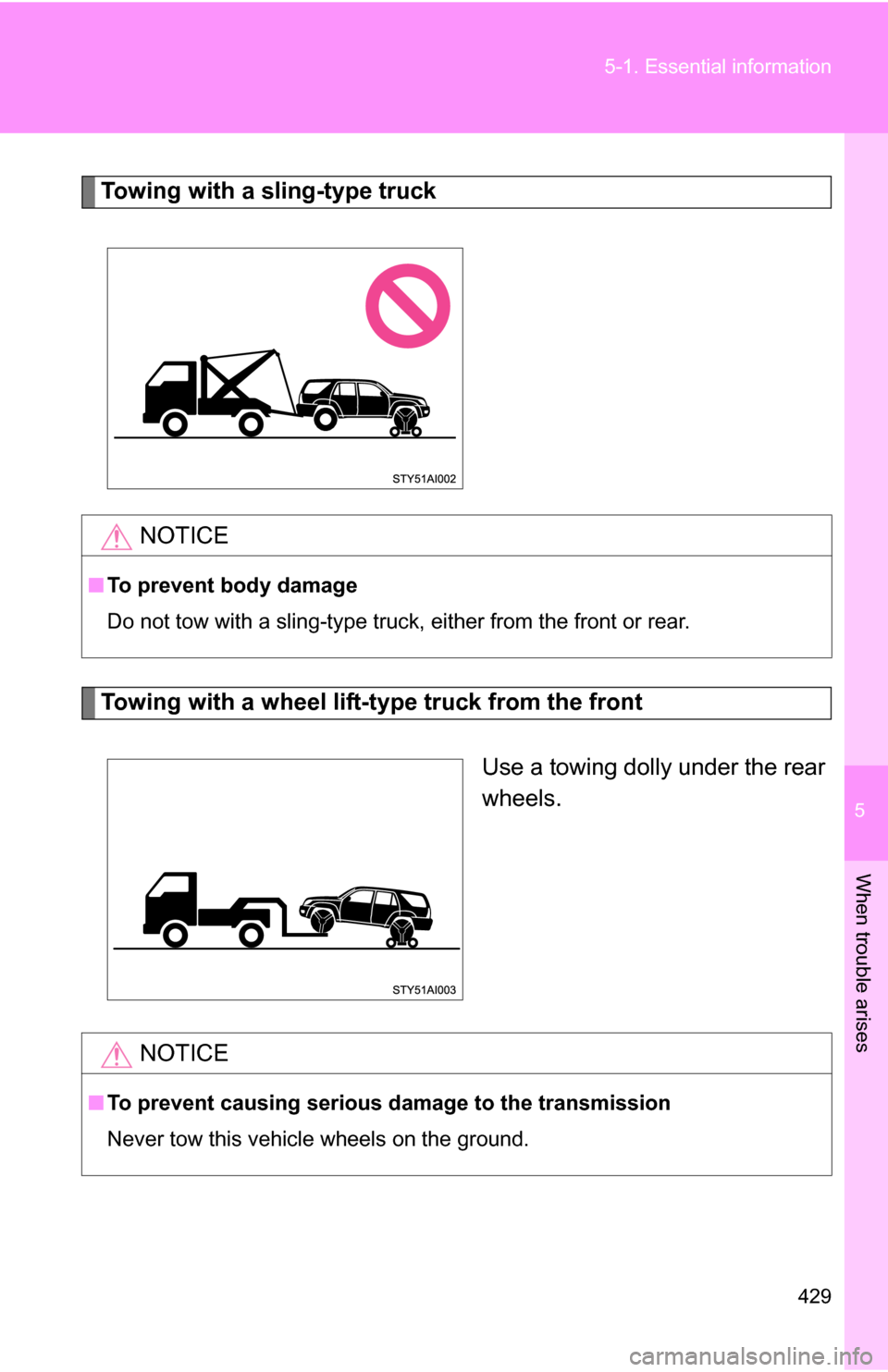
Towing with a sling-type truck
Towing with a wheel lift-type truck from the front
Use a towing dolly under the rear
wheels.
NOTICE
■To prevent body damage
Do not tow with a sling-type truck, either from the front or rear.
NOTICE
■To prevent causing serious da mage to the transmission
Never tow this vehicle wheels on the ground.
Page 430 of 520
430 5-1. Essential information
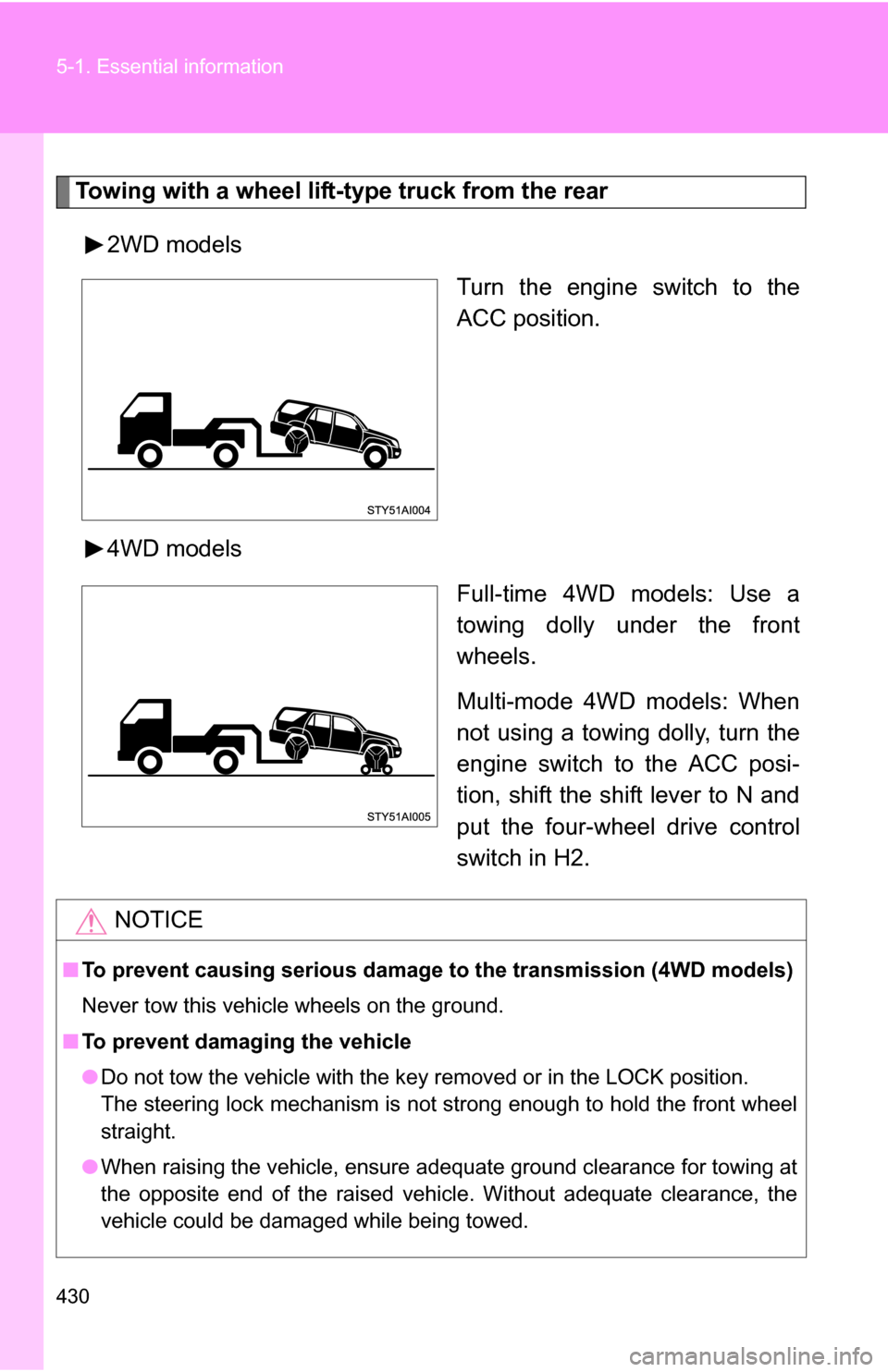
Towing with a wheel lift-type truck from the rear2WD models Turn the engine switch to the
ACC position.
4WD models Full-time 4WD models: Use a
towing dolly under the front
wheels.
Multi-mode 4WD models: When
not using a towing dolly, turn the
engine switch to the ACC posi-
tion, shift the shift lever to N and
put the four-wheel drive control
switch in H2.
NOTICE
■To prevent causing serious damage to the transmission (4WD models)
Never tow this vehicle wheels on the ground.
■ To prevent damaging the vehicle
●Do not tow the vehicle with the key removed or in the LOCK position.
The steering lock mechanism is not strong enough to hold the front wheel
straight.
● When raising the vehicle, ensure adequate ground clearance for towing at
the opposite end of the raised vehicle. Without adequate clearance, the
vehicle could be damaged while being towed.
Page 453 of 520
5
When trouble arises
453
5-2. Steps to take in an emergency
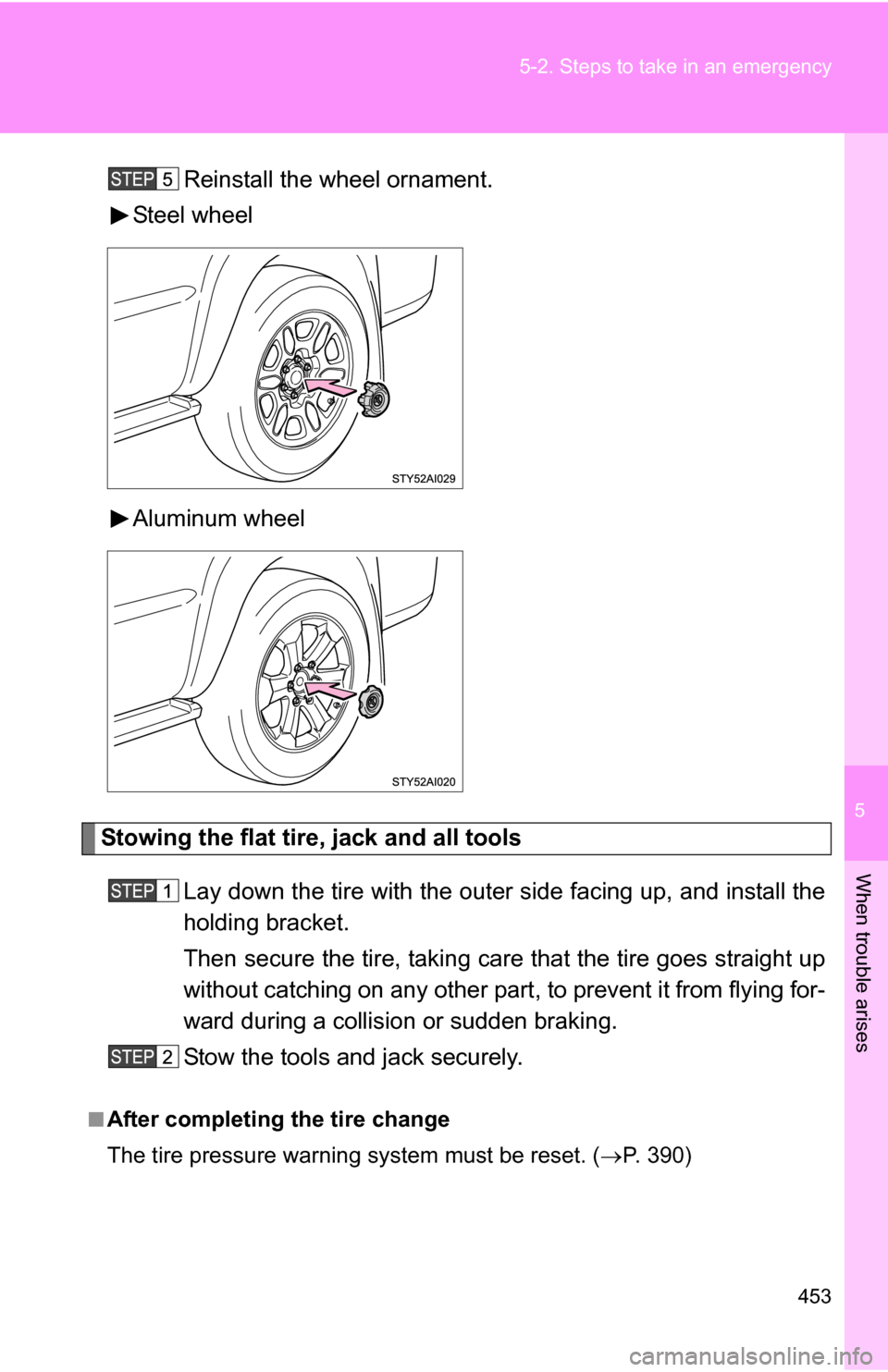
Reinstall the wheel ornament.
Steel wheel
Aluminum wheel
Stowing the flat tire, jack and all tools
Lay down the tire with the outer side facing up, and install the
holding bracket.
Then secure the tire, taking care that the tire goes straight up
without catching on any other part , to prevent it from flying for-
ward during a collisio n or sudden braking.
Stow the tools and jack securely.
■After completing the tire change
The tire pressure warning system must be reset. (P. 390)