Page 164 of 520
164 2-3. Operating the lights and wipers
■The windshield wiper and washer can be operated when
The engine switch must be in the ON position.
■ If no windshield washer fluid sprays
Check that the washer nozzles are not blocked and if there is washer fluid in
the windshield washer fluid reservoir.
NOTICE
■When the windshield is dry
Do not use the wipers, as they may damage the windshield.
■ When there is no washer fluid spray from the nozzle
Damage to the washer fluid pump may be caused if the lever is pulled
toward you and held continually.
■ When a nozzle becomes block
Do not try to clear it with a pin or other object. The nozzle will be damaged.
Washer/wiper dual opera-
tion
Wipers will automatically oper-
ate a couple of times after the
washer squirts.
Page 167 of 520
167
2-4. Using other
driving systems
2
When driving
■Cruise control can be set when
●The shift lever is in D or 4.
● Vehicle speed is more than approximately 25 mph (40 km/h).
■ Accelerating
The vehicle can be accelerated normally.
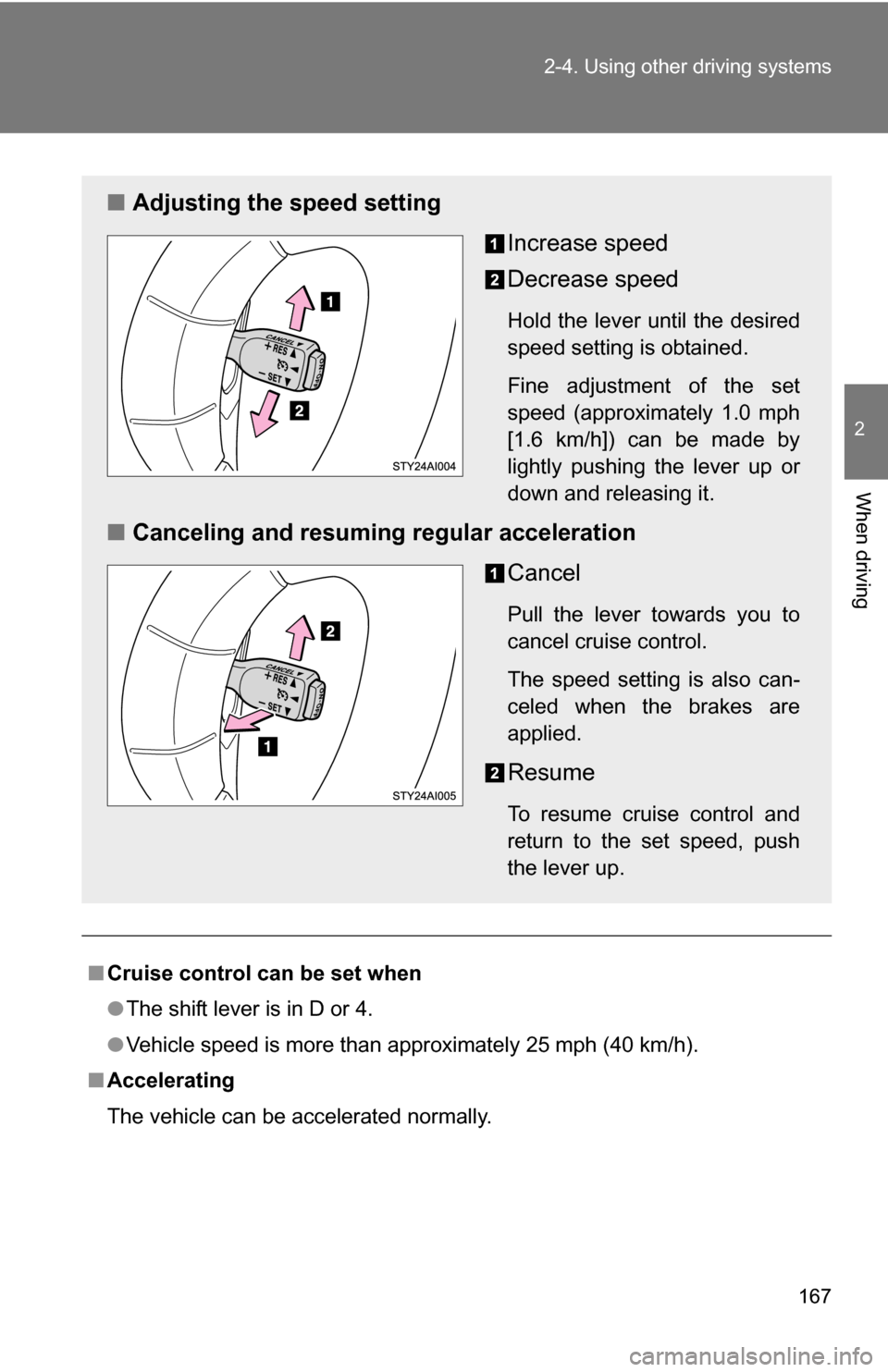
■ Adjusting the speed setting
Increase speed
Decrease speed
Hold the lever until the desired
speed setting is obtained.
Fine adjustment of the set
speed (approximately 1.0 mph
[1.6 km/h]) can be made by
lightly pushing the lever up or
down and releasing it.
■Canceling and resuming regular acceleration
Cancel
Pull the lever towards you to
cancel cruise control.
The speed setting is also can-
celed when the brakes are
applied.
Resume
To resume cruise control and
return to the set speed, push
the lever up.
Page 168 of 520
168 2-4. Using other driving systems
■Automatic cruise control cancellation
The set speed is automatically canceled in any of the following situations.
●Actual vehicle speed falls more than 10 mph (16 km/h) below the preset
vehicle speed.
At this time, the memorized set speed is not retained.
● Actual vehicle speed is below 25 mph (40 km/h).
● VSC is activated.
■ If the cruise control indicator flashes
Press the ON-OFF button to turn the cruise control off, and then reactivate
the system.
If the cruise control speed cannot be set or if the cruise control cancels
immediately after being activated, there may be a malfunction in the cruise
control system. Have the vehicle inspected by your Toyota dealer.
CAUTION
■To avoid operating the cruise control by mistake
Keep the ON-OFF button off when not in use.
■ Situations unsuitable for cruise control
Do not use cruise control in any of the following situations.
Doing so may result in control of the vehicle being lost and could cause an
accident resulting in death or serious injury.
●In heavy traffic
● On roads with sharp bends
● On winding roads
● On slippery roads, such as those covered with rain, ice or snow
● On steep hills
● When towing a trailer
Page 173 of 520

173
2-4. Using other
driving systems
2
When driving
CAUTION
■The electronically modulated air susp ension must be turned off in the
following circumstances:
Otherwise, the automatic leveling function may cause the vehicle’s height to
change, resulting in an unexpected accident.
● When driving through water such as shallow streams (Put the vehicle
height in HI mode and turn off the electronically modulated air suspension.
Drive at 18 mph [30 km/h] or slower.)
● When jacking up the vehicle, installing tire chains or tying the vehicle with
chains/wires for transportation via flat bed truck (Turn the system off and
stop the engine.)
● When the vehicle must be towed (Put the vehicle height in N mode and
turn the system off.)
● When the vehicle gets stuck (Turn the system off.)
● When disconnecting a trailer (Put the vehicle height in LO mode and turn
the system off.)
■ Selecting the correct height mode
Observe the following precautions to prevent accidents.
Failure to do so may cause damage to parts of the vehicle, as well as dan-
gerous handling characteristics, which may lead to fatal or injury accidents.
●Before you lower the vehicle’s height, check under the vehicle to make
sure that no one is there.
● The HI mode should be used for off-road driving conditions.
As the vehicle’s center of gravity is higher in this setting, the vehicle may
become unstable when turning abruptly.
● Do not select HI mode when you load cargo on the roof luggage carrier.
This may result in a loss of control or vehicle rollover.
Page 203 of 520
203
2-5. Driving information
2
When driving
Cargo and luggage
Take notice of the following information about storage precau-
tions, cargo capacity and load.
●Stow cargo and luggage in the luggage compartment whenever
possible.
● Be sure all items are secured in place.
● Be careful to keep the vehicle level. Placing the weight as far for-
ward as possible helps maintain vehicle balance.
● For better fuel economy, do no t carry unnecessary weight.
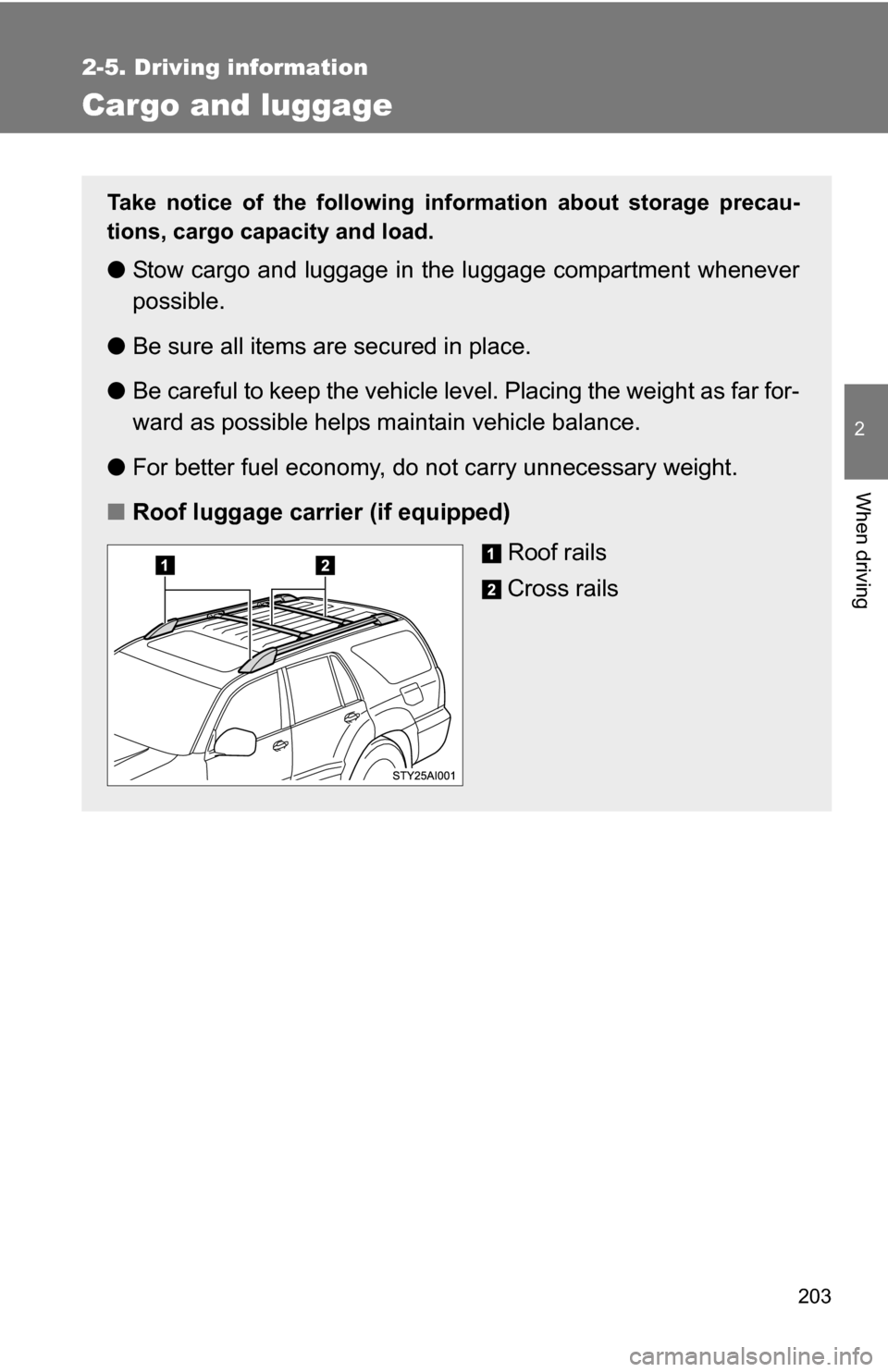
■ Roof luggage carrier (if equipped)
Roof rails
Cross rails
Page 205 of 520
205
2-5. Driving information
2
When driving
Capacity and distribution
Cargo capacity depends on the total weight of the occupants.
(Cargo capacity) = (Total load capacity) (Total weight of occupants)
Steps for Determining Correct Load Limit—
(1)Locate the statement “The co mbined weight of occupants and
cargo should never exceed XXX kg or XXX lbs.” on your vehicle’s
placard.
(2)Determine the combined weight of the driver and passengers that
will be riding in your vehicle.
(3)Subtract the combined weight of the driver and passengers from XXX kg or XXX lbs.
(4)The resulting figure equals the av ailable amount of cargo and lug-
gage load capacity.
For example, if the “XXX” amount equals 1400 lbs. and there will
be five 150 lb passengers in your vehicle, the amount of available
cargo and luggage load capacity is 650 lbs. (1400 750 (5 150)
= 650 lbs.)
(5)Determine the combined weight of luggage and cargo being loaded on the vehicle. That weight may not safely exceed the avail-
able cargo and luggage load capacity calculated in Step 4.
(6)If your vehicle will be towing a tr ailer, load from your trailer will be
transferred to your vehicle. Cons ult this manual to determine how
this reduces the available cargo and luggage load capacity of your
vehicle.
Page 211 of 520
211
2-5. Driving information
2
When driving
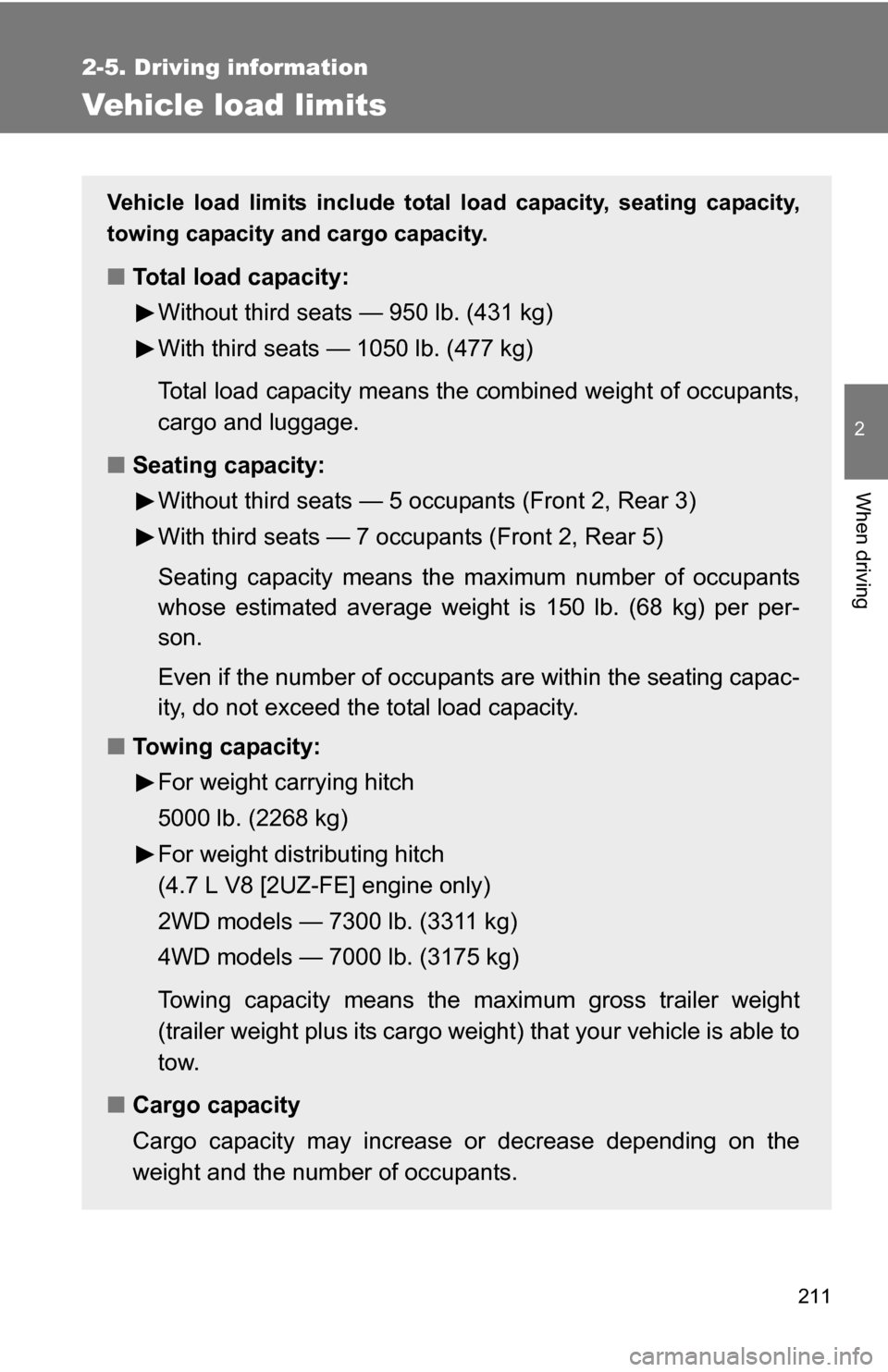
Vehicle load limits
Vehicle load limits include total load capacity, seating capacity,
towing capacity and cargo capacity.
■Total load capacity:
Without third seats — 950 lb. (431 kg)
With third seats — 1050 lb. (477 kg)
Total load capacity means the combined weight of occupants,
cargo and luggage.
■ Seating capacity:
Without third seats — 5 occupants (Front 2, Rear 3)
With third seats — 7 occupants (Front 2, Rear 5)
Seating capacity means the ma ximum number of occupants
whose estimated average weight is 150 lb. (68 kg) per per-
son.
Even if the number of occupants are within the seating capac-
ity, do not exceed the total load capacity.
■ Towing capacity:
For weight carrying hitch
5000 lb. (2268 kg)
For weight distributing hitch
(4.7 L V8 [2UZ-FE] engine only)
2WD models — 7300 lb. (3311 kg)
4WD models — 7000 lb. (3175 kg)
Towing capacity means the maximum gross trailer weight
(trailer weight plus its cargo weight) that your vehicle is able to
tow.
■ Cargo capacity
Cargo capacity may increase or decrease depending on the
weight and the number of occupants.
Page 216 of 520
216
2-5. Driving information
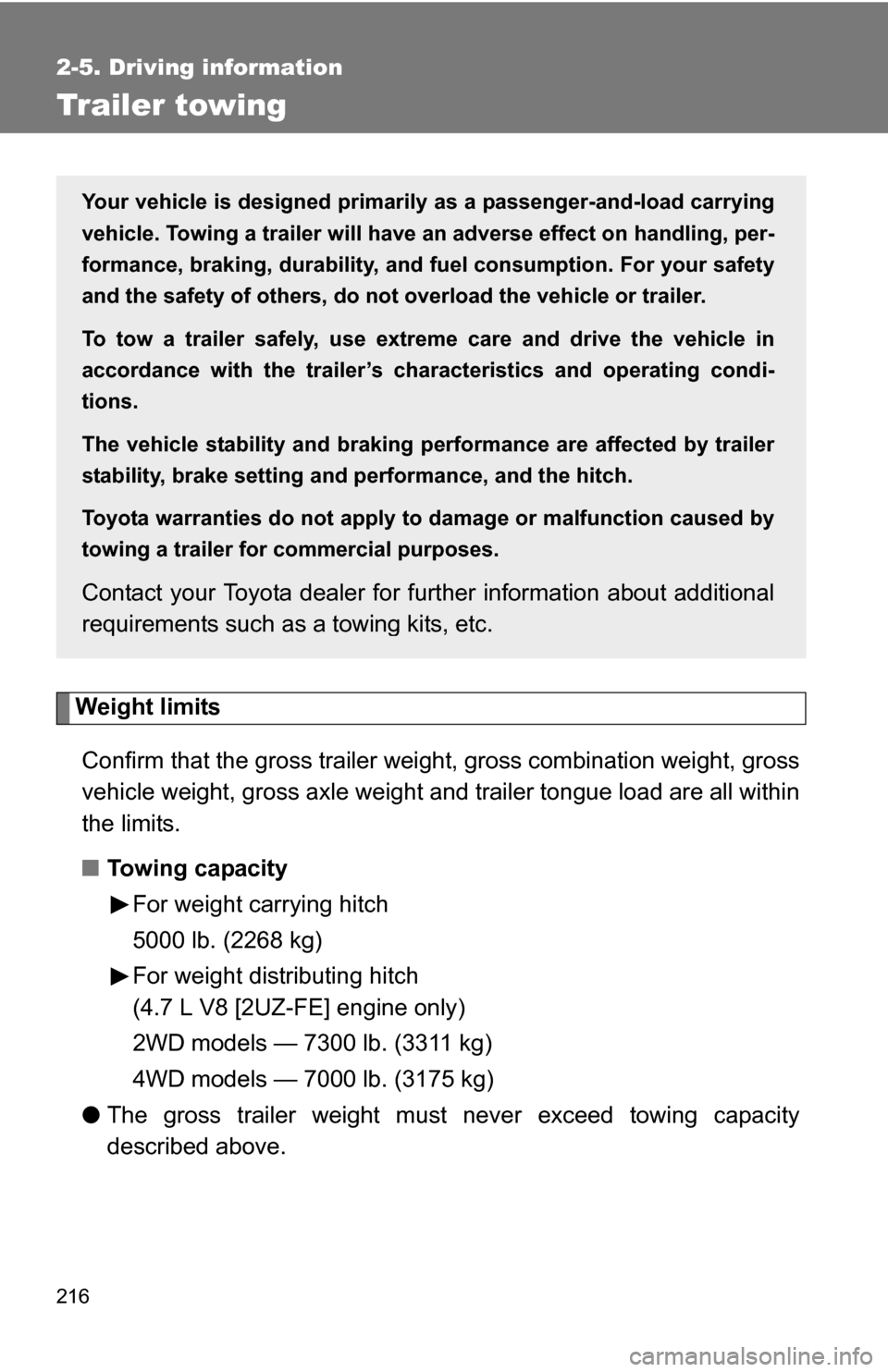
Trailer towing
Weight limitsConfirm that the gross trailer weight, gross combination weight, gross
vehicle weight, gross axle weight and trailer tongue load are all within
the limits.
■ Towing capacity
For weight carrying hitch
5000 lb. (2268 kg)
For weight distributing hitch
(4.7 L V8 [2UZ-FE] engine only)
2WD models — 7300 lb. (3311 kg)
4WD models — 7000 lb. (3175 kg)
● The gross trailer weight must never exceed towing capacity
described above.
Your vehicle is designed primarily as a passenger-and-load carrying
vehicle. Towing a trailer will have an adverse effect on handling, per-
formance, braking, durability, and fu el consumption. For your safety
and the safety of others , do not overload the vehicle or trailer.
To tow a trailer safely, use extreme care and drive the vehicle in
accordance with the trailer’s char acteristics and operating condi-
tions.
The vehicle stability and braking performance are affected by trailer
stability, brake setting and performance, and the hitch.
Toyota warranties do not apply to damage or malfunction caused by
towing a trailer for commercial purposes.
Contact your Toyota dealer for fu rther information about additional
requirements such as a towing kits, etc.