2009 SUBARU TRIBECA water pump
[x] Cancel search: water pumpPage 1873 of 2453
ME(H6DO)-7
General Description
MECHANICAL
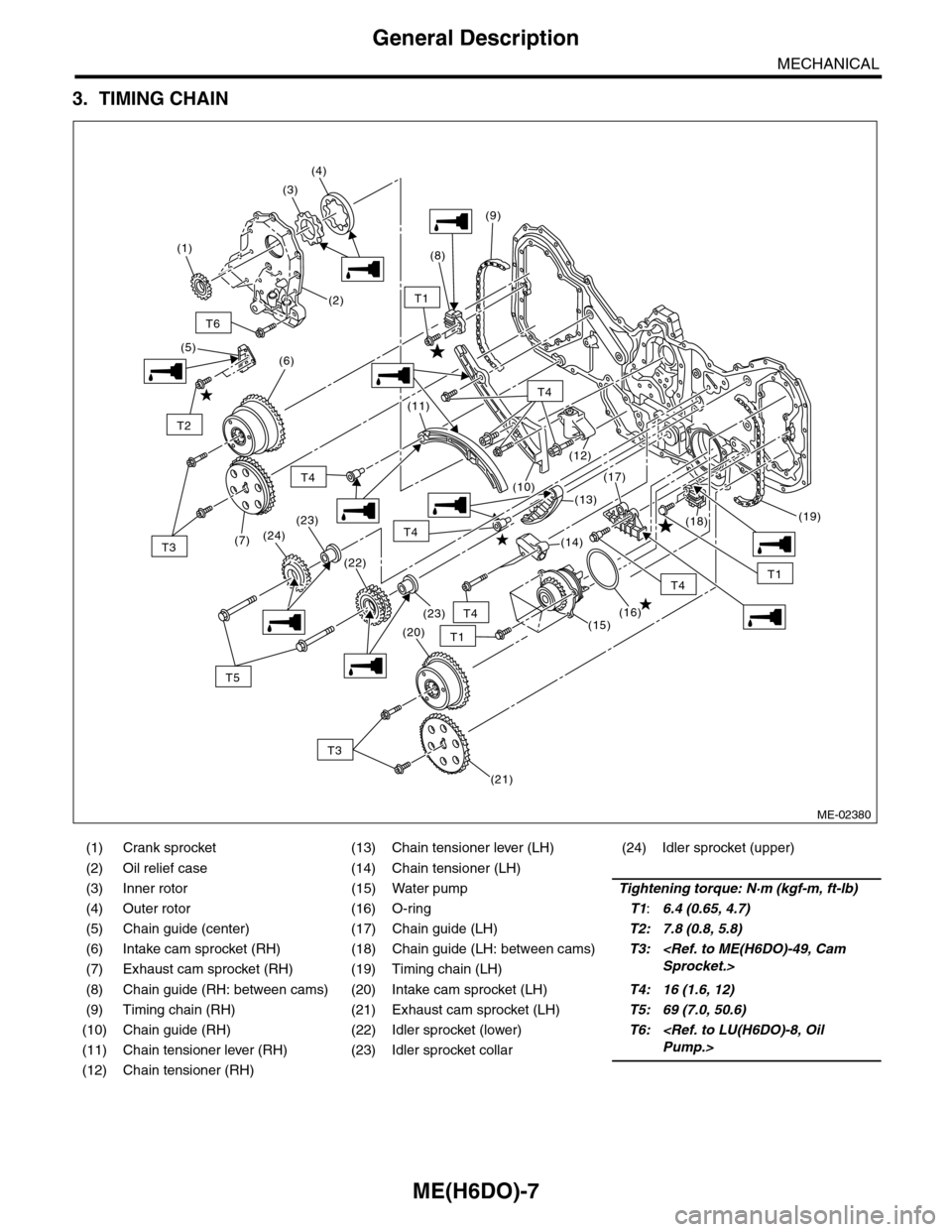
3. TIMING CHAIN
(1) Crank sprocket (13) Chain tensioner lever (LH) (24) Idler sprocket (upper)
(2) Oil relief case (14) Chain tensioner (LH)
(3) Inner rotor (15) Water pumpTightening torque: N·m (kgf-m, ft-lb)
(4) Outer rotor (16) O-ringT1:6.4 (0.65, 4.7)
(5) Chain guide (center) (17) Chain guide (LH)T2: 7.8 (0.8, 5.8)
(6) Intake cam sprocket (RH) (18) Chain guide (LH: between cams)T3:
(8) Chain guide (RH: between cams) (20) Intake cam sprocket (LH)T4: 16 (1.6, 12)
(9) Timing chain (RH) (21) Exhaust cam sprocket (LH)T5: 69 (7.0, 50.6)
(10) Chain guide (RH) (22) Idler sprocket (lower)T6:
(12) Chain tensioner (RH)
ME-02380
T6
(2)
(8)
(9)
(10)
(11)
(12)
(13)
(14)
(15)(16)
(17)
(18)(19)
(5)
T3
T3
T5
T2
T1
T1
T1
T4
T4
T4
T4
T4
(7)
(21)
(20)
(22)
(23)
(23)
(24)
(6)
(1)
(3)
(4)
Page 1899 of 2453
ME(H6DO)-33
Engine Assembly
MECHANICAL
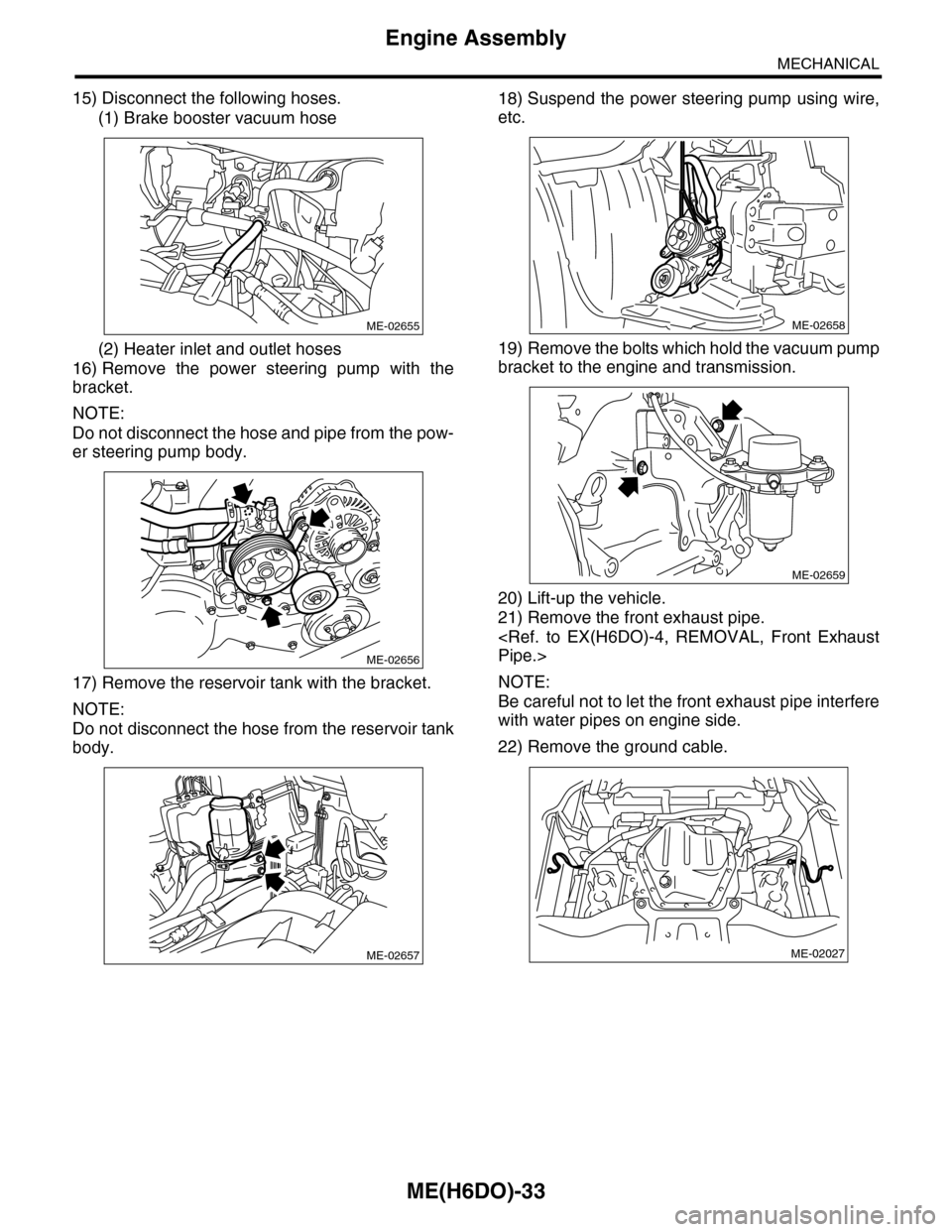
15) Disconnect the following hoses.
(1) Brake booster vacuum hose
(2) Heater inlet and outlet hoses
16) Remove the power steering pump with the
bracket.
NOTE:
Do not disconnect the hose and pipe from the pow-
er steering pump body.
17) Remove the reservoir tank with the bracket.
NOTE:
Do not disconnect the hose from the reservoir tank
body.
18) Suspend the power steering pump using wire,
etc.
19) Remove the bolts which hold the vacuum pump
bracket to the engine and transmission.
20) Lift-up the vehicle.
21) Remove the front exhaust pipe.
NOTE:
Be careful not to let the front exhaust pipe interfere
with water pipes on engine side.
22) Remove the ground cable.
ME-02655
ME-02656
ME-02657
ME-02658
ME-02659
ME-02027
Page 1903 of 2453
ME(H6DO)-37
Engine Assembly
MECHANICAL
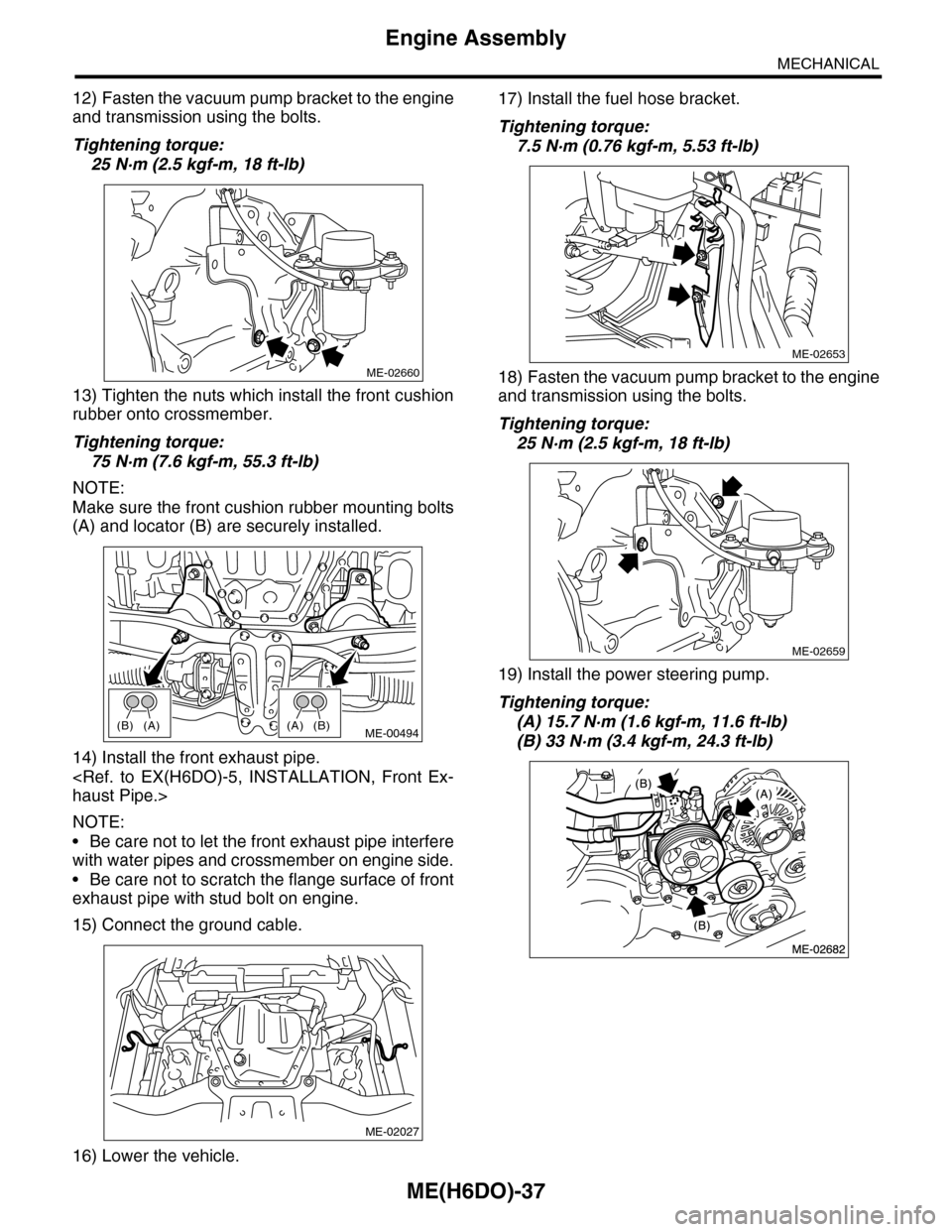
12) Fasten the vacuum pump bracket to the engine
and transmission using the bolts.
Tightening torque:
25 N·m (2.5 kgf-m, 18 ft-lb)
13) Tighten the nuts which install the front cushion
rubber onto crossmember.
Tightening torque:
75 N·m (7.6 kgf-m, 55.3 ft-lb)
NOTE:
Make sure the front cushion rubber mounting bolts
(A) and locator (B) are securely installed.
14) Install the front exhaust pipe.
NOTE:
•Be care not to let the front exhaust pipe interfere
with water pipes and crossmember on engine side.
•Be care not to scratch the flange surface of front
exhaust pipe with stud bolt on engine.
15) Connect the ground cable.
16) Lower the vehicle.
17) Install the fuel hose bracket.
Tightening torque:
7.5 N·m (0.76 kgf-m, 5.53 ft-lb)
18) Fasten the vacuum pump bracket to the engine
and transmission using the bolts.
Tightening torque:
25 N·m (2.5 kgf-m, 18 ft-lb)
19) Install the power steering pump.
Tightening torque:
(A) 15.7 N·m (1.6 kgf-m, 11.6 ft-lb)
(B) 33 N·m (3.4 kgf-m, 24.3 ft-lb)
ME-02660
(A)(B)(B)(A)ME-00494
ME-02027
ME-02653
ME-02659
Page 1912 of 2453
ME(H6DO)-46
Timing Chain Assembly
MECHANICAL
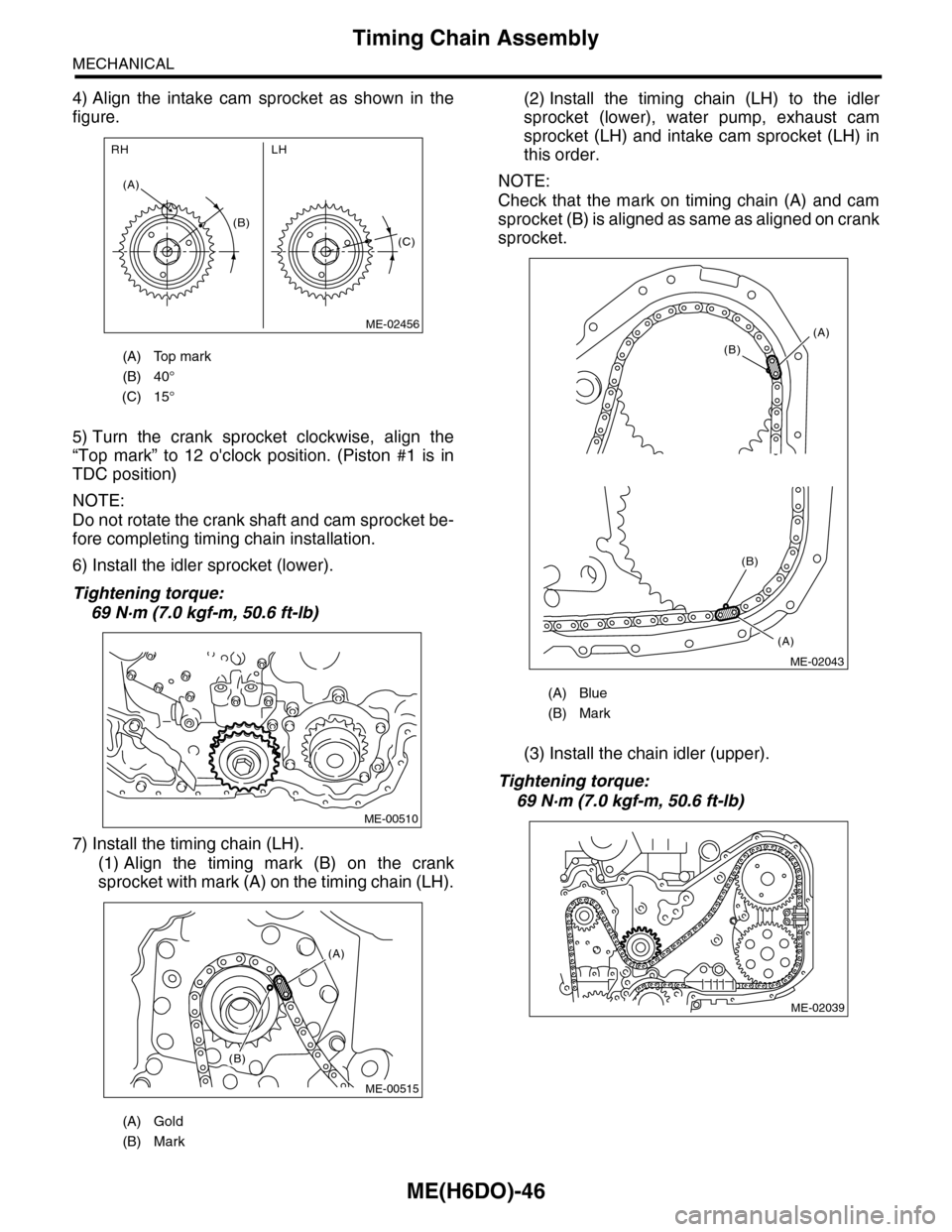
4) Align the intake cam sprocket as shown in the
figure.
5) Turn the crank sprocket clockwise, align the
“Top mark” to 12 o'clock position. (Piston #1 is in
TDC position)
NOTE:
Do not rotate the crank shaft and cam sprocket be-
fore completing timing chain installation.
6) Install the idler sprocket (lower).
Tightening torque:
69 N·m (7.0 kgf-m, 50.6 ft-lb)
7) Install the timing chain (LH).
(1) Align the timing mark (B) on the crank
sprocket with mark (A) on the timing chain (LH).
(2) Install the timing chain (LH) to the idler
sprocket (lower), water pump, exhaust cam
sprocket (LH) and intake cam sprocket (LH) in
this order.
NOTE:
Check that the mark on timing chain (A) and cam
sprocket (B) is aligned as same as aligned on crank
sprocket.
(3) Install the chain idler (upper).
Tightening torque:
69 N·m (7.0 kgf-m, 50.6 ft-lb)
(A) Top mark
(B) 40°
(C) 15°
(A) Gold
(B) Mark
(B)
(A)
LHRH
(C)
ME-02456
ME-00510
(A)
(B)
ME-00515
(A) Blue
(B) Mark
(A)
(B)
(A)
(B)
ME-02043
ME-02039
Page 1917 of 2453
ME(H6DO)-51
Rear Chain Cover
MECHANICAL
18.Rear Chain Cover
A: REMOVAL
1) Remove the crank pulley.
2) Remove the front chain cover.
3) Remove the timing chain.
4) Remove the cam sprocket.
5) Remove the crank sprocket.
6) Remove the oil pump.
7) Remove the water pump.
8) Remove the rear chain cover.
NOTE:
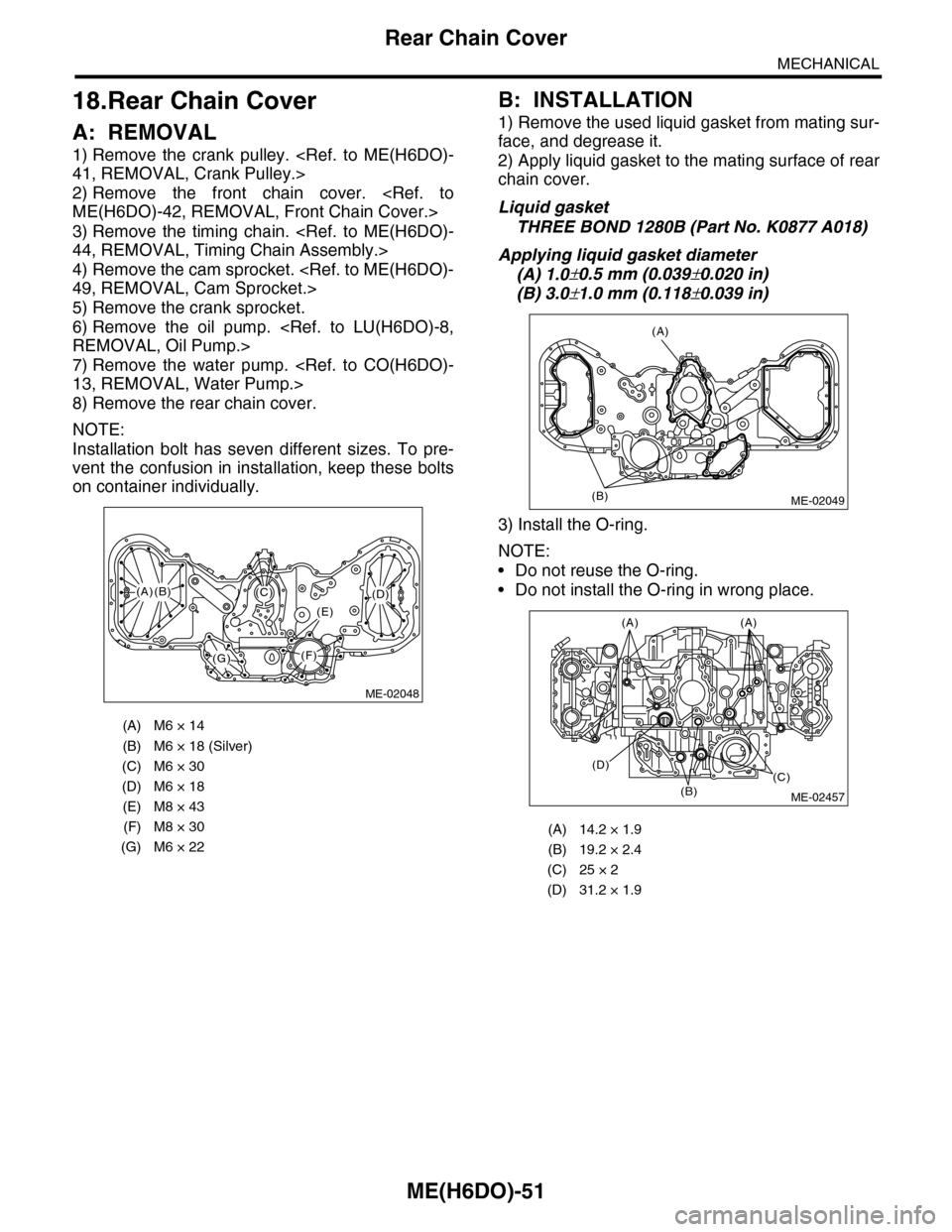
Installation bolt has seven different sizes. To pre-
vent the confusion in installation, keep these bolts
on container individually.
B: INSTALLATION
1) Remove the used liquid gasket from mating sur-
face, and degrease it.
2) Apply liquid gasket to the mating surface of rear
chain cover.
Liquid gasket
THREE BOND 1280B (Part No. K0877 A018)
Applying liquid gasket diameter
(A) 1.0±0.5 mm (0.039±0.020 in)
(B) 3.0±1.0 mm (0.118±0.039 in)
3) Install the O-ring.
NOTE:
•Do not reuse the O-ring.
•Do not install the O-ring in wrong place.
(A) M6 × 14
(B) M6 × 18 (Silver)
(C) M6 × 30
(D) M6 × 18
(E) M8 × 43
(F) M8 × 30
(G) M6 × 22
ME-02048
(F)
(C)(D)
(E)
(G)
(A)(B)
(A) 14.2 × 1.9
(B) 19.2 × 2.4
(C) 25 × 2
(D) 31.2 × 1.9
(A)
(B)ME-02049
(B)
(D)(C)
(A)(A)
ME-02457
Page 1918 of 2453
ME(H6DO)-52
Rear Chain Cover
MECHANICAL
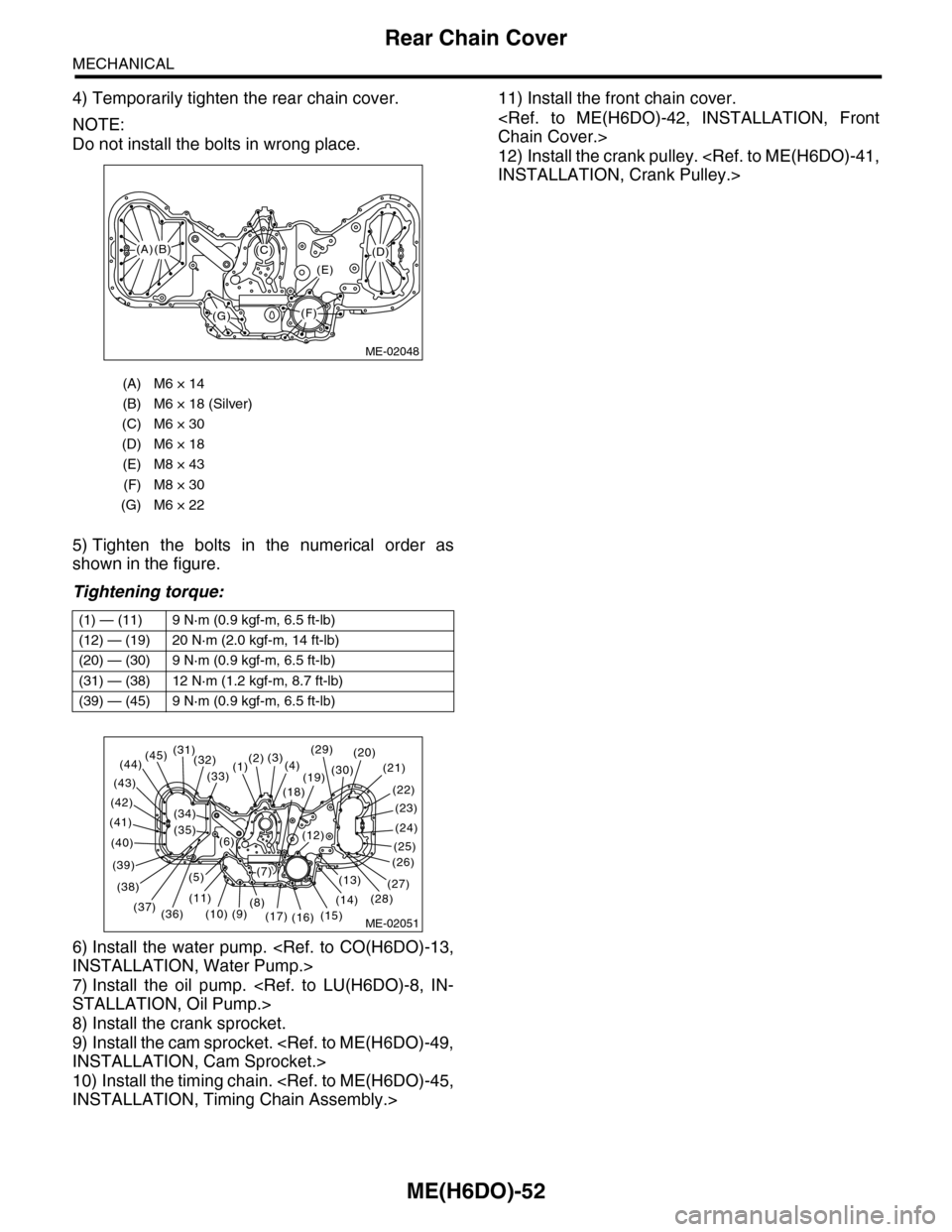
4) Temporarily tighten the rear chain cover.
NOTE:
Do not install the bolts in wrong place.
5) Tighten the bolts in the numerical order as
shown in the figure.
Tightening torque:
6) Install the water pump.
7) Install the oil pump.
8) Install the crank sprocket.
9) Install the cam sprocket.
10) Install the timing chain.
11) Install the front chain cover.
12) Install the crank pulley.
(A) M6 × 14
(B) M6 × 18 (Silver)
(C) M6 × 30
(D) M6 × 18
(E) M8 × 43
(F) M8 × 30
(G) M6 × 22
(1) — (11) 9 N·m (0.9 kgf-m, 6.5 ft-lb)
(12) — (19) 20 N·m (2.0 kgf-m, 14 ft-lb)
(20) — (30) 9 N·m (0.9 kgf-m, 6.5 ft-lb)
(31) — (38) 12 N·m (1.2 kgf-m, 8.7 ft-lb)
(39) — (45) 9 N·m (0.9 kgf-m, 6.5 ft-lb)
ME-02048
(F)
(C)(D)
(E)
(G)
(A)(B)
ME-02051(15)
(14)
(26)
(27)(13)
(25)
(24)
(23)
(22)
(21)(20)
(16)(17)
(12)
(19)(30)
(18)
(4)(3)(2)(1)(33)
(8)(9)(10)
(11)
(32)(31)(45)(44)
(43)
(42)
(41)
(40)
(39)
(38)
(37)(36)
(5)
(6)
(7)
(29)
(28)
(35)
(34)
Page 1956 of 2453
ME(H6DO)-90
Engine Noise
MECHANICAL
29.Engine Noise
A: INSPECTION
(NOTE*)
When disconnecting the fuel injector connector, the malfunction indicator light illuminates and DTC is stored in ECM memory.
Therefore, carry out the clear memory mode
mode
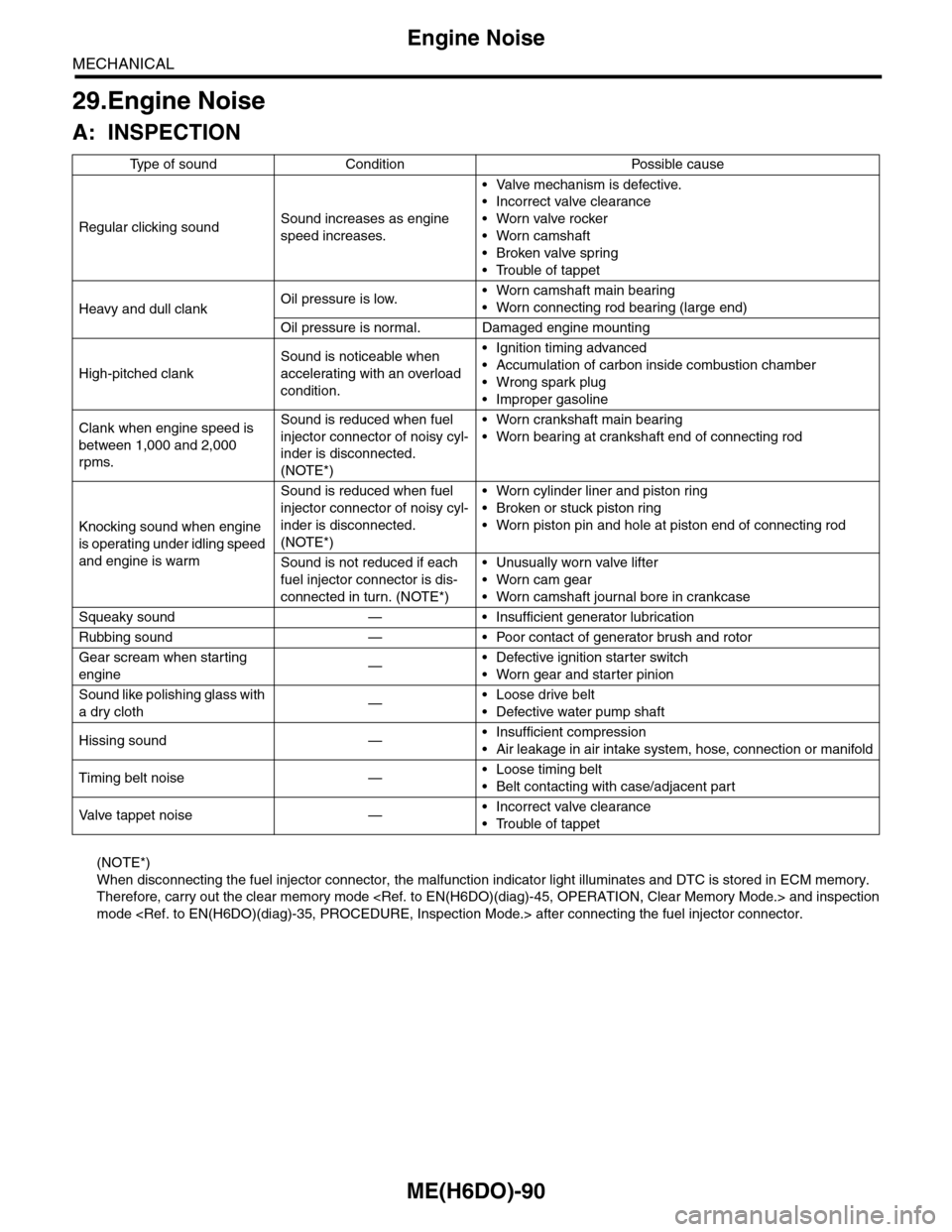
Ty p e o f s o u n d C o n d i t i o n P o s s i b l e c a u s e
Regular clicking soundSound increases as engine
speed increases.
•Valve mechanism is defective.
•Incorrect valve clearance
•Worn valve rocker
•Worn camshaft
•Broken valve spring
•Trouble of tappet
Heavy and dull clankOil pressure is low.•Worn camshaft main bearing
•Worn connecting rod bearing (large end)
Oil pressure is normal. Damaged engine mounting
High-pitched clank
Sound is noticeable when
accelerating with an overload
condition.
•Ignition timing advanced
•Accumulation of carbon inside combustion chamber
•Wrong spark plug
•Improper gasoline
Clank when engine speed is
between 1,000 and 2,000
rpms.
Sound is reduced when fuel
injector connector of noisy cyl-
inder is disconnected.
(NOTE*)
•Worn crankshaft main bearing
•Worn bearing at crankshaft end of connecting rod
Knocking sound when engine
is operating under idling speed
and engine is warm
Sound is reduced when fuel
injector connector of noisy cyl-
inder is disconnected.
(NOTE*)
•Worn cylinder liner and piston ring
•Broken or stuck piston ring
•Worn piston pin and hole at piston end of connecting rod
Sound is not reduced if each
fuel injector connector is dis-
connected in turn. (NOTE*)
•Unusually worn valve lifter
•Worn cam gear
•Worn camshaft journal bore in crankcase
Squeaky sound — • Insufficient generator lubrication
Rubbing sound — • Poor contact of generator brush and rotor
Gear scream when starting
engine—•Defective ignition starter switch
•Worn gear and starter pinion
Sound like polishing glass with
a dry cloth—•Loose drive belt
•Defective water pump shaft
Hissing sound —•Insufficient compression
•Air leakage in air intake system, hose, connection or manifold
Timing belt noise —•Loose timing belt
•Belt contacting with case/adjacent part
Va l ve t a p p e t n o i s e —•Incorrect valve clearance
•Trouble of tappet
Page 1996 of 2453
PM-13
Cooling System
PERIODIC MAINTENANCE SERVICES
9. Cooling System
A: INSPECTION
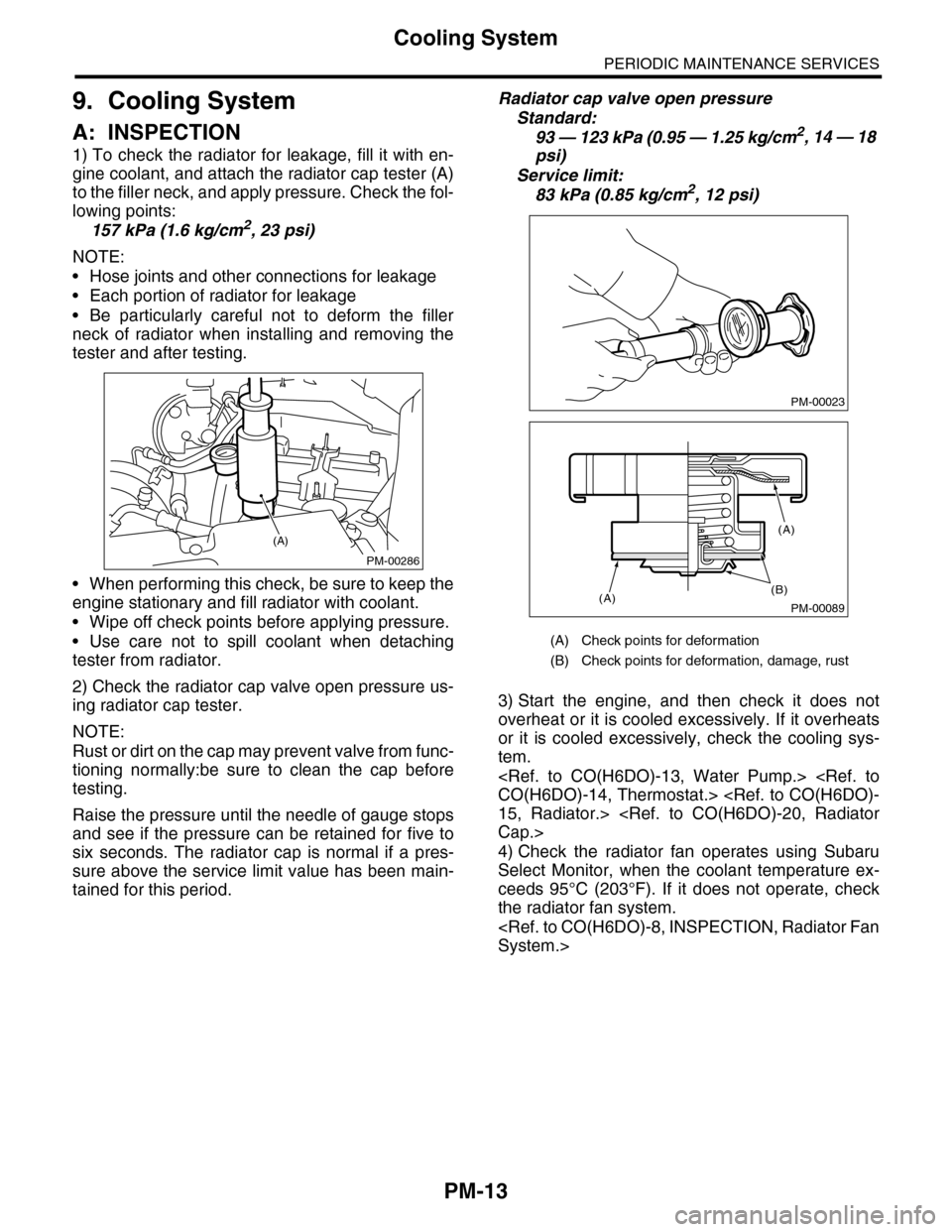
1) To check the radiator for leakage, fill it with en-
gine coolant, and attach the radiator cap tester (A)
to the filler neck, and apply pressure. Check the fol-
lowing points:
157 kPa (1.6 kg/cm2, 23 psi)
NOTE:
•Hose joints and other connections for leakage
•Each portion of radiator for leakage
•Be particularly careful not to deform the filler
neck of radiator when installing and removing the
tester and after testing.
•When performing this check, be sure to keep the
engine stationary and fill radiator with coolant.
•Wipe off check points before applying pressure.
•Use care not to spill coolant when detaching
tester from radiator.
2) Check the radiator cap valve open pressure us-
ing radiator cap tester.
NOTE:
Rust or dirt on the cap may prevent valve from func-
tioning normally:be sure to clean the cap before
testing.
Raise the pressure until the needle of gauge stops
and see if the pressure can be retained for five to
six seconds. The radiator cap is normal if a pres-
sure above the service limit value has been main-
tained for this period.
Radiator cap valve open pressure
Standard:
93 — 123 kPa (0.95 — 1.25 kg/cm2, 14 — 18
psi)
Service limit:
83 kPa (0.85 kg/cm2, 12 psi)
3) Start the engine, and then check it does not
overheat or it is cooled excessively. If it overheats
or it is cooled excessively, check the cooling sys-
tem.
4) Check the radiator fan operates using Subaru
Select Monitor, when the coolant temperature ex-
ceeds 95°C (203°F). If it does not operate, check
the radiator fan system.
PM-00286
(A)
(A) Check points for deformation
(B) Check points for deformation, damage, rust
PM-00023
PM-00089
(B)(A)
(A)