2009 SKODA YETI airbag
[x] Cancel search: airbagPage 149 of 271

Airbag system
148
Apart from their normal protective function, a further task of the
seat belts
is to also
hold the driver and front passenger in a correct seated position in the event of a frontal collision so as to enable the front ai
rbags to offer the maximum protection.
You should therefore always fasten the seat be
lts, not only because this is required by
law, but also for safety reasons and for your own protection
⇒page 141, “Why seat
belts?”.
Note
The dash panel must be replaced after the front passenger airbag has been deployed.Function of the front airbags Risk of injury to the head and ches
t area is reduced by fully inflated
airbags.The airbag system is designed in such a wa
y that the airbags for the driver and front
passenger are deployed in the event of a violent frontal collision. In certain accident situations, the front, side
, knee and head airbag are simultaneously
deployed. If the airbags are deployed, the airbags are filled with a propellant gas and inflated in front of the driver and front passenger
⇒fig. 138
. The airbags inflate in fractions of a
second and at a high speed in order to be able
to offer that additional protection in the
event of an accident. The forward movement of the driver and of the front passenger
i s c us h i o n e d w h e n th e y m a ke co n t a c t w i t h t h e f u l l y i n f l a t e d a i r ba g a n d th e r i s k o f i n j u r y to head and chest is thus reduced. The specially developed airbag allows the gas
to flow out of the inflated airbag in a
controlled manner (depending on the load of
the particular car occupant) in order to
cushion head and chest areas. The airbag then
deflates subsequently to such an extent,
after an accident, to again provide a clear view forward. A grey white, non harmful gas is released when airbag is inflated. This is perfectly normal and is not an indicati
on of a fire in the vehicle.
The airbag develops enormous forces when triggered, which can lead to injuries if the sitting position or seated position is not correct
⇒page 148.
Important safety information regarding the front airbag system Correct use of the airbag system cons
iderably reduces the risk of injury!
WARNING
•
Never transport children on the front seat of a vehicle without using a
proper restraint system. If airbags are de
ployed in the event of an accident, the
child might suffer severe
or even fatal injuries!
•
For the driver and front passenger it is important to maintain a distance of
at least 25 cm from the steering wheel or dash panel
⇒fig. 139
. Not main-
taining this minimum distance will mean that the airbag system will not be able to properly protect you - hazard! The front seats and the head restraints must always also be correctly adjusted to match the body size of the occupant.
Fig. 138 Inflated airbags
Fig. 139 Safe distance to steering wheel
sgg.6.book Page 148 Thursday, September 24, 2009 2:32 PM
Page 150 of 271

Airbag system
149
Using the system
Safety
Driving Tips
General Maintenance
Breakdown assistance
Technical Data
•
It is essential to always switch off
⇒page 154, “Deactivating an airbag” the
front passenger airbag when attaching a child safety seat on the front passenger seat where the child is seated
with its back facing in direction of
travel (in some countries also
when the child is facing the direction of travel). If
this is not done, there is a risk of the ch
ild suffering severe or even fatal injuries
if the front passenger airbag is deploy
ed. In certain countries national legal
provisions also require that the side or
head passenger airbags be deactivated.
When transporting a child on the front passenger seat, please comply with the appropriate national regu
lations regarding the use of child safety seats.
•
There must not by any further persons, animals or objects positioned
between the front seated occupants and
the deployment area of the airbag.
•
The steering wheel and the surface of th
e airbag module in the dash panel
on the passenger side must not be stuck
onto, covered or modified in any other
way. These parts should only be cleaned with a dry cloth or a cloth moistened with water. No objects such as cup holders, mobile phone mounts, etc. may be attached to the covers of the airbag modules or be located within the imme- diate area.•
No modifications of any kind may be
made to parts of the airbag system.
Any work on the airbag system includ
ing installing and removing system
components because of other repair wo
rk (e.g. removing the steering wheel)
must only be carried out by a specialist garage.•
Never carry out changes on the front bumper or on the body.
•
Never place any objects on
the surface of the front
passenger airbag module
in the dash panel.
Driver's knee airbag*Description of the driver's knee airbags The knee airbag reduces the risk of injury to the legs.The driver's knee airbag is located in th
e lower part of the dash panel below the
steering column
⇒fig. 140
. The fitting position is show
n in a picture on the side
surface of the dash panel on the driver's side. The driver's knee airbag is complementary
to the three-point seat belt and offers
adequate protection to the knees of the driver.
Please note that an airbag can only
offer you optimal protection in combination with a seat belt which is fastened
.
Apart from their normal protective function, a further task of the
seat belt
is to also
hold the driver in a correct seated position
in the event of a frontal collision so as to
enable the knee airbag to offer the maximum protection. You should therefore always fasten the seat belts, not only because this is required by law, but also for safety reasons and for your own protection
⇒page 141, “Why seat
belts?”.Function of the driver's knee airbagsThe airbag system is designed in such a way
that the driver's knee airbag is deployed
together with the belt tensioner in the even
t of a frontal collision of major severity.
If an airbag is deployed, the airbag is filled
with gas. The airbags inflate in fractions of a
second and at a high speed in order to be able to offer that additional protection in the event of an accident.
WARNING (continued)
Fig. 140 Driver's knee airbag below the steering column
sgg.6.book Page 149 Thursday, September 24, 2009 2:32 PM
Page 151 of 271

Airbag system
150
A grey white, non harmful gas is released when airbag is inflated. This is perfectly normal and is not an indicati
on of a fire in the vehicle.
The forward movement of the body is cushioned when it makes contact with the fully inflated airbag and the risk of injury to
the legs of the driv
er is thus reduced.
Important safety information on the driver's knee airbag
WARNING
•
The surface of the airbag module in the lower part of the dash panel below
the steering column must not be stuck onto, covered or modified in any other way. These parts should only be cleaned with a dry cloth or a cloth moistened with water. No objects must be attached
to the cover of the airbag module or be
located within the immediate area.•
No modifications of any kind may be
made to parts of the airbag system.
Any work on the airbag system includ
ing installing and removing system
components because of other repair wo
rk (e.g. removing the steering wheel)
must only be carried out by a specialist garage.•
Never carry out changes on the front bumper or on the body.
•
Do not attach any bulky and heavy obje
cts (keys etc.) to the keylock. These
can be ejected by the knee airb
ag being deployed and hurt you.
Side airbags*Description of side airbags The side airbag together with the head airbag offers enhanced occu- pant protection in the event of a side collision.The front side airbags are housed in the upho
lstery of the seat backrests of the front
seats
⇒fig. 141
.
The side airbag system in combination with the three-point seat belts, offers additional protection for the upper area of the body
(chest, stomach and pelvis) of the occupants
of the vehicle in the event of severe side collisions
⇒page 151.
Apart from their normal protective function, a further task of the
seat belts
is to also
hold the occupents of the front or rear exteri
or seats in a correct seated position in the
event of a side collision so as to enable th
e side airbag to offer the maximum protec-
tion. You should therefore always fasten the seat belts, not only because this is required by law, but also for safety reasons and for your own protection. Each time the side airbags are deployed, th
e head airbag* and the front belt tensioner
on the side of the car on which the collision
occures, are automati
cally deployed at the
same time in order to provide the
occupant with enhanced protection.
Fig. 141 Installation position of side airbag in driver seat
sgg.6.book Page 150 Thursday, September 24, 2009 2:32 PM
Page 152 of 271

Airbag system
151
Using the system
Safety
Driving Tips
General Maintenance
Breakdown assistance
Technical Data
Function of the side airbags Risk of injury to the upper part of the body is reduced by fully inflated side airbags.When the side airbags are deployed, the head airbag* and the belt tensioner are also automatically deployed on the relevant side
⇒fig. 142
.
If an airbag is deployed, the airbag is filled with gas. The airbags inflate in fractions of a second and at a high speed in order to be able to offer that additional protection in the event of an accident. A grey white, non harmful gas is released when airbag is inflated. This is perfectly normal and is not an indicati
on of a fire in the vehicle.
The load of the occupants is cushioned when
plunging into the fully inflated airbag and
the ri sk of i njur y to the entire uppe r body
(chest, stomach and pelvis) is reduced on the
side facing the door.Important safety information on the side airbag Correct use of the airbag system cons
iderably reduces the risk of injury!
WARNING
•
It is essential to always switch off
⇒page 154, “Deactivating an airbag” the
front passenger airbag when attaching a child safety seat on the front passenger seat where the child is seated
with its back facing in direction of
travel (in some countries also
when the child is facing the direction of travel). If
this is not done, there is a risk of the ch
ild suffering severe or even fatal injuries
if the front passenger airbag is deploy
ed. In certain countries national legal
provisions also require that the side or
head passenger airbags be deactivated.
When transporting a child on the front passenger seat, please comply with the appropriate national regulations regarding the use of child safety seats.•
Your head should never be positioned in the deployment area of the side
airbag. You might suffer severe injuries in
the event of an accident. This applies
in particular to children who are transported without using a suitable child safety seat
⇒page 158, “Child safety and side airbag*”.
•
If children adopt an incorrect seated
position when travelling, they may be
exposed to an increased risk of injury in
the event of an accident. This can result
in serious injuries
⇒page 156, “What you should know about transporting
children!”.•
There must not be any further persons,
animals as well as objects posi-
tioned between the occupants and the deployment area of the airbag. No accessories, such as a can holder, should be attached to the doors.•
The airbag control unit operates together with the pressure sensors, which
are attached in the front doors. For this reason no adjustments must be carried out at the doors as well as at the door panels (for example additional installa-tion of loudspeakers). Resulting damage
s can have a negative affect on the
operation of the airbag system. All work on the front doors and their panels must only be carried out by a specialist garage.•
In the event of a side collision, the side airbags will not function properly, if
the sensors cannot measure the increasi
ng air pressure inside the doors,
because the air can escape through lar
ge, non-sealed open
ings in the door
panel.
− Never drive with removed inner door panels. − Never drive, if parts of the inner do
or panel have been removed and the
remaining openings have not been properly sealed. − Never drive, if the loudspeakers in the doors have been removed, only if the loudspeaker openings have been properly sealed. − Always make sure that the openings are covered or filled, if additional loudspeakers or other equipment part
s are installed in the inner door
panels.
Fig. 142 Inflated side airbag
WARNING (continued)
sgg.6.book Page 151 Thursday, September 24, 2009 2:32 PM
Page 153 of 271

Airbag system
152
−Always work with an authorised Škoda dealer or have it carried out by a competent specialist workshop.
•
Only hang light items of clothing on the clothes hooks to the vehicle. Never
leave any heavy or sharp-edged objects in the pockets of the items of clothing.•
Ensure that there are no excessive forc
es, such as violent knocks, kicks etc.,
impact on the backrests of the seats
otherwise the system may be damaged.
The side airbags would not be deployed in such a case!•
Any seat or protective covers which you fit to the driver or front passenger
seats must only be of the type expressly authorised by Škoda Auto. In view of the fact that the airbag inflates out of the backrest of the seat, use of non- approved seat or protective covers would considerably impair the protective function of the side airbag.•
Any damage to the original seat covers in the area of the side airbag module
must be repaired without dela
y by your specialist garage.
•
The airbag modules in the front seats must not display any damage, cracks
or deep scratches. It is not permissible to use force in order to open the modules.•
Any work on the side airbag system including removing and installing
system components because of other repair work (e.g. removing seats) must only be carried out by a specialist garage.
Head airbags*Description of the head airbags The head airbag together with the side airbag offers enhanced occu- pant protection in the event of a side collision.The head airbags are positioned above the door
s on both sides in the interior of the
car
⇒fig. 143
. The installation positions are each marked with the “AIRBAG” logo.
The head airbag together with the three-poin
t seat belts and the side airbags, offers
additional protection for the head and neck ar
ea of the occupants in the event of a side
collision of major severity
⇒page 153.
Apart from their normal protective function, a further task of the
seat belts
is to also
hold the driver and the occupants in a correct seated position in the event of a side collision so as to enable the head airbags to offer the maximum protection. You should therefore always fasten the seat belts, not only because this is required by law, but also for safety reasons and for your own protection
⇒page 141, “Why seat belts?”.
Together with other elements (such as cross ba
rs in the seats, stable vehicle structure)
the head airbags are the consequent further development of occupant protection in the case of side collisions.
WARNING (continued)
Fig. 143 Installation position of the head airbags
sgg.6.book Page 152 Thursday, September 24, 2009 2:32 PM
Page 154 of 271
Airbag system
153
Using the system
Safety
Driving Tips
General Maintenance
Breakdown assistance
Technical Data
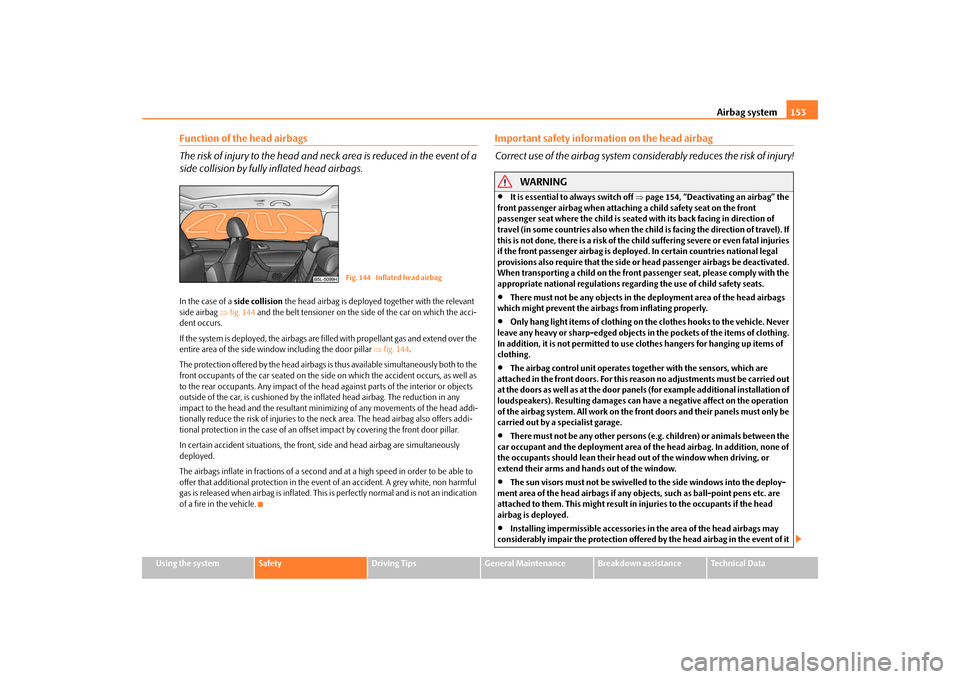
Function of the head airbags The risk of injury to the head and neck area is reduced in the event of a side collision by fully inflated head airbags.In the case of a
side collision
the head airbag is deployed together with the relevant
side airbag
⇒fig. 144
and the belt tensioner on the side of the car on which the acci-
dent occurs. If the system is deployed, the airbags are filled with propellant gas and extend over the entire area of the side wind
ow including the door pillar
⇒fig. 144
.
The protection offered by the head airbags is
thus available simultaneously both to the
front occupants of the car seated on the side on which the accident occurs, as well as to the rear occupants. Any impact of the head against parts of the interior or objects outside of the car, is cushioned by the in
flated head airbag. The reduction in any
impact to the head and the resultant minimi
zing of any movement
s of the head addi-
tionally reduce the risk of injuries to the neck area. The head airbag also offers addi-tional protection in the case of an offset
impact by covering
the front door pillar.
In certain accident situations, the front, side and head airbag are simultaneously deployed. The airbags inflate in fractions of a second an
d at a high speed in order to be able to
offer that additional protection in the even
t of an accident. A grey white, non harmful
gas is released when airbag is inflated. This is perfectly normal and is not an indication of a fire in the vehicle.
Important safety information on the head airbag Correct use of the airbag system cons
iderably reduces the risk of injury!
WARNING
•
It is essential to always switch off
⇒page 154, “Deactivating an airbag” the
front passenger airbag when attachin
g a child safety seat on the front
passenger seat where the child is seated
with its back facing in direction of
travel (in some countries also when the chil
d is facing the direct
ion of travel). If
this is not done, there is a risk of the ch
ild suffering severe or even fatal injuries
if the front passenger airbag is deploy
ed. In certain countries national legal
provisions also require that the side or
head passenger airbags be deactivated.
When transporting a child on the front passenger seat, please comply with the appropriate national regulations regarding the use of child safety seats.•
There must not be any objects in the deployment area of the head airbags
which might prevent the airbags from inflating properly.•
Only hang light items of clothing on
the clothes hooks to the vehicle. Never
leave any heavy or sharp-edged objects in
the pockets of the items of clothing.
In addition, it is not permitted to use clothes hangers for hanging up items of clothing. •
The airbag control unit operates together with the sensors, which are
attached in the front doors. For this reason no adjustments must be carried out at the doors as well as at the door panels (for example additional installation of loudspeakers). Resulting da
mages can have a negative affect on the operation
of the airbag system. All work on the front doors and their panels must only be carried out by a specialist garage.•
There must not be any other persons (e
.g. children) or animals between the
car occupant and the deployment area of
the head airbag. In addition, none of
the occupants should lean their head out of the window when driving, or extend their arms and hands out of the window.•
The sun visors must not be swivelled to the side windows into the deploy-
ment area of the head airbags if any obje
cts, such as ball-point pens etc. are
attached to them. This might result in injuries to the occupants if the head airbag is deployed.•
Installing impermissible accessories in the area of the head airbags may
considerably impair the protection offered by the head airbag in the event of it
Fig. 144 Inflated head airbag
sgg.6.book Page 153 Thursday, September 24, 2009 2:32 PM
Page 155 of 271

Airbag system
154
being deployed. When the deployed head
airbag is inflated, parts of the acces-
sories fitted may in certain circumstances be thrown into the interior of the car and cause injuries to the occupants
⇒page 221, “Accessories, changes and
replacement of parts”.•
Any work on the head airbag system
including installing and removing
system components because
of other repair work (e.g. removing headliner)
must only be carried out by a specialist garage.Deactivating an airbagDeactivating airbags If any airbags have been deactivated, switch them on again as soon as possible so that they are able to again provide their proper protection.There is the technical means installed within your vehicle to switch off the front, side* or head* airbag (take out of commission). This is why you should have the deactivation
of the airbags carried out by a specialist
garage. On vehicles equipped with the switch for de
activation of the airbags, you can deacti-
vate the front passenger airbag
by means of this switch
⇒page 154.
Deactivation of airbags is envisaged only for particular instances, such as if:•
Yo u m u s t i n
exceptional cases
use a child seat on the front passenger seat where
the child is seated with its back to the dire
ction of travel (in some countries this must
be in the direction of travel due to other legal regulations applying)
⇒page 156,
“Important safety information regarding the use of child safety seats”;•
you are not able to maintain the distance
of at least 25 cm between middle of
steering wheel and chest, despite the driver seat being correctly adjusted;•
special attachments are required in the ar
ea of the steering wheel because of a
physical disability;•
you have installed other seats (e.g. orthopaedic seats without side airbags).
Monitoring the airbag system The functionality of the airbag system is al
so monitored electronically when one airbag
has been switched off. If the airbag was switched off using diagnostic equipment:•
The warning light for the airbag system li
ghts up for 4 seconds after switching on
the ignition and then flashes for 12 seco
nds afterwards in 2 second intervals.
Front passenger airbags sw
itched off using the switch for front passenger
airbags* in storage compartmen
t on the front passenger side:
•
the airbag indicator light in the instrume
nt cluster comes on for about 4 seconds
each time the igniti
on is switched on;
•
switching off the airbag is indicated in the middle of the dash panel by the lighting
up of the yellow indicator light in display
⇒fig. 145
.
Note
A specialist garage will be able to advise you whether national legislation in your country allows airbags in
your vehicle to be deactivated, and which ones.
Switch for the front passenger airbagFig. 145 Storage compartment: Switch for the
front passenger airbag / indicator light for a
switched off front seat passenger airbagThe front passenger airbag is deactivated with the switch.
WARNING (continued)
sgg.6.book Page 154 Thursday, September 24, 2009 2:32 PM
Page 156 of 271

Airbag system
155
Using the system
Safety
Driving Tips
General Maintenance
Breakdown assistance
Technical Data
Deactivating an airbag– Switch off the ignition. – Turn the slot of the airbag switch using the key in the position (
OFF
) ⇒fig. 145
.
– Check whether the yellow airbag indicator light in display
in the middle of the dash panel lights up when the ignition is turned on
⇒fig. 145
.
Switching on an airbag– Switch off the ignition. – Turn the slot of the airbag switch using the key in the position (
ON
) ⇒fig. 145
.
– Check whether the yellow airbag indicator light in display
in the middle of the dash panel lights up when the ignition is turned on
⇒fig. 145
.
The warning light
goes out 65 seconds after th
e ignition is switched on.
The airbag should only be switched off under exceptional circumstances
⇒page 154.
Indicator light in display
(airbag switched off)
The airbag indicator ligh
t is located in the middle of the dash panel
⇒fig. 145
.
If the front passenger airbag is
switched off
, the warning light comes on about 4
seconds after the ignition is switched on. There is a system fault present in the airbag switch off
⇒
if the indicator light
flashes.
Please have the car inspected immediately by a specialist garage.WARNING
•
The driver is responsible
for whether the airbag is switched on or switched
off.•
Only switch off the airbag when the ignition is switched off! Otherwise a
fault can occur in the system for the airbag deactivation.•
If the yellow indicator light in display
(airbag
switched off) flashes:
− Front passenger airbag is not deployed in the event of an accident! − It is also important to have the system inspected without delay by a specialist garage.
A2A1
sgg.6.book Page 155 Thursday, September 24, 2009 2:32 PM