2009 SKODA ROOMSTER engine
[x] Cancel search: enginePage 166 of 263

Driving and the Environment165
Using the system
Safety
Driving Tips
General Maintenance
Breakdown assistance
Praktik
Technical Data number of tips on how to protect the environment and at the same time save
money.
The fuel consumption can naturally also be influenced by factors which are beyond
the driver's control. It is, for example, normal for the fuel consumption to increase
in winter and under worsened conditions such as poor road conditions, towing a
trailer, etc.
The technical requirements for low fuel usage and economic efficiency of the
vehicle have already been built into the vehicle at the works. Special attention has
been given to minimising negative effects on the environment. It is necessary to
take note of the guidelines given in this chapter in order to make best use of these
characteristics and to maintain their effectiveness.
Looking ahead when driving
A vehicle's highest fuel consumption occurs it accelerates.Avoid accelerating and braking unnecessarily. If you drive with forsight you will not
need to brake so often and will also then not have to accelerate so much. Let your
vehicle coast to a stop, for example, if this is possible, when you see that the next
set of traffic lights is at red.Shifting gears and saving energy
Shifting up early saves on fuel.
Manual gearbox
– Drive no more than about one length of your vehicle in first gear.
Always shift up into the next higher gear at approx. 2 000 to 2 500 revs.
Automatic gearbox
– Depress the accelerator pedal slowly. Do not depress it beyond the
kickdown position, however.An effective way of achieving good fuel economy is to shift up early. You will
consume more fuel if you drive at unnecessarily high revolutions in any given gear.
The ⇒fig. 169 shows the ratio of fuel consumption to the speed of your vehicle in
the relevant gears. Fuel consumption in 1st gear is the highest and in 5th gear is the
lowest.
Note
•
The optimal engine speed should be obtained when accelerating, in order to
avoid a high fuel consumption and resonance of the vehicle.
•
Also use the information supplied by the multi-functional indicator*
⇒page 22.
Avoiding full throttle
Driving more slowly means saving fuel.
Fig. 169 Fuel consumption
in litres/100 km. and speed in
km/h.
Fig. 170 Fuel consumption
in litres/100 km. and speed in
km/h.
s29g.4.book Page 165 Wednesday, June 17, 2009 9:54 AM
Page 167 of 263
Driving and the Environment 166Sensitive use of the accelerator will not only significantly reduce fuel consumption
but also positively influence environmental pollution and wear of your vehicle.
You should avoid exploiting the top speed of your vehicle wherever possible. Fuel
consumption, pollutant emissions and vehicle noises increase disproportionally at
high speeds.
The ⇒page 165, fig. 170 shows the ratio of fuel consumption to the speed of your
vehicle. You will cut your fuel consumption by half if you only make use three-quar-
ters of the possible top speed of your vehicle.Reducing idling
Idling also costs fuel.It is worthwhile switching off the engine in a traffic jam or when waiting at a level
crossing or at traffic lights with a lengthy red phase. Even after just 30 - 40 seconds
you will have saved more fuel than that is needed when you start the engine up
again.
If an engine is only idling it takes much longer for it to reach its normal operating
temperature. Wear-and-tear and pollutant emissions, though, are particularly high
in the warming-up phase. This is why you should drive off right after starting the
engine. Do avoid high engine revolutions at this time, however.Regular servicing
A poorly tuned engine consumes an unnecessarily high amount of
fuel.Having your vehicle serviced regularly at a specialist garge enables you to satisfy
one of the requirements for economical motoring even before you set off on your
journey. Keeping your vehicle properly serviced not only has a positive effect on the
safety of your vehicle and maintaining its value, but also saves on fuel.
A poorly tuned engine can result in a fuel consumption which is 10% higher than
normal.
The foreseen maintenance work should be undertaken exactly according to the
Service schedule by a specialist garage.Also check the oil level after refueling. Oil consumption is dependent to a consid-
erable extent on the load and speed of the engine. Oil consumption could be as
high as 0.5 litres/1 000 km depending on your style of driving.
It is quite normal that a new engine has a higher oil consumption at first, and
reaches its lowest level only after a certain running in time. It is therefore not
possible to correctly assess the oil consumption of a new vehicle until after you
have driven about 5 000 km.
For the sake of the environment
•
You can achieve additional improvements in your fuel economy by using high-
lubricity oils.
•
Check the ground below your vehicle at regular intervals to detect any leakages
in good time. Please have your vehicle inspected by a specialist garge if you find any
stains caused by oil or other fluids on the floor.
Avoid driving short distances
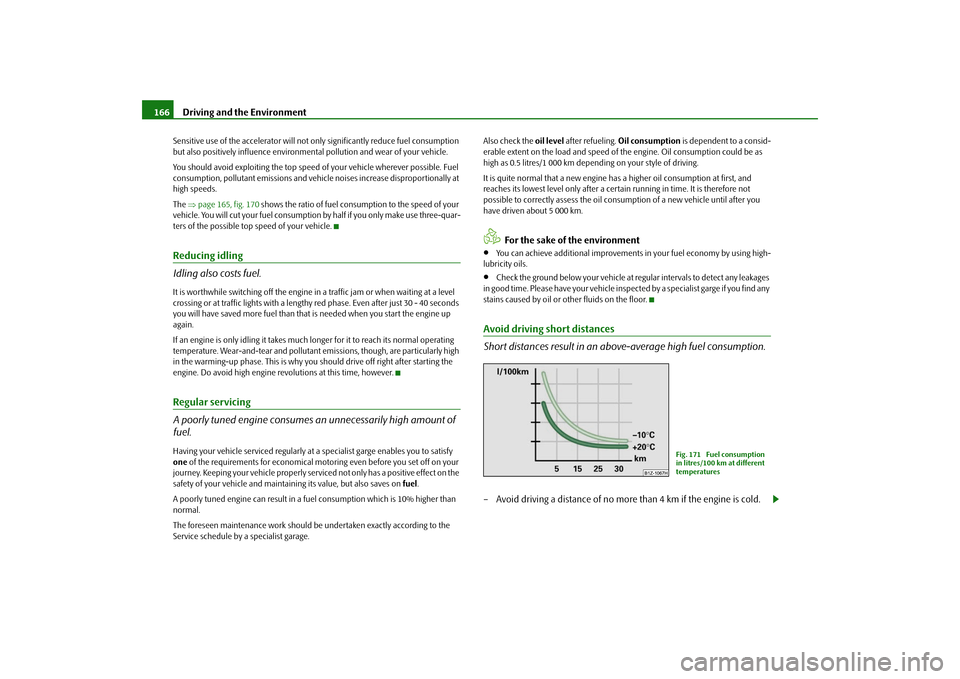
Short distances result in an above-average high fuel consumption.– Avoid driving a distance of no more than 4 km if the engine is cold.
Fig. 171 Fuel consumption
in litres/100 km at different
temperatures
s29g.4.book Page 166 Wednesday, June 17, 2009 9:54 AM
Page 168 of 263

Driving and the Environment167
Using the system
Safety
Driving Tips
General Maintenance
Breakdown assistance
Praktik
Technical Data The engine and catalytic converter must first have reached their optimal operating
temperature in order to effectively reduce fuel consumption and pollutant emis-
sions.
The cold engine vehicle consumes approx. 15 - 20 litres/100 km of fuel immediately
after starting. Fuel consumption drops to 10 litres/100 km after just 1 kilometre. The
engine reaches its operating temperature (outside temperature and engine
dependent) only after about 4 to 10 kilometres and the fuel consumption then
stabilizes. You should therefore avoid driving short distances whenever possible.
An important factor in this connection is also the ambient temperature. The
⇒page 166, fig. 171 shows the different fuel consumptions for the same distance,
on the one hand at +20°C and on the other hand at -10°C. Your vehicle has a higher
fuel consumption in winter than in summer.
Checking tyre inflation pressures
Tyres which are correctly inflated save fuel.Always ensure that your tyres are inflated to the correct pressure at all times. The
rolling resistance will be increased if the tyre filling pressure is too low. This will not
only increase fuel consumption but also tyre wear and the driving behaviour will
worsen.
Always check the inflation pressure of the tyres when cold.
Do not drive with winter tyres all year round for this costs about 10 % more fuel.
Winter tyres are also louder.No unnecessary ballast
Transporting ballast costs fuel.The fact that every kilogram of extra weight increases your fuel consumption
means that it is worth taking a look in the luggage compartment to avoid trans-
porting any unnecessary ballast.
It is par ticularly i n town tra ffi c, whe n one is accelerating quite often, that the vehicle
weight will have a significant effect upon the fuel consumption. A rule of thumb here is that an increase in weight of 100 kilograms will cause an increase in fuel
consumption of about 1 litre/100 kilometres.
You may frequently also leave a roof rack fitted on just out of convenience,
although you no longer need it. The increased aerodynamic drag of your vehicle
causes it to use about 1 l more fuel than normal at a speed of 100 - 120 km/h, even
when you are not carrying a load on the roof.
Saving electricity
Generating electricity costs fuel.– Switch off electrical components as soon as you no longer need them.When the engine is running, the alternator generates and supplies electrical power.
The greater the load on the alternator as a result of having a large number of elec-
trical components switched on, the more fuel will be consumed for operating the
alternator.Keeping a log of your fuel consumptionIf you really wish to keep a close check on your fuel consumption, it is best to enter
the figures in a logbook. This does not take much time but is a very worthwhile exer-
cise. It enables you to detect any change (positive and negative) at an early stage
and to take any appropriate action.
If you find that your fuel consumption is too high, you should reflect on how, where
and in what conditions you have driven the vehicle since you last refuelled.Environmental compatibilityEnvironmental protection has played a major role in the design, selection of mate-
rials and manufacture of your new Škoda. Particular emphasis has been paid to a
number of aspects, including:
s29g.4.book Page 167 Wednesday, June 17, 2009 9:54 AM
Page 169 of 263
Driving and the Environment 168Design measures•
Joints designed to be easily detached
•
Simplified disassembly due to the modular structure system
•
Improved purity of different classes of materials
•
Identification of all plastic parts in accordance with VDA Recommendation 260
•
Reduced fuel consumption and exhaust emission CO
2
•
Minimum fuel leakage during accidents
•
Reduced noise
Choice of materials
•
Extensive use of recyclable material
•
Air conditioning filled with CFC-free refrigerant
•
No cadmium
•
No asbestos
•
Reduction in the “vaporisation” of plastics
Manufacture
•
Solvent-free cavity protection
•
Solvent-free protection of the vehicle for transportation from the production
plant to the customer
•
The use of solvent-free adhesives
•
No CFCs used in the production process
•
Without use of mercury
•
Use of water-soluble paints
•
No use of hexavalent chromium
Trade-in and recycling of old cars
Škoda Auto meets the requirements of the brand and its products regarding envi-
ronment and ressource protection. All new Škoda vehicles can be utilized up to
95 % and always
7) be returned. In a lot of countries sufficient trade-in networks
have been created, where you can trade-in your vehicle. After you trade-in your vehicle, you will receive a confirmation stating the recycling in accordance with
environmental regulations.
Vehicles with special built-on types
Technical documents regarding changes carried out on the vehicle must be kept by
the vehicle user, in order to hand over later to the old car user. This ensures the
recycling in accordance with environmental regulations.
Note
Detailed information about the trade-in and recycling of old cars is available from
your Škoda Service Partner.Motoring abroadGeneral
Other circumstances may exist abroad.It is also possible, in certain countries, that the Škoda Service Partner network is
limited or has not been established yet. This is the reason why obtaining certain
spare parts may be somewhat complicated and specialist garage personnel may
o n l y b e a b l e t o m a ke l i m i te d re p a i rs . Š ko d a A u to i n t h e C z e c h R e pu b l i c a n d re l e v a n t
importers are happy to provide information about technical aspects of the vehicle,
required maintenance work and possibilities for getting repairs done.Unleaded petrolA vehicle fitted with a petrol engine must always be refuelled with unleaded petrol
⇒page 164. The automobile associations can provide you with information
regarding the locations of filling stations which offer unleaded petrol.
7)Subject to fulfilment of the national legal regulations.
s29g.4.book Page 168 Wednesday, June 17, 2009 9:54 AM
Page 171 of 263

Towing a trailer 170Towing a trailerTo w i n g a t r a i l e rTechnical requirements
The towing device must satisfy certain technical requirements.Your vehicle is designed primarily for transporting persons and luggage. It can,
however, also be used for towing a trailer - provided certain technical equipment is
fitted.
If your vehicle has been equipped with a towing device from Škoda Original Acces-
sories, then the towing device satisfies all technical and legal requirements.
Your vehicle is fitted with a 13-pin power socket for the electrical connection
between the vehicle and trailer. If the trailer which you wish to tow has a 7-pin
connector, you can use a suitable adapter
8) from Škoda original accessories.
This work must be carried out in accordance with the manufacturer's specifications
if a towing device is retrofitted.
Specialist garages are familiar with details relating to retrofitting a towing device
and for any necessary modifications to the cooling system.
WARNING
We recommend that you have the towing device from Škoda original acces-
sories installed by a specialist garage. He is familiar with all the relevant
details relating to retrofitting such equipment. There is a risk of an accident
if the towing device is not properly fitted!
General Maintenance
There are a number of points to pay attention to when towing a
trailer.Trailer load
The permissible trailer load must on no account be exceeded.
You can negotiate appropriately steeper inclines and descents if you do not make
full use of the permissible trailer load.
The trailer loads specified only apply for altitudes up to 1 000 metres above mean
sea level. On petrol engines without forced induction, the engine power output
drops with increasing height due to a lowering of air pressure and thus the ability to
climb, this means that the trailer load must be reduced by 10% for every further
increase of 1 000 metres in height above sea level. The towed weight is the weight
of the (laden) vehicle and the (laden) trailer together. One should take this into
account before driving up to higher altitudes. Petrol engines with forced induction
use an air pressure correction method, so that their power output does not depend
on the height above sea level.
The trailer and drawbar load information on the type plate of the towing
device are merely test data for the towing device The data relating to your
vehicle, which is often less than this test data, can be found in your vehicle
registration documents.
Distribution of the load
Distribute the load in the trailer in such a way that any heavy items are located as
close as possible to the axle. Secure the items to prevent them slipping.
Tyre pressure
Correct the tyre inflation pressure on your vehicle for that of “fully laden”,
⇒page 198. The inflation pressure of the tyres fitted to the trailer adjust in accord-
ance with the manufacturer's recommendation.
8)In some countries the adapter is supplied with the towing device.
s29g.4.book Page 170 Wednesday, June 17, 2009 9:54 AM
Page 172 of 263

Towing a trailer171
Using the system
Safety
Driving Tips
General Maintenance
Breakdown assistance
Praktik
Technical Data Exterior mirrors
You have to have additional exterior mirrors fitted if you are not able to see the
traffic behind the trailer with the standard rear-view mirrors. Both exterior mirrors
should be attached to folding arms. Adjust the mirrors so that they provide you with
an adequate field of view to the rear.
Headlights
Before starting off with a hitched trailer, also check the setting of the headlights.
Alter the setting as necessary with the aid of the headlight beam adjuster
⇒page 55.
Detachable ball head
The ball rod is detachable on vehicles with towing device and suppliable from
Škoda original accessories. It is stowed together with separate fitting instructions in
the spare wheel well in the luggage compartment of the vehicle.
Note
•
We recommend that you also have your vehicle inspected between service
intervals if you tow a trailer frequently.
•
The handbrake on the towing vehicle must be put on when coupling and
decoupling the trailer.
Driving Tips
Particular caution is required when towing a trailer.– Do not, as far as possible, drive with your vehicle unladen and the
trailer laden.
– Do not make full use of the legal maximum speeds. This applies in
particular to downhill sections.
– Apply the brakes in good time.
– Keep a check on the coolant temperature gauge if the outside temper-
ature is high.
Distribution of weight
The distribution of the weight is very poor if your vehicle is unladen and the trailer
is laden. Maintain a particularly low speed if you cannot avoid driving with this
combination.
Driving speed
Do not drive faster than 80 km/h for safety reasons. This also applies for countries
in which higher speeds are allowed.
The fact that the driving stability of the vehicle + trailer combination reduces with
increasing speed means that the legally allowed speed should not be used when
there are unfavourable road, weather or wind conditions, particularly near accident
black spots.
You must always reduce your speed immediately as soon as you detect even just
the slightest swaying of the trailer. On no account attempt to stop the trailer from
“swaying” by accelerating.
Apply the brakes in good time! If the trailer is fitted with a trailer brake, apply the
brakes gently at first and then brake firmly. This will avoid brake jolts resulting from
the trailer wheels locking. Shift down gears in good time before negotiating a down-
hill section to allow the engine to also act as a brake.
Engine overheating
Please keep a check on the coolant temperature gauge if you have to negotiate a
lengthy slope in a low gear at a high engine speed when the outside temperature is
very high ⇒page 19.
If the needle of the coolant temperature gauge moves into the right-hand area or
even the red area of the scale, reduce your speed immediately. Stop and switch off
the engine if the warning light
in the instrument cluster begins flashing. Wait a
few minutes and check the level of coolant in the coolant expansion bottle
⇒page 189, “Inspecting the coolant level”.
Please refer to the following guidelines ⇒page 32, “Coolant temperature/coolant
level ”.
The coolant temperature can be reduced by switching on the heating.
Any increase in the cooling effect of the coolant fan through shifting down a gear
and increasing the engine speed is not possible since the fan speed is independent
s29g.4.book Page 171 Wednesday, June 17, 2009 9:54 AM
Page 173 of 263
Towing a trailer 172of the engine speed. One should also not drop a gear for this reason when towing
a trailer as long as the engine can manage the slope without any drop in speed.s29g.4.book Page 172 Wednesday, June 17, 2009 9:54 AM
Page 178 of 263

Taking care of your vehicle and cleaning the vehicle177
Using the system
Safety
Driving Tips
General Maintenance
Breakdown assistance
Praktik
Technical Data
WheelsSteel wheels
You should also thoroughly wash the wheels and wheel trims when giving your
vehicle its regular wash. This prevents any brake dust, dirt and road salt from
sticking to the wheel hubs. You can remove stubborn brake abrasion adhering to
t h e w h e e l s w i t h a n i n d u s tr i a l c l e a n e r. To u c h u p a n y d a m a g e to t h e p a i n tw o r k o n th e
wheels before rust is able to form.
Light alloy wheels
Regular care of light alloy wheels is necessary in order to retain their decorative
appearance over long periods. It is particularly important to remove any road salt
and brake abrasion from light alloy wheels every two weeks, otherwise the surface
will suffer. Wash thoroughly and then treat the wheels with a protective product for
light alloy wheels which does not contain any acidic components. You should
provide the wheel hubs with a hard wax layer every three months. You must not use
any products which cause abrasion when treating the wheel hubs. Any damage to
the paint layer on the wheel hubs must be touched up immediately.
We recommend using a preservative from Škoda genuine accessories offered by
your Škoda dealer.
WARNING
One should remember when cleaning the wheels that moisture, ice and road
salt may adversely affect braking efficiency - risk of an accident!
Note
Severe layers of dirt on the wheels can also result in wheel imbalance. This may
show itself in the form of a wheel vibration which is transmitted to the steering
wheel which, in certain circumstances, can cause premature wear of the steering.
This means it is necessary to remove the dirt.
Underbody protectionThe underside of your vehicle is protected for life against chemical and mechanical
influences.
One cannot, however, completely rule out damage to the protective layer when
driving so we recommend that you inspect the protective layer on the underside of
your vehicle and on the chassis at certain intervals - this is best done at the begin-
ning and end of the winter - and to touch up any damaged areas.
Specialist garages have suitable spray products available as well as the necessary
equipment and are familiar with the instructions for use. Therefore, we recommend
you have such touch-up work or additional corrosion protection measures carried
out by a specialist garage.
WARNING
Never use additional underbody protection or corrosion-protection agents
for the exhaust pipes, catalytic converters, heat shields or diesel particle
filter*. When the engine reaches its operating temperature, these
substances might ignite - risk of fire!Protection of hollow spacesAll the cavities of your vehicle which are at risk from corrosion are protected for life
by a layer of protective wax applied in the factory.
This wax protection does not require to be inspected or re-treated. Please remove
any small amount of wax which flows out of the cavities at high temperatures with
a plastic scraper and clean the spot using petroleum cleaner.
WARNING
Safety and environmental protection regulations should observed when
using petroleum cleaner to remove wax - a risk of fire!
s29g.4.book Page 177 Wednesday, June 17, 2009 9:54 AM