2009 SKODA ROOMSTER steering
[x] Cancel search: steeringPage 160 of 263

Intelligent Technology159
Using the system
Safety
Driving Tips
General Maintenance
Breakdown assistance
Praktik
Technical Data
WARNING
•
Never switch off the engine before the vehicle is stationary.
•
The brake booster only operates when the engine is running. Greater
physical effort for braking is required when engine is switched off. Because
if you do not stop as normal, this can cause an accident and severe injuries.
Antilock brake system (ABS)*ABS prevents the wheels locking when braking.General
The ABS contributes significantly to enhancing the active safety of your vehicle.
Compared to a vehicle not fitted with the ABS brake system, you are able to retain
optimal steering ability even during a full brake application on a slippery road
surface because the wheels do not lock up.
You must not expect, however, that the braking distance will be shorter under all
circumstances as a result of the ABS. The braking distance for example on gravel
and fresh snow, when you should anyway be driving slowly and cautiously, will be
longer.
Operating principle
As soon as the vehicle speed has increased to about 20 km/hour an automatic test
procedure is conducted during which you will be able to hear a pumping noise for
about 1 second.
The brake pressure will be reduced on a wheel which is rotating at a speed which is
too low for the speed of the vehicle and tending to lock. This control cycle is notice-
able from a pulsating movement of the brake pedal which is accompanied by
noises. This is consciously intended to provide the driver with the information that
the wheels are tending to lock (ABS control range). You must always keep the brake
pedal depressed to enable the ABS to optimally control the brake application in this
braking range. Never interrupt the application of the brakes!
WARNING
•
The ABS can also not overcome the physical limits of your vehicle. Please
do not forget this, particularly when driving on icy or wet road surfaces. If the
ABS is operating within the control range, adapt your speed immediately to
the conditions of the road surface and the traffic situation. The increased
safety offered by the ABS must not tempt you to take greater risks than
otherwise - risk of an accident!
•
The normal braking system is still fully functional if there is an ABS fault.
Visit a specialist garage as quickly as possible and adjust your style of driving
to take account of the ABS fault in the meantime since you will not know the
extent of the fault and in how far the braking efficiency is affected.Note
•
A warning light comes on if a fault occurs in the ABS system
⇒page 35.
•
Changes to vehicle (e.g. on engine, on the brakes, on chassis or another combi-
nation of tyres and wheels) can influence the function of the ABS ⇒page 204,
“Accessories, changes and replacement of parts”.
Brake Assist*During a severe brake application (e.g. if a hazard exists), the Brake Assist increases
the braking force and thus makes it possible to rapidly produce the pressure
required in the brake system.
The majority of drivers do apply the brakes in good time in dangerous situations,
but do not depress the brake pedal with sufficient pressure. Consequently, it is not
possible for the vehicle to achieve its maximum deceleration and the vehicle covers
a greater distance than necessary.
The Brake Assist is activated by the very quick operation of the brake pedal. In such
cases, a much greater braking pressure exists than during a normal brake applica-
tion. This makes it possible, even with a relatively low resistance of the brake pedal,
to produce an adequate pressure in the brake system in the shortest possible time,
which is required for maximum deceleration of the vehicle. You must apply the
s29g.4.book Page 159 Wednesday, June 17, 2009 9:54 AM
Page 161 of 263
Intelligent Technology 160brake pedal firmly and hold it in this position in order to achieve the shortest
possible braking distance.
The Brake Assist is able to help you achieve a shorter braking distance in emergency
situations by rapidly producing the pressure required in the brake system. It fully
exploits the attributes of the ABS. After you release the brake pedal, the function of
the Brake Assist is automatically switched off and the brakes operate in the normal
way.
The Brake Assist is part of the ESP system. If a fault occurs in the ESP, the Brake Assist
function is also not available. Further information on the ESP ⇒page 155.
WARNING
•
The Brake Assist is also not able to overcome the physical limits of your
vehicle in terms of the braking distance required.
•
Adapt your speed to the conditions of the road surface and to the traffic
situation.
•
The increased safety offered by the Brake Assist must not tempt you to
take a greater safety risk than otherwise.
Electrohydraulic power steeringThe power steering enables you to steer the vehicle with less physical force.
The steering characteristics can be changed by a specialist garage.
You will place great stresses on the power steering system if the steering is turned
to full lock when the vehicle is stationary. Turning the steering to full lock in such a
situation will be accompanied by noises.
It is still possible to fully steer the vehicle if the power steering fails or if the engine
is not running (vehicle being towed in). The only difference is that greater physical
effort is required.
It is possible that the hydraulic pump of the power steering will not run due to the
low vehicle network voltage if the battery has gone flat and the engine must started
with the help off jump leads. This condition will be indicated by lighting up of the
warning light.The power steering operates again if the battery is charged to a specific range when
engine is running. It also operates again, if the engine can be started with its own
battery.
If there is a fault in the power steering, the warning light lights up in the instrument
cluster
⇒page 29.
Caution
Do not leave the steering at full lock for more than 15 seconds when the engine is
running - risk of damaging the power steering!
Note
Have the steering inspected as soon as possible by a specialist garage if there is a
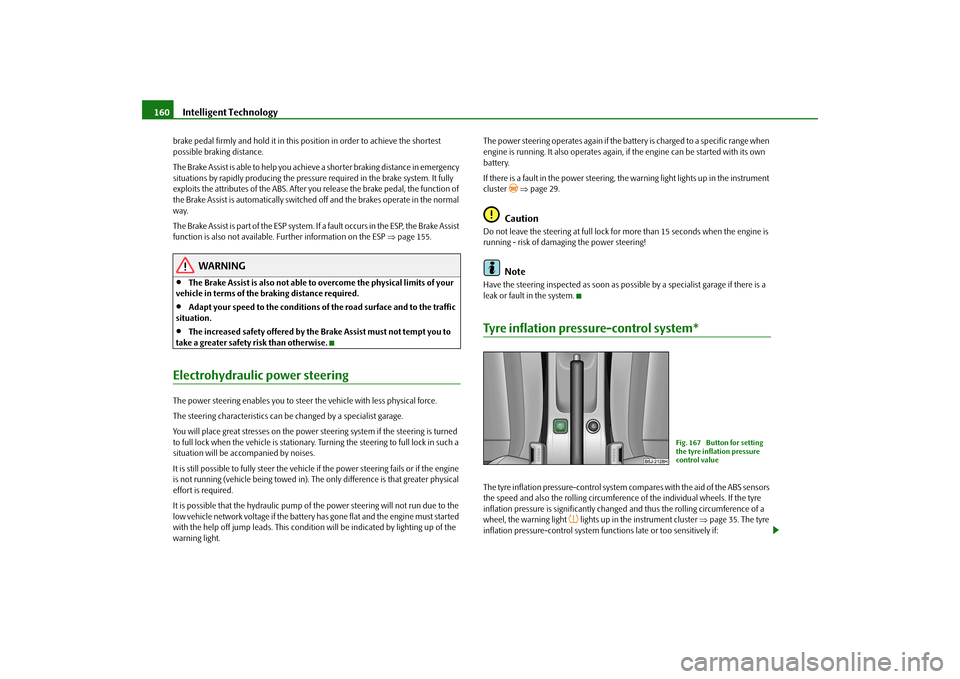
leak or fault in the system.Tyre inflation pressure-control system*The tyre inflation pressure-control system compares with the aid of the ABS sensors
the speed and also the rolling circumference of the individual wheels. If the tyre
inflation pressure is significantly changed and thus the rolling circumference of a
wheel, the warning light
lights up in the instrument cluster ⇒page 35. The tyre
inflation pressure-control system functions late or too sensitively if:
Fig. 167 Button for setting
the tyre inflation pressure
control value
s29g.4.book Page 160 Wednesday, June 17, 2009 9:54 AM
Page 162 of 263

Intelligent Technology161
Using the system
Safety
Driving Tips
General Maintenance
Breakdown assistance
Praktik
Technical Data
•
the structure of the tyre is damaged,
•
the vehicle is loaded to one side or with a load on the roof,
•
the wheels of an axle are loaded heavily (e.g. when towing a trailer or when
driving uphill or downhill),
•
the vehicle is operated in unfavourable winter conditions or on an unfirm
ground,
•
snow chains or emergency wheel are mounted,
•
the driver has a sporty style of driving (with sharp acceleration and high speed
when cornering).
Basic setting of tyre inflation pressure-control system
After changing the tyre inflation pressures or after changing one or several wheels,
a basic setting of the system must be carried out as follows.
•
Inflate all tyres to the specified inflation pressure ⇒page 198.
•
Switch on the ignition.
•
Press button
⇒page 160, fig. 167 for more than 2 seconds. While
pressing the button, the warning light
lights up. At the same time the basic
values are stored, which is confirmed with an acoustic sound and then the warning
light
goes out.
•
If the warning light
does not go out after the basic setting, there is a fault in
the system. Have the vehicle inspected by your nearest specialist garage.
Function description
After the basic setting of the system the “adaptation” of the tyre inflation pressures
and then the tyre pressure control in the individual tyres are performed.
Warning light
lights up
If the tyre inflation pressure of at least one wheel is insufficiently inflated in compar-
ison to the stored basic value, the warning light
⇒ lights up. Inflate all tyres
to the specified inflation pressure ⇒page 198, “Tyre life” and then perform a basic
setting of the system.
Warning light
flashes
If the warning light flashes, there is a system fault. Have the vehicle inspected by
your nearest specialist garage.
WARNING
•
When the warning light
lights up, immediately reduce the speed and
avoid sudden steering and brake manoeuvres. Please stop the vehicle
without delay at the nearest possible stop and inspect the tyres and their
inflation pressures.
•
The driver is responsible for the correct tyre inflation pressures. For this
reason, the tyre inflation pressures must be checked regularly.
•
Under certain circumstances (e.g. sporty style of driving, wintry or
unpaved roads) the warning light
can be delayed or does not light up at
all.
•
The tyre inflation pressure-control system does not take away the
responsability from the driver for the correct tyre inflation pressure.Note
The tyre inflation pressure-control system:•
does not replace the regular tyre inflation pressure control, because the system
cannot detect an even pressure loss;
•
cannot warn in case of very rapid tyre inflation pressure loss, e.g. in case of
sudden tyre damage. In this case carefully bring the vehicle to a standstill without
sudden steering movements and without sharp braking.
s29g.4.book Page 161 Wednesday, June 17, 2009 9:54 AM
Page 178 of 263

Taking care of your vehicle and cleaning the vehicle177
Using the system
Safety
Driving Tips
General Maintenance
Breakdown assistance
Praktik
Technical Data
WheelsSteel wheels
You should also thoroughly wash the wheels and wheel trims when giving your
vehicle its regular wash. This prevents any brake dust, dirt and road salt from
sticking to the wheel hubs. You can remove stubborn brake abrasion adhering to
t h e w h e e l s w i t h a n i n d u s tr i a l c l e a n e r. To u c h u p a n y d a m a g e to t h e p a i n tw o r k o n th e
wheels before rust is able to form.
Light alloy wheels
Regular care of light alloy wheels is necessary in order to retain their decorative
appearance over long periods. It is particularly important to remove any road salt
and brake abrasion from light alloy wheels every two weeks, otherwise the surface
will suffer. Wash thoroughly and then treat the wheels with a protective product for
light alloy wheels which does not contain any acidic components. You should
provide the wheel hubs with a hard wax layer every three months. You must not use
any products which cause abrasion when treating the wheel hubs. Any damage to
the paint layer on the wheel hubs must be touched up immediately.
We recommend using a preservative from Škoda genuine accessories offered by
your Škoda dealer.
WARNING
One should remember when cleaning the wheels that moisture, ice and road
salt may adversely affect braking efficiency - risk of an accident!
Note
Severe layers of dirt on the wheels can also result in wheel imbalance. This may
show itself in the form of a wheel vibration which is transmitted to the steering
wheel which, in certain circumstances, can cause premature wear of the steering.
This means it is necessary to remove the dirt.
Underbody protectionThe underside of your vehicle is protected for life against chemical and mechanical
influences.
One cannot, however, completely rule out damage to the protective layer when
driving so we recommend that you inspect the protective layer on the underside of
your vehicle and on the chassis at certain intervals - this is best done at the begin-
ning and end of the winter - and to touch up any damaged areas.
Specialist garages have suitable spray products available as well as the necessary
equipment and are familiar with the instructions for use. Therefore, we recommend
you have such touch-up work or additional corrosion protection measures carried
out by a specialist garage.
WARNING
Never use additional underbody protection or corrosion-protection agents
for the exhaust pipes, catalytic converters, heat shields or diesel particle
filter*. When the engine reaches its operating temperature, these
substances might ignite - risk of fire!Protection of hollow spacesAll the cavities of your vehicle which are at risk from corrosion are protected for life
by a layer of protective wax applied in the factory.
This wax protection does not require to be inspected or re-treated. Please remove
any small amount of wax which flows out of the cavities at high temperatures with
a plastic scraper and clean the spot using petroleum cleaner.
WARNING
Safety and environmental protection regulations should observed when
using petroleum cleaner to remove wax - a risk of fire!
s29g.4.book Page 177 Wednesday, June 17, 2009 9:54 AM
Page 192 of 263
Inspecting and replenishing191
Using the system
Safety
Driving Tips
General Maintenance
Breakdown assistance
Praktik
Technical Data
For the sake of the environment
Do not re-use coolant if it is necessary to drain the coolant in the system. It should
be collected and disposed of in compliance with environmental protection
regulations.Radiator fan
The radiator fan may switch on suddenly.The radiator fan is driven by an electric motor and controlled by a thermostat
according to the coolant temperature.
The radiator fan may continue running for up to 10 minutes after the engine has
been switched off - even if the ignition is also off. It may also switch on suddenly
after a certain time, if•
the coolant temperature has risen because of an accumulation of heat or
•
the warm engine compartment is heated up additionally by strong sunlight.
WARNING
You must therefore be aware when working in the engine compartment that
the fan may switch on suddenly - risk of injury!
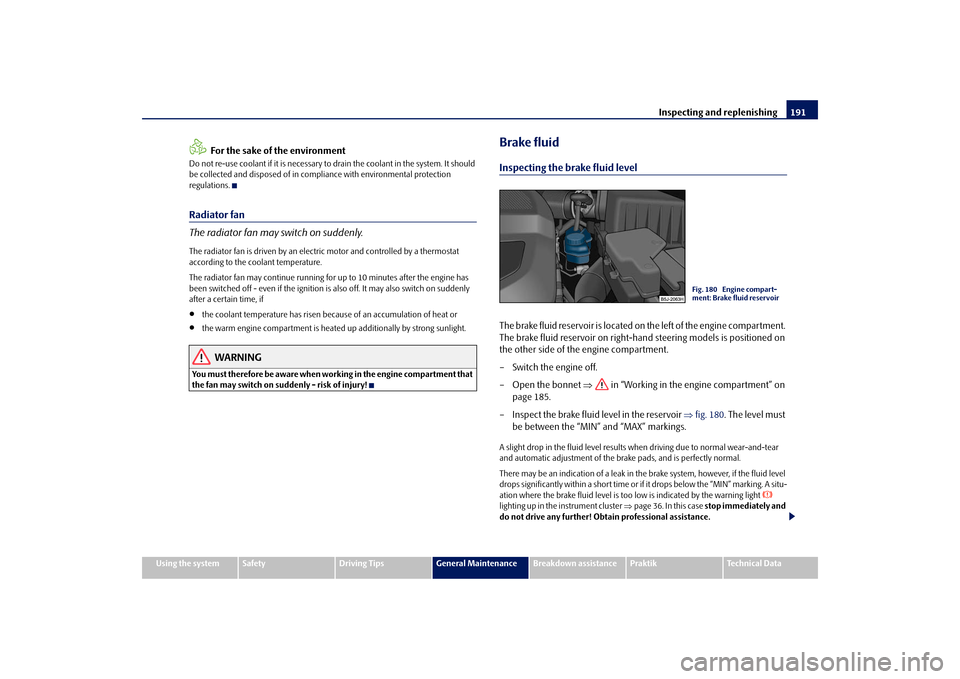
Brake fluidInspecting the brake fluid levelThe brake fluid reservoir is located on the left of the engine compartment.
The brake fluid reservoir on right-hand steering models is positioned on
the other side of the engine compartment.
– Switch the engine off.
– Open the bonnet ⇒ in “Working in the engine compartment” on
page 185.
– Inspect the brake fluid level in the reservoir ⇒fig. 180. The level must
be between the “MIN” and “MAX” markings.A slight drop in the fluid level results when driving due to normal wear-and-tear
and automatic adjustment of the brake pads, and is perfectly normal.
There may be an indication of a leak in the brake system, however, if the fluid level
drops significantly within a short time or if it drops below the “MIN” marking. A situ-
ation where the brake fluid level is too low is indicated by the warning light
lighting up in the instrument cluster ⇒page 36. In this case stop immediately and
do not drive any further! Obtain professional assistance.
Fig. 180 Engine compart-
ment: Brake fluid reservoir
s29g.4.book Page 191 Wednesday, June 17, 2009 9:54 AM
Page 200 of 263

Wheels and Tyres199
Using the system
Safety
Driving Tips
General Maintenance
Breakdown assistance
Praktik
Technical Data setting off on a long trip. Please do not forget the spare wheel when checking the
tyres.
The tyre inflation pressures for summer tyres are indicated on the inside of the fuel
filler flap ⇒page 198, fig. 185. The inflation pressures for winter tyres are 20 kPa
(0.2 bar) higher than those for summer tyres ⇒page 202.
The tyre pressure should be at the highest pressure specified for your vehicle at all
times.
Always check the inflation pressure of tyres when cold. Do not reduce the higher
pressure of warm tyres. Adapt the inflation pressure of the tyres accordingly if your
vehicle is carrying a significantly higher payload.
Driving style
Fast cornering, sharp acceleration and braking (squealing tyres) increase wear-and-
tear on your tyres.
Balancing wheels
The wheels of a new vehicle are balanced. There are a wide range of influences
when driving which may result in an imbalance and which makes themselves felt
through vibration in the steering.
You should have the wheels rebalanced since any imbalance increases wear-and-
tear on the steering, the suspension and tyres. A wheel must also be rebalanced
when a new tyre is fitted and each time a tyre is repaired.
Wheel alignment errors
Incorrect wheel alignment at the front and rear will not only increase wear-and-tear
on the tyres but will also has an adverse effect on vehicle safety. Contact your
specialist garage if you notice any unusual tyre wear.
WARNING
•
If the inflation pressure is too low, the tyre must perform a greater flexing
work. At higher speeds the tyre will warm up as a result of this. This can
result in tread separation and even a tyre blowout.
•
Immediately replace the damaged rims or tyres.
•
Tyres which are 6 years old or more should only be fitted in exceptional
cases and when adopting an appropriately cautious style of driving.For the sake of the environment
Tyres which are insufficiently inflated increase your fuel consumption.Wear indicatorsThe base of the tread of the original tyres has wear indicators 1.6 mm high, installed
at right angles to the direction of travel. These wear indicators are located at 6 - 8
points depending on the make and are evenly spaced around the circumference of
the tyre ⇒fig. 186. Markings on the walls of the tyres through the letters “TWI”,
triangular symbols or other symbols identify the position of the wear indicators.
A remaining tread of just 1.6 mm, measured in the grooves of the tread next to the
wear indicators, means that your tyres have reached their legally permissible
minimum tread depth.
WARNING (continued)
Fig. 186 Tyre tread with wear
indicators
s29g.4.book Page 199 Wednesday, June 17, 2009 9:54 AM
Page 216 of 263

Breakdown assistance215
Using the system
Safety
Driving Tips
General Maintenance
Breakdown assistance
Praktik
Technical Data
Tow-starting and towing vehicleGeneralPlease pay attention to the following instructions if you are going to use a
tow rope:
Driver of the towing vehicle
– Do not drive off until the tow rope is taught.
– Release the clutch particularly gently when starting off.
Driver of the towed vehicle
– Switch the ignition on so that the steering wheel is not blocked and
you can also operate the turn signal lights, the headlight flasher, the
windscreen wipers and windscreen washer system.
– Take the vehicle out of gear or move the selector lever into position N
if your vehicle is fitted with an automatic gearbox.
– Note that the brake servo unit and power steering only operate if the
engine is running. You will require significantly greater physical force
to depress the brake pedal and to steer the vehicle if the engine is not
running.
– Ensure that the tow rope is always kept taught.Tow rope or tow bar
A tow bar is safest way of towing a vehicle and also minimizes any shocks. You can
use a tow rope only if a suitable tow bar is not available.
The tow rope must be elastic to protect the vehicle. Thus one should only use
plastic fibre rope or a rope made out of a similarly elastic material.
Attach the tow rope or the tow bar only to the towing eyes provided for this
purpose ⇒page 215, “Front towing eye” and ⇒page 216, “Rear towing eye”.Driving style
Towing another vehicle requires a certain amount of practice. Both drivers should
be familiar with the particular points about towing a vehicle. Unskilled drivers
should not attempt to tow in another vehicle or to be towed in.
One should be constantly vigilant not to allow impermissibly high towing forces or
jerky loadings. There is always a risk of excessive stresses and damage resulting at
the points to which you attach the tow rope or tow bar when you attempt to tow a
vehicle which is not standing on a paved road.
Caution
If the gearbox of your vehicle no longer contains any oil because of a defect, your
vehicle must only be towed in with the driven wheels raised clear of the ground, or
on a special vehicle transporter or trailer.
Note
•
Please comply with any legal requirements particularly regarding the switched
on signal systems, when towing in or tow-starting another vehicle.
•
The tow rope must not be twisted as it may in certain circumstances result in the
front towing eye being unscrewed out of your vehicle.
Front towing eye
The towing eye is stored in the box for the vehicle tool kit.
Fig. 196 Front bumper:
Protective grille
s29g.4.book Page 215 Wednesday, June 17, 2009 9:54 AM
Page 220 of 263

Fuses and light bulbs219
Using the system
Safety
Driving Tips
General Maintenance
Breakdown assistance
Praktik
Technical Data
Note
We recommend that you have these fuses replaced by a specialist garage.Fuse assignment in the dash panelCertain electrical components are only standard on certain vehicle model versions
or only suppliable as optional equipment for certain models.
Fig. 200 Schematic repre-
sentation of the fuse boxFig. 201 Schematic repre-
sentation of the fuse box for
vehicles with right-hand
steering.
No.
Power consumer
Amperes
1
Not assigned
2
Not assigned
3
Instrument cluster, headlight range adjustment
5
4
ABS control unit
5
5
Petrol engine: Brake light switch, cruise control system
5
6
Not assigned
7
Engine control unit 1.2 ltr.
15
8
Injection valves - 1.4 ltr.; 1.6 ltr.
10
9
Operating controls for the heating, control unit for air condi-
tioning system, parking aid, control unit for cornering lights
5
10
Not assigned
11
Electrically adjustable rear mirror, power windows
7,5
12
Reversing light
7,5
13
Engine control unit (for vehicles with automatic gearbox)
10
14
Motor for cornering lights
10
15
Navigation PDA
5
16
Electrohydraulic power steering, engine control unit - petrol
engine
5
17
Left parking light, licence plate light
5
18
Right parking light
5
19
Radio, central control unit
5
20
Engine control unit 1.4 ltr.; 1.9 ltr. - diesel engine
5
21
Brake lights
10
22
Operating controls for the heating, control unit for air condi-
tioning system, parking aid, mobile phone, instrument clus-
ter, steering angle sender, ESP, vehicle voltage control unit
7,5
s29g.4.book Page 219 Wednesday, June 17, 2009 9:54 AM