2009 SKODA ROOMSTER heating
[x] Cancel search: heatingPage 66 of 263

Seats and Storage65
Using the system
Safety
Driving Tips
General Maintenance
Breakdown assistance
Praktik
Technical Data
– Move the head restraint downwards if required by pressing the locking
button ⇒fig. 62 and by pressing with the other hand the head
restraint downwards.
Removing and installing a head restraint
– Pull the head restraint out of the seat backrest as far as the stop.
– Press the locking button in the direction of arrow ⇒fig. 62 and pull
the head restraint out.
– To re-insert the head restraint, push it down into the seat backrest far
enough until you hear the locking button engage.The position of the front, rear outer head restraints and the rear middle head
restraint* is adjustable for height.
The head restraints must be adjusted to match the size of the seat occupant.
Correctly adjusted head restraints together with the seat belts offer effective
protection for the occupants ⇒page 128.
WARNING
•
The head restraints must be correctly adjusted in order to offer effective
protection for the occupants in the event of an accident.
•
Do not drive under any circumstance with removed head restraints - risk
of injury!
Heating the front seats*The seating and leaning surfaces of the driver and front passenger seat
can be heated when the ignition is switched on.
Front seats
– By pressing the rocker switch in the position or switch on the
front seat heating to 25 % or 100 % of its power output ⇒fig. 63.
– To switch off the heating shift the rocker switch into the horizontal
position.
WARNING
•
If, as an occupant, you have a subdued pain and/or temperature sensi-
tivity, e.g. through medication, paralysis or because of chronic illness (e.g.
diabetes), we recommend not to use the seat heating of the driver or front
passenger seat. This can lead to burns on the back, the posterior and the legs
which are difficult to heal. If the seat heating is used, we recommend to make
regular breaks in your journey when driving long distances, so that the body
can recuperate from the stress of the journey. Please consult your doctor,
who can evaluate your specific condition.
Fig. 63 Rocker switch: Front
seat heatingA1
A2
s29g.4.book Page 65 Wednesday, June 17, 2009 9:54 AM
Page 67 of 263
Seats and Storage 66•
Do not use the seat heating if objects are fastened or stored on a seat for
example a child seat, a bag etc. A fault in the system of the seat heating can
occur.Caution
•
You should not kneel on the seats or otherwise apply pressure at specific points
in order to avoid damaging the heating elements of the seat heaters.
•
Do not clean the seats moist ⇒page 178.Note
The seat heating should only be switched on when the engine is running. This has
a significant effect of saving on the battery capacity.Rear seatsAdjusting seats in forward/back direction
To enlarge the luggage compartment, the outer rear seats can be pushed
forwards, folded fully forwards or the seats can be removed.
Moving seats in forward/back direction
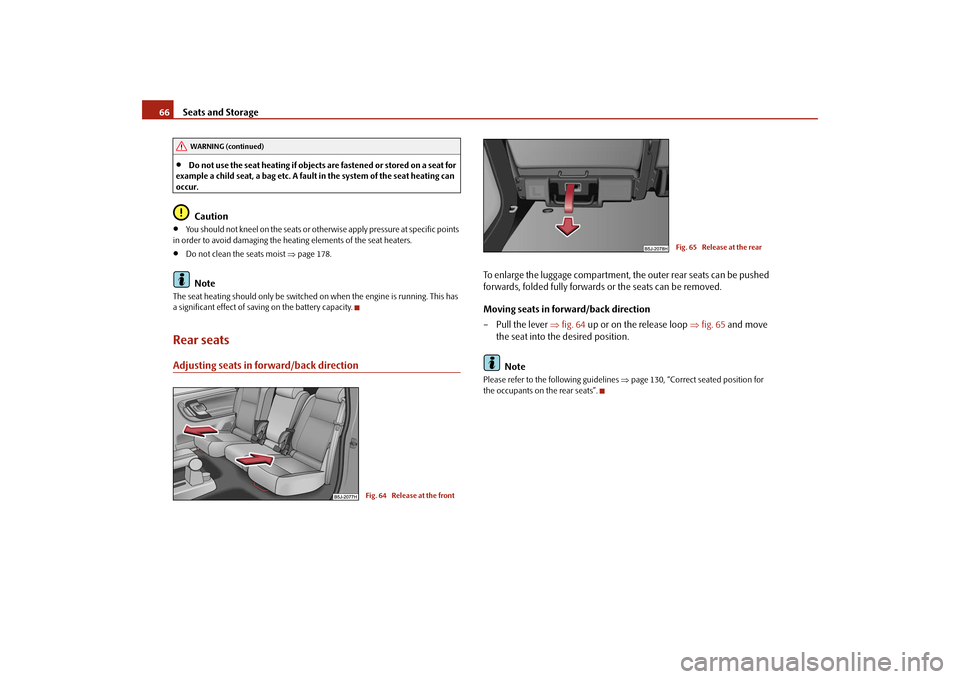
– Pull the lever ⇒fig. 64 up or on the release loop ⇒fig. 65 and move
the seat into the desired position.
NotePlease refer to the following guidelines ⇒page 130, “Correct seated position for
the occupants on the rear seats”.
WARNING (continued)
Fig. 64 Release at the front
Fig. 65 Release at the rear
s29g.4.book Page 66 Wednesday, June 17, 2009 9:54 AM
Page 72 of 263

Seats and Storage71
Using the system
Safety
Driving Tips
General Maintenance
Breakdown assistance
Praktik
Technical Data
•
On no account exceed the permissible axle loads and the permissible
gross weight of the vehicle - risk of accident!
•
Never transport occupants in the luggage compartment.Caution
Please ensure that the heating elements of the rear window heater are not
damaged as a result of objects sliding in this area.
Note
•
Tyre pressure must be adjusted to the load ⇒page 198, fig. 185.
•
The circulation of air in the vehicle helps to prevent the windows from misting
up. The used air streams out through the air venting slits which are located under
the bumper in the luggage compartment. Check for yourself that the air venting slits
are not covered.
Fastening elementsEyes are located on the sides of the loading area for lashing the goods to be loaded
⇒fig. 74.You can also attach fixing nets* to these eyes for lashing small objects.
The fixing nets* and the installation instruction are located in the luggage compart-
ment.
WARNING
•
The load to be transported must be fixed in place in such a way that it
cannot move during the journey and when braking.
•
If the items of luggage or objects are attached to the lashing eyes with
unsuitable or damaged lashing straps, injuries can occur in the event of
braking manoeuvres or accidents. In order to prevent the items of luggage
being thrown forward, always use suitable lashing straps which are firmly
attached to the lashing eyes. Never attach a child seat to the lashing eyes!
Folding hooksFolding hooks for attaching small items of luggage, such as bags etc., are provided
on both sides of the luggage compartment ⇒fig. 75.
An item of luggage weighing up to 10 kg can be attached to the hook.
WARNING (continued)
Fig. 74 Luggage compart-
ment: Lashing eyes and
fastening elements
Fig. 75 Luggage compart-
ment: folding hooks
s29g.4.book Page 71 Wednesday, June 17, 2009 9:54 AM
Page 74 of 263

Seats and Storage73
Using the system
Safety
Driving Tips
General Maintenance
Breakdown assistance
Praktik
Technical Data
The luggage compartment cover can be removed as required if one must
transport bulky goods.
– Unhook the support straps on the boot lid ⇒page 72, fig. 78.
– Slightly raise the luggage compartment cover.
– Remove the luggage compartment cover from the holder by
pulling to the rear or with adequate blows to the bottom side of the
cover.
– Install again by pushing the luggage compartment cover forwards into
the holder and hanging the support straps on the boot lid.The luggage compartment cover can also be put into the lower position on the
supporting elements ⇒fig. 79.
The procedure of installing or removing is identical.
The luggage compartment cover is foreseen for storage of small objects of up to 2.5
kg. in weight.
WARNING
No objects should be placed on the luggage compartment cover, the vehicle
occupants could be endangered if there is sudden braking or the vehicle
collides with something.
Caution
Please ensure that the heating elements of the rear window heater are not
damaged as a result of objects placed in this area.
Note
When opening the boot lid, lift the luggage compartment cover - risk that objects
placed in this area can slip forward!Static separation net*
Fig. 79 Luggage compart-
ment cover in the lower posi-
tionA1
A2
A2
A1
Fig. 80 Use of the static
separation net behind the
rear seatsFig. 81 Use of the static
separation net behind the
front seats
s29g.4.book Page 73 Wednesday, June 17, 2009 9:54 AM
Page 85 of 263
Seats and Storage 84•
Ensure that when driving no objects from the centre console of from
other storage possibilities may get into the footwell of the driver. You would
then no longer be able to apply the brakes, operate the clutch or accelerator
- risk of accident!
Storage compartments on the front passenger side*On some vehicles, the storage compartments are not equipped with lids.
Opening and closing the storage compartments on the front
passenger side
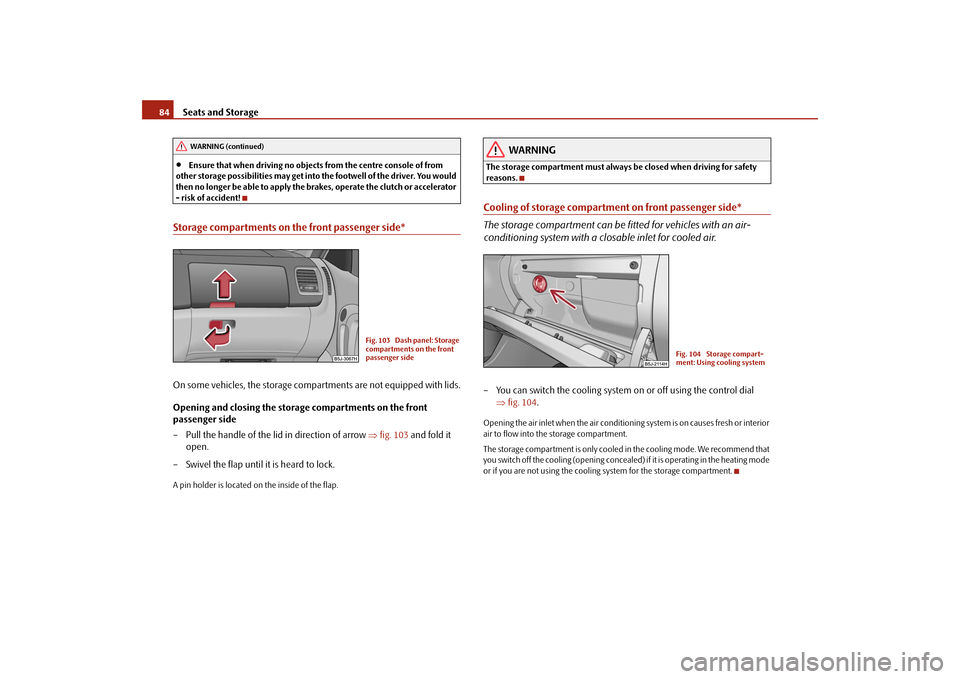
– Pull the handle of the lid in direction of arrow ⇒fig. 103 and fold it
open.
– Swivel the flap until it is heard to lock.A pin holder is located on the inside of the flap.
WARNING
The storage compartment must always be closed when driving for safety
reasons.Cooling of storage compartment on front passenger side*
The storage compartment can be fitted for vehicles with an air-
conditioning system with a closable inlet for cooled air.– You can switch the cooling system on or off using the control dial
⇒fig. 104.Opening the air inlet when the air conditioning system is on causes fresh or interior
air to flow into the storage compartment.
The storage compartment is only cooled in the cooling mode. We recommend that
you switch off the cooling (opening concealed) if it is operating in the heating mode
or if you are not using the cooling system for the storage compartment.
WARNING (continued)
Fig. 103 Dash panel: Storage
compartments on the front
passenger side
Fig. 104 Storage compart-
ment: Using cooling system
s29g.4.book Page 84 Wednesday, June 17, 2009 9:54 AM
Page 90 of 263

Heating and air conditioning system89
Using the system
Safety
Driving Tips
General Maintenance
Breakdown assistance
Praktik
Technical Data
Heating and air conditioning systemAir outlet ventsFig. 114 Air outlet ventsOpen air outlet vents
– Turn the rotary knob into the upper position.
Close air outlet vents
– Turn the rotary knob into the lower position.
Redirecting air flow
– The horizontal as well as the vertical direction of the air flow is set with
the handle in the middle of the air outlet vents.You can set the air supply to the individual vents with the air distribution control
⇒page 90, fig. 115. Air outlet vents 3 and 4 can also be opened or closed individ-
ually.
Unwarmed or cooled air will flow out of the opened air outlet vents according to
the setting of the control dial ⇒page 90, fig. 115 and according to atmospheric
conditions.
Recirculated air modeIn recirculated air mode air is sucked out of the interior of the vehicle
and then fed back into the interior.Recirculated air mode prevents polluted air outside the vehicle from
getting into the vehicle, for example when driving through a tunnel or
when standing in a traffic jam.
Switching recirculated air mode on
– Press button , the button symbol
lights up ⇒page 90, fig. 115.
Switching recirculated air mode off
– Press button again, the button symbol
goes out.
The recirculated air mode is switched off automatically if the air distribution control
is in position
⇒page 90, fig. 115. You can also switch recirculated air mode
on again from this setting by repeatedly pressing button .
WARNING
You should not leave recirculated air mode on over a longer period of time,
as “stale” air may result in fatigue in the driver and occupants, divert your
attention and also cause the windows to mist up. The risk of having an acci-
dent increases. Switch recirculated air mode off as soon as the windows
begin misting up.
AC
AA
AC
s29g.4.book Page 89 Wednesday, June 17, 2009 9:54 AM
Page 91 of 263
Heating and air conditioning system 90HeatingUsing the system
The heating system delivers air into the interior of the vehicle and
warms it as required.Setting temperature
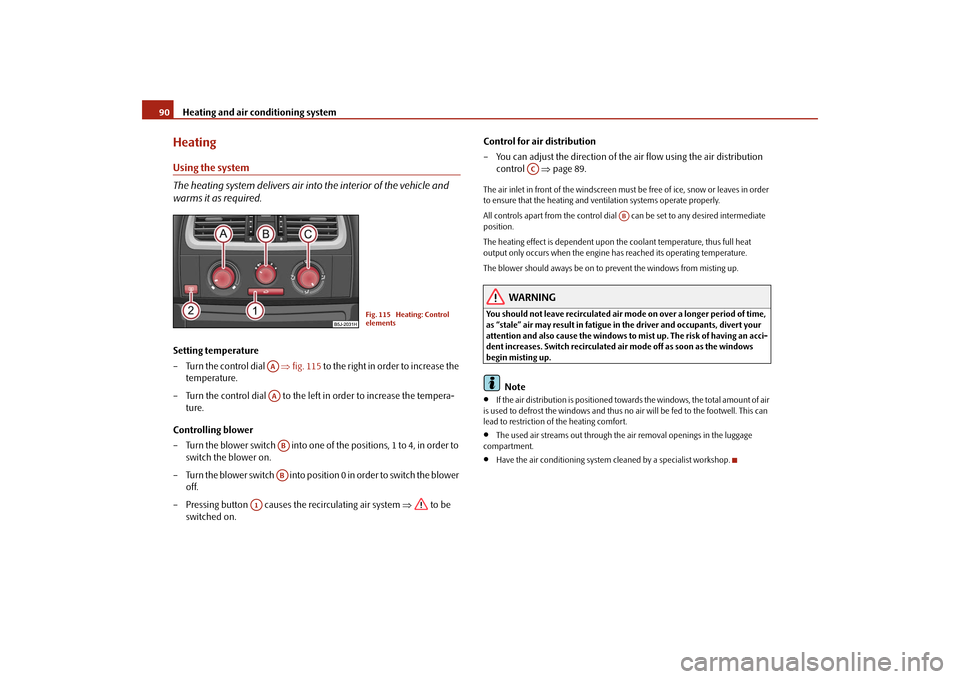
– Turn the control dial ⇒fig. 115 to the right in order to increase the
temperature.
– Turn the control dial to the left in order to increase the tempera-
ture.
Controlling blower
– Turn the blower switch into one of the positions, 1 to 4, in order to
switch the blower on.
– Turn the blower switch into position 0 in order to switch the blower
off.
– Pressing button causes the recirculating air system ⇒ to be
switched on.Control for air distribution
– You can adjust the direction of the air flow using the air distribution
control ⇒page 89.
The air inlet in front of the windscreen must be free of ice, snow or leaves in order
to ensure that the heating and ventilation systems operate properly.
All controls apart from the control dial can be set to any desired intermediate
position.
The heating effect is dependent upon the coolant temperature, thus full heat
output only occurs when the engine has reached its operating temperature.
The blower should aways be on to prevent the windows from misting up.
WARNING
You should not leave recirculated air mode on over a longer period of time,
as “stale” air may result in fatigue in the driver and occupants, divert your
attention and also cause the windows to mist up. The risk of having an acci-
dent increases. Switch recirculated air mode off as soon as the windows
begin misting up.
Note
•
If the air distribution is positioned towards the windows, the total amount of air
is used to defrost the windows and thus no air will be fed to the footwell. This can
lead to restriction of the heating comfort.
•
The used air streams out through the air removal openings in the luggage
compartment.
•
Have the air conditioning system cleaned by a specialist workshop.
Fig. 115 Heating: Control
elements
AAAAABAB
A1
AC
AB
s29g.4.book Page 90 Wednesday, June 17, 2009 9:54 AM
Page 92 of 263

Heating and air conditioning system91
Using the system
Safety
Driving Tips
General Maintenance
Breakdown assistance
Praktik
Technical Data
Set heatingRecommended settings of heating controls for:
Set-up
Setting of the control dial
Button
Air outlet vents 3
Air outlet vents 4
Defrosting the windscreen and
side windows
up to the stop
towards the right
3
do not switch on
close
open and align with the side
window
Free windscreen and side win-
dows from mist
desired tempera-
ture
2 or 3
do not switch on
close
open and align with the side
window
the fastest heating
up to the stop
towards the right
3
briefly switched on
open
open
comfortable heating
desired tempera-
ture
2 or 3
do not switch on
close
open
Fresh air mode - ventilation
up to the stop
towards the left
desired position
do not switch on
open
open
A1
AA
AB
AC
s29g.4.book Page 91 Wednesday, June 17, 2009 9:54 AM