2009 SKODA OCTAVIA TOUR fuel
[x] Cancel search: fuelPage 76 of 224

Seats and Storage
75
Using the system
Safety
Driving Tips
General Maintenance
Breakdown assistance
Technical Data
Removing and installing net partition housingRemoving – Fold the rear seats forwards
⇒
page 65
– Open the right rear door. – Push the net partition housing in the direction of arrow up to
the stop and take it out of the mounts
of the seat backrest in direction
of arrow .
Installing – Position the net partition housing into the mounts of the rear seat
backrests.
– Push the net partition housing in the opposite direction of arrow
as far as the stop.
– Fold the rear seats back into its original position.
The roof rack*DescriptionPay attention to the following points if yo
u wish to transport luggage or other items
on the roof of your vehicle:•
A special roof luggage rack system was
developed for the vehicle, that is why
you should only use a roof luggage rack
which has been released for use by Škoda
Auto.•
The base carrier is the basis for a comple
te roof luggage rack system. Separate
additional holders are required for safety reasons for transporting luggage, bikes, surfboards, skis and boats.•
The basic version of the roof luggage rack system and further components are
obtainable as accessories from the specialist garages.
Caution
•
If you use other roof rack sy
stems or if the roof bars are not properly fitted, then
any damage which may result to your ca
r is not covered by the warranty agree-
ments. It is therefore essential to pay attention to the fitting instructions supplied with the roof luggage rack system.•
On models fitted with a power sliding/tilting roof, ensure that the opened
sliding/tilting roof does not strike any items of luggage transported on the roof.•
Ensure that the opened boot lid does not collide with the roof load.For the sake of the environment
The increased aerodynamic drag results in
a higher fuel consumption. One should
therefore take off the roof bar system after use.
Note
A roof rail is obtainable from a specialist garage if hasn't been fitted onto an estate car at the works, which carries
out the professional fitting.
Fig. 84 Rear seats: Net parti- tion housing
AB
A1
A2
A1
s2g8.b.book Page 75 Tuesday, April 7, 2009 8:53 AM
Page 89 of 224

Heating and air conditioning system
88
Recirculated air mode In recirculated air mode air is sucked
out of the interior of the vehicle
and then fed back into the interior.Recirculated air mode prevents polluted air outside the vehicle from getting into the vehicle, for example when driving through a tunnel or when standing in a traffic jam. Switching recirculated air mode on – Press the button
⇒
page 86, fig. 101
- the warning light lights up
in the button.
Switching recirculated air mode off – Press again the button - the warning light in the button goes out.The button cannot be pressed if the control dial is in the position
or close
to this position.
WARNING
You should not leave recirculated air mode on over a longer period of time, as “stale” air may result in fatigue in the driver and occupants, divert your attention and also cause the windows to mist up. The risk of having an acci-
dent increases. Switch recirculated air mode off as soon as the windows begin misting up.Using the air conditioning system economicallyThe compressor on the air co
nditioning system uses po
wer from the engine when
in cooling mode which will effect the fuel consumption. It recommended to open the windows or the doors of a vehicle for which the inte- rior has been strongly heated through the ef
fect of direct sunlight in order to allow
the heated air to escape. The cooling system should not be switched on while travelling when the window is open. The desired interior temperature can also be achieved without switching in the cooling system just by switching to fresh air mode.
For the sake of the environment
When you economize on fuel, you also reduce pollutant emissions.
the fastest cooling
To the left up to
the stop
briefly 4, then
2or 3
switched on
briefly switched on
Opening
Opening
optimal cooling
Desired temper-
ature
1, 2 or 3
switched on
Do not switch on
Opening
Opening
Fresh air mode - ventilation
To the left up to
the stop
Desired posi-
tion
Switched off
Do not switch on
Opening
Opening
Set-up
Setting of the control dial
Button
Air outlet vents 3
Air outlet vents 4
AA
AB
AC
AD
AE
AC
WARNING (continued)
s2g8.b.book Page 88 Tuesday, April 7, 2009 8:53 AM
Page 95 of 224
Starting-off and Driving
94
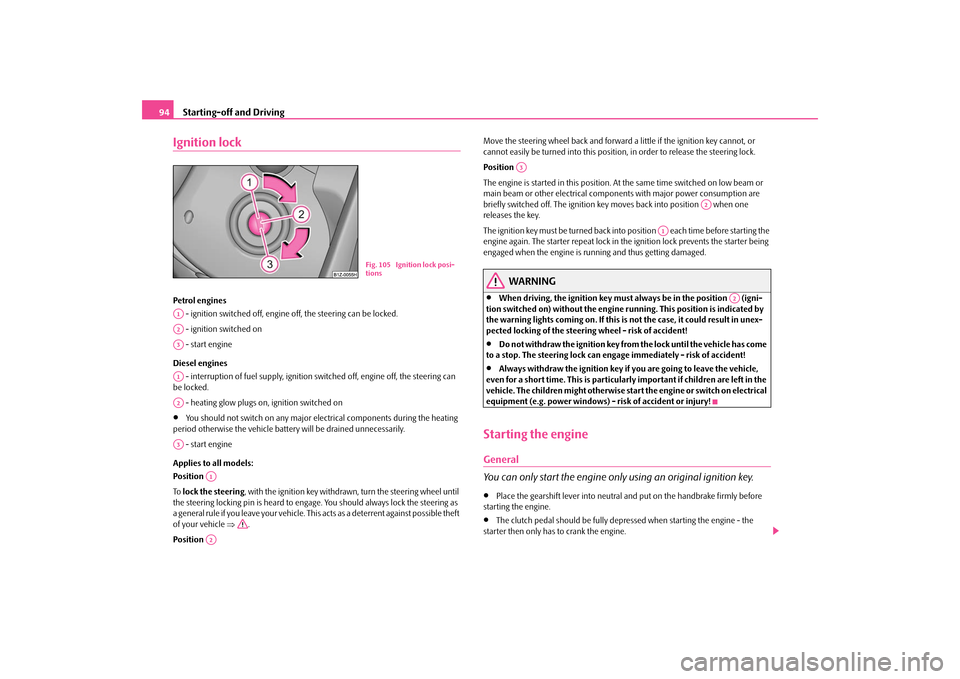
Ignition lockPetrol engines - ignition switched off, engine
off, the steering can be locked.
- ignition switched on - start engine Diesel engines - interruption of fuel supply, ignition sw
itched off, engine off, the steering can
be locked. - heating glow plugs on, ignition switched on•
You should not switch on any major elec
trical components during the heating
period otherwise the vehicle batt
ery will be drained unnecessarily.
- start engine Applies to all models: Position
To lock the steering
, with the ignition key withdrawn, turn the steering wheel until
the steering locking pin is heard to engage. You should always lock the steering as a general rule if you leave your
vehicle. This acts as a deterrent against possible theft
of your vehicle
⇒
.
Position
Move the steering wheel back and forward a little if the ignition key cannot, or cannot easily be turned into
this position, in order to
release the steering lock.
Position
The engine is started in this position. At
the same time switched on low beam or
main beam or other electrical compon
ents with major power consumption are
briefly switched off. The ignition key
moves back into position when one
releases the key. The ignition key must be turned back into position each time before starting the engine again. The starter repeat lock in th
e ignition lock prevents the starter being
engaged when the engine is r
unning and thus getting damaged.
WARNING
•
When driving, the ignition key must always be in the position (igni-
tion switched on) without the engine running. This position is indicated by the warning lights coming on. If this is not the case, it could result in unex- pected locking of the steerin
g wheel - risk of accident!
•
Do not withdraw the ignition key from the lock until the vehicle has come
to a stop. The steering lock can en
gage immediately - risk of accident!
•
Always withdraw the ignition key if
you are going to leave the vehicle,
even for a short time. This is particularly important if children are left in the vehicle. The children might
otherwise start the engine
or switch on electrical
equipment (e.g. power windows) - risk of accident or injury!Starting the engineGeneral You can only start the engine only using an original ignition key.•
Place the gearshift lever into neutral an
d put on the handbrake firmly before
starting the engine.•
The clutch pedal should be fully depr
essed when starting the engine - the
starter then only has to crank the engine.
Fig. 105 Ignition lock posi- tions
A1A2A3A1A2A3
A1A2
A3
A2
A1
A2
s2g8.b.book Page 94 Tuesday, April 7, 2009 8:53 AM
Page 96 of 224
Starting-off and Driving
95
Using the system
Safety
Driving Tips
General Maintenance
Breakdown assistance
Technical Data
•
Let go of the key as soon as the engine starts otherwise there may be damage
to the starter. The engine running noises may louder at
first be louder for
a short time after
starting the cold engine until oil pressure
can be built up in the hydraulic valve
clearance compensation. This is quite normal and is not an operating problem. If the engine does not start ... You can use the battery of anothe
r vehicle as a jump-start aid
⇒page 188.
It is only possible to tow-start vehicl
es fitted with a manual gearbox. The tow-
starting distance must not be more than 50 metres
⇒page 191.
WARNING
•
Never run the engine in non ventilat
ed or enclosed areas. The exhaust
gases of the engine contain besides
the odorless and colourless carbon
monoxide a poisonous gas - hazard! Carbon monoxide can cause uncon- sciousness and death.•
Never leave your vehicle unattended with the engine running.Caution
•
The starter may only be operated (ignition key position ), if the engine is not
running. If the starter is immediately oper
ated after switching off the engine, the
starter or the engine can be damaged.•
Avoid high engine revolutions, full throttle and high engine loads as long as the
engine has not yet reached its normal oper
ating temperature - risk of damaging the
engine!•
Vehicles which are fitted wi
th an exhaust gas catalyti
c converter should not be
tow-started over a distance of more than 50 metres.
For the sake of the environment
Never warm up the engine when the vehi
cle is standing. Drive off right away.
Through this the engine reaches its operating temperature more rapidly and the pollutant emissions are lower.
Petrol enginesThese engines are fitted with a starter system which selects the correct fuel-air mixture for every external air temperature.•
Do
not depress
accelerator before and when starting engine.
•
Interrupt the attempt at starting after
10 seconds if the engine does not start
right awayand wait for about 30 se
conds before repeating the attempt.
•
It is possible that the fuse on the electric
al fuel pump is defect if the engine still
does not start. Check the fuse and replace it if necessary
⇒page 192.
•
Contact the nearest specialist garage to obtain professional assistance.
It may be necessary, if the engine is
very hot
, to slightly depress the accelerator
after the engine has started.Diesel enginesGlow plug system Diesel engines are equipped with a glow
plug system, the preglow period being
controlled automatically in
line with the coolant temperature and outside temper-
ature. The preglow indicator light
comes on after the ignition has been switched on.
You should not switch on any major electrical components during the heating period otherwise the vehicle battery will be drained unnecessarily.•
You should start the engine immediately after the glow plug warning light
has gone out.•
The glow plug warning light will come on for about one second if the engine is
at a normal operating temperature or if the outside temperature is above +5°C. This means that you can start the engine
right away
.
•
Interrupt the attempt at starting after
10 seconds if the engine does not start
right awayand wait for about 30 se
conds before repeating the attempt.
•
It is possible that the fuse on the diesel preglow system is defect if the engine
still does not start. Check the fuse and replace it if necessary
⇒page 192.
•
Contact the nearest specialist garage to obtain professional assistance.
A3
s2g8.b.book Page 95 Tuesday, April 7, 2009 8:53 AM
Page 97 of 224

Starting-off and Driving
96
Starting the engine after the fuel tank has run dry It may take longer than normal to start the
engine after refuelling
if the fuel tank has
run completely dry - up to one minute. This is because the fuel system must first of all be filled while the attempting to start the engine.Switching off the engine– The engine can be swit
ched off by turning the ignition key from posi-
tion into
⇒
page 94, fig. 105
.
WARNING
•
Never switch off the engine before the
vehicle is stationary - risk of acci-
dent!•
The brake booster only operates when the engine is running. Greater
physical effort for braking is required
when engine is switched off. Because
if you do not stop as normal, this can cause an accident and severe injuries.
Caution
you should not switch the engine off right
away at the end of your journey after the
engine has been operated fo
r a lengthy period at high
loads but should be allowed
it to run at idling speed for about 2 minutes
. This prevents any accumulation of heat
when the engine is switched off.
Note
•
The radiator fan may continue running fo
r a further 10 minutes or so after the
engine and the ignition have been switched
off. The coolant fan may, however, also
switch on again after some time if the coolant temperature rises because of an accumulation of heat in the engine or
if the engine is warm and the engine
compartment is additionally
heated by strong sunlight.
•
This is why particular care is required when carrying out any work in the engine
compartment
⇒page 160, “Working in the engine compartment”.
ShiftingShift into reverse only when the vehicle is
stationary. Depress the clutch pedal and
hold it fully depressed. Wa
it a moment before engaging reverse gear in order to
avoid any shift noises. The reversing lights will come on once reverse gear is engaged, provided the igni- tion is on.
WARNING
Never engage the reverse gear when driving - risk of accident!
Note
•
One should not lay the hand on the shift lever while driving the vehicle. The
pressure of the hand will be transferred to
the gearshift forks in the gearbox. This
can, over a period of time, lead to
early wear of the gearshift forks.
•
Depress the clutch pedal fully when chan
ging gears, in order to avoid unneces-
sary wear and damage.
A1
Fig. 106 Shift pattern on models fitted with 5-speed manual gearbox
s2g8.b.book Page 96 Tuesday, April 7, 2009 8:53 AM
Page 138 of 224

Driving and the Environment
137
Using the system
Safety
Driving Tips
General Maintenance
Breakdown assistance
Technical Data
Driving and the EnvironmentThe first 1 500 kilometres and then afterwardsA new engine The engine has to be run in during the first 1 500 kilometres.Up to 1 000 kilometres – Do not drive faster than 3/4 of the
maximum speed of the gear in use,
that is 3/4 of the maximum permissible engine speed.
– Do not use full throttle.– Avoid high engine revolutions. – Do not tow a trailer. From 1 000 up to 1 500 kilometres – Increase the power output of the engine
gradually
up to the full
speed of the gear engaged, that
is up to the maximum permissible
engine revolutions.
During the first operating hours the engine
has higher internal
friction than later
until all of the moving parts have harmonized. The driving style which you adopt during the first approx.1 500 kilometres
plays a decisive part in the success of
running in yo
ur vehicle.
You should not drive at unnecessarily
high engine revolutions
even after the
running-in period is
complete. The maximum permissib
le engine spee
d is marked
by the beginning of the red zone on the scale of the revolutions counter. Shift up into the next higher gear on a vehicle
fitted with manual gearbox before the red
zone is reached.
Extremely
high engine revolutions are automatically governed, by
the way. For a vehicle fitted with a manual gearbox
the converse situation also applies: Do
not drive at engine revolutions which are
too low
. Shift down as soon as the engine
is no longer running smoothly.
Caution
All the speed and engine revolution figure
s apply only when the engine is at its
normal operating temperature. Never rev up
an engine which is cold, neither when
the vehicle is stationary nor when driving in individual gears.
For the sake of the environment
Not driving at unnecessarily high engine revolutions and shifting to a higher gear as early as possible are ways to minimise fuel consumption and operating noise levels and protects the environment.New tyresNew tyres have to be “run in” since they do
not offer optimal grip at first. You should
take account of this fact for the first 500 kilometres and drive particularly carefully.New brake padsAllow for the fact that new brake pads do
not achieve their full braking efficiency
until approximately 200 kilometres. New brake pads must be first “run in” before they develop their optimal friction force.
You can, however, compensate for this
slightly reduced braking force by increasing the pressure on the brake pedal. This guideline also applies to any new
brake pads installed at a future date.
During the running-in period, you should
avoid excessive stresses on the brakes.
This includes, for example, violent braking,
particularly from very high speeds, and
also when crossing mountain passes.
s2g8.b.book Page 137 Tuesday, April 7, 2009 8:53 AM
Page 139 of 224

Driving and the Environment
138
Catalytic converterProper operation of the emission co
ntrol system (catal
ytic converter)
is of major significance for drivin
g your vehicle in an environmen-
tally conscious way.Please refer to the following guidelines: – For vehicles with petrol engine
only refuel with unleaded petrol
⇒
page 155, “Grades of petrol”.
– Never run the fuel tank completely empty. – Do not switch off the ignition while you are driving the vehicle. – Do not pour too much oil into the engine
⇒
page 163, “Replenishing
engine oil”.
– Do not tow-start the vehicle over a
distance of more than 50 metres
⇒
page 191, “Tow-starting a vehicle”.
If you drive your vehi
cle in a country in which unleaded
petrol is not available, you
must have the catalytic converter replaced
later when driving the vehicle into a
country in which use of a cata
lytic converter is mandatory.
WARNING
•
In view of the high temperatures which may be produced in the catalytic
converter, one should always park a vehicle in such a way that the catalytic converter cannot come into contact with
easily flammable materials below
the vehicle - a risk of fire!•
Never use additional underbody protection or corrosion-protection
agents for the exhaust pipes, catalyti
c converters or heat shields. Such
substances might ignite when driving - risk of fire!
Caution
•
On vehicles fitted with
a catalytic converter, never let the fuel tank run
completely empty. An irregular fuel supply can result in poor ignition or misfiring. Unburnt fuel may get into the exhaust sy
stem and damage the catalytic converter.
•
Filling the tank even only once with le
aded petrol will resu
lt in the catalytic
converter being destroyed.•
If you detect misfiring, a drop in performance or irregular engine running when
driving, reduce your speed immediately and have the vehicle inspected by the nearest specialist garage. The symptoms described may be caused by a fault in the ignition system. Unburnt fuel may get in
to the exhaust system and damage the
catalytic converter.
For the sake of the environment
Even if the exhaust system is operating properly, a sulphur-like exhaust odour may be produced under certain op
erating conditions of the en
gine. This depends on the
sulphur content of the fuel. It is often su
fficient to refuel with unleaded premium-
grade petrol of a different brand or at a different filling station.Driving in an economical and environmentally conscious mannerGeneral Your personal style of driving is a major factor.Your fuel consumption, any pollution of
the environmental and the wear-and-tear
to the engine, brakes and tyres, depend essentially on three factors:•
your personal style of driving,
•
the conditions under which
your vehicle is operated,
•
technical aspects.
You can easily improve your fuel economy by 10 - 15 percent by driving in an economical way with foresight. This section is intended to provide you with a
s2g8.b.book Page 138 Tuesday, April 7, 2009 8:53 AM
Page 140 of 224

Driving and the Environment
139
Using the system
Safety
Driving Tips
General Maintenance
Breakdown assistance
Technical Data
number of tips on how to protect the environment and at the same time save money. The fuel consumption can naturally also be
influenced by factors which are beyond
the driver's control. It is,
for example, normal for the fu
el consumption to increase
in winter and under worsened
conditions such as poor road conditions, towing a
trailer, etc. The technical requirements for low fuel
usage and economic efficiency of the
vehicle have already been built into the ve
hicle at the works.
Special attention has
been given to minimising ne
gative effects on the environment. It is necessary to
take note of the guidelines given in this
chapter in order to make best use of these
characteristics and to maintain their effectiveness. The optimal engine speed should be obtained when accelerating, in order to avoid a high fuel consumption an
d resonance of the vehicle.
Looking ahead when driving A vehicle's highest fuel consumption occurs it accelerates.Avoid accelerating and brakin
g unnecessarily. If you drive
with forsight you will not
need to brake so often and will also then
not have to accelerate so much. Let your
vehicle coast to a stop, for example, if this
is possible, when you see that the next
set of traffic lights is at red.
Shifting gears and saving energy Shifting up early saves on fuel.Manual gearbox – Drive no more than about one length of your vehicle in first gear. – Always shift up into the next higher gear at approx. 2 000 to 2 500 revs.An effective way of achieving good
fuel economy is to shift up
early
. You will
consume more fuel if you drive at unnecessa
rily high revolutions in any given gear.
The
⇒fig. 141
shows the ratio of fuel consumption to the speed of your vehicle in
the relevant gears. Fuel consumption in 1st
gear is the highest and in 5th gear is the
lowest.
Note
Also use the information supplied by the multi-functional indicator*
⇒page 19.
Fig. 141 Fuel consumption in litres/100 km. and speed in km/h.
s2g8.b.book Page 139 Tuesday, April 7, 2009 8:53 AM