2009 SKODA OCTAVIA TOUR roof
[x] Cancel search: roofPage 76 of 224

Seats and Storage
75
Using the system
Safety
Driving Tips
General Maintenance
Breakdown assistance
Technical Data
Removing and installing net partition housingRemoving – Fold the rear seats forwards
⇒
page 65
– Open the right rear door. – Push the net partition housing in the direction of arrow up to
the stop and take it out of the mounts
of the seat backrest in direction
of arrow .
Installing – Position the net partition housing into the mounts of the rear seat
backrests.
– Push the net partition housing in the opposite direction of arrow
as far as the stop.
– Fold the rear seats back into its original position.
The roof rack*DescriptionPay attention to the following points if yo
u wish to transport luggage or other items
on the roof of your vehicle:•
A special roof luggage rack system was
developed for the vehicle, that is why
you should only use a roof luggage rack
which has been released for use by Škoda
Auto.•
The base carrier is the basis for a comple
te roof luggage rack system. Separate
additional holders are required for safety reasons for transporting luggage, bikes, surfboards, skis and boats.•
The basic version of the roof luggage rack system and further components are
obtainable as accessories from the specialist garages.
Caution
•
If you use other roof rack sy
stems or if the roof bars are not properly fitted, then
any damage which may result to your ca
r is not covered by the warranty agree-
ments. It is therefore essential to pay attention to the fitting instructions supplied with the roof luggage rack system.•
On models fitted with a power sliding/tilting roof, ensure that the opened
sliding/tilting roof does not strike any items of luggage transported on the roof.•
Ensure that the opened boot lid does not collide with the roof load.For the sake of the environment
The increased aerodynamic drag results in
a higher fuel consumption. One should
therefore take off the roof bar system after use.
Note
A roof rail is obtainable from a specialist garage if hasn't been fitted onto an estate car at the works, which carries
out the professional fitting.
Fig. 84 Rear seats: Net parti- tion housing
AB
A1
A2
A1
s2g8.b.book Page 75 Tuesday, April 7, 2009 8:53 AM
Page 77 of 224

Seats and Storage
76
Lashing points (Octavia)Fitting – The plastic caps
⇒
fig. 85
can be removed by inserting a thin screw-
driver into the recess of the caps and carefully lever out the caps to avoid paint damage.
– The feet are inserted into the openings of the roof bars.
Note
•
Pay attention to the information regarding assembly and disassembly in the
attached instructions.•
If you have any questions, plea
se contact a specialist garage.
•
The figure is not valid for an estate car.
Roof loadDistribute weight evenly over the roof
luggage rack system. The maximum permis-
sible roof load (including roof rack system) of
75 kg
and the maximum permissible
total weight of the vehicl
e should not be exceeded.
You cannot make full use of the permissible roof load if you use a roof luggage rack system with a lower load
carrying capacity.
The load transported on the roof
luggage rack system must not exceed the weight limit which is stated in the fitting instructions.
WARNING
•
The items which you transport on the roof bar system must be reliably
attached - risk of accident!•
You must on no account exceed the permissible roof load, the permis-
sible axle loads and the permissible gros
s weight of your vehicle - risk of
accident!•
Please note that the handling prop
erties of your ve
hicle change when
you transport heavy or bulky items on the roof bar system as a result of the displacement of the centre of gravity and the increased wind attack area - risk of accident! You must absolutely adapt your style of driving and the speed of the vehicle to the specific circumstances.Cup holder in front centre consoleAfter pressing in direction of arrow,
the cup holder slides out and opens up
⇒ fig. 86
.
It is designed to place drink cans or other beverage packagings in (with a content of 0.33°ltr. or 0.5°ltr.).
Fig. 85 Attachment points for base roof carrier
Fig. 86 Front centre console: Cup holder
s2g8.b.book Page 76 Tuesday, April 7, 2009 8:53 AM
Page 142 of 224

Driving and the Environment
141
Using the system
Safety
Driving Tips
General Maintenance
Breakdown assistance
Technical Data
Avoid driving short distances Short distances result in an above-average high fuel consumption.– Avoid driving a distance of no more than 4 km if the engine is cold.The engine and catalytic converter mu
st first have reached their optimal
operating
temperature
in order to effectively reduce fu
el consumption and pollutant emis-
sions. The cold engine vehicle consumes approx. 15 - 20 litres/100 km of fuel immediately after starting. Fuel co
nsumption drops to 10 litres/100 km after just 1 kilometre. The
engine reaches its operating temperat
ure (outside temperature and engine
dependent) only after about
4 to 10
kilometres and the fuel consumption then
stabilizes. You should therefore avoid driving short distances whenever possible. An important factor in this connection is also the
ambient temperature
. The
⇒ fig. 143
shows the different fuel consumptions for the same distance, on the one
hand at +20°C and on the other hand at
-10°C. Your vehicle has a higher fuel
consumption in winter than in summer.Checking tyre inflation pressures Tyres which are correctly inflated save fuel.Always ensure that your tyres are inflated
to the correct pressure at all times. The
rolling resistance will be increased if the tyre filling pressure is too low. This will not
only increase fuel consumption but also
tyre wear and the driving behaviour will
worsen. Always check the inflation pressure of the tyres when
cold
.
Do not drive with
winter tyres
all year round for this costs about 10 % more fuel.
Winter tyres are also louder.No unnecessary ballast Transporting ballast costs fuel.The fact that every kilogram of extra
weight
increases your fuel consumption
means that it is worth taking a look in the luggage compartment to avoid trans- porting any unnecessary ballast. It is particularly in town traffic, when one
is accelerating quite often, that the vehicle
weight will have a significant effect upon
the fuel consumption. A rule of thumb
here is that an increase in weight of 100
kilograms will cause an increase in fuel
consumption of about 1
litre/100 kilometres.
You may frequently also leave a
roof rack fitted
on just out of convenience,
although you no longer need it. The incr
eased aerodynamic drag of your vehicle
causes it to use about 10% more fuel th
an normal at a speed of 100 - 120 km/h,
even when you are not carr
ying a load on the roof.
Saving electricity Generating electricity costs fuel.– Switch off electrical components as
soon as you no longer need them.
When the engine is running, the alternator
generates and supplies
electrical power.
The greater the load on the alternator as a result of having a large number of elec-trical components switched on, the more
fuel will be consumed for operating the
alternator.
Fig. 143 Fuel consumption in litres/100 km at different temperatures
s2g8.b.book Page 141 Tuesday, April 7, 2009 8:53 AM
Page 149 of 224

Taking care of your vehicle and cleaning the vehicle
148
Automatic vehicle wash systemsThe paintwork of the vehicle is sufficiently resistant that the vehicle can be washed normally in automatic vehicle wash plants without any problem. The actual stress to which the paintwork is subjected, however, depends greatly on the design of the vehicle wash system, the filtering of the water and the type of washing and care products used. If the paintwork of your
vehicle appears mat after being washed or
even has scratches, point this out to the operator of the vehicle wash plant. Use a different vehicle wash plant, if necessary. There are no particular points to note be
fore washing your vehicle in such a plant
other than the usual precautionary measur
es (closing windows and sliding/tilting
roof, moving any factory-fitted aerials down flat against the bodywork, etc.). If you have any particular atta
ch e d p a r t s f i t te d t o y o u r c a r - s u ch a s s p o i l e r, ro o f ra ck
system, two-way radio aerial - it is best to
first of all consult the operator of the car
wash plant. It is important to degrease the lips of
the windscreen wiper rubbers after passing
through the automatic vehicle wash system.
Caution
Do not screw the swivelling down roof aeri
al tight before washing the vehicle in an
automatic vehicle wash sy
stem - risk of damage!
Washing vehicle by handIt is important to first soften the dirt with
plenty of water and
rinse it off as thor-
oughly as possible before wa
shing your vehi
cle by hand.
One should then clean the vehicle using a soft
washing sponge
, washing glove
or
a washing brush
and only slight pressure. Work
from the top to the bottom -
beginning with the roof. Only place slight
pressure on the vehicle paintwork during
cleaning Only use a
car shampoo
for stubborn dirt.
Wash out the sponge or washing glove thoroughly at short intervals.Clean wheels, door sills and similar parts
last. Use a second sponge for such areas.
Rinse off the vehicle well after giving it a
wash and dry it off using a chamois leather.
WARNING
•
The ignition should always be switched off when you wash your vehicle -
risk of accident!•
Protect your hands and arms from sharp-edged metal parts when you
are cleaning the underfloor, the inside
of the wheel housings or the wheel
trims - risk of cuts.
Caution
•
Do not wash your vehicle in bright
sunlight - risk of paint damage.
•
Ensure that the jet of water is not aimed di
rectly at the locking cylinders or at the
door and panel joints if you spray your vehicle in winter down with a hose - risk of freezing.•
Do not use any insect sponges, rough ki
tchen sponges or simi
lar cleaning prod-
ucts - risk of damage to the surface of paintwork.
For the sake of the environment
Only wash your vehicle at washing bays specifically reserved for this purpose. This ensures that no water which may be cont
aminated by oil flow
s into the sewage
system. It is not even permitted to wash your vehicle in certain areas except at such specific washing bays.Washing with a high-pressure cleanerWhen you wash your vehicle with a high-pre
ssure cleaner, it is
essential to comply
with the instructions for use of the cleaning equipment. This applies in particular to the
pressure
used and to the
spraying distance
. Maintain a sufficiently large
distance to soft materials such as
rubber hoses or insulation material.
On no account use
circular spray nozzles
or so-called
dirt cutters
!
s2g8.b.book Page 148 Tuesday, April 7, 2009 8:53 AM
Page 180 of 224

Accessories, changes and
replacement of parts
179
Using the system
Safety
Driving Tips
General Maintenance
Breakdown assistance
Technical Data
Accessories, changes and replacement of partsAccessories and replacement partsŠkoda vehicles have been bu
ilt according to the latest discoveries in safety engi-
neering. Thus one should no
t change the condition in which the vehicle was deliv-
ered from the manufacturer without some thought. The following guidelines should be observed when a vehicle is to be retrofitted with accessories, have technical ch
anges made to it or a par t has to be replaced at some
time in the future.•
Advise should always be obtained from a specialist garage
before
buying any
accessories and
before
making any technical changes
⇒
.
•
This is particularly the case when acce
ssories are bought in a foreign country.
•
Škoda Genuine Accessories which have b
een released for use and Skoda orig-
inal parts can be bought from specialist
garages that professionally undertake the
assembly of parts which were purchased there.•
All Škoda original accessories which are listed in the catalogue of original acces-
sories such as sliding/tilting roofs, sp
oilers, wheel rims et
c. are homologized.
•
Radios, aerials and other electrical acce
ssories should only be installed by a
specialist garage.•
The guidelines issued by Škoda Auto must be observed when making technical
changes.•
This is to ensure that no technical damage
occurs to the vehicle, that travelling
and operating safety are maintained and that the chnages are permissible. The specialist garages also undertake this work professionally or refer it to another specialist garage in special cases. Any damage which is done caused by technical changes made without consulting a Skoda dealer is
excluded from the guarantee.
WARNING
•
We advise you, in your own interest, to only use Škoda Genuine Accesso-
ries and Škoda original parts which have
been expressly approved for use on
your Škoda. Reliability, safety and su
itabiliity have been established for
these Škoda original parts.•
We cannot guarantee suitability of installation into your vehicle of other
products despite keeping a constant ey
e on market developments (also not
in the case where there is an attestation or permission can be produced).Technical changesInterference on the electronic components and their software can lead to opera-tional faults. This interference can also impair not directly affected systems because of the networking of the electronic co
mponents. This means that the operating
safety of your vehicle can
be considerably jeopardized,
a greater wear of vehicle
parts can occur and finally the vehi
cle registration documents expire.
We trust that you will understand that
Škoda Auto cannot be liable for damage
resulting from unprofessional work. We therefore recommend that you have all work carried out with Škoda original parts at specialist garages.
WARNING
Work or modifications on your vehicle, which have been carried out unpro-fessionally, can cause operational faults - risk of accident!Vehicles of the group N1The vehicle of the group N1 is a box car wh
ich is designed and manufactured for the
transportation of goods.
WARNING (continued)
s2g8.b.book Page 179 Tuesday, April 7, 2009 8:53 AM
Page 196 of 224
Fuses and light bulbs
195
Using the system
Safety
Driving Tips
General Maintenance
Breakdown assistance
Technical Data
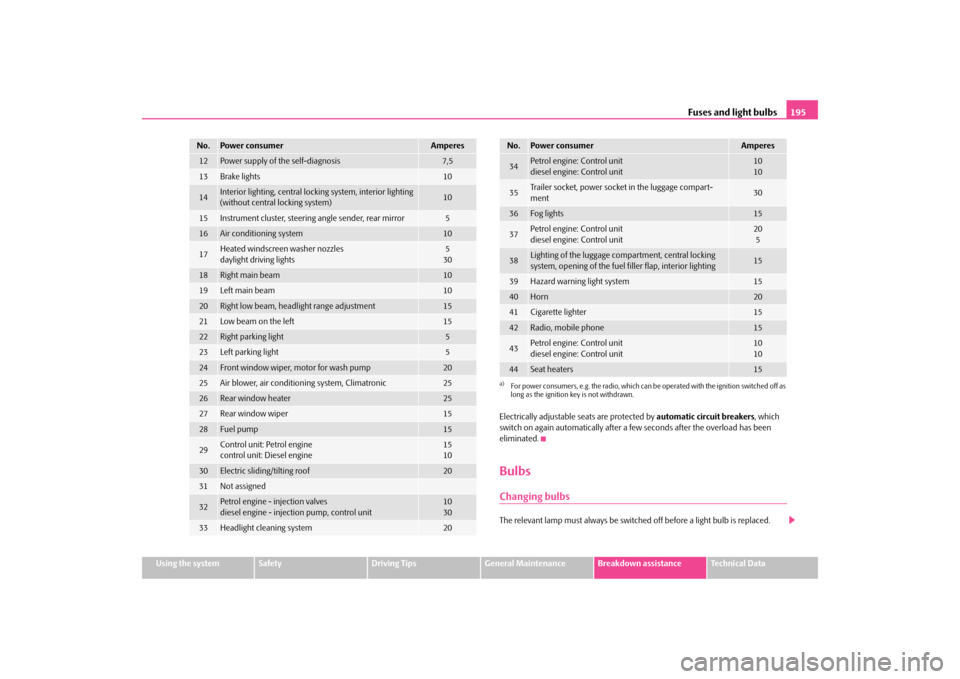
Electrically adjustable
seats are protected by
automatic circuit breakers
, which
switch on again automatically after a fe
w seconds after the overload has been
eliminated.BulbsChanging bulbsThe relevant lamp must always be switch
ed off before a light bulb is replaced.
12
Power supply of the self-diagnosis
7,5
13
Brake lights
10
14
Interior lighting, central lockin
g system, interior lighting
(without central locking system)
10
15
Instrument cluster,
steering angle sender, rear mirror
5
16
Air conditioning system
10
17
Heated windscreen washer nozzles daylight driving lights
530
18
Right main beam
10
19
Left main beam
10
20
Right low beam, headlight range adjustment
15
21
Low beam on the left
15
22
Right parking light
5
23
Left parking light
5
24
Front window wiper, motor for wash pump
20
25
Air blower, air conditioning system, Climatronic
25
26
Rear window heater
25
27
Rear window wiper
15
28
Fuel pump
15
29
Control unit: Petrol engine control unit: Diesel engine
1510
30
Electric sliding/tilting roof
20
31
Not assigned
32
Petrol engine - injection valvesdiesel engine - injection pump, control unit
1030
33
Headlight cleaning system
20
No.
Power consumer
Amperes
34
Petrol engine: Control unitdiesel engine: Control unit
1010
35
Trailer socket, power socket in the luggage compart- ment
30
36
Fog lights
15
37
Petrol engine: Control unit diesel engine: Control unit
205
38
Lighting of the luggage compartment, central locking system, opening of the fuel filler flap, interior lighting
15
39
Hazard warning light system
15
40
Horn
20
41
Cigarette lighter
15
42
Radio, mobile phone
15
43
Petrol engine: Control unit diesel engine: Control unit
1010
44
Seat heaters
15
a)For power consumers, e.g. the radio, which can be
operated with the ignition switched off as
long as the ignition key is not withdrawn.No.
Power consumer
Amperes
s2g8.b.book Page 195 Tuesday, April 7, 2009 8:53 AM
Page 217 of 224

Index
216
Child seat . . . . . . . . . . . . . . . . . . . . . . . . . . . . . . . . . . . 126
Classification into groups . . . . . . . . . . . . . . . . . 126ISOFIX system . . . . . . . . . . . . . . . . . . . . . . . . . . . . 129Use of child safety seats . . . . . . . . . . . . . . . . . . 126
Children and safety . . . . . . . . . . . . . . . . . . . . . . . . . . 123Chrome parts . . . . . . . . . . . . . . . . . . . . . . . . . . . . . . . 149 Cigarette lighter . . . . . . . . . . . . . . . . . . . . . . . . . . . . . . 78 Cleaning . . . . . . . . . . . . . . . . . . . . . . . . . . . . . . . . . . . . 147Climatronic
Defrosting windows . . . . . . . . . . . . . . . . . . . . . . . 91Recirculated air mode . . . . . . . . . . . . . . . . . . . . . 91Setting temperature . . . . . . . . . . . . . . . . . . . . . . . 92
Climatronic (automatic air conditioning) . . . . . . . 89 Clock . . . . . . . . . . . . . . . . . . . . . . . . . . . . . . . . . . . . . . . . 19Clothes hooks . . . . . . . . . . . . . . . . . . . . . . . . . . . . . . . . 82 Cockpit
General view . . . . . . . . . . . . . . . . . . . . . . . . . . . . . . . 9
Compartments . . . . . . . . . . . . . . . . . . . . . . . . . . . . . . . 79Computer . . . . . . . . . . . . . . . . . . . . . . . . . . . . . . . . . . . . 19 Convenience operation . . . . . . . . . . . . . . . . . . . . . . . 45 Converting/masking over headlights . . . . . . . . . . 142Coolant . . . . . . . . . . . . . . . . . . . . . . . . . . . . . . . . . . . . . 165
replenishing . . . . . . . . . . . . . . . . . . . . . . . . . . . . . 166Warning light . . . . . . . . . . . . . . . . . . . . . . . . . . . . . 30
Coolant level
Warning light . . . . . . . . . . . . . . . . . . . . . . . . . . . . . 30
Coolant quantity
Warning light . . . . . . . . . . . . . . . . . . . . . . . . . . . . . 30
Coolant temperature gauge . . . . . . . . . . . . . . . . . . . 16 Coolant temperature/coolant level
Warning light . . . . . . . . . . . . . . . . . . . . . . . . . . . . . 30
Correct seated position . . . . . . . . . . . . . . . . . . . . . . 104
Counter for distance driven . . . . . . . . . . . . . . . . . . . . 18 Cruise control system . . . . . . . . . . . . . . . . . . . . . . . . . . 98Cup holder
front . . . . . . . . . . . . . . . . . . . . . . . . . . . . . . . . . . . . . . 76
DDeactivating
an airbag . . . . . . . . . . . . . . . . . . . . . . . . . . . . . . . . 120
Deactivating an airbag . . . . . . . . . . . . . . . . . . . . . . . 120 Defrosting rear window . . . . . . . . . . . . . . . . . . . . . . . . 55De-icing the windows . . . . . . . . . . . . . . . . . . . . . . . 150 Detachable towing device . . . . . . . . . . . . . . . . . . . 146 Diesel . . . . . . . . . . . . . . . . . . . . . . . . . . . . . . . . . . . . . . 155Diesel engines
Starting the engine . . . . . . . . . . . . . . . . . . . . . . . . . 95
Digital clock . . . . . . . . . . . . . . . . . . . . . . . . . . . . . . . . . . 19 Direction indicators . . . . . . . . . . . . . . . . . . . . . . . . . . . 52
Warning light . . . . . . . . . . . . . . . . . . . . . . . . . . . . . . 28
Display . . . . . . . . . . . . . . . . . . . . . . . . . . . . . . . . . . . . . . . 23 Distance driven . . . . . . . . . . . . . . . . . . . . . . . . . . . . . . . 18 Door
Child safety lock . . . . . . . . . . . . . . . . . . . . . . . . . . . 37
Driving economically . . . . . . . . . . . . . . . . . . . . . . . . 138EEDL . . . . . . . . . . . . . . . . . . . . . . . . . . . . . . . . . . . . . . . . 132 Electric sliding/tilting roof . . . . . . . . . . . . . . . . . . . . . . 46 Electrically adjustable exterior mirror . . . . . . . . . . . 58Electronic Differential Lock . . . . . . . . . . . . . . . . . . . 132Electronic immobiliser . . . . . . . . . . . . . . . . . . . . . 29, 36
Warning light . . . . . . . . . . . . . . . . . . . . . . . . . . . . . . 29
Electronic stability programme . . . . . . . . . . . . . . . . 131 Electronic stability programme (ESP)
Warning light . . . . . . . . . . . . . . . . . . . . . . . . . . . . . 33
Emergency wheel . . . . . . . . . . . . . . . . . . . . . . . . . . . . 183 Engine
starting . . . . . . . . . . . . . . . . . . . . . . . . . . . . . . . . . . . 94switching off . . . . . . . . . . . . . . . . . . . . . . . . . . . . . . 96
Engine compartment
Safety information . . . . . . . . . . . . . . . . . . . . . . . . 160
Engine electronics
Warning light . . . . . . . . . . . . . . . . . . . . . . . . . . . . . 29
Engine oil . . . . . . . . . . . . . . . . . . . . . . . . . . . . . . . . . . . 162
Changing . . . . . . . . . . . . . . . . . . . . . . . . . . . . . . . . 164changing . . . . . . . . . . . . . . . . . . . . . . . . . . . . . . . . 164check . . . . . . . . . . . . . . . . . . . . . . . . . . . . . . . . . . . . 163replenishing . . . . . . . . . . . . . . . . . . . . . . . . . . . . . 163Warning light . . . . . . . . . . . . . . . . . . . . . . . . . . . . . 31
Engine revolutions counter . . . . . . . . . . . . . . . . . . . . 16Environment . . . . . . . . . . . . . . . . . . . . . . . . . . . . . . . . 138 Environmental compatibility . . . . . . . . . . . . . 138, 142 ESP . . . . . . . . . . . . . . . . . . . . . . . . . . . . . . . . . . . . . . . . . 131
Warning light . . . . . . . . . . . . . . . . . . . . . . . . . . . . . 33
Exhaust gas
Warning light . . . . . . . . . . . . . . . . . . . . . . . . . . . . . 29
Exhaust gas inspection
Warning light . . . . . . . . . . . . . . . . . . . . . . . . . . . . . 29
Explanations . . . . . . . . . . . . . . . . . . . . . . . . . . . . . . . . . . . 6Exterior mirror . . . . . . . . . . . . . . . . . . . . . . . . . . . . . . . . 58 Exterior mirror heater . . . . . . . . . . . . . . . . . . . . . . . . . 58FFirst-aid box . . . . . . . . . . . . . . . . . . . . . . . . . . . . . . . . . 181
s2g8.b.book Page 216 Tuesday, April 7, 2009 8:53 AM
Page 218 of 224
Index
217
Using the system
Safety
Driving Tips
General Maintenance
Breakdown assistance
Technical Data
Fixing net
Combi . . . . . . . . . . . . . . . . . . . . . . . . . . . . . . . . . . . . 70Octavia . . . . . . . . . . . . . . . . . . . . . . . . . . . . . . . . . . . 69
Fog lights . . . . . . . . . . . . . . . . . . . . . . . . . . . . . . . . . . . . . 50
Warning light . . . . . . . . . . . . . . . . . . . . . . . . . . . . . . 29
Front airbag . . . . . . . . . . . . . . . . . . . . . . . . . . . . . . . . . 116 Front armrest . . . . . . . . . . . . . . . . . . . . . . . . . . . . . . . . . 81 Fuel . . . . . . . . . . . . . . . . . . . . . . . . . . . . . . . . . . . . . . . . 155
Diesel fuel . . . . . . . . . . . . . . . . . . . . . . . . . . . . . . . 155Fuel gauge . . . . . . . . . . . . . . . . . . . . . . . . . . . . . . . . 17Petrol . . . . . . . . . . . . . . . . . . . . . . . . . . . . . . . . . . . 155
Fuel consumption . . . . . . . . . . . . . . . . . . . . . . . . . . . 138
Saving energy . . . . . . . . . . . . . . . . . . . . . . . . . . . 138
Fuel gauge . . . . . . . . . . . . . . . . . . . . . . . . . . . . . . . . . . . . 17 Fuel reserve
Warning light . . . . . . . . . . . . . . . . . . . . . . . . . . . . . . 31
Full wheel trim . . . . . . . . . . . . . . . . . . . . . . . . . . . . . . 185 Fuses . . . . . . . . . . . . . . . . . . . . . . . . . . . . . . . . . . . . . . . 192GGauges . . . . . . . . . . . . . . . . . . . . . . . . . . . . . . . . . . . . . . . 16 Gearbox
mechanical . . . . . . . . . . . . . . . . . . . . . . . . . . . . . . . . 96
General view
Cockpit . . . . . . . . . . . . . . . . . . . . . . . . . . . . . . . . . . . . 9
Glass roof . . . . . . . . . . . . . . . . . . . . . . . . . . . . . . . . . . . . . 46 Glow plug system . . . . . . . . . . . . . . . . . . . . . . . . . . . . . 95
Warning light . . . . . . . . . . . . . . . . . . . . . . . . . . . . . . 30
HHandbrake . . . . . . . . . . . . . . . . . . . . . . . . . . . . . . . . . . . 97
Hazard warning light system . . . . . . . . . . . . . . . . . . . 52
Warning light . . . . . . . . . . . . . . . . . . . . . . . . . . . . . . 28
Head restraint . . . . . . . . . . . . . . . . . . . . . . . . . . . . . . . . 64Headlight flasher . . . . . . . . . . . . . . . . . . . . . . . . . . . . . . 52 Headlights
Fog lights . . . . . . . . . . . . . . . . . . . . . . . . . . . . . . . . . 50
Heated windscreen washer nozzles . . . . . . . . . . . . 56Heating . . . . . . . . . . . . . . . . . . . . . . . . . . . . . . . . . . . . . . 83
Air outlet vents . . . . . . . . . . . . . . . . . . . . . . . . . . . . 83Defrosting windows . . . . . . . . . . . . . . . . . . . . . . . 84Recirculated air mode . . . . . . . . . . . . . . . . . . . . . 85
Horn . . . . . . . . . . . . . . . . . . . . . . . . . . . . . . . . . . . . . . . . . . 9IIgnition . . . . . . . . . . . . . . . . . . . . . . . . . . . . . . . . . . . . . . 94 Ignition lock . . . . . . . . . . . . . . . . . . . . . . . . . . . . . . . . . . 94Immobiliser . . . . . . . . . . . . . . . . . . . . . . . . . . . . . . . . . . 36 Information display . . . . . . . . . . . . . . . . . . . . . . . . . . . 23 Instrument cluster . . . . . . . . . . . . . . . . . . . . . . . . . . . . 16Instrument lighting . . . . . . . . . . . . . . . . . . . . . . . . . . . . 51 Interior light
Luggage compartment . . . . . . . . . . . . . . . . . . . . . 54
Interior lighting
front . . . . . . . . . . . . . . . . . . . . . . . . . . . . . . . . . . . . . . 53rear . . . . . . . . . . . . . . . . . . . . . . . . . . . . . . . . . . . . . . 54
Interior mirror . . . . . . . . . . . . . . . . . . . . . . . . . . . . . . . . 58 Intermittent wiping . . . . . . . . . . . . . . . . . . . . . . . . . . . 56 ISOFIX . . . . . . . . . . . . . . . . . . . . . . . . . . . . . . . . . . . . . . 129ISOFIX system . . . . . . . . . . . . . . . . . . . . . . . . . . . . . . . 129
JJacking points . . . . . . . . . . . . . . . . . . . . . . . . . . . . . . . 187Jump-starting . . . . . . . . . . . . . . . . . . . . . . . . . . . 188, 189KKey . . . . . . . . . . . . . . . . . . . . . . . . . . . . . . . . . . . . . . . . . . 35LLashing eyes . . . . . . . . . . . . . . . . . . . . . . . . . . . . . . . . . 68Leather care . . . . . . . . . . . . . . . . . . . . . . . . . . . . . . . . 152 Lifting jack . . . . . . . . . . . . . . . . . . . . . . . . . . . . . . 182, 187 Light
Changing bulbs . . . . . . . . . . . . . . . . . . . . . . . . . . 195
Lighting of the interior of the vehicle . . . . . . . . . . . 53
rear . . . . . . . . . . . . . . . . . . . . . . . . . . . . . . . . . . . . . . 54
Lights
converting/masking over . . . . . . . . . . . . . . . . . 142Range adjustment . . . . . . . . . . . . . . . . . . . . . . . . . 51switching on and off . . . . . . . . . . . . . . . . . . . . . . . 49Warning lights . . . . . . . . . . . . . . . . . . . . . . . . . . . . 27
Lights and Visibility . . . . . . . . . . . . . . . . . . . . . . . . . . . 51Liquid in reservoir for windshield washer system
Warning light . . . . . . . . . . . . . . . . . . . . . . . . . . . . . 31
Loading . . . . . . . . . . . . . . . . . . . . . . . . . . . . . . . . . . . . . . 68 Lock
Central locking system . . . . . . . . . . . . . . . . . . . . 39
lock
Central locking system . . . . . . . . . . . . . . . . . . . . 39
Locking . . . . . . . . . . . . . . . . . . . . . . . . . . . . . . . . . . . 37, 38
Remote control . . . . . . . . . . . . . . . . . . . . . . . . . . . 42
s2g8.b.book Page 217 Tuesday, April 7, 2009 8:53 AM