2009 SKODA OCTAVIA steering
[x] Cancel search: steeringPage 59 of 304

Lights and Visibility
58
Lights and VisibilityLightsSwitching lights on and off
Switching on side lights – Turn the light switch into position
.
Switching on the low beam and main beam – Turn the light switch into position
.
– Press the main beam lever forward in order to switch on the main
beam
⇒
page 64, fig. 60
.
Switching off lights (except daylight driving lights) – Turn the light switch into position°0.Low beam comes on only if the ignition is switched on. After switching off the igni- tion, the low beam is switched off automati
cally and only the side lights come on.
For vehicles which are equipped with
the function Comi
ng/Leaving-Home*
⇒ page 60, the side lights also go out.
On models fitted with
right-hand steering
the position of certain switches differs
from that shown in
⇒fig. 54
. The symbols which mark the switch positions are
identical, however.
WARNING
Never drive with side lights on - risk of accident! The side lights are not bright enough to light up the road sufficiently in front of you or to be seen by other oncoming traffic. In this case, always switch on the low beam when it is dark or if visibility is poor.
Note
•
An audible warning will sound if you withdraw the ignition key and open the
driver's door when the vehicle lights are still on.•
The acoustic warning signal is switched off over the door contact when the
driver's door is closed (ignition off). The
vehicle can be parked with the side lights
on.•
If the car is parked for a lengthy period
, we recommend switching off all lights,
or leaving only the parking lights switched on.•
The switching on of the described lights
should only be undertaken in accord-
ance with the legal requirements.•
If a fault occurs in the light switch, the low beam comes on automatically
•
In the event of cool or humid weather co
nditions, the headligh
ts can be misted
up from inside.
− The temperature difference between interior and external area of the head- light lenses is decisive. − When the driving lights are switched on, the light outlet surfaces are free from mist after a short period. The headli
ght lenses can possib
ly mist up at the
border areas. − It also concerns reverse light and turn signal lights. − This mist has no influence on th
e life of the lighting system.
Fig. 54 Dash panel: Light switch
se0.1.book Page 58 Friday, April 10, 2009 3:19 PM
Page 60 of 304

Lights and Visibility
59
Using the system
Safety
Driving Tips
General Maintenance
Breakdown assistance
Technical Data
Daylight driving lights*In some countries, the national legisl
ation requires that the vehicles are
equipped with the function
daylight driving lights.
Switching on daylight driving lights – Switch on the ignition without turnin
g the light switch out of the posi-
tion 0.
Deactivate function daylight driving lights – Pull the turn signal light lever towards the steering wheel up to 3
seconds after switching on the ignition
and at the same time, slide it to
the bottom and hold it in this position for at least 3 seconds.
Activate function daylight driving lights – Pull the turn signal light lever towards the steering wheel up to 3
seconds after switching on the ignition
and at the same time, slide it to
the top and hold it in this position for at least 3 seconds.
When the daylight driving lights are switched on, the side lights and the low beam come on together. On vehicles which are fitted with bulbs for
daylight driving lights* in the fog lights,
the parking lights do not co
me on when activating the function daylight driving
lights
9).
When the daylight driving lights are switched on, the illumination of the instrument cluster is switched off, however, it is switched on in the position
when it is dark
and the low beam shines with full brightness (100 % of the performance). On vehicles fitted with an information displa
y*, you can activate or
deactivate in the
menu the function daylight driving lights:„
SETUP (Settings)
„
Lights & Vision (Lights & Vision)
Automatic light control*Switching on automatic light control* – Turn the light switch
⇒
fig. 55
into position
.
Switching off automatic light control* – Turn the light switch to the position 0,
or
.
If the light switch is in the position
, the symbol illuminates when the ignition
is switched on
next to the light switch. If th
e low beam is activated with the
light sensor, the symbol
illuminates additionally next to the light switch.
If the light comes on automatically, the side lights and low beam as well as licence plate light light up at the same time. If the automatic light control* is switched on, the light is regulated with the light sensor in the rear mirror holder. If the light intensity drops below the set value, e.g when driving during the day into a tunnel, the low beam and the side lights as well as the licence plate light come on automa
tically. If the light intensity increases
again, the lights switch off automatically. Motorway lights If the automatic light control* has been sw
itched on and the vehicle speed is over
140 km/h for at least 10 seconds, the side
lights and low beam are switched on
automatically.
9)Only valid for some countries.
Fig. 55 Dash panel: Light switch
se0.1.book Page 59 Friday, April 10, 2009 3:19 PM
Page 63 of 304

Lights and Visibility
62
Fog lights*
Switching on the fog lights – First of all turn the light switch into position
or
⇒
fig. 56
.
– Pull the light switch into position .The rear fog light warning light
⇒page 31 lights up in the instrument cluster
when the fog light is switched off.Fog lights with the function “Corner”* The fog lights with the function “Corner” improve the illumination of areas close to the vehicle
when turning, parking etc.
The fog lights with the function “Corner”
are regulated according to the steering
angle or after switching on the turn signal light
10) in the following circumstances:
•
the vehicle is stationary and the engine
is running or it moves with a speed of
maximum 40 km/h,•
the daylight driving lights are not switched on,
•
the low beam is switched on or the
light switch is in the position
and the
intensity of the ambient light causes
the low beam to be switched on,
•
the fog lights are not switched on,
•
no reverse gear is engaged.Note
If you engage the reverse gear during the
active function “Corner”, both fog lights
illuminate.Rear fog light
Switching on the rear fog light – First of all turn the light switch into position
or
⇒
fig. 56
.
– Pull the switch into position .The rear fog light warning light
⇒page 31 lights up in the instrument cluster
when the fog light is switched off. Only the rear fog light of the trailer ligh
ts up automatically when you are towing a
trailer
using a factory-fitted towing device
which is fitted with the rear fog light.
The rear fog light is located in the rear light array on the driver's side.
Caution
The rear fog light should only be switched
on if visibility is particularly poor
(conform with any varying legal provisions) to avoid dazzling vehicles behind your vehicle.
10)If both switch on versions are conflicting, fo
r example if the steering wheel is turned to the
left and the right turn signal light is switched on, the turn signal light has the higher priority.
Fig. 56 Dash panel: Light switch
A1
A2
se0.1.book Page 62 Friday, April 10, 2009 3:19 PM
Page 66 of 304

Lights and Visibility
65
Using the system
Safety
Driving Tips
General Maintenance
Breakdown assistance
Technical Data
Headlight flasher
– Pull the lever towards the steering wheel (spring-tensioned position)
- the main beam and warning light
in the instrument cluster come
on.
Parking light
– Switch off the ignition. – Push the lever up or down - the ri
ght-hand or left-hand parking light
is switched on.
Information concerning the function of the lights.•
The
turn signal system
only operates when the ignition is switched on. The
corresponding indicator light
or in the instrument cluster also flashes.
•
The turn signal is automatically cancelled after negotiating a curve.
•
The indicator light flashes at twice its normal
ra te if a bulb of the turn s ignal lig ht
fails.•
The side light and rear light on the appropriate side of the vehicle are switched
on when the
parking light
is selected. The parking light only operates if the ignition
is switched off.
Caution
Use main beam or the headlight flasher only
if this does not risk dazzling other road
users.
Note
•
If you have switched on the right or left
turn signal light and you switch off the
ignition, the parking light is
not automatically switched on.
•
Use only in accordance with the legal
requirements the described lighting and
signal systems.
Interior lightingvehicle interior lighting front and rear*The same principles apply for the lighti
ng of the front and rear part of the
vehicle. Switching the interior light on – Press the switch to the left, the symbol
⇒
fig. 61
appears.
Switching the interior light off – Press the switch into the middle position
O.
– On the version without reading lights press the switch to the right,
the symbol
O appears.
Door contact setting – Press the switch to the right, the symbol
appears.
– On the version without reading lights press the switch into the
middle position
.
Fig. 61 Detail of the head- liner: Front and rear interior lighting
AAAA
AA
AA
AA
se0.1.book Page 65 Friday, April 10, 2009 3:19 PM
Page 70 of 304

Lights and Visibility
69
Using the system
Safety
Driving Tips
General Maintenance
Breakdown assistance
Technical Data
Windshield wiper and wash systemWindshield wiper You can operate the windscreen wipers and automatic wipe/wash using the windscreen wiper lever.The windscreen wiper lever
⇒
fig. 68
has the following positions:
Finger-operated wiping – If you wish to wipe the windscreen only
briefly
, push the lever into the
sprung position . If you hold the le
ver in the lower position for more
than 1 second, the wiper wipes faster.
Intermittent wiping – Position the lever up into position . – Set with the switch the desired break between the individual wiper
strokes
Slow wipe – Position the lever up into position .
Fa s t w ip e – Position the lever up into position . Automatic wipe/wash for windscreen – Pull the lever towards the steering
wheel into sprung position , the
wash system sprays immediately, the windscreen wiper starts wiping a little later. The wash system and the windscreen wiper operate simultaneously at a speed of more than 120 km/h.
– Release the lever. The windscreen wash system stops and the wiper
continues for another 3 - 4 wiper strokes (depending on the period of spraying of the windscreen). At a speed of more than 2 km/h, the wiper wipes once again* 5 seconds after the last wiper stroke in order to wipe the last drops from the windscreen. This function can be acti-vated/deactivated by a specialist garage.
Rain sensor* – Move the lever into position . – You can set the sensitivity of the sensor individually with switch . Wiping the rear window pane* – Push the lever away from the steering wheel into position - the
widescreen wiper will operate every 6 seconds.
Automatic wipe/wash for the rear window pane* – Press the lever from the steering wheel forward into the sprung posi-
tion , the wash system sprays immediately, the windscreen wiper starts wiping a little later. As long as you hold the lever in this position, the wiper operates as well as the wash system.
– Letting go of the lever will cause the windscreen wash system to stop
and the wiper to continue for another 2 - 3 wiper strokes (depending on the period of spraying of the windscreen).
The lever will stay in
position after releasing it
.
Fig. 68 Windscreen wiper lever
A4
A1
AA
A2
A3
A5
A1
AA
A6
A7
A6
se0.1.book Page 69 Friday, April 10, 2009 3:19 PM
Page 76 of 304

Seats and Stowage
75
Using the system
Safety
Driving Tips
General Maintenance
Breakdown assistance
Technical Data
Seats and StowageFront seatsBasic informationThe front seats have a wide range of differ
ent settings and can thus be matched to
the physical characteristics of the driver
and front passenger. Correct adjustment of
the seats is particularly important for:•
safely and quickly reaching the controls,
•
a relaxed, fatigue-free body position,
•
achieving the maximum protection offere
d by the seat belts and the airbag
system.
WARNING
•
Never transport more occupants than the maximum seating in the
vehicle.•
Each occupant must correctly fasten the seat belt belonging to the seat.
Children must be fastened
⇒page 184, “Transporting children safely” with
a suitable restraint system.•
The front seats and the head restraints must always be adjusted to match
the body size of the seat occupant as well as the seat belts must always be correctly fastened in order to provide an optimal protection for you and your occupants.•
Always keep your feet in the footwell
when the vehicle is being driven -
never place your feet on the instrument panel, out of the window or on the surfaces of the seats. This is particularly important for the front seat passenger. You will be exposed to increa
sed risk of injury if it becomes
necessary to apply the brake or in the ev
ent of an accident.
If an airbag is
deployed, you may suffer fatal injuries
when adopting an incorrect seated
position!•
It is important for the driver and front passenger to maintain a distance
of at least 25 cm from the steering wheel or dash panel. Not maintaining this
minimum distance will mean that the airb
ag system will not be able to prop-
erly protect you - hazard! The front seats and the head restraints must always also be correctly adjusted to match the body size of the occupant.•
Ensure that there are no objects in the footwell as any objects may get
behind the pedals during a driving or
braking manoeuvre. You would then
no longer be able to operate the clutch, to brake or accelerate.Adjusting the front seatsAdjusting a seat in a forward/back direction –Pull the lever
⇒
fig. 73
up and push the seat into the desired posi-
tion.
– Release the lever and push the seat further until the lock is heard
to engage.
Adjusting height of seat* – Lift the seat if required by pulling or pumping lever upwards.
WARNING (continued)
Fig. 73 Controls at seat
A1
A1
A2
se0.1.book Page 75 Friday, April 10, 2009 3:19 PM
Page 77 of 304

Seats and Stowage
76
– Lower the seat if required by pushing or pumping lever down-
wards.
Adjust the angle of the seat backrest – Relieve any pressure on the seat backrest (do not lean on it) and turn
the handwheel
⇒
page 75, fig. 73
to adjust the desired angle of the
backrest.
Adjusting lumbar support* – Turn the wheel until you have set the most comfortable curvature
of the seat upholstery in
the area of your spine.
The driver's seat should be adjusted in
such a way that the pedals can be pressed
to the floor with slightly bent legs. The seat backrest on the driver's seat sh
ould be adjusted in such a way that the
upper point of the steering wheel can be easily reached with slightly bent arms.
WARNING
•
Only adjust the driver seat when the ve
hicle is stationary - risk of injury!
•
Take care when adjusting the seat! Adjusting the seat without care can
lead to bruises or injuries.•
The seat backrests must not be angl
ed too far back when driving other-
wise this will affect proper operation of the seat belts and of the airbag system - risk of injury!
Adjusting front seats electrically*Adjusting seatsAdopt the correct seated position before setting
⇒
page 75.
Adjusting a seat in a forward/back direction – Press the switch
⇒
fig. 74
forwards or backwards
⇒
fig. 75
.
Set the height of the seat – Press the switch
⇒
fig. 74
upwards or downwards.
A2
A3A4
Fig. 74 Side view: Controls for adjusting the seatFig. 75 Side view: Seat setting switch
AA
A1
AA
se0.1.book Page 76 Friday, April 10, 2009 3:19 PM
Page 123 of 304
Starting-off and Driving
122
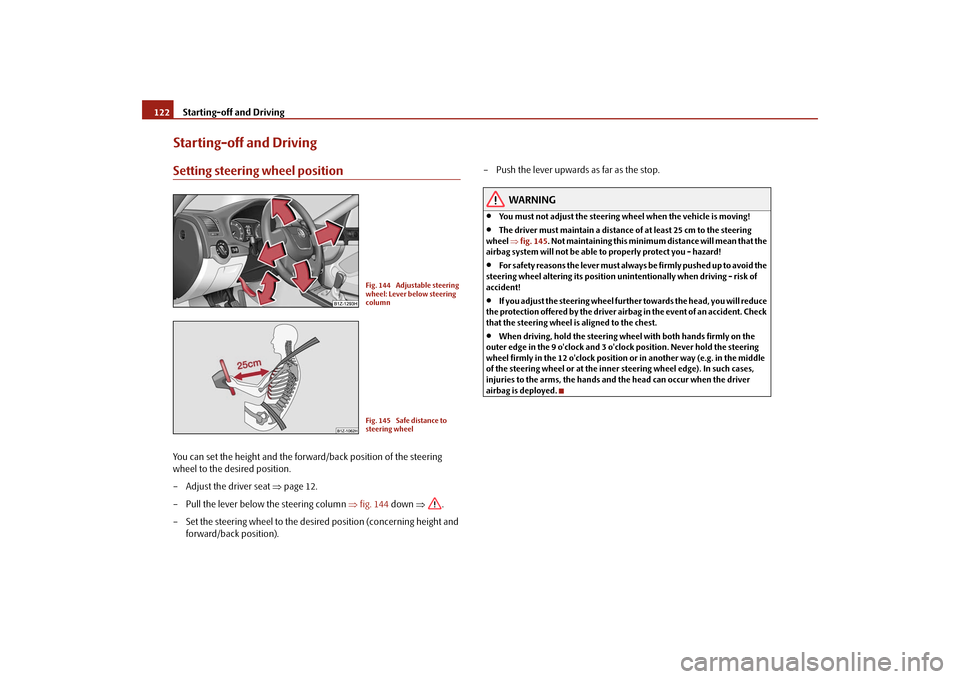
Starting-off and DrivingSetting steering wheel positionYou can set the height and the forward/back position of the steering wheel to the desired position. – Adjust the driver seat
⇒
page 12.
– Pull the lever below the steering column
⇒
fig. 144
down
⇒
.
– Set the steering wheel to the desired position (concerning height and
forward/back position).
– Push the lever upwards as far as the stop.
WARNING
•
You must not adjust the steering wh
eel when the vehicle is moving!
•
The driver must maintain a distance of at least 25 cm to the steering
wheel
⇒fig. 145
. Not maintaining this minimum distance will mean that the
airbag system will not be able to properly protect you - hazard!•
For s afe ty re a so ns t he le ve r m ust al wa y s b e fi rm ly pus he d up to a voi d the
steering wheel alteri
ng its position unintentionally when driving - risk of
accident!•
If you adjust the steering wheel furthe
r towards the head, you will reduce
the protection offered by the driver airb
ag in the event of an accident. Check
that the steering wheel is aligned to the chest.•
When driving, hold the steering wheel
with both hands firmly on the
outer edge in the 9 o'clock and 3 o'clock position. Never hold the steering wheel firmly in the 12 o'clock position or in another way (e.g. in the middle of the steering wheel or at the inner
steering wheel edge). In such cases,
injuries to the arms, the hands and
the head can occur when the driver
airbag is deployed.
Fig. 144 Adjustable steering wheel: Lever below steering columnFig. 145 Safe distance to steering wheel
se0.1.book Page 122 Frida
y, April 10, 2009 3:19 PM