2009 SKODA OCTAVIA warning
[x] Cancel search: warningPage 119 of 304

Heating and air conditioning system
118
Lengthy and uneven distribution of the air flow out of the vents (in particular at the leg area) and large differences in temperature, for example when getting out of the vehicle, can result in chills in sensitive persons.Recirculated air mode In recirculated air mode air is sucked
out of the interior of the vehicle
and then fed back into the interior. When the automatic air distribu-tion control is switched on, an air quality sensor measures the concentration of pollutants in the drawn-in air.Recirculated air mode prevents polluted air outside the vehicle from getting into the vehicle, for example when driving through a tunnel or when standing in a traffic jam. If a considerable increase in concentration of pollutants is recognized by the ai
r quality sensor, when the automatic
air distribution control is switched
on, the air distribution control will
temporarily be switched off. If the concentration of pollutants decreases to the normal level, the air distributi
on control is automatically switched
off so that fresh air can be guided into the vehicle interior. Switching recirculated air mode on – Press the button repeatedly until the warning light on the left
side of the button lights up.
Switch on automatic air distribution control – Press the button repeatedly until the warning light on the right
side of the button lights up.
Switch off automatic air distribution control temporarily – If the air quality sensor does not sw
itch on the air distribution control
automatically when there is a nausea
ting smell, you can switch it on
yourself by pressing the button *.
The warning light lights up in
the button on the left side.
Switching recirculated air mode off – Press the button or press the button repetitively, until the
warning lights in the button go out.
WARNING
You should not leave recirculated air mode on over a longer period of time, as “stale” air may result in fatigue in the driver and occupants, divert your attention and also cause the windows to mist up. The risk of having an acci- dent increases. Switch recirculated air mode off as soon as the windows begin misting up.
Note
•
If the windscreen mists up, press the button
⇒page 116, fig. 141
.
After the windscreen has been demisted, press the button .•
The automatic air distribution control operates only if the outside temperature
is higher than approx. 2°C.Controlling blower There are a total of seven blower stages available.The Climatronic system controls the bl
ower stages automatically in line
with the interior temperature. You
can also, however, adapt the blower
stages manually to suit your particular needs. – Press again the button on the left side (reduce blower speed) or on
the right side (increase blower speed).
If you switch off the blower, th
e Climatronic is switched off.
The set blower speed is displayed above the button when the respective number of warning lights come on.
AUTO
A1
AUTO
se0.1.book Page 118 Frida
y, April 10, 2009 3:19 PM
Page 120 of 304

Heating and air conditioning system
119
Using the system
Safety
Driving Tips
General Maintenance
Breakdown assistance
Technical Data
WARNING
•
“Stale air” may result in fatigue in the driver and occupants, reduce
attention levels and also cause the windows to mist up. The risk of having an accident increases.•
Do not switch the Climatronic system off for longer than necessary.
•
Switch the Climatronic system on as soon as the windows mist up.
Defrosting windscreenDefrosting windscreen - switching on – Press the button
⇒
page 116, fig. 141
.
Defrosting windscreen - switching off – Once again press the button or the button .The temperature control is controlled automa
tically. More air flows out of the air
outlet vents
1.
Auxiliary heating (auxiliary heating and ventilation)*Description and important information The auxiliary heating (auxiliary heating and ventilation) heats or supplies the interior of the vehicl
e with fresh air independent of the
engine.Auxiliary heating (auxiliary heating) The auxiliary heating (auxiliary heating) f
unctions in connection with the Climatic or
Climatronic. It can be used when stationa
ry, when engine is switched off for preheating of the
vehicle as well as while driving (only during the heating phase of the engine).
The auxiliary heating (auxiliary heating)
warms up the coolant during the combus-
tion of fuel from the vehicle tank. The coolant warms up the air, which (if the blower speed is not set to zero) flows into the occupant compartment. Auxiliary ventilation The auxiliary ventilation enables fresh air to flow into the vehicle interior by switching off the engine, whereby the interior temperature is effectively decreased (e.g. with the vehicle parked in the sun).
WARNING
•
The auxiliary heating must never be operated in closed rooms - risk of
poisoning!•
The auxiliary heating must not be running during refueling - risk of fire.
•
The exhaust pipe of the auxiliary heating is located on the underside of
the vehicle. Therefore do not place the
vehicle, if you wish to operate the
auxiliary heating, in su
ch a way that the exhaust gases of the auxiliary
heating can come easily into contact
with inflammable materials (e.g. dry
grass) or easily inflammable su
bstances (e.g. fuel run out).
Note
•
If the auxiliary heating runs, the fuel
consumption comes from the vehicle tank.
Therefore the auxiliary heating should not be operated, if there is very little fuel in the tank.•
The exhaust pipe of the auxiliary heating,
which is located on the underside of
the vehicle, must not be clogged and
the exhaust flow must not be blocked.
•
If the auxiliary heating and
ventilation is runni
ng, the vehicle battery discharges.
If the auxiliary heating and ventilation
has been operated several times over a
longer period, the vehicle must be driven a few kilometers in order to recharge the vehicle battery.•
The auxiliary heating only switches the bl
ower on, if it has achieved a coolant
temperature of approx. 50 °C.•
At low outside temperatures, this can result in a formation of water vapour in
the area of the engine compartment. This is quite normal and is not an operating problem.
AUTO
se0.1.book Page 119 Frida
y, April 10, 2009 3:19 PM
Page 122 of 304

Heating and air conditioning system
121
Using the system
Safety
Driving Tips
General Maintenance
Breakdown assistance
Technical Data
– By selecting the menu point
Back
, you will reach in the menu
Aux. Heating (auxiliary heating)
.
– In the menu
Aux. heating (auxiliary heating)
select the menu point
Mode
.
– In the menu
Mode
select the desired mode
Heating
or
Ventilation
.
ProgrammingFor the programming of the auxiliary heating (auxiliary heating and ventilation) in the menu
Aux. heating (Aux. heating)
there are three pre-set times:
•
Pre-set time 1
•
Pre-set time 2
•
Pre-set time 3
In each pre-set time, the day and the ti
me (hour and minute) can be set for
switching on the auxiliary heating and/or ventilation. An empty position can be found between
Sunday and Monday when selecting the
day. If this empty position
is selected, the activation is performed without taking
into account the day. If you leave the pre-set menu by selecting the menu
Back
or do not operate the
display for longer than 10°seconds, the set values are stored, but the pre-set time is not active. Both other pre-set times can be prog
rammed and stored in the same way.
If you select the menu
Activate
after setting the desired values, appears on the
display
Pre-set time (weekday, hours, minute) activated! (Pre-set time
(weekday, hour, minute) activated!
and the set pre-set time is active.
Only one programmed pre-set time can be active.The last programmed pre-set time remains active.After the auxiliary heating activates at the set time, it is necessary to pre-set a time again.
Changing the active pre-set time is carried out after selecting the menu point Activate
in the menu
Aux. heating (auxiliary heating)
by selecting a pre-set time.
The prerequisite for the correct switching on of the auxiliary heating (auxiliary heating and ventilation) according to th
e programmed pre-set time is the correct
setting of the current time and the weekday
⇒page 120.
If the system is running, a warning light in
the button for direct switching on/off of
the auxiliary heating lights up. The running system deactivates after expirati
on of the operating period or is deac-
tivated earlier by pres
sing the button for direct swit
ching on/off of the auxiliary
heating
⇒page 120.
The random pre-set time can be deactivated by selecting the menu point
Deactive
in the menu
Activate
.
After selecting the menu point
Fa c t o r y s e t t i n g
in the menu
Aux. heating
(auxiliary heating)
, it is possible to change to the factory setting.
se0.1.book Page 121 Frida
y, April 10, 2009 3:19 PM
Page 123 of 304
Starting-off and Driving
122
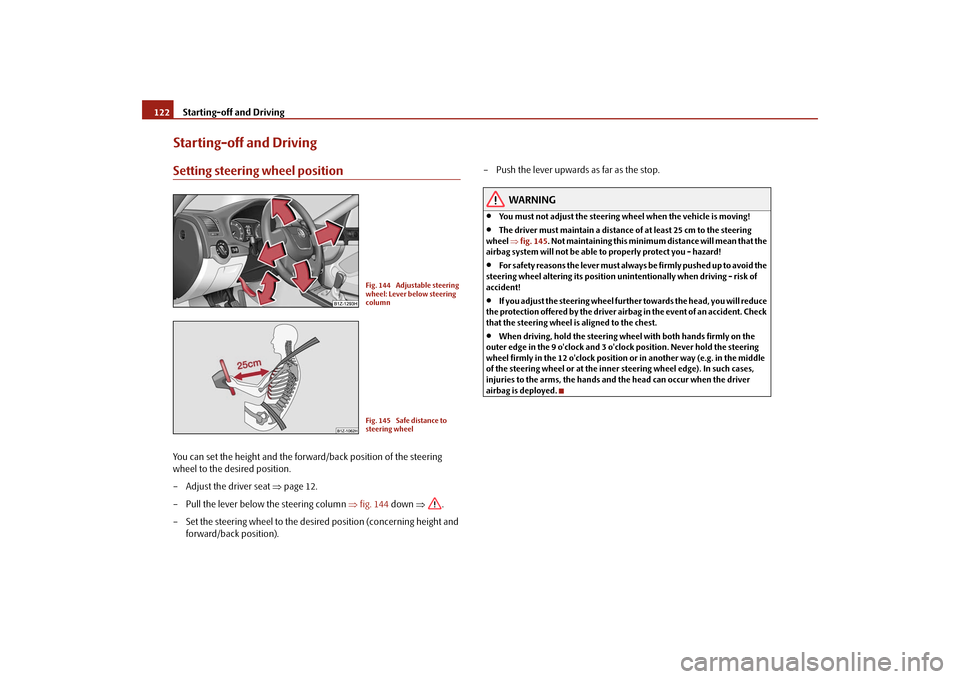
Starting-off and DrivingSetting steering wheel positionYou can set the height and the forward/back position of the steering wheel to the desired position. – Adjust the driver seat
⇒
page 12.
– Pull the lever below the steering column
⇒
fig. 144
down
⇒
.
– Set the steering wheel to the desired position (concerning height and
forward/back position).
– Push the lever upwards as far as the stop.
WARNING
•
You must not adjust the steering wh
eel when the vehicle is moving!
•
The driver must maintain a distance of at least 25 cm to the steering
wheel
⇒fig. 145
. Not maintaining this minimum distance will mean that the
airbag system will not be able to properly protect you - hazard!•
For s afe ty re a so ns t he le ve r m ust al wa y s b e fi rm ly pus he d up to a voi d the
steering wheel alteri
ng its position unintentionally when driving - risk of
accident!•
If you adjust the steering wheel furthe
r towards the head, you will reduce
the protection offered by the driver airb
ag in the event of an accident. Check
that the steering wheel is aligned to the chest.•
When driving, hold the steering wheel
with both hands firmly on the
outer edge in the 9 o'clock and 3 o'clock position. Never hold the steering wheel firmly in the 12 o'clock position or in another way (e.g. in the middle of the steering wheel or at the inner
steering wheel edge). In such cases,
injuries to the arms, the hands and
the head can occur when the driver
airbag is deployed.
Fig. 144 Adjustable steering wheel: Lever below steering columnFig. 145 Safe distance to steering wheel
se0.1.book Page 122 Frida
y, April 10, 2009 3:19 PM
Page 124 of 304

Starting-off and Driving
123
Using the system
Safety
Driving Tips
General Maintenance
Breakdown assistance
Technical Data
Ignition lockPetrol engines - ignition switched off, engine
off, the steering can be locked.
- ignition switched on - start engine Diesel engines - interruption of fuel supply, ignition sw
itched off, engine off, the steering can
be locked. - heating glow plugs on, ignition switched on•
You should not switch on any major elec
trical components during the heating
period otherwise the vehicle batter
y will be drained unnecessarily.
- start engine Applies to all models: Position
To lock the steering
, with the ignition key withdrawn, turn the steering wheel until
the steering locking pin is heard to engage.
You should always lock the steering as
a general rule if you leave your vehicle. This acts as a deterrent against possible theft of your vehicle
⇒
.
Position
Move the steering wheel back and forward a little if the ignition key cannot, or cannot easily be turned into
this position, in order to
release the steering lock.
Position
The engine is started in this position. At
the same time switched on low beam or
main beam or other electrical compon
ents with major po
wer consumption are
briefly switched off. The ignition key moves back into position when one releases the key. The ignition key must be turned back into
position each time before starting the
engine again. The starter repeat lock in th
e ignition lock prevents the starter being
engaged when the engine is running and thus getting damaged. Ignition key withdrawal lock (automatic gearbox) You can only withdraw the ignition key after switching off the ignition if the selector lever is in position
P.
WARNING
•
When driving, the ignition key must always be in the position (igni-
tion switched on) without the engine running. This position is indicated by the warning lights coming on. If this is not the case, it could result in unex- pected locking of the steering wheel - risk of accident!•
Only remove the ignition key from the ignition lock when the vehicle has
come to a standstill (by applying the handbrake or moving the selector lever into the position P). The steering lock
can engage immediately - risk of acci-
dent!•
Always withdraw the ignition key if
you are going to leave the vehicle,
even for a short time. This is particularly
important if children are left in the
vehicle. The children might otherwise star
t the engine or switch on electrical
equipment (e.g. power windows) - risk of accident or injury!
Fig. 146 Ignition lock posi- tions
A1A2A3A1A2A3
A1A2
A3
A2
A1
A2
se0.1.book Page 123 Frida
y, April 10, 2009 3:19 PM
Page 125 of 304
Starting-off and Driving
124
Starting the engineGeneral You can only start the engine only using an original ignition key.•
Place the gearshift lever into neutral (or place the selector lever to the position
P or N in the case of an automatic gearbox)
and put on the handbrake firmly before
starting the engine.•
The clutch pedal should be fully depressed when starting the engine which
means that the starter only has to crank the engine.•
Let go of the key as soon as the engine starts otherwise there may be damage
to the starter. The engine running noises ma
y louder at first be louder for a short time after
starting the cold engine until oil pressure
can be built up in the hydraulic valve
clearance compensation. This is quite no
rmal and is not an operating problem.
If the engine does not start ... You can use the battery of anothe
r vehicle as a jump-start aid
⇒page 252.
It is only possible to tow-start vehicles
fitted with a manual gearbox. The tow-
starting distance must not be more than 50 metres
⇒page 256.
WARNING
•
Never run the engine in non ventilat
ed or enclosed areas. The exhaust
gases of the engine contain besides the odorless and colourless carbon monoxide a poisonous gas - hazard!
Carbon monoxide can cause uncon-
sciousness and death.•
Never leave your vehicle unattended with the engine running.Caution
•
The starter may only be operated (ignition key position ), if the engine is not
running. If the starter is i
mmediately operated
after switching off the engine, the
starter or the engine can be damaged.
•
Avoid high engine revolutions, full throttle and high engine loads as long as the
engine has not yet reached its normal oper
ating temperature - risk of damaging the
engine!•
Vehicles which are fitted with an exhaus
t gas catalytic conver
ter should not be
tow-started over a distance of more than 50 metres.
For the sake of the environment
Never warm up the engine when the vehi
cle is standing. Drive off right away.
Through this the engine reaches its operating temperature more rapidly and the pollutant emissions are lower.Petrol enginesThese engines are fitted with a starter system which selects the correct fuel/air mixture for every external air temperature.•
Do not operate accelerator befo
re and when starting engine.
•
Interrupt the attempt at starting after 10 seconds if the engine does not start
right awayand wait for about 30 seconds before repeating the attempt.•
It is possible that the fuse on the electrical fuel pump is defect if the engine still
does not start. Check the fuse and replace it if necessary
⇒page 258.
•
Contact the nearest specialist garage to obtain professional assistance.
It may be necessary, if the engine is
very hot
, to slightly depress the accelerator
after the engine has started.Diesel enginesGlow plug system Diesel engines are equipped with a glow plug system, the preglow period being controlled automatically in line with the coolant temperature and outside temper-ature. The preglow indicator light
comes on after the igniti
on has been switched on.
A3
se0.1.book Page 124 Frida
y, April 10, 2009 3:19 PM
Page 126 of 304

Starting-off and Driving
125
Using the system
Safety
Driving Tips
General Maintenance
Breakdown assistance
Technical Data
You should not switch on any major electrical components during the heating period otherwise the vehicle battery will be drained unnecessarily.•
You should start the engine immediately after the glow plug warning light
has gone out.•
The glow plug warning light will come on for about one second if the engine is
at a normal operating temperature or if th
e outside temperature is above +5°C. This
means that you can start the engine
right away
.
•
Interrupt the attempt at starting after 10 seconds if the engine does not start
right awayand wait for about 30 seconds before repeating the attempt.•
It is possible that the fuse on the diesel
preglow system is defect if the engine
still does not start. Check the fuse and replace it if necessary
⇒page 258.
•
Contact the nearest specialist garage to obtain professional assistance.
Starting the engine after the fuel tank has run dry It may take longer than normal to start the
engine after refuelling if the fuel tank has
run completely dry - up to one minute. This is because the fuel system must first of all be filled while the attempting to start the engine.Switching off the engine– The engine can be switched off by turning the ignition key from posi-
tion into
⇒
page 123, fig. 146
.
WARNING
•
Never switch off the engine before the
vehicle is stationary - risk of acci-
dent!•
The brake booster only operates when the engine is running. Greater
physical effort for braking is required
when engine is switched off. Because
if you do not stop as normal, this can cause an accident and severe injuries.
Caution
you should not switch the engine off right
away at the end of yo
ur journey
after the
engine has been operated for a lengthy peri
od at high loads but should be allowed
it to run at idling speed for about 2 minutes
. This prevents any accumulation of heat
when the engine is switched off.
Note
•
The radiator fan may conti
nue running for a further 10
minutes or
so after the
engine and the ignition have
been switched off. The coolant fan may, however, also
switch on again after some time if the
coolant temperature rises because of an
accumulation of heat in the engine or
if the engine is warm and the engine
compartment is additionally
heated by strong sunlight.
•
This is why particular care is required when carrying out any work in the engine
compartment
⇒page 225, “Working in the engine compartment”.
Shifting (manual gearbox)Shift into reverse only when the vehicle is
stationary. Depress the clutch pedal and
hold it fully depressed. Wait a moment be
fore engaging reverse gear in order to
avoid any shift noises.
A1
Fig. 147 The shift pattern: 5- speed or 6-speed manual gearbox
se0.1.book Page 125 Frida
y, April 10, 2009 3:19 PM
Page 127 of 304

Starting-off and Driving
126
The reversing lights will come on once reverse gear is engaged, provided the igni- tion is on.
WARNING
Never engage the reverse gear when driving - risk of accident!
Note
•
One should not lay the hand on the shift lever while driving the vehicle. The
pressure of the hand will be transferred to
the gearshift forks in the gearbox. This
can, over a period of time, lead to early wear of the gearshift forks.•
Depress the clutch pedal fully when chan
ging gears, in order to avoid unneces-
sary wear and damage to the clutch.HandbrakeApplying the handbrake – Pull the handbrake lever up fully.
Releasing the handbrake – Pull the handbrake lever up slightly
and
at the same time
press in the
locking button
⇒
fig. 148
.
– Hold the button pressed and push the handbrake lever down fully
⇒
.
The handbrake warning light
lights up when the handbrake is applied, provided
the ignition is on. A warning signal sounds and the following text appears in the display* if you have inadvertently driven off with the handbrake applied:
Handbrake on
The handbrake warning is activated if you drive at a speed of more than 6 km/h for more than 3 seconds.
WARNING
•
Please note that the handbrake must be fully released. A handbrake
which is only partially released can re
sult in the rear brakes overheating
which will have a negative effect on the operation of the brake system - risk of accident! In addition this can result in premature wear of the rear brake pads.•
Never leave children unattended in the vehicle. The children might, for
example, release the handbrake or take the vehicle out of gear. The vehicle might then move off - risk of accident!
Caution
After the car has come to a stop, always firs
t of all apply the handbrake firmly before
then additionally engaging a gear (manual gearbox) or moving the selector lever into position
P (automatic gearbox).
Fig. 148 Centre console: Handbrake
se0.1.book Page 126 Frida
y, April 10, 2009 3:19 PM