2009 SKODA FABIA type of battery
[x] Cancel search: type of batteryPage 57 of 259

Lights and Visibility 56A time delay switch* causes the inner lighting on vehicles without a central locking
system stays on for a few seconds after the doors have been closed. The inner light
goes out out immediately after the ignition is switched on.
The interior lighting is switched off after about 30 minutes when a door has been
left open in order to avoid discharging the battery of the vehicle.Front interior lighting - without reading lightsThe rear interior lighting ⇒fig. 55 is actuated by moving the switch to the symbol , O or to the middle position
.
The same principles apply for the interior lighting at the rear as for the for the inte-
rior lighting at the front ⇒page 55.
Note
We recommend having the bulb replaced by a specialist garage.
Rear interior lighting* - type 2The rear interior lighting is operated by pressing the button ⇒fig. 56.
The button has two positions for the interior lighting at the rear. In the first position,
the interior lighting is switched on permanently, in the second position (after
pressing) it is switched via the door contacts.
Note
We recommend having the bulb replaced by a specialist garage.Luggage compartment lightThe lighting comes on automatically when the boot lid is opened. The luggage
compartment lighting will switch off again automatically if the boot lid remains
open for more than about 30 minutes.
Fig. 55 Roof liner light at the
rear
Fig. 56 Roof liner light at the
rear
s3f4.1.book Page 56 Thursday, June 18, 2009 11:07 AM
Page 195 of 259

Inspecting and replenishing 194•
Do not place the battery in direct daylight in order to protect the battery
housing from the effects of ultra-violet light.For the sake of the environment
A removed battery is a special type of waste which is harmful to the environment -
we recommend that you contact your Škoda Service Partner regarding disposing of
the battery.
Note
•
Please also refer to the guidelines ⇒page 196, “Disconnecting and recon-
necting the battery”, also after connecting the battery.
Battery with a two-tone indicatorAn indicator for the electrolyte level, the so-called magic eye ⇒fig. 188, is located
on the top of the battery. The indicator changes its colour in line with the electrolyte
level in the battery.
Air bubbles can influence the colour of the indicator. For this reason carefully knock
on the indicator before carrying out the check.•
Black colour - electrolyte level is correct.
•
Colourless or light yellow colour - electrolyte level too low, the battery must be
replaced.
Batteries, which are more than 5 years old, must be replaced. We recommend you
have the battery checked or replaced by a specialist garage.Caution
If the vehicle has not been driven for more than 3 to 4 weeks, the battery will
discharge because certain electrical components consume electricity (e.g. control
units) also in idle state. You can prevent the discharging of the battery by discon-
necting the negative terminal or charging the battery constantly with a very low
charging current. Please also refer to the notes when working on the battery ⇒
in “Working on the battery” on page 192.
Note
•
Batteries with two-tone indicator, which are mounted as of factory, are marked
with a code which always begins with 5K0. The exact marking can be e.g.
5K0 915 105 D.
•
Replacement batteries with two-tone indicator, which were obtained from
Škoda original accessories, are marked with the code 000 915 105 Dx, whereby
“x” stands for a variable. The exact marking can be e.g. 000 915 105 DB.
Battery with a three-tone indicatorAn indicator for the electrolyte level and the charge state, the so-called magic eye
⇒fig. 188, is located on the top of the battery. The indicator changes its colour in
line with the charge state and the electrolyte level in the battery.
Air bubbles can influence the colour of the indicator. For this reason carefully knock
on the indicator before carrying out the check.•
Green colour - the battery is adequately charged.
•
Dark colour - the battery has to be charged
•
Colourless or yellow colour - electrolyte level too low, the battery must be
replaced.
Fig. 188 The battery: Show
s3f4.1.book Page 194 Thursday, June 18, 2009 11:07 AM
Page 219 of 259
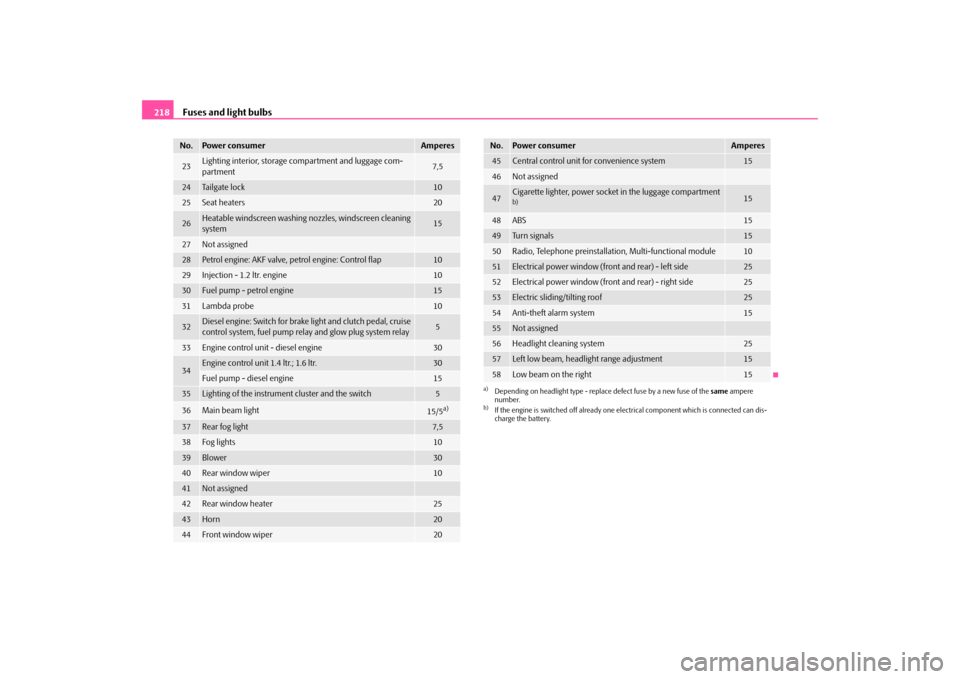
Fuses and light bulbs 21823
Lighting interior, storage compartment and luggage com-
partment
7,5
24
Tailgate lock
10
25
Seat heaters
20
26
Heatable windscreen washing nozzles, windscreen cleaning
system
15
27
Not assigned
28
Petrol engine: AKF valve, petrol engine: Control flap
10
29
Injection - 1.2 ltr. engine
10
30
Fuel pump - petrol engine
15
31
Lambda probe
10
32
Diesel engine: Switch for brake light and clutch pedal, cruise
control system, fuel pump relay and glow plug system relay
5
33
Engine control unit - diesel engine
30
34
Engine control unit 1.4 ltr.; 1.6 ltr.
30
Fuel pump - diesel engine
15
35
Lighting of the instrument cluster and the switch
5
36
Main beam light
15/5
a)
37
Rear fog light
7,5
38
Fog lights
10
39
Blower
30
40
Rear window wiper
10
41
Not assigned
42
Rear window heater
25
43
Horn
20
44
Front window wiper
20
No.
Power consumer
Amperes
45
Central control unit for convenience system
15
46
Not assigned
47
Cigarette lighter, power socket in the luggage compartment b)
15
48
ABS
15
49
Tu r n s i g n a l s
15
50
Radio, Telephone preinstallation, Multi-functional module
10
51
Electrical power window (front and rear) - left side
25
52
Electrical power window (front and rear) - right side
25
53
Electric sliding/tilting roof
25
54
Anti-theft alarm system
15
55
Not assigned
56
Headlight cleaning system
25
57
Left low beam, headlight range adjustment
15
58
Low beam on the right
15
a)Depending on headlight type - replace defect fuse by a new fuse of the same ampere
number.b)If the engine is switched off already one electrical component which is connected can dis-
charge the battery.No.
Power consumer
Amperes
s3f4.1.book Page 218 Thursday, June 18, 2009 11:07 AM
Page 222 of 259
Fuses and light bulbs221
Using the system
Safety
Driving Tips
General Maintenance
Breakdown assistance
Technical Data
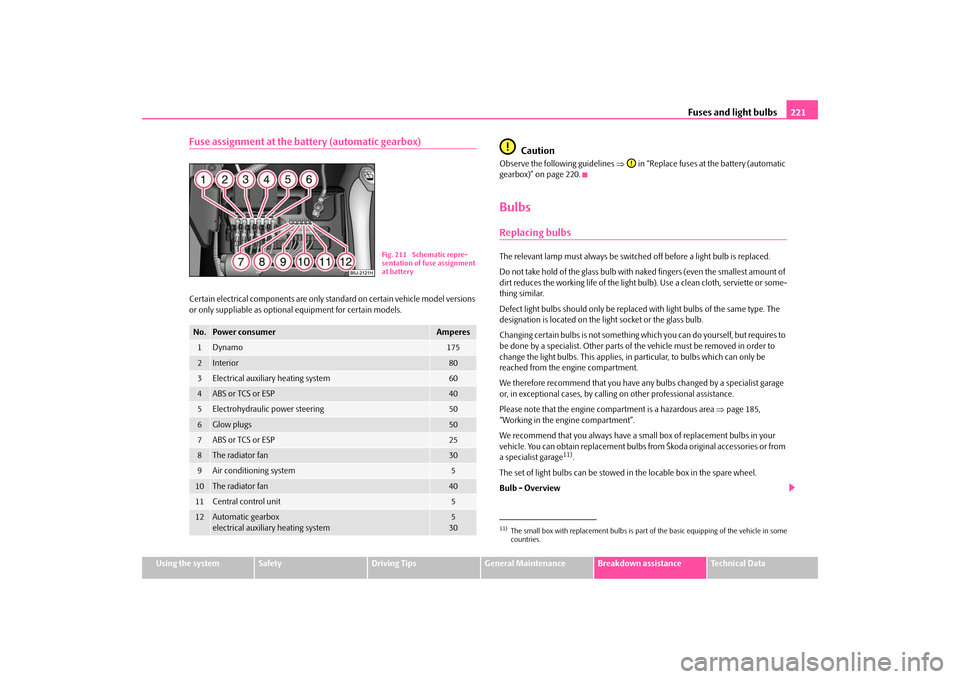
Fuse assignment at the battery (automatic gearbox)Certain electrical components are only standard on certain vehicle model versions
or only suppliable as optional equipment for certain models.
Caution
Observe the following guidelines ⇒ in “Replace fuses at the battery (automatic
gearbox)” on page 220.BulbsReplacing bulbsThe relevant lamp must always be switched off before a light bulb is replaced.
Do not take hold of the glass bulb with naked fingers (even the smallest amount of
dirt reduces the working life of the light bulb). Use a clean cloth, serviette or some-
thing similar.
Defect light bulbs should only be replaced with light bulbs of the same type. The
designation is located on the light socket or the glass bulb.
Changing certain bulbs is not something which you can do yourself, but requires to
be done by a specialist. Other parts of the vehicle must be removed in order to
change the light bulbs. This applies, in particular, to bulbs which can only be
reached from the engine compartment.
We therefore recommend that you have any bulbs changed by a specialist garage
or, in exceptional cases, by calling on other professional assistance.
Please note that the engine compartment is a hazardous area ⇒page 185,
“Working in the engine compartment”.
We recommend that you always have a small box of replacement bulbs in your
vehicle. You can obtain replacement bulbs from Škoda original accessories or from
a specialist garage
11).
The set of light bulbs can be stowed in the locable box in the spare wheel.
Bulb - Overview
No.
Power consumer
Amperes
1
Dynamo
175
2
Interior
80
3
Electrical auxiliary heating system
60
4
ABS or TCS or ESP
40
5
Electrohydraulic power steering
50
6
Glow plugs
50
7
ABS or TCS or ESP
25
8
The radiator fan
30
9
Air conditioning system
5
10
The radiator fan
40
11
Central control unit
5
12
Automatic gearbox
electrical auxiliary heating system
5
30
Fig. 211 Schematic repre-
sentation of fuse assignment
at battery
11)The small box with replacement bulbs is part of the basic equipping of the vehicle in some
countries.
s3f4.1.book Page 221 Thursday, June 18, 2009 11:07 AM