2009 SKODA FABIA electric
[x] Cancel search: electricPage 197 of 259

Inspecting and replenishing 196It is not normally necessary to disconnect the cables of the battery if you recharge
the battery using low amperages (as for example from a mini-charger). Please also
refer to the instructions from the charger manufacturer.
A charging current of 0.1 of the total battery capacity (or lower) is that which should
be used until full charging is achieved.
It is, however, necessary to disconnect both cables before charging the battery with
high amperages, so-called “quick-charging”.
“Quick-charging” a battery is dangerous ⇒ in “Working on the battery” on
page 192. It requires a special charger and appropriate knowledge. We therefore
recommend that you have your battery quick-charged only by your specialist
garage.
A discharged battery may already freeze at temperatures just below 0°C ⇒. We
recommend that you no longer use a battery which has thawed out because the
casing of the battery may be cracked through the formation of ice and this would
allow battery electrolyte to flow out.
The vent plugs of the battery should not be opened for charging.
WARNING
Never charge a frozen or thawed battery - risk of explosion and caustic
burns! Replace a frozen battery.Disconnecting and reconnecting the batteryOn disconnecting and reconnecting the battery the following functions are initially
deactivated or are no longer able to operate fault-free.We recommend having the vehicle checked by a specialist garage to ensure full
functionality of all electrical systems.
Replacing the batteryYou should only replace a battery with a new battery of the same capacity, voltage
(12 V), amperage and of the same size. Specialist garages have a range of suitable
batteries available.
We re c o m m e nd t h a t y o u o n l y ha v e a n o l d b a t te r y d i s p o s e d o f b y a s p e c i a l i s t g a ra g e
since it does require special disposal.
For the sake of the environment
Batteries contain poisonous substances such as sulphuric acid and lead. They must
be disposed of in accordance with local environmental protection regulations and
on no account as domestic waste.Operation
Operating measure
Electrical power window (operational faults)
⇒page 48
Enter radio code number
see Radio Operating Instructions
Set hours
⇒page 19
Data in the multi-functional indicator* are
deleted.
⇒page 19
s3f4.1.book Page 196 Thursday, June 18, 2009 11:07 AM
Page 205 of 259

Accessories, changes and replacement of parts 204Accessories, changes and replacement of partsAccessories and replacement partsŠkoda vehicles have been built according to the latest discoveries in safety engi-
neering. Thus one should not change the condition in which the vehicle was deliv-
ered from the manufacturer without some thought.
The following guidelines should be observed when a vehicle is to be retrofitted with
accessories, have technical changes made to it or a par t has to be replaced at some
time in the future.•
Advise should always be obtained from a specialist garage before buying any
accessories and before making any technical changes ⇒.
•
This is particularly the case when accessories are bought in a foreign country.
•
Škoda Genuine Accessories which have been released for use and Skoda orig-
inal parts can be bought from specialist garages that professionally undertake the
assembly of parts which were not purchased there.
•
All Škoda original accessories which are listed in the catalogue of original acces-
sories such as spoilers, transport systems, child seats, etc., are homologized.
•
Radios, aerials and other electrical accessories should only be installed by a
specialist garage.
•
The guidelines issued by Škoda Auto must be observed when making technical
changes.
•
This is to ensure that no technical damage occurs to the vehicle, that travelling
and operating safety are maintained and that the chnages are permissible. The
specialist garages also undertake this work professionally or refer it to another
specialist garage in special cases.
Any damage which is done caused by technical changes made without
consulting a Skoda dealer is excluded from the guarantee.
WARNING
•
We advise you, in your own interest, to only use Škoda Genuine Accesso-
ries and Škoda original parts which have been expressly approved for use on your Škoda. Reliability, safety and suitabiliity have been established for
these Škoda original parts.
•
We cannot guarantee suitability of installation into your vehicle of other
products despite keeping a constant eye on market developments (also not
in the case where there is an attestation or permission can be produced).
Technical changesInterference on the electronic components and their software can lead to opera-
tional faults. This interference can also impair not directly affected systems because
of the networking of the electronic components. This means that the operating
safety of your vehicle can be considerably jeopardized, a greater wear of vehicle
parts can occur and finally the vehicle registration documents expire.
We trust that you will understand that Škoda Auto cannot be liable for damage
resulting from unprofessional work.
We therefore recommend that you have all work carried out with Škoda original
parts at specialist garages.
WARNING
Work or modifications on your vehicle, which have been carried out unpro-
fessionally, can cause operational faults - risk of accident!Vehicles of the group N1The vehicle of the group N1 is a box car which is designed and manufactured for the
transportation of goods.
WARNING (continued)
s3f4.1.book Page 204 Thursday, June 18, 2009 11:07 AM
Page 213 of 259

Breakdown assistance 212•
We recommend purchasing jump-start cables from Škoda Service Partners as a
Škoda original accessory or from retailers who sell branded batteries.
Start engineIt is important to connect the jump-start cables in the correct order.
Connecting positive terminals
– Attach one end to the positive terminal ⇒fig. 200 of the
discharged battery .
– Attach the other end to the positive terminal of the battery
supplying the power .
Connecting negative terminal and engine block
– Attach one end to the negative terminal of the battery supplying
the power .
– Attach the other end to a solid metal part which is connected
firmly to the engine block, or to the engine block itself ⇒.Starting engine
– Start the engine of the vehicle providing current and run the engine at
idling speed.
– Now start the engine of the vehicle with the discharged battery.
– Interrupt the attempt at starting an engine after 10 seconds if it does
not start right away and wait for about 30 seconds before repeating
the attempt.
– Disconnect the cables on the engine in exactly the reverse order they
were connected up.
WARNING
•
The non-insulated parts of the terminal clamps must never make contact
with each other. Furthermore, the cable connected to the positive terminal
of the battery must not come into contact with electrically conducting parts
of the vehicle - risk of a short circuit!
•
Do not affix the jump starting cables to the negative terminal of the
discharged battery. There is the risk of detonating gas seeping out the
battery being ignited by the strong spark which results from the engine
being started.
•
Do not affix the cable end to parts of the fuel and brake system.
•
Run the jump-start cables so that they cannot be caught by any rotating
parts in the engine compartment.
•
Do not bend over the batteries - risk of caustic burns!
•
The vent screws of the battery cells must be tightened firmly.
•
Keep any sources of ignition (naked flame, smouldering cigarettes etc.)
away from the battery - risk of an explosion!
•
Never jump-start the batteries which have a too low electrolyte level -
risk of explosion and caustic burns!
Fig. 200 Jump-starting using
the battery from another
vehicle: A - flat vehicle
battery, B - battery providing
current
A1AAA2AB
A3
AB
A4
A4
s3f4.1.book Page 212 Thursday, June 18, 2009 11:07 AM
Page 217 of 259

Fuses and light bulbs 216Fuses and light bulbsElectric fusesReplacing fuses in the dash panel
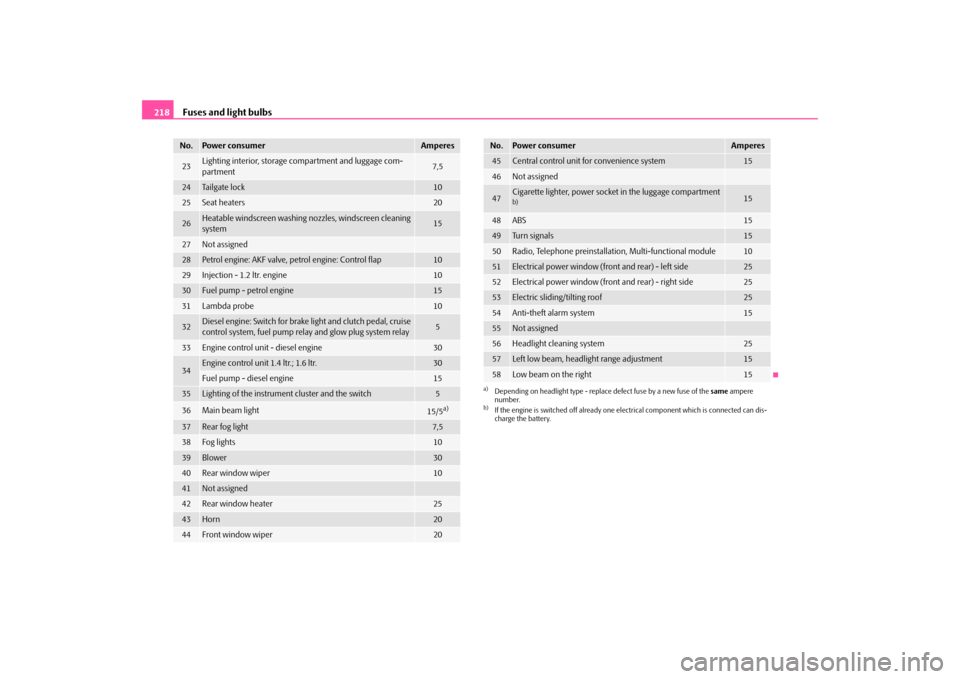
Defect fuses must be replaced.Individual electrical circuits are protected by fuses. The fuses are located
on the left side of the dash panel behind the safety cover.
– Switch the ignition off and also the electrical component affected.
– Carefully swivel the cover in the direction of arrow and pull it out
⇒fig. 204.
– Find out which fuse belongs to the component which is not operating
⇒page 217, “Fuse assignment in the dash panel”.
– Take the plastic clip out of its fixture in the fuse cover, insert it onto the
respective fuse and pull out this fuse.
– Defect fuses can be detected by their melted metal strips. Replace the
defect fuse by a new fuse of the same ampere number.– Insert the fuse cover into the dash panel in such a way that the guide
lugs are guided into the openings of the dash panel and then lock
them by pressing.
We recommend that you always have the small box of replacement fuses in your
vehicle. You can obtain replacement fuses from Škoda original accessories or from
a specialist garage
10).
Colour coding of fuses
Caution
•
Never attempt to “repair” fuses and also do not replace them with a fuse of a
higher amperage - risk of fire! This may also cause damage at another part of the
electrical system.
•
Have the electrical system checked as quickly as possible by a specialist garage
if a newly inserted fuse blows again after a short time.
Fig. 204 Bottom side of the
dash panel: fuse cover
10)The small box with replacement fuses is part of the basic equipping of the vehicle in some
countries.
Colour
Maximum amperage
light brown
5
brown
7,5
red
10
blue
15
yellow
20
white
25
green
30
s3f4.1.book Page 216 Thursday, June 18, 2009 11:07 AM
Page 218 of 259

Fuses and light bulbs217
Using the system
Safety
Driving Tips
General Maintenance
Breakdown assistance
Technical Data
Note
We recommend that you have these fuses replaced by a specialist garage.Fuse assignment in the dash panelCertain electrical components are only standard on certain vehicle model versions
or only suppliable as optional equipment for certain models.
Fig. 205 Schematic repre-
sentation of the fuse box for
vehicles with left-hand
steering.Fig. 206 Schematic repre-
sentation of the fuse box for
vehicles with right-hand
steering.
No.
Power consumer
Amperes
1
Not assigned
2
Not assigned
3
Instrument cluster, headlight range adjustment
5
4
ABS control unit
5
5
Petrol engine: Brake light switch, cruise control system
5
6
Not assigned
7
Engine control unit 1.2 ltr.
15
8
Injection valves - 1.4 ltr.; 1.6 ltr.
10
9
Operating controls for the heating, control unit for air condi-
tioning system, parking aid, control unit for cornering lights
5
10
Not assigned
11
Electrically adjustable rear mirror, power windows
7,5
12
Reversing light
7,5
13
Engine control unit (for vehicles with automatic gearbox)
10
14
Motor for cornering lights
10
15
Navigation PDA
5
16
Electrohydraulic power steering, engine control unit - petrol
engine
5
17
Left parking light, licence plate light
5
18
Right parking light
5
19
Radio, central control unit
5
20
Engine control unit 1.4 ltr.; 1.9 ltr. - diesel engine
5
21
Brake lights
10
22
Operating controls for the heating, control unit for air condi-
tioning system, parking aid, mobile phone, instrument clus-
ter, steering angle sender, ESP, vehicle voltage control unit
7,5
s3f4.1.book Page 217 Thursday, June 18, 2009 11:07 AM
Page 219 of 259
Fuses and light bulbs 21823
Lighting interior, storage compartment and luggage com-
partment
7,5
24
Tailgate lock
10
25
Seat heaters
20
26
Heatable windscreen washing nozzles, windscreen cleaning
system
15
27
Not assigned
28
Petrol engine: AKF valve, petrol engine: Control flap
10
29
Injection - 1.2 ltr. engine
10
30
Fuel pump - petrol engine
15
31
Lambda probe
10
32
Diesel engine: Switch for brake light and clutch pedal, cruise
control system, fuel pump relay and glow plug system relay
5
33
Engine control unit - diesel engine
30
34
Engine control unit 1.4 ltr.; 1.6 ltr.
30
Fuel pump - diesel engine
15
35
Lighting of the instrument cluster and the switch
5
36
Main beam light
15/5
a)
37
Rear fog light
7,5
38
Fog lights
10
39
Blower
30
40
Rear window wiper
10
41
Not assigned
42
Rear window heater
25
43
Horn
20
44
Front window wiper
20
No.
Power consumer
Amperes
45
Central control unit for convenience system
15
46
Not assigned
47
Cigarette lighter, power socket in the luggage compartment b)
15
48
ABS
15
49
Tu r n s i g n a l s
15
50
Radio, Telephone preinstallation, Multi-functional module
10
51
Electrical power window (front and rear) - left side
25
52
Electrical power window (front and rear) - right side
25
53
Electric sliding/tilting roof
25
54
Anti-theft alarm system
15
55
Not assigned
56
Headlight cleaning system
25
57
Left low beam, headlight range adjustment
15
58
Low beam on the right
15
a)Depending on headlight type - replace defect fuse by a new fuse of the same ampere
number.b)If the engine is switched off already one electrical component which is connected can dis-
charge the battery.No.
Power consumer
Amperes
s3f4.1.book Page 218 Thursday, June 18, 2009 11:07 AM
Page 220 of 259

Fuses and light bulbs219
Using the system
Safety
Driving Tips
General Maintenance
Breakdown assistance
Technical Data
Replace fuses at the battery (manual gearbox)– Press together ⇒fig. 207 the interlocks of the fuse cover simultane-
ously in direction of arrow and push out the cover in direction of
arrow .
– Find out which fuse belongs to the component which is not operating.
– Defect fuses can be detected by their melted metal strips. Replace the
defect fuse by a new fuse of the same ampere number.
Caution•
Never attempt to “repair” fuses and also do not replace them with a fuse of a
higher amperage - risk of fire! This may also cause damage at another part of the
electrical system.
•
Have the electrical system checked as quickly as possible by a specialist garage
if a newly inserted fuse blows again after a short time.Note
We recommend that you have these fuses replaced by a specialist garage.
Fuse assignment at the battery (manual gearbox)Certain electrical components are only standard on certain vehicle model versions
or only suppliable as optional equipment for certain models.
Fig. 207 The battery: fuse
cover
AA
AB
No.
Power consumer
Amperes
1
Dynamo
175
2
Not assigned
3
Interior
80
4
Electrical auxiliary heating system
60
5
Interior
40
6
Glow plugs, coolant fan
50
7
Electrohydraulic power steering
50
8
ABS or TCS or ESP
25
9
The radiator fan
30
10
The radiator fan
5
Fig. 208 Schematic repre-
sentation of fuse assignment
at battery
s3f4.1.book Page 219 Thursday, June 18, 2009 11:07 AM
Page 221 of 259

Fuses and light bulbs 220
CautionObserve the following guidelines ⇒ in “Replace fuses at the battery (manual
gearbox)”.
Note
The fuses 1 - 7 can be replaced by a specialist garage.Replace fuses at the battery (automatic gearbox)
– Open the positive terminal cover (+) ⇒fig. 209.
– Press onto the interlocks of the fuse covers ⇒fig. 210 and open
the covers.
– Press together the interlocks of the fuse cover simultaneously and
push out the cover in the direction of the arrow.
– Find out which fuse belongs to the component which is not operating
⇒page 221, “Fuse assignment at the battery (automatic gearbox)”.
– Defect fuses can be detected by their melted metal strips. Replace the
defect fuse by a new fuse of the same ampere number.
Caution•
Never attempt to “repair” fuses and also do not replace them with a fuse of a
higher amperage - risk of fire! This may also cause damage at another part of the
electrical system.
•
Have the electrical system checked as quickly as possible by a specialist garage
if a newly inserted fuse blows again after a short time.Note
•
We recommend that you have these fuses replaced by a specialist garage.
•
Some vehicles are only fitted with the cover ⇒fig. 210.
11
ABS or TCS or ESP
40
12
Central control unit
5
13
Automatic gearbox
electrical auxiliary heating system
5
30
No.
Power consumer
Amperes
Fig. 209 The battery:
Opening of the positive
terminal cover.
Fig. 210 The battery: fuse
coverAAAB
AB
s3f4.1.book Page 220 Thursday, June 18, 2009 11:07 AM