2009 SKODA FABIA wheels
[x] Cancel search: wheelsPage 162 of 259

Intelligent Technology161
Using the system
Safety
Driving Tips
General Maintenance
Breakdown assistance
Technical Data
•
the structure of the tyre is damaged,
•
the vehicle is loaded to one side or with a load on the roof,
•
the wheels of an axle are loaded heavily (e.g. when towing a trailer or when
driving uphill or downhill),
•
the vehicle is operated in unfavourable winter conditions or on an unfirm
ground,
•
Snow chains or emergency wheel* are mounted,
•
the driver has a sporty style of driving (with sharp acceleration and high speed
when cornering).
Basic setting of tyre inflation pressure-control system
After changing the tyre inflation pressures or after changing one or several wheels,
a basic setting of the system must be carried out as follows.
•
Inflate all tyres to the specified inflation pressure ⇒page 198.
•
Switch on the ignition.
•
Press button
⇒page 160, fig. 172 for more than 2 seconds. While
pressing the button, the warning light
lights up. At the same time the basic
values are stored, which is confirmed with an acoustic sound and then the warning
light
goes out.
•
If the warning light
does not go out after the basic setting, there is a fault in
the system. Have the vehicle inspected by your nearest specialist garage.
Function description
After the basic setting of the system the “adaptation” of the tyre inflation pressures
and then the tyre pressure control in the individual tyres are performed.
Warning light
lights up
If the tyre inflation pressure of at least one wheel is insufficiently inflated in compar-
ison to the stored basic value, the warning light
⇒ lights up. Inflate all tyres
to the specified inflation pressure ⇒page 198, “Tyre life” and then perform a basic
setting of the system.
Warning light
flashes
If the warning light flashes, there is a system fault. Have the vehicle inspected by
your nearest specialist garage.
WARNING
•
When the warning light
lights up, immediately reduce the speed and
avoid sudden steering and brake manoeuvres. Please stop the vehicle
without delay at the nearest possible stop and inspect the tyres and their
inflation pressures.
•
The driver is responsible for the correct tyre inflation pressures. For this
reason, the tyre inflation pressures must be checked regularly.
•
Under certain circumstances (e.g. sporty style of driving, wintry or
unpaved roads) the warning light
can be delayed or does not light up at
all.
•
The tyre inflation pressure-control system does not take away the
responsability from the driver for the correct tyre inflation pressure.Note
The tyre inflation pressure-control system:•
does not replace the regular tyre inflation pressure control, because the system
cannot detect an even pressure loss;
•
cannot warn in case of very rapid tyre inflation pressure loss, e.g. in case of
sudden tyre damage. In this case carefully bring the vehicle to a standstill without
sudden steering movements and without sharp braking.
s3f4.1.book Page 161 Thursday, June 18, 2009 11:07 AM
Page 172 of 259

Towing a trailer171
Using the system
Safety
Driving Tips
General Maintenance
Breakdown assistance
Technical Data should be attached to folding arms. Adjust the mirrors so that they provide you with
an adequate field of view to the rear.
Headlights
Before starting off with a hitched trailer, also check the setting of the headlights.
Alter the setting as necessary with the aid of the headlight beam adjuster
⇒page 53.
Detachable ball head
The ball rod is detachable on vehicles with towing device and suppliable from
Škoda original accessories. It is stowed together with separate fitting instructions in
the spare wheel well in the luggage compartment of the vehicle.
Note
•
We recommend that you also have your vehicle inspected between service
intervals if you tow a trailer frequently.
•
The handbrake on the towing vehicle must be put on when coupling and
decoupling the trailer.
•
Keep the mechanism of the ball head of the towing device clean and take
proper care of it with a suitable preservative.
Driving Tips
Particular caution is required when towing a trailer.– Do not, as far as possible, drive with your vehicle unladen and the
trailer laden.
– Do not make full use of the legal maximum speeds. This applies in
particular to downhill sections.
– Apply the brakes in good time.
– Keep a check on the coolant temperature gauge if the outside temper-
ature is high.
Distribution of weight
The distribution of the weight is very poor if your vehicle is unladen and the trailer
is laden. Maintain a particularly low speed if you cannot avoid driving with this
combination.
Driving speed
Do not drive faster than 80 km/h for safety reasons. This also applies for countries
in which higher speeds are allowed.
The fact that the driving stability of the vehicle + trailer combination reduces with
increasing speed means that the legally allowed speed should not be used when
there are unfavourable road, weather or wind conditions, particularly near accident
black spots.
You must always reduce your speed immediately as soon as you detect even just
the slightest swaying of the trailer. On no account attempt to stop the trailer from
“swaying” by accelerating.
Apply the brakes in good time! If the trailer is fitted with a trailer brake, apply the
brakes gently at first and then brake firmly. This will avoid brake jolts resulting from
the trailer wheels locking. Shift down gears in good time before negotiating a down-
hill section to allow the engine to also act as a brake.
Engine overheating
Please keep a check on the coolant temperature gauge if you have to negotiate a
lengthy slope in a low gear at a high engine speed when the outside temperature is
very high ⇒page 16.
If the needle of the coolant temperature gauge moves into the right-hand area or
even the red area of the scale, reduce your speed immediately. Stop and switch off
the engine if the warning light
in the instrument cluster begins flashing. Wait a
few minutes and check the level of coolant in the coolant expansion bottle
⇒page 189, “Inspecting the coolant level”.
Please refer to the following guidelines ⇒page 29, “Coolant temperature/coolant
level ”.
The coolant temperature can be reduced by switching on the heating.
Any increase in the cooling effect of the coolant fan through shifting down a gear
and increasing the engine speed is not possible since the fan speed is independent
s3f4.1.book Page 171 Thursday, June 18, 2009 11:07 AM
Page 175 of 259

Taking care of your vehicle and cleaning the vehicle 174Automatic vehicle wash systemsThe paintwork of the vehicle is sufficiently resistant that the vehicle can be washed
normally in automatic vehicle wash plants without any problem. The actual stress
to which the paintwork is subjected, however, depends primarily on the design of
the vehicle wash system, the filtering of the water and the type of washing and care
products used. If the paintwork of your vehicle appears mat after being washed or
even has scratches, point this out to the operator of the vehicle wash plant. Use a
different vehicle wash plant, if necessary.
There are no particular points to note before washing your vehicle in such a plant
other than the usual precautionary measures (closing windows, moving any
factory-fitted aerials down flat against the bodywork, etc.).
If you have any particular attach e d p a r t s f i t te d t o y o u r c a r - s u ch a s s p o i l e r, ro o f ra ck
system, two-way radio aerial - it is best to first of all consult the operator of the car
wash plant.
It is important to degrease the lips of the windscreen wiper rubbers after passing
through the automatic vehicle wash system.
Caution
Do not screw the swivelling down roof aerial tight before washing the vehicle in an
automatic vehicle wash system - risk of damage!Washing vehicle by handIt is important to first soften the dirt with plenty of water and rinse it off as thor-
oughly as possible before washing your vehicle by hand.
One should then clean the vehicle using a soft washing sponge, washing glove or
a washing brush and only slight pressure. Work from the top to the bottom -
beginning with the roof. Only place slight pressure on the vehicle paintwork during
cleaning Only use a car shampoo for stubborn dirt.
Wash out the sponge or washing glove thoroughly at short intervals.
Clean wheels, door sills and similar parts last. Use a second sponge for such areas.Rinse off the vehicle well after giving it a wash and dry it off using a chamois leather.
WARNING
•
The ignition should always be switched off when you wash your vehicle -
risk of accident!
•
Protect your hands and arms from sharp-edged metal parts when you
are cleaning the underfloor, the inside of the wheel housings or the wheel
trims - risk of cuts.Caution
•
Do not wash your vehicle in bright sunlight - risk of paint damage.
•
Ensure that the jet of water is not aimed directly at the locking cylinders or at the
door and panel joints if you spray your vehicle in winter down with a hose - risk of
freezing.
•
Do not use any insect sponges, rough kitchen sponges or similar cleaning prod-
ucts - risk of damage to the surface of paintwork.For the sake of the environment
Only wash your vehicle at washing bays specifically reserved for this purpose. This
ensures that no water which may be contaminated by oil flows into the sewage
system. It is not even permitted to wash your vehicle in certain areas except at such
specific washing bays.Washing with a high-pressure cleanerWhen you wash your vehicle with a high-pressure cleaner, it is essential to comply
with the instructions for use of the cleaning equipment. This applies in particular to
the pressure used and to the spraying distance. Maintain a sufficiently large
distance to soft materials such as rubber hoses or insulation material.
On no account use circular spray nozzles or so-called dirt cutters.
s3f4.1.book Page 174 Thursday, June 18, 2009 11:07 AM
Page 178 of 259

Taking care of your vehicle and cleaning the vehicle177
Using the system
Safety
Driving Tips
General Maintenance
Breakdown assistance
Technical Data
WheelsSteel wheels
You should also thoroughly wash the wheels and wheel trims when giving your
vehicle its regular wash. This prevents any brake dust, dirt and road salt from
sticking to the wheel hubs. You can remove stubborn brake abrasion adhering to
t h e w h e e l s w i t h a n i n d u s tr i a l c l e a n e r. To u c h u p a n y d a m a g e to t h e p a i n tw o r k o n th e
wheels before rust is able to form.
Light alloy wheels
Regular care of light alloy wheels is necessary in order to retain their decorative
appearance over long periods. It is particularly important to remove any road salt
and brake abrasion from light alloy wheels every two weeks, otherwise the surface
will suffer. Wash thoroughly and then treat the wheels with a protective product for
light alloy wheels which does not contain any acidic components. You should
provide the wheel hubs with a hard wax layer every three months. You must not use
any products which cause abrasion when treating the wheel hubs. Any damage to
the paint layer on the wheel hubs must be touched up immediately.
We recommend using a preservative from Škoda genuine accessories offered by
your Škoda dealer.
WARNING
One should remember when cleaning the wheels that moisture, ice and road
salt may adversely affect braking efficiency - risk of an accident!
Note
Severe layers of dirt on the wheels can also result in wheel imbalance. This may
show itself in the form of a wheel vibration which is transmitted to the steering
wheel which, in certain circumstances, can cause premature wear of the steering.
This means it is necessary to remove the dirt.
Underbody protectionThe underside of your vehicle is protected for life against chemical and mechanical
influences.
One cannot, however, completely rule out damage to the protective layer when
driving so we recommend that you inspect the protective layer on the underside of
your vehicle and on the chassis at certain intervals - this is best done at the begin-
ning and end of the winter - and to touch up any damaged areas.
Specialist garages have suitable spray products available as well as the necessary
equipment and are familiar with the instructions for use. Therefore, we recommend
you have such touch-up work or additional corrosion protection measures carried
out by a specialist garage.
WARNING
Never use additional underbody protection or corrosion-protection agents
for the exhaust pipes, catalytic converters or heat shields. These products
might ignite when driving - risk of fire!Protection of hollow spacesAll the cavities of your vehicle which are at risk from corrosion are protected for life
by a layer of protective wax applied in the factory.
This wax protection does not require to be inspected or re-treated. Please remove
any small amount of wax which flows out of the cavities at high temperatures with
a plastic scraper and clean the spot using petroleum cleaner.
WARNING
Safety and environmental protection regulations should observed when
using petroleum cleaner to remove wax - a risk of fire!
s3f4.1.book Page 177 Thursday, June 18, 2009 11:07 AM
Page 199 of 259

Wheels and Tyres 198Wheels and TyresWheelsGeneral information•
New tyres do not offer optimal grip at first and should therefore be run in for
about 500 km at a moderate speed and an appropriately cautious style of driving.
You will also profit from longer tyre life.
•
The tread depth of new tyres may differ because of design features and the
configuration of the tread (depending on the type of tyre and the manufacturer).
•
Drive over curbs on the side of the road and other such obstacles slowly and,
where possible, at a right angle in order to avoid damage to tyres and wheel trims.
•
Inspect your tyres from time to time for damage (punctures, cuts, splits and
bulges). Remove foreign bodies from the tyre profile.
•
Damage to tyres and wheels is frequently not visible. Unusual vibrations or
pulling of the vehicle to one side could be a sign of tyre damage. Please reduce
your speed immediately and stop if you suspect that a wheel is damaged.
Inspect the tyres for signs of damage (bulges, splits, etc.). If no visible damage is
present, please drive at an appropriately slow speed and carefully to the nearest
specialist garage in order to have your vehicle inspected.
•
Also protect your tyres from contact with oil, grease and fuel.
•
Immediately replace any dust caps of the valves which have got lost.
•
Mark wheels before removing them so that their previous direction of running
can be maintained when mounted them again.
•
Always store wheels or tyres which been removed in a cool, dry and, where
possible, dark place. Tyres which are not fixed to a wheel trim should be stored
upright.
Unidirectional tyres*
The direction of rotation of the tyres is marked by arrows on the wall of the tyre. This
indicates the direction of rotation of the tyre, and it is essential that the tyres are
fitted on to run in this direction. Only then are the tyres able to provide the optimal
properties in terms of grip, low noise, wear-and-tear and aquaplaning.Further information concerning the use of unidirectional tyres ⇒page 202.
WARNING
•
New tyres during the first 500 km do not offer optimal grip and should
therefore be run appropriately - risk of accident!
•
Never drive with damaged tyres - risk of accident!Note
Please observe the various differing legal requirements regarding tyres.Tyre lifeThe life of your tyres very much depends on the following points:
Tyre pressure
The working life of tyres will be shortened considerably if the tyres are insufficiently
or over-inflated and this will have an adverse effect on the handling of your vehicle.
Correctly inflated tyres are of particular importance when travelling at high speeds.
It is therefore good to check the pressure at least once a month and also before
Fig. 190 An opened fuel filler
flap with a tyre size and tyre
inflation pressure table
s3f4.1.book Page 198 Thursday, June 18, 2009 11:07 AM
Page 200 of 259

Wheels and Tyres199
Using the system
Safety
Driving Tips
General Maintenance
Breakdown assistance
Technical Data setting off on a long trip. Please do not forget the spare wheel* when checking the
tyres.
The tyre inflation pressures for summer tyres are indicated on the inside of the fuel
filler flap ⇒page 198, fig. 190. The inflation pressures for winter tyres are 20 kPa
(0.2 bar) higher than those for summer tyres ⇒page 202.
The tyre pressure should be at the highest pressure specified for your vehicle at all
times.
Always check the inflation pressure of tyres when cold. Do not reduce the higher
pressure of warm tyres. Adapt the inflation pressure of the tyres accordingly if your
vehicle is carrying a significantly higher payload.
Driving style
Fast cornering, sharp acceleration and braking (squealing tyres) increase wear-and-
tear on your tyres.
Balancing wheels
The wheels of a new vehicle are balanced. There are a wide range of influences
when driving which may result in an imbalance and which makes themselves felt
through vibration in the steering.
You should have the wheels rebalanced since any imbalance increases wear-and-
tear on the steering, the suspension and tyres. A wheel must also be rebalanced
when a new tyre is fitted and each time a tyre is repaired.
Wheel alignment errors
Incorrect wheel alignment at the front and rear will not only increase wear-and-tear
on the tyres but will also has an adverse effect on vehicle safety. Contact your
specialist garage if you notice any unusual tyre wear.
WARNING
•
If the inflation pressure is too low, the tyre must perform a higher rolling
resistance. At higher speeds the tyre will warm up as a result of this. This can
result in tread separation and even a tyre blowout.
•
Immediately replace the damaged rims or tyres.
•
Tyres which are 6 years old or more should only be fitted in exceptional
cases and when adopting an appropriately cautious style of driving.For the sake of the environment
Tyres which are insufficiently inflated increase your fuel consumption.Wear indicatorsThe base of the tread of the original tyres has wear indicators 1.6 mm high, installed
at right angles to the direction of travel. These wear indicators are located at 6 - 8
points depending on the make and are evenly spaced around the circumference of
the tyre ⇒fig. 191. Markings on the walls of the tyres through the letters “TWI”,
triangular symbols or other symbols identify the position of the wear indicators.
A remaining tread of just 1.6 mm, measured in the grooves of the tread next to the
wear indicators, means that your tyres have reached their legally permissible
minimum tread depth.
WARNING (continued)
Fig. 191 Tyre tread with wear
indicators
s3f4.1.book Page 199 Thursday, June 18, 2009 11:07 AM
Page 201 of 259
Wheels and Tyres 200
WARNING
•
You must have your tyres replaced with new ones at the latest when the
wear indicators have been worn down. The legally permissible minimum
tread depth should be observed.
•
Worn tyres do not provide the necessary adhesion to the road surface at
high speeds on wet roads. One could experience “aquaplaning” (uncon-
trolled movements of the vehicle - “swimming” on a wet road surface).
Changing wheels aroundIf significantly greater wear is present on the front tyres, we recommend changing
the front wheels around with the rear wheels. You will then obtain approximately
the same life for all the tyres.
It may be advantageous to swap the tyres over “crosswise” when certain types of
wear characteristic arise on the running surface of the tyres (but not in the case of
unidirectional tyres). Specialist garages are familiar with details.
We recommend that you change the wheels around every 10 000 km in order to
achieve even wear on all wheels and to obtain optimal tyre life.New tyres and wheelsTyres and wheel rims are important design elements. One should therefore use the
tyres and wheel rims which have been released for use by Škoda Auto. They are
exactly matched to the vehicle type and therefore contribute significantly to good
road holding and safe driving characteristics ⇒.
Only fit radial tyres of the same type on all 4 wheels, size (rolling circumference)
and, if possible, the same tread pattern on one axle.
The specialist garages have access to the most current information about which
tyres we have released for use on your vehicle.
We recommend that you have any work relating to tyres or wheels carried out by a
specialist garage. Your dealer has all of the necessary special tools and replace-
ment parts available plus the required specialist knowledge and is also in a position to properly dispose of the old tyres. A large number of specialist garages also have
an attractive range of tyres and wheels available.
The tyre/wheel combinations which are approved for your vehicle are indicated in
your vehicle documents. Approval and licensing may differ according to the legis-
lation prevailing in individual countries.
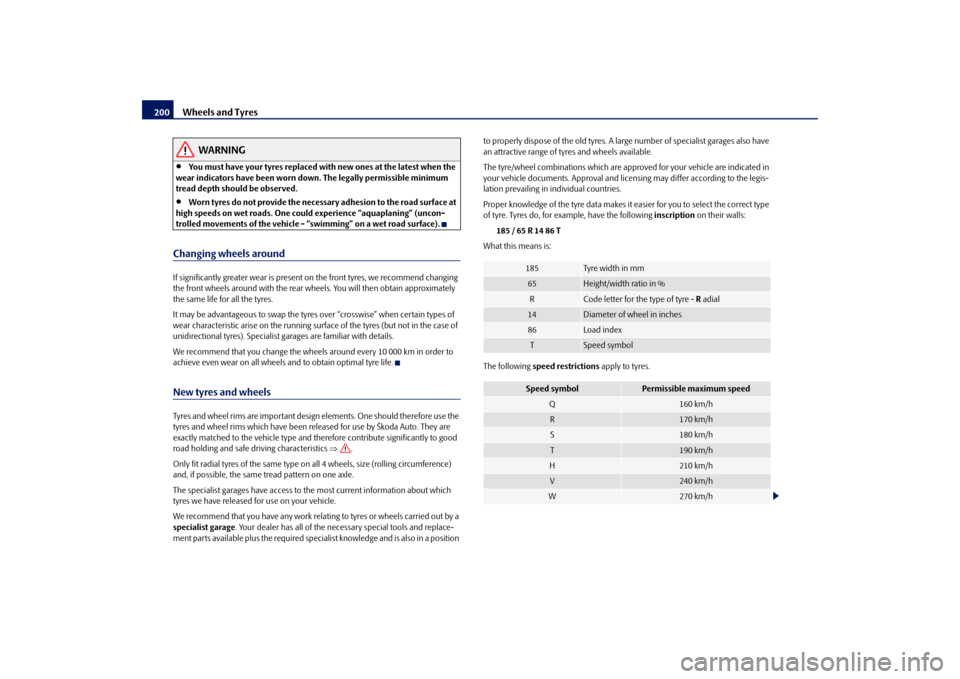
Proper knowledge of the tyre data makes it easier for you to select the correct type
of tyre. Tyres do, for example, have the following inscription on their walls:
185 / 65 R 14 86 T
What this means is:
The following speed restrictions apply to tyres.
185
Tyre w idt h in mm
65
Height/width ratio in %
R
Code letter for the type of tyre - R adial
14
Diameter of wheel in inches
86
Load index
T
Speed symbol
Speed symbol
Permissible maximum speed
Q
160 km/h
R
170 km/h
S
180 km/h
T
190 km/h
H
210 km/h
V
240 km/h
W
270 km/h
s3f4.1.book Page 200 Thursday, June 18, 2009 11:07 AM
Page 202 of 259
Wheels and Tyres201
Using the system
Safety
Driving Tips
General Maintenance
Breakdown assistance
Technical Data The date of manufacture is also stated on the tyre wall (possibly only on the inside
of wheel).
DOT ... 22 09...
means, for example, that the tyre was manufactured in the 22nd week of the year
2009.
If the spare wheel* differs from the tyres fitted to the vehicle (e.g. winter tyres or
low-profile tyres), the spare wheel* should only be used for a short time in the
event of a puncture and when adopting an appropriately cautious style of driving.
It should be replaced as quickly as possible by a normal wheel.
WARNING
•
Only use those tyres or wheel rims which have been approved for your
model of Škoda Auto vehicle. Failure to observe this instruction will
adversely affect the road safety of your vehicle - risk of accident! Approval
and licencing of your vehicle on public roads may also become void as a
result.
•
You must on no account drive at a higher speed than is permissible for
your tyres - risk of an accident resulting from tyre damage and loss of control
over your vehicle.
•
Tyres which are 6 years old or more should only be fitted in exceptional
cases and when adopting an appropriately cautious style of driving.
•
Never fit tyres which have already been used without having adequate
knowledge of their previous history. Tyres age even if they have not been
used at all or only very little. A spare tyre must only be used in exceptional
cases and only then when adopting an appropriately cautious style of
driving.
•
Do not, where possible, replace individual tyres but at least replace them
on both wheels of a given axle at the same time. Always fit the tyres with the
deeper tread depth to the front wheels.For the sake of the environment
Old tyres must be disposed of in conformity with the appropriate regulations.
Note
It is not normally possible to fit wheels from other models of cars for technical
reasons. This may also apply in certain circumstances to the wheels of the same
type of vehicle.Wheel boltsWheels and wheel bolts are matched to each other in terms of design. Each time
you fit other wheels - e.g. light alloy wheels or wheels with winter tyres - you must
therefore also use the matching wheel bolts of the correct length and shape of
spherical cap. This is essential to ensure that the wheels are tightly fitted and that
the brake system operates properly.
If you retrofit wheel trims (or have this done), please also ensure that an adequate
flow of air remains assured for cooling the brake system.
The specialist garages are informed about the technical possibilities which exist
regarding converting or retrofitting wheels, tyres and wheel trims.
WARNING
•
In case of incorrect treatment of the wheel bolts, the wheel can loosen
when the car is moving - risk of accident!
•
The wheel bolts must be clean and must turn easily. However, they must
never be treated with grease or oil.
•
If the wheel bolts are tightened to a too low tightening torque, the rim
can lossen when the car is moving - risk of accident! A tightening torque
which is too high can damage the bolts and threads and this can result in
permanent deformation of the contact surfaces on the rims.Caution
The prescribed tightening torque of the wheel bolts for steel and light alloy wheels
is 120 Nm.
s3f4.1.book Page 201 Thursday, June 18, 2009 11:07 AM