2009 SKODA FABIA air conditioning
[x] Cancel search: air conditioningPage 95 of 259

Heating and air conditioning system 94Set ClimaticRecommended settings of Climatic controls for the respective operating modes:
Set-up
Setting of the control dial
Button
Air outlet vents 4
Defrosting the windscreen and
side windows
recommended
22°C
3
do not switch on
switched off
open and align with the side
window
Free windscreen and side win-
dows from mist
desired tempera-
ture
2
do not switch on
switched on
open and align with the side
window
the fastest heating
recommended
22°C
3
briefly switched on
switched off
open
comfortable heating
desired tempera-
ture
2 or 3
do not switch on
switched off
open
the fastest cooling
recommended
22°C
briefly 4, then
2or 3
briefly switched on
switched on
open
optimal cooling
desired tempera-
ture
1, 2 or 3
do not switch on
switched on
open and align to the roof
Fresh air mode - ventilation
up to the stop
towards the left
desired position
do not switch on
switched off
open
AA
AB
AC
AD
AE
s3f4.1.book Page 94 Thursday, June 18, 2009 11:07 AM
Page 96 of 259

Heating and air conditioning system95
Using the system
Safety
Driving Tips
General Maintenance
Breakdown assistance
Technical Data
Using the air conditioning system economicallyThe compressor on the Climatic uses power from the engine when in cooling mode
which will effect the fuel consumption.
It recommended to open the windows or the doors of a vehicle for which the inte-
rior has been strongly heated through the effect of direct sunlight in order to allow
the heated air to escape.
The cooling system should not be switched on while travelling when the window is
open.
The desired interior temperature can also be achieved without switching in the
cooling system just by switching to fresh air mode.
For the sake of the environment
When you economize on fuel, you also reduce pollutant emissions.Operational problemsIf the cooling system does not operate at outside temperatures higher than +2 °C,
there is a problem in the system. The reasons for this may be:•
The fuse of the Climatic is defective. Check the fuse, replace it if necessary
⇒page 216.
•
The cooling system has switched off automatically for a short time because the
coolant temperature of the engine is too hot ⇒page 16.
If you are not able to rectify the operational problem yourself, or if the cooling
capacity decreases, switch the cooling system off. Contact a specialist garage.
If there is a fault at the Climatronic, all symbols on the display flash after switching
on the ignition for 15 seconds. Contact a specialist garage.
Climatronic (automatic air conditioning)*Description
The Climatronic system is a combination of an automatic heating,
fresh air and cooling system which provides optimal comfort for the
occupants of the car.The Climatronic maintains a constant temperature fully automatically, once it has
been set. This is achieved by automatically varying the temperature of the
outflowing air, the blower stages and the air distribution. The system also takes into
account sunlight which eliminates the need to alter the settings manually. The
automatic mode ⇒page 97 ensures maximum wellbeing of the occupants at all
times of the year.
Description of Climatronic system
The cooling operates only if the following conditions are met:•
engine running,
•
outside temperature above +2°C,
•
the button is not pressed.
If the cooling system is switched on, the temperature and air humidity drops in the
vehicle. The wellbeing of the occupants of the car is enhanced as a result of this
particularly at high outside temperatures and a high air humidity. The system
prevents the windows misting up during the cold season of the year.
The heating effect is dependent upon the coolant temperature, thus full heat
output only occurs when the engine has reached its operating temperature.
It is possible to briefly activate recirculated air mode in order to enhance the
cooling effect ⇒.
The air inlet in front of the windscreen must be free of ice, snow or leaves in order
to ensure that the heating and cooling systems operate properly.
The AC compressor is switched off at a high coolant temperature in order to provide
cooling at a high load of the engine.
ECON
s3f4.1.book Page 95 Thursday, June 18, 2009 11:07 AM
Page 97 of 259

Heating and air conditioning system 96After switching on the cooling Condensation from the evaporator of the air condi-
tioning may drip down and form a puddle below the vehicle. This is quite normal
and not an indication of a leak!
Recommended setting for all periods of the year:•
Set the temperature to 22 °C.
•
Press the button ⇒fig. 121.
•
Move the air outlet vents 3 and 4, so that the air flow is directed slightly
upwards.
Switching over between degrees Celsius and degrees Fahrenheit
Press and hold the buttons and ⇒fig. 121. The information in the
desired temperature measuring unit appears in the display.
WARNING
•
For your own safety and that of other road users, ensure that all the
windows are free of ice, snow and misting. Please familiarize yourself about
how to correctly operate the heating and ventilation systems, how to demist
and defrost the windows, as well as with the cooling mode.
•
You should not leave recirculated air mode on over a longer period of
time, as “stale” air may result in fatigue in the driver and occupants, divert
your attention and also cause the windows to mist up. The risk of having an
accident increases. Switch recirculated air mode off as soon as the windows
begin misting up.Note
•
If the cooling system has not been switched on for a lengthy period, odours may
be produced at the evaporator because of deposits. Switch the cooling system on
at least once a month for approximately 5 minutes at the highest blower stage - also
during the cold season of the year - in order to remove such odours. Also open a
window for a short time.
•
We recommend that you do not smoke in the vehicle when the recirculating air
mode is operating since the smoke which is drawn at the evaporator from the inte-
rior of the vehicle forms deposits in the evaporator of the air conditioning system. This produces a permanent odour when the air conditioning system is operating
which can only be eliminated through considerable effort and expense (replace-
ment of compressor).
•
The used air streams out through the air removal openings in the luggage
compartment.
•
Using the cooling economically ⇒page 95.
•
Operational problems ⇒page 95.
Overview of the control elementsFig. 121 Climatronic: Control elementsButtons / control dial
Setting the blower speed
The displays
Set blower speed
The outside temperature
Climatronic fault, have the vehicle inspected by a specialist garage
Air flow to the windows
Recirculated air mode
Air flow to the head, upper body and feet
AUTO
ECON
AUTO
A1A2A3A4A5A6A7
s3f4.1.book Page 96 Thursday, June 18, 2009 11:07 AM
Page 98 of 259

Heating and air conditioning system97
Using the system
Safety
Driving Tips
General Maintenance
Breakdown assistance
Technical Data Display of selected interior temperature, here: +20 °C
Automatic mode
ECON mode
Buttons / control dial
Setting the interior temperature
Air flow to the windows
Automatic mode
Air flow in the footwell
Air flow to the upper body
Air flow to head
Button for switching off cooling system
Recirculated air mode
Note
The interior temperature sensor is located in the bottom part of the device. Do
not glue or cover over the sensor, otherwise it could have an unfavourable effect on
the Climatronic.Automatic mode
The automatic mode is used in order to maintain a constant temper-
ature and to keep the windows in the interior of the car dry.Switching automatic mode on
– Set a temperature between +18 °C and +29 °C.
– Move the air outlet vents 3 and 4, s o t h a t t h e a i r f l o w i s d i re c t e d s l i g h t l y
upwards.
– Press the button , AUTO appears in the display.The automatic mode is switched off by pressing the button for the air distribution
or increasing or decreasing the blower speed. The temperature is nevertheless
regulated.
ECON mode
The cooling system is switched off in the ECON mode - heating and
ventilation are regulated automatically.Switching ECON mode on
–Press the button , ECON appears in the display.
– Set a temperature between +18 °C and +29 °C.
Recirculated air mode in ECON mode
– First of all press the button , AUTO appears in the display.
– Then press the button , ECON appears in the display.The ECON mode operates only within the control temperature range from +18°C
up to +29°C.
The ECON mode is switched off when pressing button or .
Please note that, in the ECON mode, the interior temperature cannot be lower than
the outside temperature. The interior is not cooled and the air is not dehumidified.
Please refer to the information regarding recirculated air mode ⇒page 89.Defrosting windscreenDefrosting windscreen - switching on
–Press the button ⇒page 96, fig. 121.
Defrosting windscreen - switching off
– Once again press the button or the button .The temperature control is controlled automatically. More air flows out of the air
outlet vents 1 and2.
A8A9A10A11A12A14A15A16A17A18A19
A13
AUTO
ECON
ECON
AUTO
s3f4.1.book Page 97 Thursday, June 18, 2009 11:07 AM
Page 99 of 259

Heating and air conditioning system 98Setting temperature– You can set the desired interior temperature after switching on the
ignition with the control dial .You can set the interior temperature between +18°C and +29 °C. The interior
temperature is regulated automatically within this range. If you select a tempera-
ture of less than +18 °C, “LO” is shown on the display. If you select a temperature
above +29 °C, “HI” is shown on the display. In both limit positions the Climatronic
operates at maximum cooling or heating capacity, respectively. The temperature is
not controlled in this case.
Lengthy and uneven distribution of the air flow out of the vents (in particular at the
leg area) and large differences in temperature, for example when getting out of the
vehicle, can result in chills in sensitive persons.Controlling blower
There are a total of seven blower stages available.The Climatronic system controls the blower stages automatically in line
with the interior temperature. You can also, however, adapt the blower
stages manually to suit your particular needs.
– Turn the control dial ⇒page 96, fig. 121 to the left (reduce blower
speed) or right (increase blower speed).If you switch off the blowers, the Climatronic is switched off and OFF is shown in
the display.
The set blower speed is displayed next to the control dial when the respective
number of warning lights come on.
WARNING
•
“Stale air” may result in fatigue in the driver and occupants, reduce
attention levels and also cause the windows to mist up. The risk of having an
accident increases.
•
Do not switch the Climatronic system off for longer than necessary.
•
Switch the Climatronic system on as soon as the windows mist up.
A11
A1
A1
WARNING (continued)
s3f4.1.book Page 98 Thursday, June 18, 2009 11:07 AM
Page 169 of 259

Driving and the Environment 168•
Simplified disassembly due to the modular structure system
•
Improved purity of different classes of materials
•
Identification of all plastic parts in accordance with VDA Recommendation 260
•
Reduced fuel consumption and exhaust emission CO
2
•
Minimum fuel leakage during accidents
•
Reduced noise
Choice of materials
•
Extensive use of recyclable material
•
Air conditioning filled with CFC-free refrigerant
•
No cadmium
•
No asbestos
•
Reduction in the “vaporisation” of plastics
Manufacture
•
Solvent-free cavity protection
•
Solvent-free protection of the vehicle for transportation from the production
plant to the customer
•
The use of solvent-free adhesives
•
No CFCs used in the production process
•
Without use of mercury
•
Use of water-soluble paints
•
No use of hexavalent chromium
Trade-in and recycling of old cars
Škoda Auto meets the requirements of the brand and its products regarding envi-
ronment and ressource protection. All new Škoda vehicles can be utilized up to
95 % and always
7) be returned. In a lot of countries sufficient trade-in networks
have been created, where you can trade-in your vehicle. After you trade-in your
vehicle, you will receive a confirmation stating the recycling in accordance with
environmental regulations.Vehicles with special built-on types
Technical documents regarding changes carried out on the vehicle must be kept by
the vehicle user, in order to hand over later to the old car user. This ensures the
recycling in accordance with environmental regulations.
Note
Detailed information about the trade-in and recycling of old cars is available from
your Škoda Service Partner.Motoring abroadGeneral
Other circumstances may exist abroad.It is also possible, in certain countries, that the Škoda Service Partner network is
limited or has not been established yet. This is the reason why obtaining certain
spare parts may be somewhat complicated and specialist garage personnel may
o n l y b e a b l e t o m a ke l i m i te d re p a i rs . Š ko d a A u to i n t h e C z e c h R e pu b l i c a n d re l e v a n t
importers are happy to provide information about technical aspects of the vehicle,
required maintenance work and possibilities for getting repairs done.Unleaded petrolA vehicle fitted with a petrol engine must always be refuelled with unleaded petrol
⇒page 164. The automobile associations can provide you with information
regarding the locations of filling stations which offer unleaded petrol.HeadlightsThe low beam of your headlights is set asymmetrically. It illuminates the side of the
road on which you are driving to a greater extent. If you drive abroad on the other
side of the road, you will dazzle oncoming traffic.
7)Subject to fulfilment of the national legal regulations.
s3f4.1.book Page 168 Thursday, June 18, 2009 11:07 AM
Page 222 of 259
Fuses and light bulbs221
Using the system
Safety
Driving Tips
General Maintenance
Breakdown assistance
Technical Data
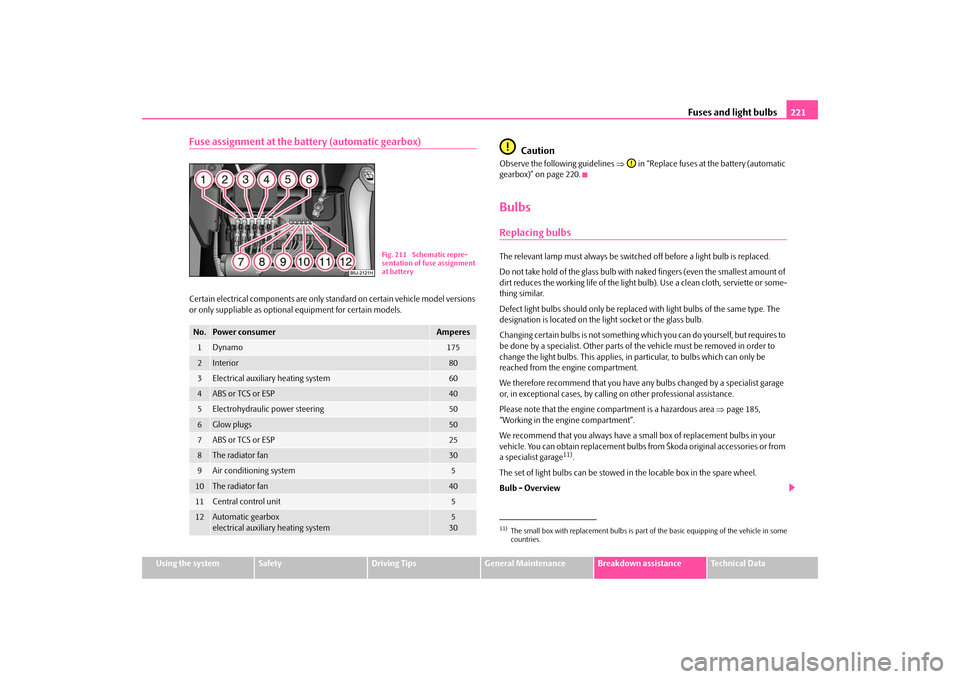
Fuse assignment at the battery (automatic gearbox)Certain electrical components are only standard on certain vehicle model versions
or only suppliable as optional equipment for certain models.
Caution
Observe the following guidelines ⇒ in “Replace fuses at the battery (automatic
gearbox)” on page 220.BulbsReplacing bulbsThe relevant lamp must always be switched off before a light bulb is replaced.
Do not take hold of the glass bulb with naked fingers (even the smallest amount of
dirt reduces the working life of the light bulb). Use a clean cloth, serviette or some-
thing similar.
Defect light bulbs should only be replaced with light bulbs of the same type. The
designation is located on the light socket or the glass bulb.
Changing certain bulbs is not something which you can do yourself, but requires to
be done by a specialist. Other parts of the vehicle must be removed in order to
change the light bulbs. This applies, in particular, to bulbs which can only be
reached from the engine compartment.
We therefore recommend that you have any bulbs changed by a specialist garage
or, in exceptional cases, by calling on other professional assistance.
Please note that the engine compartment is a hazardous area ⇒page 185,
“Working in the engine compartment”.
We recommend that you always have a small box of replacement bulbs in your
vehicle. You can obtain replacement bulbs from Škoda original accessories or from
a specialist garage
11).
The set of light bulbs can be stowed in the locable box in the spare wheel.
Bulb - Overview
No.
Power consumer
Amperes
1
Dynamo
175
2
Interior
80
3
Electrical auxiliary heating system
60
4
ABS or TCS or ESP
40
5
Electrohydraulic power steering
50
6
Glow plugs
50
7
ABS or TCS or ESP
25
8
The radiator fan
30
9
Air conditioning system
5
10
The radiator fan
40
11
Central control unit
5
12
Automatic gearbox
electrical auxiliary heating system
5
30
Fig. 211 Schematic repre-
sentation of fuse assignment
at battery
11)The small box with replacement bulbs is part of the basic equipping of the vehicle in some
countries.
s3f4.1.book Page 221 Thursday, June 18, 2009 11:07 AM
Page 228 of 259

Technical Data227
Using the system
Safety
Driving Tips
General Maintenance
Breakdown assistance
Technical Data
Technical DataTechnical DataGeneral informationThe details given in the official vehicle registration documents always take prece-
dence over the details in the Owner's Manual. Please refer to the official vehicle
registration documents or consult a specialist garage concerning the engine with
which your vehicle is equipped.Used abbreviationsPerformancesThe listed performance values were determined without performance-reducing
equipment, e.g. air conditioning system.
WeightThe loading capacity is reduced in line with the range of the special equipment. The
unloaden weight contains a fuel tank topped up to 90%. A driver with a weight of
75 kg is also included in the value.Identification detailsVehicle data sticker
The vehicle data sticker ⇒fig. 221 is located on the floor of the luggage compart-
ment and is also stated in the Service schedule.
The vehicle data sticker contains the following data:
Vehicle identification number (VIN)
Vehicle type
Gearbox code, paint number, interior equipment number, engine output,
engine code
Abbreviation
Importance
kW
Kilowatt, measuring unit for the engine output
rpm
Engine revolutions per minute
Nm
Newton meter, measuring unit for the engine torque
CO2 in g/km
discharged quantity of carbon dioxide in grams per driven kilom-
eter
RON
Research octane number, measuring unit for the knocking resist-
ance of petrol
DPF
Diesel particle filter
M5
5-speed manual gearbox
AG6
6-speed automatic gearbox
Fig. 221 Vehicle data sticker
A1A2A3
s3f4.1.book Page 227 Thursday, June 18, 2009 11:07 AM