2009 Seat Ibiza ST ESP
[x] Cancel search: ESPPage 38 of 250

Airbag system37
Safety First
Operating instructions
Practical tips
Technical Data
– Check that the warning lamp “AIRBAG OFF” in the console does
⇒page 36, fig. 22 not light up when the ignition is switched on
⇒ .
WARNING
•The driver is responsible for the proper position of the key-operated
switch. •You should only deactivate the front passenger airbag when, in excep-
tional cases, you have to use a rear-facing child seat on the front passeger
seat ⇒page 38, “Child safety”.•Never install a child seat facing backwards (or rear-facing) on the front
passenger seat unless the front passenger airbag has been disabled. This
represents a risk of fatal injuries to the child! However, if it is necessary in
exceptional circumstances to transport a child in a rear-facing child seat on
the front passenger seat, you must always disable the front passenger
airbag.•As soon as the child seat is no longer needed on the front passenger
seat, enable the front passenger airbag again.•Only deactivate the passenger airbag when the ignition is off, other-
wise a fault may occur in the airbag system, this will create a danger that
in case of an accident, the airbag does not deploy properly or does not
deploy at all.•When the passenger airbag is deactivated, if the warning lamp AIRBAG
OFF is not continuously lit up when the front passenger airbag is disabled,
there may be a fault in the airbag system:
−Have the airbag system inspected immediately by a qualified work-
shop.
− Do not use a child seat on the front passenger seat! The front
passenger airbag could be triggered despite the fact that there is a fault
in the system and, as a result, a child could sustain serious or fatal inju-
ries. −
It is predictable whether the front passenger airbag will deploy
during an accident! Warn all your passengers of this.
WARNING (continued)
Ibiza ST_EN.book Seite 37 Dienstag, 12. Januar 2010 4:03 16
Page 39 of 250
Child safety
38Child safetyBrief introductionIntroduction
Statistics show that children are generally safer on the rear
seat than on the front passenger seat.For safety reasons we recommend that children under 12 years of age are
transported on the rear seats. Children travelling on the rear seat must use a
child restraint system or the seat belts provided, depending on their age,
height and weight. For safety reasons, the child seat should be installed in
the centre of the rear seat or behind the front passenger seat.
The physical laws involved and the forces acting in a collision apply also to
children ⇒page 18, “Why wear seat belts?”. But unlike adults, children do
not have muscle and bone structures fully developed. This means that chil-
dren are subject to a greater risk of injury.
To reduce this risk, children must always use special child restraint systems
when travelling in the vehicle.
We recommend the use of child safety products from the SEAT Genuine Acces-
sories Programme, which includes systems for all ages made by “Peke”
2).
These systems have been especially designed and approved, complying with
the ECE-R44. regulation.
Follow the manufacturer's instructions and observe any statutory require-
ments when installing and using child seats. Always read and note
⇒ page 38, “Safety notes on using child seats”. We recommend you to include together with the on-board documentation,
the manufacturer's Child Seat instruction manual.
Safety notes on using child seats
Proper use of child seats substantially reduces the risk of
injury in an accident!As the driver, you are responsible for any children you transport in
your vehicle.
– Protect your children by properly using appropriate child seats
⇒page 40.
– Always ensure that the seat belt is properly positioned according to the instructions provided by the manufacturer of the child
seat.
– When travelling, do not allow children to distract you from traffic.
– Take breaks regularly during long trips. Take a break at least
every two hours.
WARNING
•Never install a child seat facing backwards (or rear-facing) on the front
passenger seat unless the front passenger airbag has been disabled. This
could lead to a risk of potentially fatal injuries to the child! However, if it is
necessary, in exceptional cases, to transport a child in the front passenger
seat, the front passenger airbag must always be disabled ⇒page 36,
2)Not for all countries
Ibiza ST_EN.book Seite 38 Dienstag, 12. Januar 2010 4:03 16
Page 40 of 250

Child safety39
Safety First
Operating instructions
Practical tips
Technical Data
“Deactivating airbags*”. If the passenger seat has a height adjustment
option, move it to the highest position.
•For those vehicles that do not include a key lock switch to turn the
airbag off, an Authorised Service Centre must be consulted.•All passengers, especially children, must assume the proper sitting
position and be properly belted in while travelling.•Never hold children or babies on your lap, this can result in potentially
fatal injuries to the child!•Never allow a child to be transported in a vehicle without being properly
secured, or to stand up or kneel on a seat while travelling. In an accident,
the child could be flung through the vehicle, causing possibly fatal injuries
to themselves and to the other passengers.•If children assume an improper sitting position when the car is moving,
they expose themselves to greater risk of injury in the event of sudden
braking manoeuvre or in an accident. This is particularly important if the
child is travelling on the front passenger seat and the airbag system is trig-
gered in an accident; as this could cause serious injury or even death.•A suitable child seat can protect your child!•Never leave an unsupervised child alone on a child seat or in the
vehicle.•Depending on weather conditions, it may become extremely hot or cold
inside the vehicle. This can be fatal.•Children who are less than 1.5 metres tall must not wear a normal seat
belt without a child seat, as this could cause injuries to the abdominal and
neck areas during a sudden braking manoeuvre or in an accident.•Do not allow the seat belt to become twisted or jammed, or to rub on
any sharp edges.•Incorrectly worn seat belts can cause injuries even in a minor collision
or in sudden braking manoeuvres.
•The seat belt provides maximum protection only when the seat belt is
properly positioned ⇒page 21, “Seat belts”.•Only one child may occupy a child seat ⇒page 40, “Child seats”.
WARNING (continued)
WARNING (continued)
Ibiza ST_EN.book Seite 39 Dienstag, 12. Januar 2010 4:03 16
Page 48 of 250
Cockpit47
Safety First
Operating instructions
Practical tips
Technical Data
Operating instructionsCockpitOverviewOverview of the dash panel
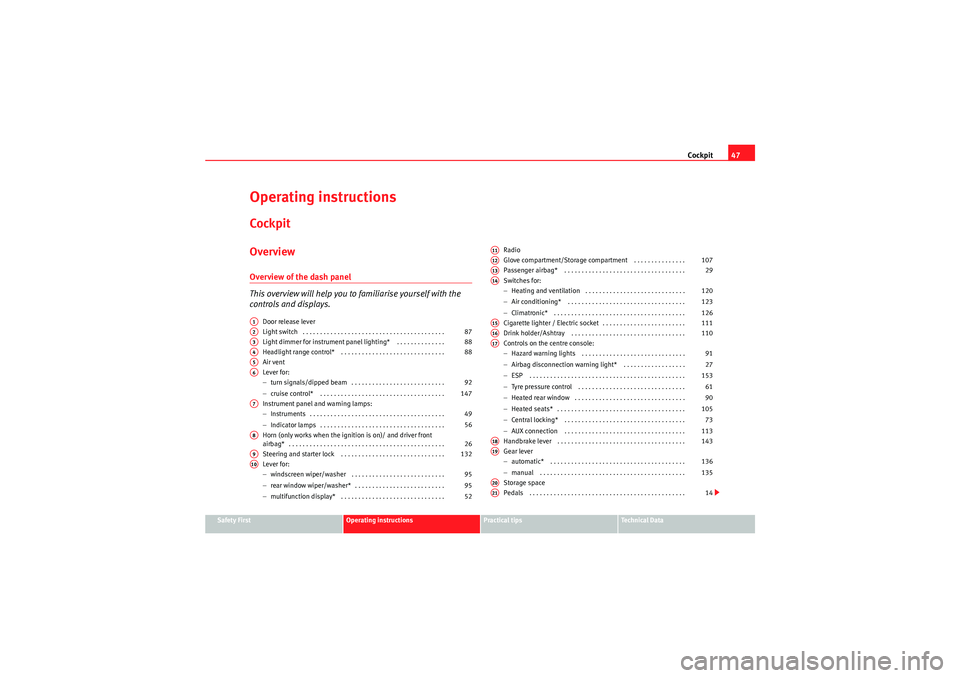
This overview will help you to familiarise yourself with the
controls and displays.
Door release lever
Light switch . . . . . . . . . . . . . . . . . . . . . . . . . . . . . . . . . . . . . . . . .
Light dimmer for instrument panel lighting* . . . . . . . . . . . . . .
Headlight range control* . . . . . . . . . . . . . . . . . . . . . . . . . . . . . .
Air vent
Lever for:
− turn signals/dipped beam . . . . . . . . . . . . . . . . . . . . . . . . . . .
− cruise control* . . . . . . . . . . . . . . . . . . . . . . . . . . . . . . . . . . . .
Instrument panel and warning lamps:
− Instruments . . . . . . . . . . . . . . . . . . . . . . . . . . . . . . . . . . . . . . .
− Indicator lamps . . . . . . . . . . . . . . . . . . . . . . . . . . . . . . . . . . . .
Horn (only works when the ignition is on)/ and driver front
airbag* . . . . . . . . . . . . . . . . . . . . . . . . . . . . . . . . . . . . . . . . . . . . .
Steering and starter lock . . . . . . . . . . . . . . . . . . . . . . . . . . . . . .
Lever for:
− windscreen wiper/washer . . . . . . . . . . . . . . . . . . . . . . . . . . .
− rear window wiper/washer* . . . . . . . . . . . . . . . . . . . . . . . . . .
− multifunction display* . . . . . . . . . . . . . . . . . . . . . . . . . . . . . . Radio
Glove compartment/Storage compartment . . . . . . . . . . . . . . .
Passenger airbag* . . . . . . . . . . . . . . . . . . . . . . . . . . . . . . . . . . .
Switches for:
−
Heating and ventilation . . . . . . . . . . . . . . . . . . . . . . . . . . . . .
− Air conditioning* . . . . . . . . . . . . . . . . . . . . . . . . . . . . . . . . . .
− Climatronic* . . . . . . . . . . . . . . . . . . . . . . . . . . . . . . . . . . . . . .
Cigarette lighter / Electric socket . . . . . . . . . . . . . . . . . . . . . . . .
Drink holder/Ashtray . . . . . . . . . . . . . . . . . . . . . . . . . . . . . . . . .
Controls on the centre console:
− Hazard warning lights . . . . . . . . . . . . . . . . . . . . . . . . . . . . . .
− Airbag disconnection warning light* . . . . . . . . . . . . . . . . . .
− ESP . . . . . . . . . . . . . . . . . . . . . . . . . . . . . . . . . . . . . . . . . . . . .
− Tyre pressure control . . . . . . . . . . . . . . . . . . . . . . . . . . . . . . .
− Heated rear window . . . . . . . . . . . . . . . . . . . . . . . . . . . . . . . .
− Heated seats* . . . . . . . . . . . . . . . . . . . . . . . . . . . . . . . . . . . . .
− Central locking* . . . . . . . . . . . . . . . . . . . . . . . . . . . . . . . . . . .
− AUX connection . . . . . . . . . . . . . . . . . . . . . . . . . . . . . . . . . . .
Handbrake lever . . . . . . . . . . . . . . . . . . . . . . . . . . . . . . . . . . . . .
Gear lever
− automatic* . . . . . . . . . . . . . . . . . . . . . . . . . . . . . . . . . . . . . . .
− manual . . . . . . . . . . . . . . . . . . . . . . . . . . . . . . . . . . . . . . . . . .
Storage space
Pedals . . . . . . . . . . . . . . . . . . . . . . . . . . . . . . . . . . . . . . . . . . . . .
A1A2
87
A3
88
A4
88
A5A6
92
147
A7
49
56
A8
26
A9
132
A10
95
95
52
A11A12
107
A13
29
A14
120
123
126
A15
111
A16
110
A17
91
27
153 61
90
105 73
113
A18
143
A19
136
135
A20A21
14
Ibiza ST_EN.book Seite 47 Dienstag, 12. Januar 2010 4:03 16
Page 58 of 250

Cockpit57
Safety First
Operating instructions
Practical tips
Technical Data
WARNING
•Failure to observe warning lamps and warning messages can result in
serious personal injuries or damage to your vehicle.•The risk of an accident increases if your vehicle breaks down. Use a
warning triangle to draw the attention of other road users in order to
prevent danger to thirds.
Item
Symbol
Meaning of warning and
control lamps
Further
information
Engine fault (petrol engine)
⇒ page 58
Glow plug system for diesel engine
If lit: glow plug system active
If flashing: engine fault
⇒page 58
Pollen accumulation in the diesel
engine particulate filter
⇒page 58
Engine oil pressure
⇒page 59
Bulb defective
⇒page 59
Rear fog light switched on
⇒page 59
Seat belt warning lamp*
⇒page 17
Anti-lock brake system (ABS) *
⇒page 59
If flashing : Electronic Stability Pro-
gramme (ESP) is working
If it remains lit: fault on ESP
⇒ page 60
Handbrake applied,
lack of brake fluid level or
serious fault in the brake system
⇒page 61
Cruise control system switched on
⇒page 61
Tyre pressure
⇒page 61
Automatic gear lever lock (automatic
gearbox)
⇒page 62
A1A1A2A3A4A5A6A7A8A9A10A11A12
Fuel level / reserve
⇒page 62
Doors open
⇒page 62
Rear lid open
⇒page 62
Airbag or belt tensioner system fault
or airbag disabled
⇒page 27
Main beam switched on
⇒page 63
Electro-hydraulic steering
⇒page 63
Fault in the emission control system
⇒page 63
Coolant level / coolant temperature
⇒page 63
Alternator fault
⇒page 64
Turn signals in operation
⇒page 64
SAFE
Electronic immobiliser
⇒page 64
Item
Symbol
Meaning of warning and
control lamps
Further
information
A13A14A15A16A17A18A19A20A21
Ibiza ST_EN.book Seite 57 Dienstag, 12. Januar 2010 4:03 16
Page 60 of 250

Cockpit59
Safety First
Operating instructions
Practical tips
Technical Data
•The diesel engine particulate filter may reach extremely high tempera-
tures; it should not enter into contact with flammable materials under-
neath the vehicle. Failure to comply could result in fire.
Engine oil pressure
This warning lamp indicates that the engine oil pressure is
too low.If this warning symbol starts to flash, and is accompanied by three audible
warnings , switch off the engine and check the oil level. If the oil level is too
low, top up with oil.
If the symbol flashes although the oil level is correct, do not drive on. The
engine must not even run at idle speed. Obtain technical assistance.Bulb defect*
The indicator lights up when a bulb is not functioning.The
warning lamp lights up when there is a fault on the turn signals, head-
lights, side lights and fog lights.
Rear fog light*
This warning lamp lights up when the rear fog light is switched on
. For
further information see ⇒page 87.
Anti-lock brake system (ABS)*
An indicator lamp monitors the ABS.
The indicator lamp
should light up for a few seconds when the ignition is
switched on. It goes out again after the system has run through an automatic
test sequence.
There is a fault in the ABS if:
•The warning lamp
does not light up when the ignition is switched on.
•The warning lamp does not go out again after a few seconds.•The warning lamp lights up when the vehicle is moving.
The vehicle can still be braked in the normal way (except that the ABS control
function will not function). Please take the vehicle to a qualified workshop as
soon as possible. For further information on the ABS see the ⇒page 152.
If there is a fault in the ABS, the ESP* and the tyre pressure warning lamp will
also light up.
Brake system fault
If the ABS warning lamp
lights up together with the brake warning lamp
, this indicates not only a fault in the ABS function, but also a possible fault
in the brake system ⇒.
WARNING
•Before opening the bonnet, read and observe the warnings on
⇒ page 179, “Working in the engine compartment”.•If the brake warning lamp
should light up together with the ABS
warning lamp
, stop the vehicle immediately and check the brake fluid
level in the reservoir ⇒ page 191, “Brake fluid”. If the fluid level has
dropped below the “MIN” mark you must not drive on. Risk of accident.
Obtain technical assistance.
WARNING (continued)
Ibiza ST_EN.book Seite 59 Dienstag, 12. Januar 2010 4:03 16
Page 61 of 250
Cockpit
60•If the brake fluid level is correct, the fault in the brake system may have
been caused by a failure of the ABS system. This could cause the rear
wheels to lock quickly when you brake. This could cause the rear to break
away. Risk of skidding. Stop the vehicle and seek technical assistance.
Differential lock fault (EDL)*
EDL operates along with the ABS in vehicles equipped with an
Electronic Stability Programme (ESP)*A malfunction in the EDL is indicated by the ABS warning lamp
. Please
take the vehicle to a qualified workshop as soon as possible. For further infor-
mation on the EDL see ⇒page 154, “Electronic differential lock (EDL)*”.
Traction control system (TCS)*
The traction control system prevents the driven wheels from
spinning when the vehicle is acceleratingThe warning lamp lights up when the ignition is switched on and should turn
out after about 2 seconds.
When the TCS is operating while driving, its warning lamp flashes rapidly. If
there is a fault in the system, the warning lamp is lit permanently.
It will also come on if a fault should occur in the ABS because the TCS oper-
ates in conjunction with the ABS. For further information, see ⇒page 151,
“Brakes” If ESP* button is activated, TCS function deactivates and the warning lamp
flashes slowly. By pressing again, TCS function is reactivated and the warning
lamp switched off.
Electronic Stability Programme (ESP)*
This warning lamp monitors the Electronic Stability
Programme.This programme includes the ABS, EDL and TCS.
The warning lamp
has the following functions:
•It will light for about 2 seconds when the ignition is switched on while a
test of the function is carried out.•It flashes rapidly when the ESP is activated while driving.•It will light up continuously if there is a malfunction in the ESP.•It will also come on if a fault should occur in the ABS because the ESP
operates in conjunction with the ABS.
If the ESP warning lamp
lights up and stays on after the engine is started,
this may mean that the control system has temporarily switched off the ESP.
In this case the ESP can be reactivated by switching the ignition off and then
on again. If the warning lamp goes out, this means the system is fully
functional.
WARNING (continued)
Ibiza ST_EN.book Seite 60 Dienstag, 12. Januar 2010 4:03 16
Page 62 of 250

Cockpit61
Safety First
Operating instructions
Practical tips
Technical Data
Brake system* / handbrake
The warning lamp lights up if the handbrake is applied, if the
brake fluid level falls too low or if there is a fault in the brake
system.
This warning lamp
lights up if
•the handbrake is on.•the brake fluid level is too low ⇒page 191.•there is a fault in the brake system.
This warning lamp can light up together with the ABS system warning lamp.WARNING
•If the brake warning lamp does not go out, or if it lights up when
driving, the brake fluid level ⇒page 191, “Brake fluid” in the reservoir is
too low. Risk of accident. Stop the vehicle and do not drive on. Obtain tech-
nical assistance.•If the brake warning lamp
lights up together with the ABS warning
lamp
, the control function of the ABS could be out of action. This could
cause the rear wheels to lock quickly when you brake. This could cause the
rear to break away. Risk of skidding. Stop the vehicle and seek technical
assistance.
Cruise control system*
The warning lamp comes on when the cruise control system
is switched on.The warning lamp
lights up when the cruise control system is switched on.
For further information on the cruise control system, see ⇒page 147.
Tyre pressure*
The tyre monitor
5) co m p a r e s w h e e l r e v o l u t i o ns a n d wi t h t h is i n f o r m a t i o n , t h e
diameter of each wheel using the ESP sensors. If the diameter of a wheel
changes, the tyre monitor indicator lights . The wheel diameter changes
when:
•Tyre pressure is insufficient.•The tyre structure is damaged.•The vehicle is unbalanced because of a load.•The wheels of one axle are under more pressure (for example, driving with
a trailer or on extreme slopes).•The vehicle is fitted with snow chains.•The temporary spare wheel is fitted.•The wheel on one axle is changed.5)Depending on the model version
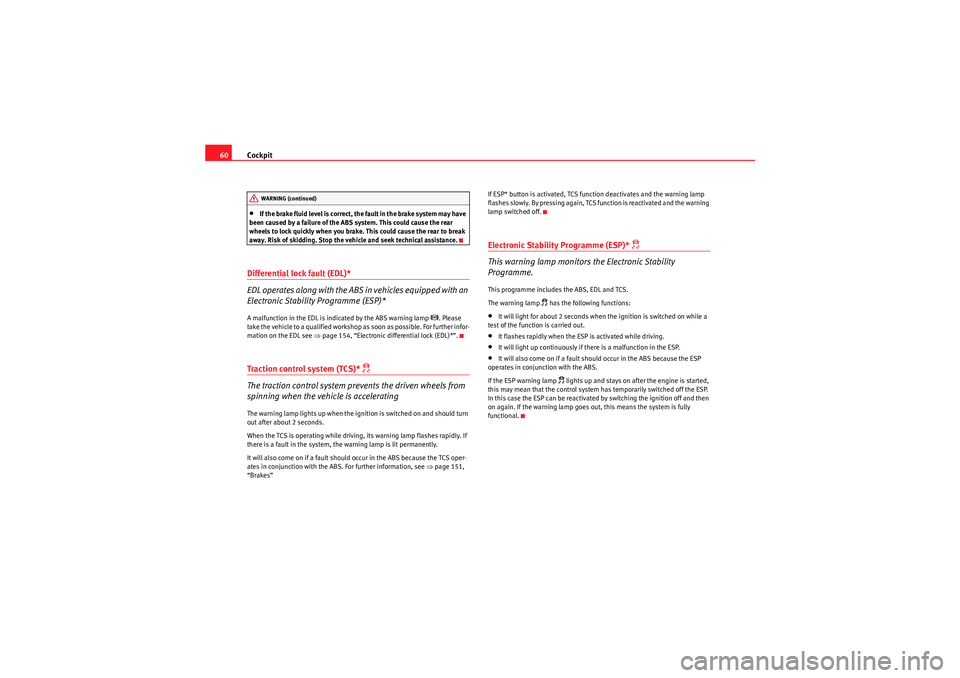
Fig. 36 Centre console:
tyre monitor system
button
Ibiza ST_EN.book Seite 61 Dienstag, 12. Januar 2010 4:03 16