2009 Seat Exeo ST warning light
[x] Cancel search: warning lightPage 134 of 316

Lights and visibility
132
Switching off anti-dazzle function
–Press button ⇒page 131, fig. 104 . Warning lamp goes
out:
Switching on anti-dazzle function
–Press button ⇒page 131, fig. 104 . The indicator lamp
will light up.Anti-dazzle function
The anti-dazzle function is activated every time the ignition is switched on.
The green indicator lamp lights up in the mirror housing.
When the anti-dazzle function is enabled, the interior rear view mirror will
darken automatically according to the amount of light it receives. The anti-
dazzle function is disabled if:•the interior lighting is switched on•reverse gear is engaged
Sensors for automatic headlights*
When the light switch is set to the AUTO position, the dipped beam head-
lights are switched on and off automatically according to the ambient light
level with the aid of the sensors located in the interior rear view mirror
⇒ page 117.WARNING
Electrolyte fluid can leak from a broken mirror. This fluid can cause irrita-
tion to the skin, eyes and respiratory organs. Wash thoroughly with clean
water should you come into contact with this fluid. Seek medical assist-
ance if needed!
Caution
Electrolyte fluid leaking from a broken mirror can cause damage to plastic
surfaces. Use a sponge or similar to remove the fluid as soon as possible.
Note
•The rear-view mirror's automatic anti-dazzle function* will only work prop-
erly if the sun blind* for the rear window is retracted and if there are no other
objects preventing light from reaching the interior mirror.•If you have to stick any type of sticker on the windscreen, do not do so in
front of the sensors. Doing so could prevent the automatic headlight or anti-
dazzle function from working correctly or even from working at all.Exterior mirrors
The exterior mirrors are adjusted electrically.
AA
AB
AA
AB
Fig. 105 Detailed view of
the armrest: Adjuster
knob
ExeoST_EN.book Seite 132 Donnerstag, 3. September 2009 12:24 12
Page 146 of 316
Seats and stowage
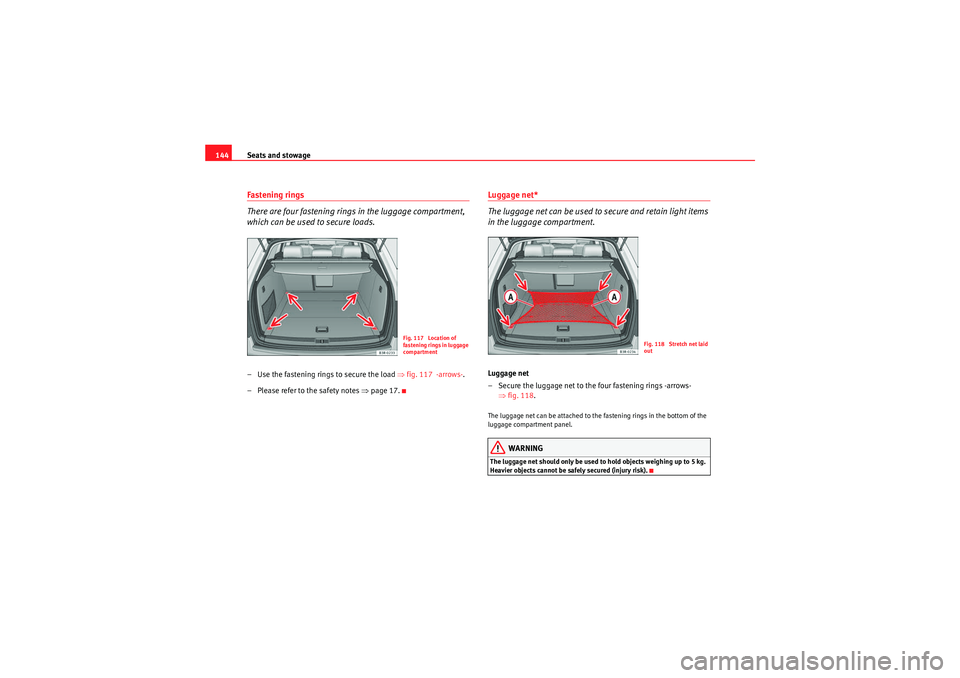
144Fastening rings
There are four fastening rings in the luggage compartment,
which can be used to secure loads.– Use the fastening ring s to secure the load ⇒fig. 117 -arrows- .
– Please refer to the safety notes ⇒page 17.
Luggage net*
The luggage net can be used to secure and retain light items
in the luggage compartment.Luggage net
– Secure the luggage net to the four fastening rings -arrows-
⇒fig. 118 .The luggage net can be attached to the fastening rings in the bottom of the
luggage compartment panel.
WARNING
The luggage net should only be used to hold objects weighing up to 5 kg.
Heavier objects cannot be safely secured (injury risk).
Fig. 117 Location of
fastening rings in luggage
compartment
Fig. 118 Stretch net laid
out
ExeoST_EN.book Seite 144 Donnerstag, 3. September 2009 12:24 12
Page 156 of 316

Seats and stowage
154•Do not use hard china cups or glasses. These could cause injury in the
event of an accident.
Ashtray*, cigarette lighter* and power pointsFront ashtray*Opening the ashtray
– Lightly press the front part of the ashtray ⇒fig. 133 .
Removing the ashtray
– Take hold of the sides of the ashtray ⇒fig. 133 and lift it out. Fitting the ashtray casing
– Insert the casing and press it into its mountings.
WARNING
Never put waste paper in the ashtray, as this could cause a fire.Rear ashtrayOpening the ashtray
– Lift the lid.
Removing the ashtray
–Take hold of the lid ⇒
fig. 134 and lift out the ashtray.
WARNING (continued)
Fig. 133 Centre console:
Open ashtrayAA
AB
Fig. 134 Rear ashtray
ExeoST_EN.book Seite 154 Donnerstag, 3. September 2009 12:24 12
Page 157 of 316

Seats and stowage155
Safety First
Controls and equipment
Practical tips
Technical Data
Fitting the ashtray casing
– Open the lid on the ashtray and press the casing into the
mounting as far as it will go.
WARNING
Never put waste paper in the ashtray, as this could cause a fire.Cigarette lighter*
The 12-volt socket for the cigarette lighter can also be used as
a power source for other electrical appliances.Using the cigarette lighter
–Press in the ciga rette lighter knob.
– Wait for the lighter to pop out slightly. – Pull out the cigarette lighter immediately.
– Use the glowing heater element of the cigarette lighter to light
your cigarette.
– Put the cigarette lighter back in its socket.
Operating the socket
– Take out the cigarette lighter.
– Insert the plug of the electrical appliance into the cigarette lighter socket.
The cigarette lighter ⇒fig. 135 employs a standard 12-volt socket, which can
also be used as a power source for electrical appliances. The appliances
connected to the socket must not exceed a power rating of 100 W.
WARNING
•Be careful when using the electric cigarette lighter. Carelessness or
negligence when using the cigarette lighter can cause burns.•The lighter will only work when the ignition is switched on.•The electrical sockets and, therefore, any appliances connected to
them will only work when the ignition is switched on.Caution
Always use the correct type of plugs to avoid damaging the sockets.
Note
The use of electrical appliances with the engine switched off will cause a
battery discharge.
Fig. 135 Cigarette lighter
in the centre console
ExeoST_EN.book Seite 155 Donnerstag, 3. September 2009 12:24 12
Page 159 of 316

Seats and stowage157
Safety First
Controls and equipment
Practical tips
Technical Data
Glove compartment
The glove compartment is equipped with a lock* and a light.Opening the glove compartment
– Pull the handle on the lid in the direction indicated (arrow)
⇒fig. 137 and open the lid.
Closing the glove compartment
– Close the lid and push it in until it engages.If the side lights or headlights are switched on, the light in the glove compart-
ment comes on when it is opened.
The lid has separate holders for a pen and a note pad.
WARNING
For safety reasons, the glove compartment must always be closed when
the vehicle is moving. Failure to do so could result in an accident.Cool box in glove compartment*
The cool box will only work when the climate control is deliv-
ering cooled air.– Open the glove compartment ⇒fig. 137 .
– Open the lid of the cool box ⇒fig. 138 .
– Turn switch to switch cooling on and off.
Fig. 137 Glove compart-
ment
Fig. 138 Glove compart-
ment with cool box open
AA
ExeoST_EN.book Seite 157 Donnerstag, 3. September 2009 12:24 12
Page 160 of 316

Seats and stowage
158The cool box will only work when the climate control is delivering cooled air.
We recommend you switch off the cool box if the climate control is delivering
warm air to heat the interior.
Note
The “non-slip” mat in the cool box can be removed for cleaning.Compartments in the door trim
Storage compartments are provided in the door trims.
WARNING
The storage compartments in the door trims should only be used to store
small objects. Make sure that they are stored safely inside the compart-
ment, as they might otherwise impair the protection offered by the side
airbags.
Coat hooks
There is a coat hook above each of the rear doors.
WARNING
•Please make sure that any items of clothing hanging from the coat
hooks do not obstruct your view to the rear.•The coat hooks should only be used for lightweight clothing. Do not
leave any heavy or sharp objects in the pockets.•Do not use clothes hangers to hang up the clothing, as this could inter-
fere with the function of the head-protection airbags*.
Fig. 139 Door trim with
storage compartment
Fig. 140 Area above the
rear doors: Coat hooks
ExeoST_EN.book Seite 158 Donnerstag, 3. September 2009 12:24 12
Page 166 of 316

Heating, Ventilation and Air conditioning
164Defrosting
The windscreen and side windows are defrosted or demisted
as quickly as possible.– To enable this mode, press the ⇒page 162, fig. 141 button.
– To disable, press the button again or select the button.The temperature is regulated automatically. The air output is increased to
maximum and most of the air comes out of outlets 1 and 2 ⇒page 167.
The air recirculation and ECON modes are switched off when the button is
pressed.Air recirculation: manual enabling
The air recirculation setting prevents fumes etc. from entering
the interior.Enabling air recirculation mode
–Press the ⇒page 162, fig. 141 ⇒ button.
Disabling air recirculation mode
– Press the button again or
– Press the button or
–Press the button.In this setting, the air in the vehicle is constantly recirculated. We recommend
using the air recirculation mode in the following circumstances:
•When driving through a tunnel or in queues of traffic, to prevent fumes
entering the interior of the vehicle.WARNING
Do not drive for too long with the air recirculation mode enabled because,
if the compressor is disconnected, the windscreen may mist up because no
fresh air is entering the interior of the vehicle, with the subsequent risk of
accidents.ECON Mode (economy)
ECON mode helps save fuel.– To enable, press the button ⇒page 162, fig. 141.
– To disable, press the button again or select the button.Air cooling is disconnected in ECON mode. The heating and the blower are
adjusted automatically. “ECON” stands for “Economy”. Disconnecting air
cooling (compressor) saves on fuel.
Please note that the interior temperature must not be lower than the outside
temperature in ECON mode. The blower does not cool or dehumidify the air in
the interior. The windows could therefore mist up.
On diesel vehicles, the supplementary heater is switched off in ECON mode
to save fuel.
Note
If the diode on the ECON button continues to light up when the ECON mode
has been switched off (i.e. the climate control has been switched on) this is
AUTO
AUTO
ECONECONECON
AUTO
ExeoST_EN.book Seite 164 Donnerstag, 3. September 2009 12:24 12
Page 173 of 316

Driving171
Safety First
Controls and equipment
Practical tips
Technical Data
The Electronic Stabilisation Program (ESP) contains the electronic differential
lock (EDL) and the traction control system (TCS). The ESP function works
together with the ABS. If a fault in the ABS occurs, both warning lamps light
up, but if the ESP fails, only the ESP warning lamp lights up.
The ESP is started automatically when the engine is started.
The ESP switch deactivates both TCS and ESP functions. The ESP, in spite of
being deactivated, will always self-connect when necessary if brakes are
being used.
The TCS can be deactivated when in cases where wheel sliding is desirable.
For example:
•When driving with snow chains,•when driving in deep snow or on loose surfaces,•when rocking the vehicle backwards and forwards to free it from mud, for
example.
Next, the button should be pressed to reactivate the TCS.
When does the warning light switch on or flash ?•On switching the ignition on, it lights up for about two seconds to carry
out a function control.•The warning lamp will start flashing when the vehicle is moving if the ESP
or the TCS is activated.•It will light up continuously if there is a malfunction in the ESP.WARNING
•The electronic stabilisation programme (ESP) cannot defy the laws of
physics. This should be kept in mind, particularly on slippery and wet
roads and when towing a trailer.•Always adapt your driving style to suit the condition of the roads and
the traffic situation. Do not let the extra safety afforded by ESP tempt you
into taking any risks when driving, this can cause accidents.
•Please refer to the corresponding warning notes on ESP in ⇒page 189,
“Intelligent technology”.
Ignition lockIgnition key positions
The ignition key is used to start and stop the engine.Position
The ignition key is inserted in this position. To engage the steering wheel
lock , take out the key and turn the wheel until you hear the pin engage. You
should always engage the steering lock when you leave the vehicle. This will
help to deter thefts ⇒.
WARNING (continued)
Fig. 147 Ignition key
positions
A1
ExeoST_EN.book Seite 171 Donnerstag, 3. September 2009 12:24 12