Page 291 of 543

SET Button – To Set the Pushbutton Memory
When you are receiving a channel that you wish to
commit to pushbutton memory, press the SET button.
The symbol SET 1 will now show in the display window.
Select the button (1-6) you wish to lock onto this channel
and press and release that button. If a button is not
selected within five seconds after pressing the SET but-
ton, the channel will continue to play but will not be
stored into pushbutton memory.
You may add a second channel to each pushbutton by
repeating the above procedure with this exception: Press
the SET button twice and SET 2 will show in the display
window. Each button can be set for SET 1 and SET 2. This
allows a total of 12 Satellite channels to be stored into
pushbutton memory. The channels stored in SET 2
memory can be selected by pressing the pushbutton
twice.Every time a preset button is used, a corresponding
button number will display.
Buttons 1 - 6
These buttons tune the radio to the channels that you
commit to pushbutton memory (12 Satellite stations).
Operating Instructions - uconnect�
phone (If
Equipped)
Refer to “uconnect� phone” in Section 3.4
UNDERSTANDING YOUR INSTRUMENT PANEL 289
Page 296 of 543

Front Blower Control
There are four blower speeds. Use this
control to regulate the amount of air
forced through the system in any
mode you select. The blower speed
increases as you move the control
clockwise from the OFF position.
NOTE: For vehicles equipped with Remote Start, the
climate controls will not function during Remote Start
operation if the blower control is left in the OFF position.
Temperature Control
Use this control to regulate the tem-
perature of the air inside the passenger
compartment. Rotating the knob coun-
terclockwise, from top center into the
blue area of the scale, indicates cooler temperatures. Rotating the knob clockwise, into the red
area, indicates warmer temperatures.
NOTE:
If your air conditioning performance seems
lower than expected, check the front of the A/C con-
denser (located in front of the radiator), for an accumu-
lation of dirt or insects. Clean with a gentle water spray
from behind the radiator and through the condenser.
Fabric front fascia protectors may reduce airflow to the
condenser, reducing air conditioning performance.
Mode Control (Air Direction)
Mode control allows you to choose
from several patterns of air distribu-
tion. You can select either a primary
mode, as identified by the symbols, or
a blend of two of these modes. The
closer the control is to a particular
mode, the more air distribution you
receive from that mode.
294 UNDERSTANDING YOUR INSTRUMENT PANEL
Page 298 of 543

Recirculation Control
Press this button to choose between
outside air intake or recirculation of
the air inside the vehicle. A lamp will
illuminate when you are in Recircula-
tion mode. Only use the Recirculation
mode to temporarily block out any
outside odors, smoke, or dust, and to
cool the interior rapidly upon initial start-up in very hot
or humid weather.
NOTE:
•If the RECIRCULATION button is pressed when the
system is in Mix or Defrost mode the Recirculation
LED indicator will flash three times and then turn off
to indicate Recirculation mode is not allowed.
•Continuous use of the Recirculation mode may make
the inside air stuffy and window fogging may occur.
Extended use of this mode is not recommended.
•In cold or damp weather, the use of the Recirculation
mode will cause windows to fog on the inside because
of moisture buildup inside the vehicle. For maximum
defogging, select the Outside Air position.
•The A/C can be deselected manually without disturb-
ing the mode control selection by pressing the A/C
button.
Air Outlets
The airflow from each of the instrument panel outlets can
be adjusted for direction, and turned on or off to control
airflow.
NOTE: For maximum airflow to the rear, the center
instrument panel outlets can be directed toward the rear
seat passengers.
296 UNDERSTANDING YOUR INSTRUMENT PANEL
Page 302 of 543

Manual Operation
This system offers a full complement of manual override
features.
NOTE:Each of these features operate independently
from each other. If any one feature is controlled manually,
the temperature doors will continue to operate automati-
cally.
There are six fixed blower speeds. Use
this control to regulate the amount of
air forced through the system in any
mode you select. The blower speed
increases as you move the control
clockwise from the OFF position.
The blower fan speed can be set to any fixed speed by
adjusting the blower control knob. The fan will now
operate at a fixed speed until additional speeds are selected. This allows the front occupants to control the
volume of air circulated in the vehicle and cancel the
Auto mode.
The operator can also select the direction of the airflow
by selecting one of the following positions.
Panel Mode
Air comes from the outlets in the instrument panel.
Each of these outlets can be individually adjusted to
direct the flow of air. The air vanes of the center outlets
and outboard outlets can be rotated to regulate or shut off
the airflow from these outlets.
Bi-Level Mode Air comes from the instrument panel outlets, floor
outlets and defrost outlets.
NOTE: In many temperature positions, the BI-LEVEL
mode is designed to provide cooler air out of the panel
outlets and warmer air from the floor outlets.
Blower Control
300 UNDERSTANDING YOUR INSTRUMENT PANEL
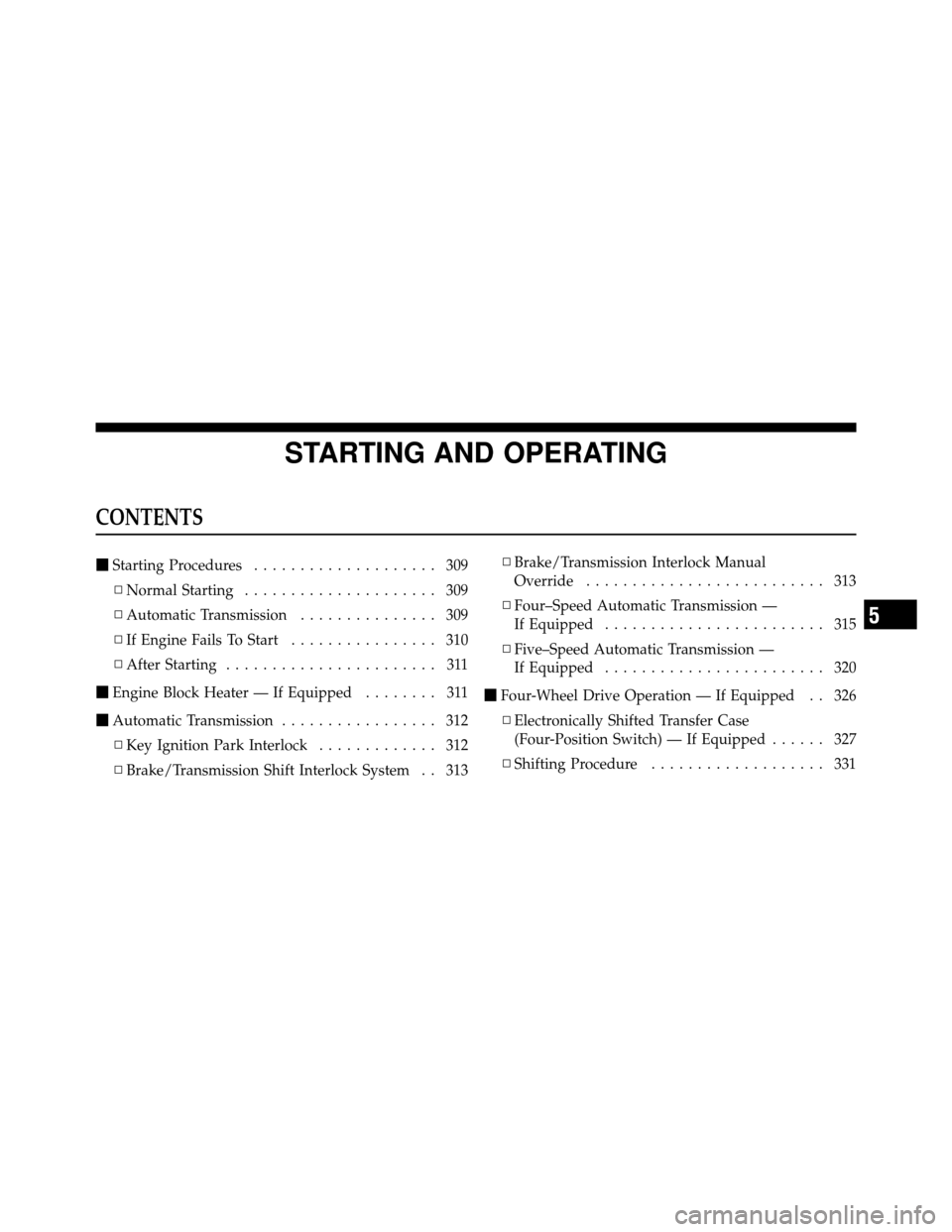
Page 307 of 543
STARTING AND OPERATING
CONTENTS
�Starting Procedures .................... 309
▫ Normal Starting ..................... 309
▫ Automatic Transmission ............... 309
▫ If Engine Fails To Start ................ 310
▫ After Starting ....................... 311
� Engine Block Heater — If Equipped ........ 311
� Automatic Transmission ................. 312
▫ Key Ignition Park Interlock ............. 312
▫ Brake/Transmission Shift Interlock System . . 313 ▫
Brake/Transmission Interlock Manual
Override .......................... 313
▫ Four–Speed Automatic Transmission —
If Equipped ........................ 315
▫ Five–Speed Automatic Transmission —
If Equipped ........................ 320
� Four-Wheel Drive Operation — If Equipped . . 326
▫ Electronically Shifted Transfer Case
(Four-Position Switch) — If Equipped ...... 327
▫ Shifting Procedure ................... 331
5
Page 308 of 543

▫Electronically Shifted Transfer Case
(Five-Position Switch) — If Equipped ...... 333
▫ Shifting Procedure ................... 337
� Limited-Slip Differential – If Equipped ...... 339
� Driving On Slippery Surfaces ............. 340
� Driving Through Water ................. 341
▫ Flowing/Rising Water ................. 341
▫ Shallow Standing Water ............... 341
� Driving Off-Road ..................... 343
� Power Steering ....................... 343
▫ Power Steering Fluid Check ............. 345
� Parking Brake ........................ 346
� Brake System ........................ 347
▫ Four-Wheel Anti-Lock Brake System ....... 348�
Multi-Displacement System (MDS)
(If Equipped) – 5.7L Engine Only ........... 349
� Electronic Brake Control System ........... 350
▫ Anti-Lock Brake System (ABS) ........... 350
▫ Traction Control System (TCS) ........... 351
▫ Brake Assist System (BAS) .............. 351
▫ Hill Start Assist (HSA) ................ 352
▫ Electronic Stability Program (ESP) ........ 356
▫ Trailer Sway Control (TSC) ............. 361
� Tire Safety Information ................. 362
▫ Tire Markings ....................... 362
▫ Tire Identification Number (TIN) ......... 366
▫ Tire Loading And Tire Pressure .......... 367
� Tires — General Information ............. 371
▫ Tire Pressure ....................... 371
306 STARTING AND OPERATING
Page 311 of 543

STARTING PROCEDURES
Before starting your vehicle, adjust your seat, adjust both
inside and outside mirrors, and fasten your seat belt.
The starter should not be operated for more than 15-
second intervals. Waiting a few seconds between such
intervals will protect the starter from overheating.
WARNING!
•Accidents can be caused by inadvertently moving
the shift lever or by pressing the accelerator pedal.
This may cause excessive heat in the exhaust
system, resulting in overheating and vehicle fire
which may cause serious or fatal injuries.
•Do not leave children or animals inside parked
vehicles in hot weather. Interior heat buildup may
cause serious injury or death.
Normal Starting
Normal starting of either a warm or cold engine is
obtained without pumping or depressing the accelerator
pedal. Turn the key to the START position and release
when the engine starts. If the engine fails to start within
10 seconds, turn the key to the OFF position, wait five
seconds, then repeat the “Normal Starting” procedure.
Automatic Transmission
Start the engine with the shift lever in the NEUTRAL or
PARK position. Apply the brake before shifting into any
driving range.
NOTE: This vehicle is equipped with a transmission
shift interlocking system. The brake pedal must be
depressed to shift out of PARK.5
STARTING AND OPERATING 309
Page 313 of 543

If the engine has been flooded, it may start to run, but not
have enough power to continue running when the key is
released. If this occurs, continue cranking with the accel-
erator pedal pushed all the way to the floor. Release the
accelerator pedal and the key once the engine is running
smoothly.
If the engine shows no sign of starting after two 15-
second periods of cranking with the accelerator pedal
held to the floor, the “Normal Starting” procedure should
be repeated.
After Starting
The idle speed is automatically controlled and will de-
crease as the engine warms up.
ENGINE BLOCK HEATER — IF EQUIPPED
The engine block heater warms the engine and permits
quicker starts in cold weather. Connect the cord to a
standard 110-115 Volt AC electrical outlet with a
grounded, three-wire extension cord.The engine block heater cord is routed under the hood on
the passenger side of the vehicle near the right head lamp
assembly. It is located between the front grill and the
radiator, but underneath the black upper seal.
It includes a removable cap that is secured by a tethered
strap. It also has a c-clip that is used for storage when not
in use for the winter months. During winter months,
remove the heater cord wiring assembly from itself on
the c-clip.
WARNING!
Remember to disconnect the cord before driving.
Damage to the 110-115 Volt electrical cord could cause
electrocution.
5
STARTING AND OPERATING 311