2009 PORSCHE PANAMERA tow
[x] Cancel search: towPage 230 of 343

228
Storage, Luggage Compartment and Roof Transport System
Stowing Loads
Danger!
Danger of injury. An unsecured or incorrectly
positioned load can slip out of place or
endanger the vehicle occupants during
braking, direction changes or in accidents.
Never transport objects that are not secured.
f Always transport loads in the luggage
compartment, never in the passenger
compartment (e.g. on or in front of the seats).
f Support the load against the seat backrests
wherever possible. Always lock the backrests
into place.
f Only transport heavy objects with the rear seat
backrests upright and engaged.
f Place the load behind unoccupied seats
whenever possible.
f Stow heavy objects as far forward as possible
on the floor, with lightweight objects behind
them.
f Never load the vehicle higher than the top
edge of the seat backrest.
f Always protect the passenger compartment
with a luggage compartment cover. Do not
drive with objects on top of the luggage
compartment cover. f
If the rear seats are not occupied, the
backrests can be addition ally secured with the
seat belts. Simply cro ss the outer seat belts
and insert each into the opposite buckle.
f Make sure that the load cannot damage the
heating filaments and the TV antenna in the
rear window.
Tie-down belts
f Do not use elastic belt s or straps to tie
down a load.
f Do not route belts and straps over
sharp edges.
f Observe the directions for use and information
for the tie-down equipment.
f Use only belts with a tear strength of at least
1543 lbs (700 kg) and a maximum width of
1 in. (25 mm).
f Cross the belts over the load. Driving
f
Vehicle handling changes depending on the
vehicle load. Adapt your driving style to the
changed driving behavior.
f Do not exceed the maximum gross weight
and axle load.
This information can be found under “Technical
data” in this Owner’s Manual:
f Please see the chapter “WEIGHTS” on
page 328.
f Never drive with the tailgate open. Exhaust
gases can enter the passenger compartment.
f Adapt the tire pressure to the load.
After you change the tire pressure, you must
also update the setting for Tire Pressure
Monitoring.
For information on setting Tire Pressure
Monitoring on the multi-function display:
f Please see the chapter “OVERVIEW OF
WARNING MESSAGES” on page 152.
Information on tire pressures for partially and fully
loaded vehicles can be found under “Technical
data” in this Owner’s Manual:
f Please see the chapter “TIRE PRESSURE FOR
COLD TIRES (68 °F/20 °C)” on page 326.
Page 231 of 343
Storage, Luggage Compartment and Roof Transport System
229
Luggage Compartment Cover
Warning!
Risk of injury. In the event of braking,
direction changes or in an accident, objects
can slide into the passenger compartment
and endanger the occupants.
f Do not place objects on the retractable
luggage compartment cover or on the fixed luggage compartment cover.
Retractable luggage compartment coverLuggage can be protected against prying eyes
with the retractable luggage compartment cover.
fAlways pull out the retractable luggage
compartment cover when transporting objects
in the luggage compartment.
The retractable luggage compartment cover is
not designed to carry objects.
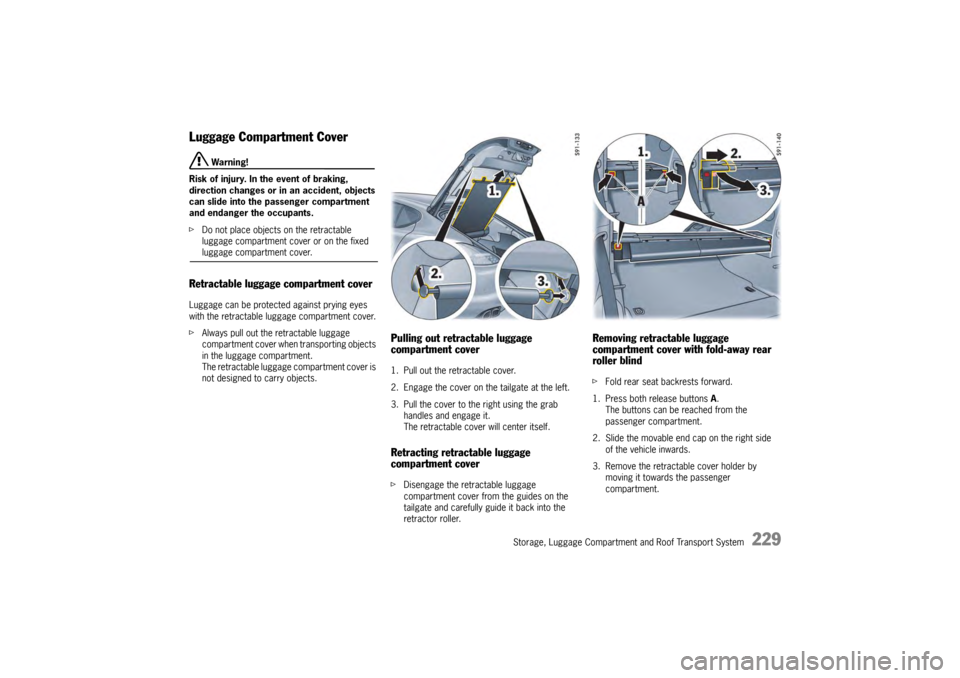
Pulling out retractable luggage
compartment cover1. Pull out the retractable cover.
2. Engage the cover on the tailgate at the left.
3. Pull the cover to the right using the grab
handles and engage it.
The retractable cove r will center itself.Retracting retractable luggage
compartment coverfDisengage the retractable luggage
compartment cover from the guides on the
tailgate and carefully guide it back into the
retractor roller.
Removing retractable luggage
compartment cover with fold-away rear
roller blindf Fold rear seat backrests forward.
1. Press both release buttons A.
The buttons can be reached from the
passenger compartment.
2. Slide the movable end cap on the right side of the vehicle inwards.
3. Remove the retractable cover holder by moving it towards the passenger
compartment.
Page 232 of 343
230
Storage, Luggage Compartment and Roof Transport System
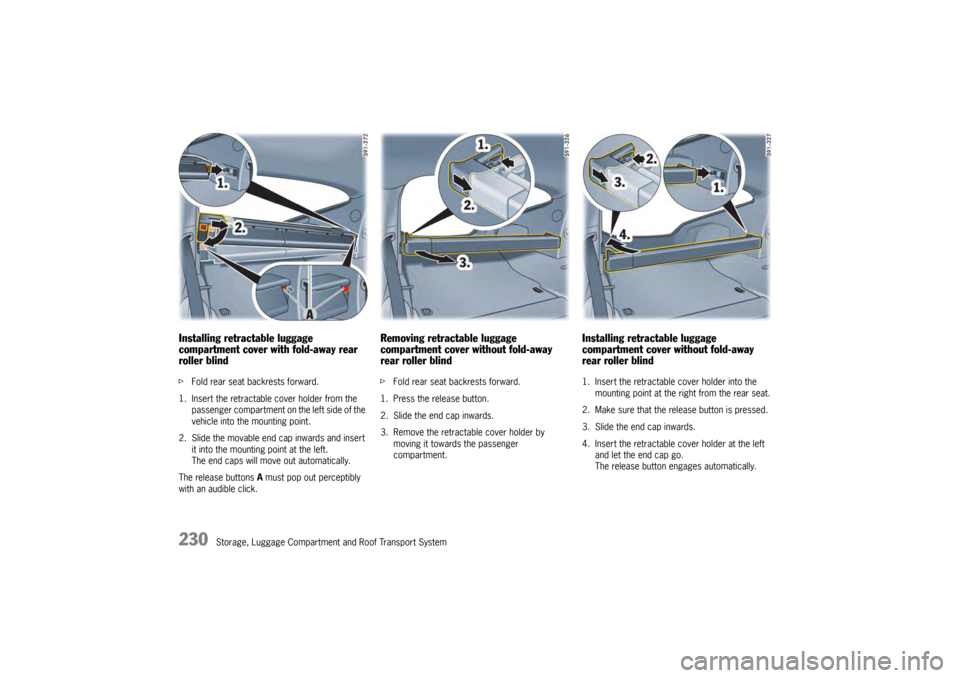
Installing retractable luggage
compartment cover with fold-away rear
roller blindfFold rear seat backrests forward.
1. Insert the retractable cover holder from the passenger compartment on the left side of the
vehicle into the mounting point.
2. Slide the movable end cap inwards and insert it into the mounting point at the left.
The end caps will move out automatically.
The release buttons A must pop out perceptibly
with an audible click.
Removing retractable luggage
compartment cover without fold-away
rear roller blindf Fold rear seat backrests forward.
1. Press the release button.
2. Slide the end cap inwards.
3. Remove the retractable cover holder by moving it towards the passenger
compartment.
Installing retractable luggage
compartment cover without fold-away
rear roller blind1. Insert the retractable cover holder into the mounting point at the right from the rear seat.
2. Make sure that the release button is pressed.
3. Slide the end cap inwards.
4. Insert the retractable cover holder at the left and let the end cap go.
The release button engages automatically.
Page 233 of 343
Storage, Luggage Compartment and Roof Transport System
231
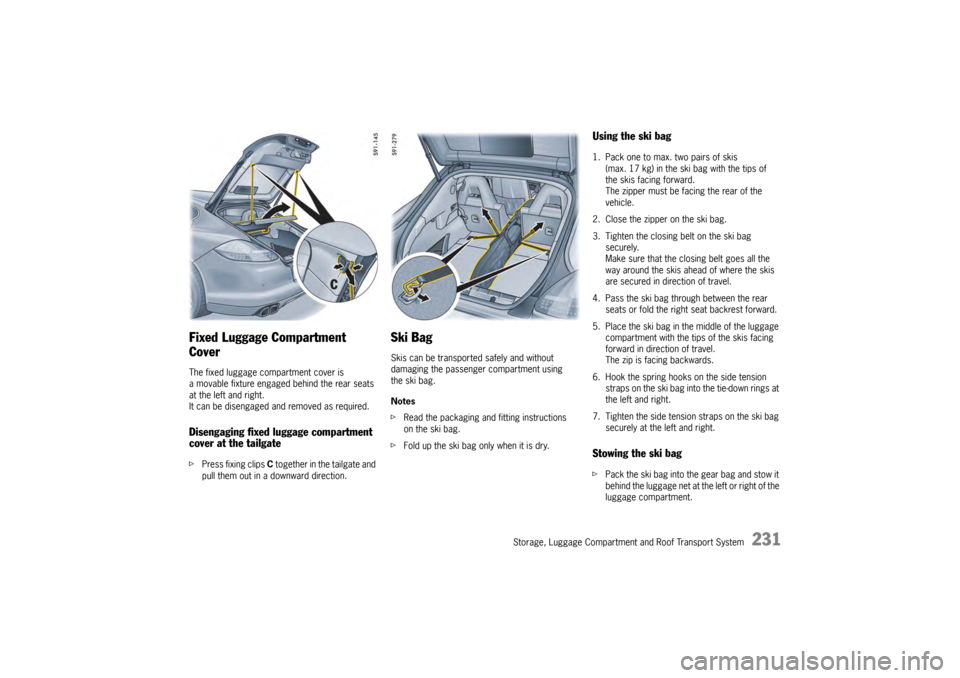
Fixed Luggage Compartment
CoverThe fixed luggage compartment cover is
a movable fixture engaged behind the rear seats
at the left and right.
It can be disengaged and removed as required.Disengaging fixed luggage compartment
cover at the tailgatefPress fixing clips C together in the tailgate and
pull them out in a downward direction.
Ski BagSkis can be transported safely and without
damaging the passenger compartment using
the ski bag.
Notes
f Read the packaging and fitting instructions
on the ski bag.
f Fold up the ski bag only when it is dry.
Using the ski bag1. Pack one to max. two pairs of skis
(max. 17 kg) in the ski bag with the tips of
the skis facing forward.
The zipper must be facing the rear of the
vehicle.
2. Close the zipper on the ski bag.
3. Tighten the closing belt on the ski bag securely.
Make sure that the closing belt goes all the
way around the skis ahead of where the skis
are secured in direction of travel.
4. Pass the ski bag through between the rear seats or fold the right seat backrest forward.
5. Place the ski bag in the middle of the luggage compartment with the tips of the skis facing
forward in direction of travel.
The zip is facing backwards.
6. Hook the spring hooks on the side tension straps on the ski bag into the tie-down rings at
the left and right.
7. Tighten the side tension straps on the ski bag securely at the left and right.Stowing the ski bagfPack the ski bag into the gear bag and stow it
behind the luggage net at the left or right of the
luggage compartment.
Page 249 of 343

Alarm System and Theft Protection
247
Alarm System and Passenger
Compartment MonitoringThis device complies with:
Part 15 of the FCC Rules
RSS-210 of Industry Canada.
Operation of this device is subject to the following
two conditions:
– It may not cause harmful interference, and
– it must accept any interference received including interference that may cause
undesired operation.
Note
The manufacturer is not responsible for any radio
or TV interference caused by unauthorized
modifications to this equipment.
Such modification could void the user's authority
to operate the equipment.
Warning!
Any changes or modifications not expressly ap-
proved by Porsche could void the user’s authority
to operate this equipment.
The alarm system monitors the following alarm
contacts:
– Alarm contacts in doors, tailgate, engine compartment lid and headlights
– Interior surveillance: Movement in the interior when the vehicle is locked, e.g. attempted
theft after breaking a window.
– Inclination sensor: Tilting of the vehicle (e.g. attempt to tow away the vehicle).
If one of these alarm contacts is interrupted,
the alarm horn sounds for approx. 30 seconds
and the emergency flasher flashes on and off.
After 5 seconds of interruption, the alarm is
triggered again. This cycle is repeated ten times.Switching onf The alarm system is activated when the vehicle
is locked. Switching offfThe alarm system is deactivated when the
vehicle is unlocked. Note on operation
f
If you unlock the vehicle with the emergency
key in the door lock, you must switch the
ignition on (ignition lock position 1) within
10 seconds of opening the door in order to
prevent the alarm system from being
triggered.
The vehicle is locked ag ain automatically after
20 seconds if no doors are opened.
Switching off the alarm system if it is
triggeredf Unlock vehicle doors with the remote control
or
Switch on ignition.Switching off interior surveillance and
inclination sensorIf people or animals are remaining in the locked
vehicle or the vehicle is being transported on
a train or ship, for example, the interior
surveillance system and inclination sensor must
be switched off temporarily.
f Inform any persons remaining in the vehicle
that the alarm system will be triggered if the
door is opened.
USA: KR55WK50138
Canada: 7812D-5WK50138
Page 262 of 343

260
Maintenance and Car Care
The warning light on the instrument panel and
the warning message on the multi-function display
alert you to the fact that the washer fluid level
is too low.
f
Add washer fluid at the next opportunity.
In this case, the remaining quantity is only approx.
1 litre. The maximum filling capacity is approx.
5.8USquarts (5.5liters).
Adding washer fluid
1. Open cap on washer fluid reservoir.
2. Add washer fluid.
3. Close cap carefully.
Power Steering
Warning!
Risk of accidents. When the engine is
stationary (e.g. when on tow) or the hydraulic
system fails, there is no power steering
assistance available.
Therefore, substantially more force will have
to be exerted to steer the vehicle.
f Exercise extreme care when your vehicle is
being towed.
f Have the fault corrected. Please contact a
qualified specialist workshop. We recommend
that you have an authorized Porsche dealer to
do this work as they have trained workshop personnel and the necessary parts and tools.
Regular checking of hydraulic fluid is part of
servicing.
The flow noise heard at full steering lock is design-
related and does not indicate a defect in the
steering system. Vehicles with Porsche Dynamic Chassis
Control (PDCC)
If the fluid level is too
low, the message “Check
steering oil level” will appe ar on the multi-function
display.
f Have the fluid level checked immediately.
f Please contact a qualified specialist workshop.
We recommend that you have an authorized
Porsche dealer to do this work as they have
trained workshop personnel and the necessary
parts and tools.
Warning light and warning
message
Page 265 of 343

Maintenance and Car Care
263
How Emission Control WorksWhen an automobile engine is running, it uses
energy generated through the combustion of a
mixture of air and fuel. Depending on whether a
car is driven fast or slowly or whether the engine
is cold or hot, some of the fuel (hydrocarbons)
may not be burned completely, but may be
discharged into the engine crankcase or exhaust
system. Additonal hydrocarbons may enter the
atmosphere through evaporation of fuel from the
fuel tank. These hydrocarbons (HC), when
released into the air, co ntribute to undesirable
pollution.
In addition, carbon monoxide (CO) and oxides of
nitrogen (NOx) contribute to engine emissions.
They, too, are formed during the combustion
process and discharged into the exhaust system.
To reduce these pollutants, your Porsche is
equipped with a precisely calibrated fuel injection
system to assure a finely balanced air/fuel mixture
under all operating conditions.
Oxygen sensorThe oxygen sensor, installed in the exhaust pipe
continuously senses the oxygen content of the
exhaust and signals the information to an
electronic control unit. The control unit corrects
the air/fuel ratio, so the engine always receives an
accurately metered air/fuel mixture.Crankcase ventilationThrough crankcase ventilation, undesirable
emissions from the engine crankcase are not
permitted to reach the outside atmosphere. These
emissions are recirculated from the crankcase to
the air intake system. From here the emissions
mix with the intake air an d are later burned in the
engine.Catalytic convertersThe catalytic converters are efficient “clean-up”
devices built into the exhaust system of the
vehicle. The catalytic converters burn the
undesirable pollutants in the exhaust gas before it
is released into the atmosphere.
The exclusive use of unleaded fuel is
critically important for the life of the
catalytic converters. Therefore, only
unleaded fuel must be used. The catalytic converters will be damaged by:
– push or tow starting the vehicle
– misfiring of the engine
– turning off the ignition while the vehicle is
moving or
– driving until the fuel tank is completely empty
– by other unusual operating conditions.
f Do not continue to operate your vehicle under
these conditions, since raw fuel might reach
the catalytic converters. This could result in
overheating of the converters. Federal law
prohibits use of leaded fuel in this car.
Page 267 of 343

Maintenance and Car Care
265
FuelWhen the ignition is on, the fuel level is displayed
on the instrument panel.
fPlease see the chapter “FUEL GAUGE” on
page 111.
Warning!
Fuel is highly flammable and harmful to
health.
f Fire, open flame and smoking are prohibited
when handling fuel.
f Avoid contact with skin or clothing, since injury
to your skin may occur.
f Do not inhale fuel vapors, since they may make
you ill and possibly cause death if inhalation is
prolonged and occurs in a closed space.
To prevent damage to the emission control
system and engine:
f Never drive the tank dry.
f Avoid high cornering speeds after the warning lights have come on.
f Please see the chapter “FUEL ECONOMY” on
page 264. To avoid permanent damage
to the functionality of
the catalytic converters and oxygen sensors, use
unleaded fuel only.
The engine is designed to provide optimum
performance and fuel consumption if unleaded
premium fuel with 98 RON/88 MON is used.
If unleaded fuels with octane ratings of less than
98 RON/88 MON are used, the engine’s knock
control automatically adapts the ignition timing.
Porsche recommends that you use fuel with
at least 95 RON/85 MON in your vehicle.
The emission control system can be damaged in
various ways (e.g. fueling incorrectly, shortage of
fuel, tow-starting).
f Please see the chapter “HOW EMISSION
CONTROL WORKS” on page 263. Note on operation
Information on the fuel quality can normally
be found on the pump.
If this is not the case, ask a fuel station attendant.
If the recommended fuel
is not available, you
can also use unleaded regular fuel (91 RON/
82.5 MON) in an emergency.
However, this could reduce performance and
increase fuel consumption.
f Avoiding driving at full throttle.
In some countries the available fuel quality may
not meet requirements and can result in coking
around the inlet valve.
In this case, the fuel may be mixed with the
additive sold and recommended by Porsche after
consulting a authorized Porsche dealer.
Porsche part number 000 043 206 89.
f Observe the instructions and mixture ratios
stated on the container.
It is important that the service intervals,
particularly the oil change intervals, are
observed in accordance with the specifications
in the “Maintenance” booklet.