2009 PORSCHE PANAMERA tow
[x] Cancel search: towPage 201 of 343

Driving and Driving Safety
199
StoppingfFor a brief stop, e.g. at traffic lights, leave the
selector lever in drive position and hold the
vehicle with the brake pedal.
f Do not hold the vehicle on a slope using the
accelerator. Use the brake pedal or the
electric parking brake instead.
f Before leaving the vehicle, always apply the
electric parking brake and move the selector
lever to position P.Parkingf Go easy on the accelerator!
f When parking or maneuvering in a small
space, control the speed by careful use of
the footbrake.Driving in winterIn wintry road conditions, it is advisable to take
steep inclines in manual mode. This prevents gear
changes occurring that could cause wheel spin.Tow-starting, towingfPlease see the chapter “TOWING” on
page 316.
Reduced driving programIf there is a fault in the transmission
– Depending on priority, either the “Gearbox
emergency operation” warning in yellow or red
or the warning “Gearbox temperature too high”
will appear on the multi-function display.
“Gearbox emergency operation” warning in
yellow
Effects:
– Restricted gearshift comfort, reverse gear may not function.
Action required:
f Have the fault corrected immediately.
Please contact a qualified specialist workshop.
We recommend that you have an authorized
Porsche dealer to do this work as they have
trained workshop personnel and the necessary
parts and tools. “Gearbox emergency operation” warning in red
Effect:
– Vehicle can be driven
only until it comes to
astop.
Action required:
f It is not possible to continue driving. Stop the
vehicle immediately in a suitable place. Have
the vehicle towed to a qualified specialist
workshop.
f Please see the chapter “TOWING” on
page 316.
Warning “Gearbox temperature too high”
–Effects: “Warning jerks” can be fe lt when driving off and
the engine power may be restricted.
Action required:
Do not hold the vehicle with the accelerator on
a hill, for example. Hold the vehicle with the
brake. Reduce engine load. Stop the vehicle in
a suitable place if possib le. Allow the engine to
run in selector-lever position P or N until the
warning disappears.
Page 202 of 343
200
Driving and Driving Safety
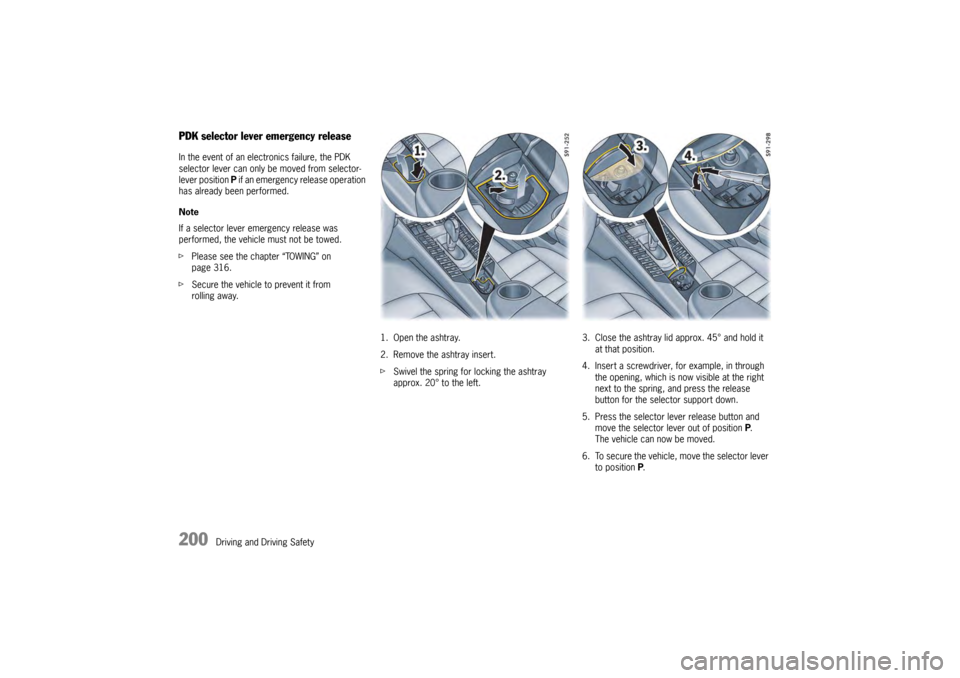
PDK selector lever emergency releaseIn the event of an electronics failure, the PDK
selector lever can only be moved from selector-
lever position P if an emergency release operation
has already been performed.
Note
If a selector lever emergency release was
performed, the vehicle must not be towed.
f Please see the chapter “TOWING” on
page 316.
f Secure the vehicle to prevent it from
rolling away.
1. Open the ashtray.
2. Remove the ashtray insert.
fSwivel the spring for locking the ashtray
approx. 20° to the left. 3. Close the ashtray lid a
pprox. 45° and hold it
at that position.
4. Insert a screwdriver, for example, in through the opening, which is now visible at the right
next to the spring, and press the release
button for the selector support down.
5. Press the selector lever release button and move the selector lever out of position P.
The vehicle can now be moved.
6. To secure the vehicle, move the selector lever
to position P.
Page 207 of 343

Driving and Driving Safety
205
When you brake in the ABS control range,
the vehicle is stabilised even when PSM is
switched off.
One-sided spinning of the wheels is prevented,
even with PSM switched off.
PSM should always be switched on during
“normal” driving.
H o w e v e r, i t m a y b e a g o o d i d e a to s w it c h o f f P S M
temporarily in exceptional situations:
– On a loose surface and in deep snow.
– When “rocking the vehicle free”.
– When using snow chains.
Tip on driving
The vehicle retains its enhanced braking readiness
through prefilling of the br ake system even when
PSM is switched off.
When PSM is switched off, wheel-specific brake
interventions and the anti-slip control system (ASR)
are also switched off.
The automatic brake differential (ABD) remains on.
Adaptive cruise control is deactivated when PSM
is switched off.
When PSM is switched off, the slip monitoring
function of Porsche Doppelkupplung (PDK) is also
deactivated.
Switching PSM back onf Press button .
PSM is active immediately.
The indicator light on the button and the
PSM OFF warning light on the instrument
panel go out.
The message “PSM switched on” appears on
the multi-function disp lay in the instrument
panel.“Sport Plus” modeA sportier setup is obtained when “Sport Plus”
mode is switched on.
PSM interventions occur later than in Normal
mode. The vehicle can be maneuvered with
greater agility at its pe rformance limits, without
having to dispense with th e assistance of PSM in
emergency situations. This helps to achieve
optimal lap times, particular ly on race circuits and
on a dry road surface. – The PSM warning light on the instrument panel
lights up for a lamp check when the ignition is
switched on.
– The light indicates a control operation, even when PSM is switched off, e.g. brake control in
the event of one-sided wheel spin.
– The light - in conjunction with the multi-function display - indicates a fault.
The warning message “PSM failure” appears
on the multi-function display in the instrument
panel.
For information on warning messages on the multi-
function display:
f Please see the chapter “OVERVIEW OF
WARNING MESSAGES” on page 152.
f Adapt your driving style according to the
changed conditions.
f Contact a qualified spec ialist workshop in
order to correct the fault. We recommend that
you have an authorized Porsche dealer to do
this work, as they have the trained workshop
personnel and the necessary parts and tools
for this type of work.
To w i n g
For information on towing:
f Please see the chapter “TOWING” on
page 316.
PSM warning light
Page 214 of 343

212
Driving and Driving Safety
“Sport” and “Sport Plus” Mode FunctionThe selectable chassis settings mean that the
vehicle can offer various modes for a sportier
overall setup.
When “Sport” or “Sport Plus” mode is selected, all
the vehicle’s control systems are intentionally
shifted towards greater agility and driving
performance:
– PASM (Porsche Active Suspension Management) is automa tically changed to
“PASM Sport” or “PASM Sport Plus” mode,
resulting in a stiffer suspension setup.
The vehicle switches to Low Level in “PASM
Sport Plus” mode.
f Please see the chapter “PORSCHE ACTIVE
SUSPENSION MANAGEMENT (PASM)” on
page 208.
– Just like PASM, PDCC is switched to the corresponding “Sport” or “Sport Plus” mode,
whereby the rolling movements of the vehicle
are reduced further, depending on the
selected mode.
f Please see the chapter “PORSCHE DYNAMIC
CHASSIS CONTROL (PDCC)” on page 211.
– The PDK transmission switches to a sporty gear-changing map and shortens the gear
shifting times when Sport mode is activated.
Gear changes take place faster. f
Please see the chapter ““SPORT” AND “SPORT
PLUS” MODE” on page 195.
– The electronic accelerator pedal reacts sooner, and the engine is more responsive to
throttle inputs. When Sport mode is switched
on and the vehicle is travelling at a speed of
less than 25 mph (40 km/h), this function is
activated only after the driver has floored the
accelerator pedal or released it briefly.
– The rpm limiter characteristic is “harder”. In other words: the engine is immediately
throttled when the performance limits are
reached (only in manual selection mode on
vehicles with PDK).
– The turbo overboost briefly increases the engine boost pressure in the engine speed
range from 2,500 rpm to approx. 4,000 rpm.
As a result, torque in this speed range is
increased by 70 Nm (52 ftlb.). This
considerably improves acceleration and
flexibility, particularly in the medium engine
speed range. This does not affect the
maximum power. Quickly flooring the
accelerator pedal acti vates turbo overboost
in the engine control system. Overboost has
an effective operating time of approx.
10 seconds. After this time, it can be re-
activated by quickly flooring the accelerator
pedal again. – PSM (Porsche Stability Management) control is
more sporty in “Sport Plus” mode. PSM
interventions are later than in Normal mode.
The driver can maneuver the vehicle with
greater agility at it s performance limits,
without having to dispense with the assistance
of PSM in emergency situations. This helps to
achieve optimal lap times, particularly on race
circuits with a dry road surface.
f Please see the chapter “PORSCHE STABILITY
MANAGEMENT (PSM)” on page 202.
– Adaptive cruise control regulates speed and distance more dynamically.
– The Auto Start Stop function is deactivated.
f Please see the chapter “AUTO START STOP
FUNCTION” on page 169.
– The rear spoiler extends earlier and retracts later (“Sport Plus” mode only).
f Please see the chapter “RETRACTABLE REAR
SPOILER” on page 214.
– The system switches from High Level.
f Please see the chapter “HIGH LEVEL” on
page 209.
Page 219 of 343
Storage, Luggage Compartment and Roof Transport System
217
Storage, Luggage Compartment and Roof Transport System
Storage ...........................................
.......... 218
Drinks Holder/Cuphold er ............................ 221
Front Ashtray ............... .............................. 224
Rear Ashtray ................ .............................. 224
Cigarette Lighter ..... ................................... 225
Refrigerated box in the re ar of the vehicle .... 226
Folding Rear Seats Forward and Returning
to Upright Position .. ................................... 226
Luggage Compartment . .............................. 227
Stowing Loads ............. .............................. 228
Luggage Compartment Cover ..................... 229
Fixed Luggage Compartm ent Cover............. 231
Ski Bag ....................... .............................. 231
Roof Transport System ............................... 232
Loading Information. ................................... 236
Page 220 of 343
218
Storage, Luggage Compartment and Roof Transport System
Storage
Warning!
Risk of injury during braking, rapid direction
changes or in an accident.
f Do not transport items of luggage or objects
unsecured in the passenger compartment.
f Do not transport any heavy objects in open
storage trays.
f Always keep the covers of the storage trays
closed while driving.
f Always protect the passenger compartment with a luggage compartment cover.
Note on operation
An unsecured or incorrectly positioned load can
slip out of place or endanger the vehicle
occupants during braking, direction changes or
in accidents.
For information on stowing loads and luggage:
f Please see the chapter “STOWING LOADS” on
page 228.
Storage optionsThere are various storage options available,
depending on the vehicle equipment:
– Glove box with pen and paper holder.
– In the front and rear armrests.
– In the door panels.
– In the center console, front and rear.
– On the back of the front seat backrests.
– Clothes hooks on the rear grab handles.
– Under the luggage compartment floor.
– In the front and rear cupholders.
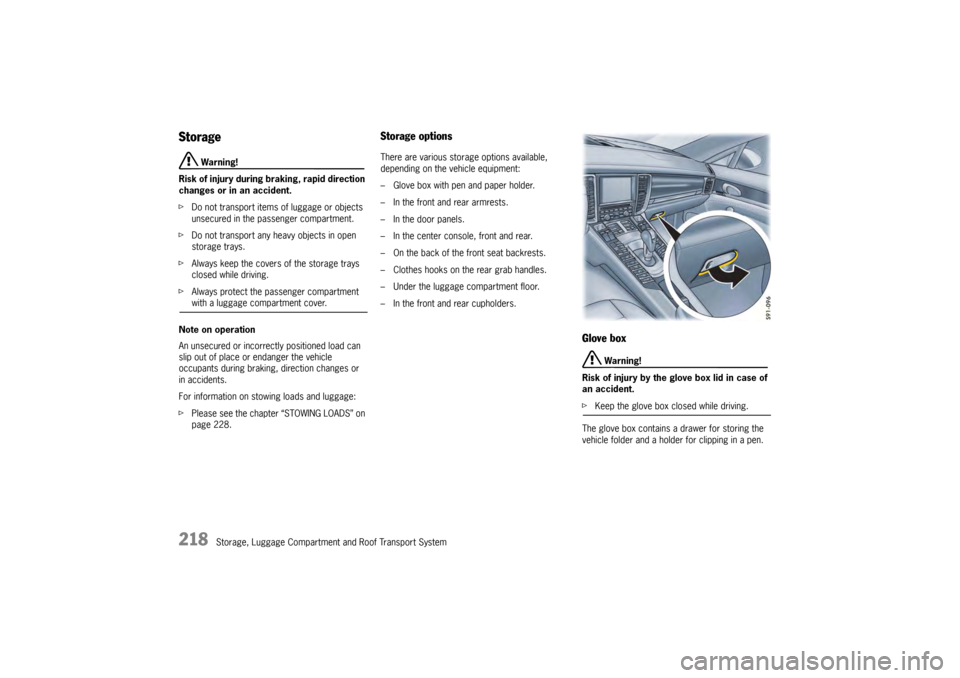
Glove box
Warning!
Risk of injury by the glove box lid in case of
an accident.
f Keep the glove box closed while driving.
The glove box contains a drawer for storing the
vehicle folder and a holder for clipping in a pen.
Page 223 of 343
Storage, Luggage Compartment and Roof Transport System
221
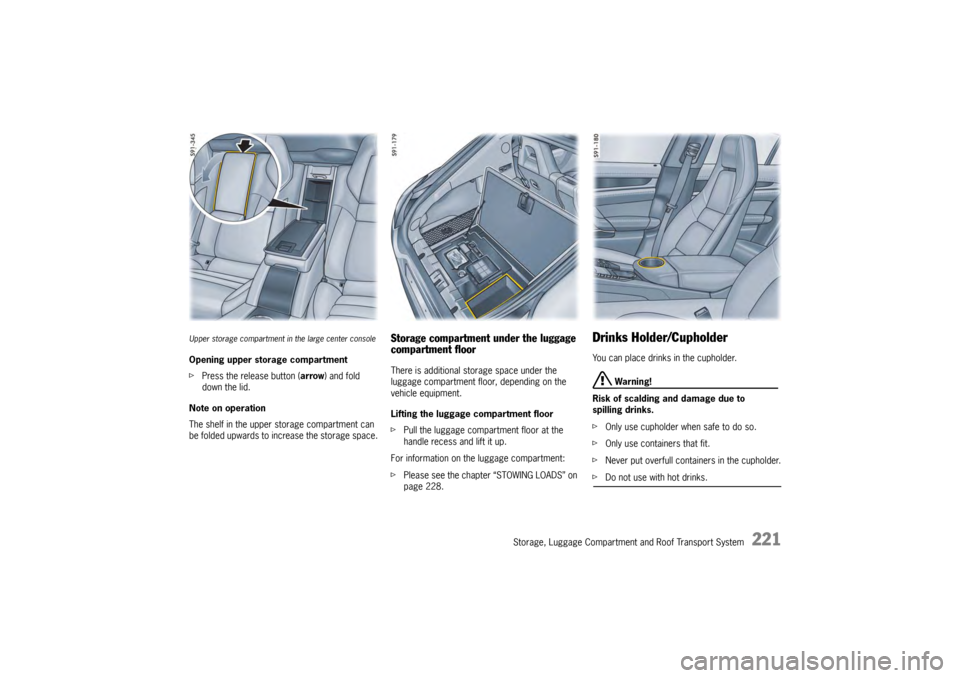
Upper storage compartment in the large center consoleOpening upper storage compartment
fPress the release button ( arrow) and fold
down the lid.
Note on operation
The shelf in the upper storage compartment can
be folded upwards to increase the storage space.
Storage compartment under the luggage
compartment floorThere is additional storage space under the
luggage compartment floor, depending on the
vehicle equipment.
Lifting the luggage compartment floor
f Pull the luggage compartment floor at the
handle recess and lift it up.
For information on the luggage compartment:
f Please see the chapter “STOWING LOADS” on
page 228.
Drinks Holder/CupholderYou can place drinks in the cupholder.
Warning!
Risk of scalding and damage due to
spilling drinks.
f Only use cupholder when safe to do so.
f Only use containers that fit.
f Never put overfull containers in the cupholder.
fDo not use with hot drinks.
Page 229 of 343
Storage, Luggage Compartment and Roof Transport System
227
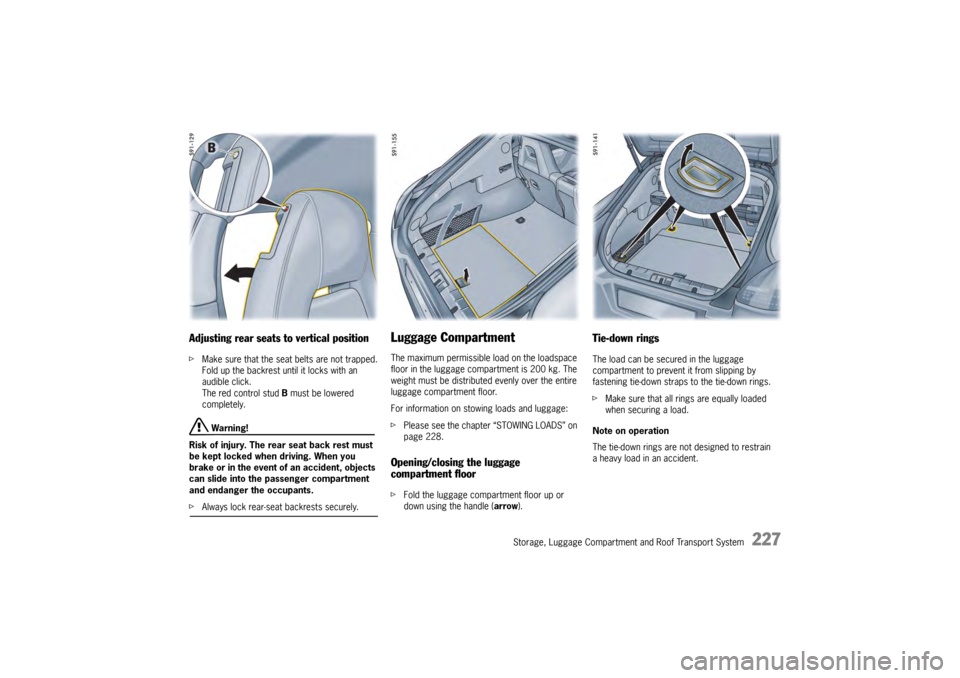
Adjusting rear seats to vertical positionfMake sure that the seat belts are not trapped.
Fold up the backrest until it locks with an
audible click.
The red control stud B must be lowered
completely.
Warning!
Risk of injury. The rear seat back rest must
be kept locked when driving. When you
brake or in the event of an accident, objects
can slide into the passenger compartment
and endanger the occupants.
f Always lock rear-seat backrests securely.
Luggage CompartmentThe maximum permissible load on the loadspace
floor in the luggage compartment is 200 kg. The
weight must be distributed evenly over the entire
luggage compartment floor.
For information on stowing loads and luggage:
fPlease see the chapter “STOWING LOADS” on
page 228.Opening/closing the luggage
compartment floorfFold the luggage compartment floor up or
down using the handle ( arrow).
Tie-down ringsThe load can be secured in the luggage
compartment to prevent it from slipping by
fastening tie-down straps to the tie-down rings.
fMake sure that all ring s are equally loaded
when securing a load.
Note on operation
The tie-down rings are no t designed to restrain
a heavy load in an accident.