2009 PORSCHE PANAMERA warning
[x] Cancel search: warningPage 287 of 343

Minor Repairs
285
In case of tire damage, where it is uncertain
whether there is a break in the ply with all its
consequences or tire damage caused by thermal
or mechanical overloading due to loss of pressure
or any other prior damage, we recommend that
the tire be replaced for safety reasons.
If one faulty tire is replac ed it should be noted that
the difference in tread depth on one axle must not
exceed 30%. Handling inconsistencies may result.
f Perform a visual inspection if necessary.Tire replacementsfUse only tire makes and types tested by
Porsche.
If you do not use a Porsche recommended
replacement tire, make sure that you
purchase your new tires from a reputable tire
dealer and that the dealer complies with all
manufacturers warnings for those tires.
Only tires with the same manufacturer and
with the same specific ation code (e.g. “N0”,
“N1”…) should be mounted on the vehicle.
Before mounting new tires, check with your
Porsche dealer about the current release
status.
Tires should be replaced no less than on one axle
at the time. Only tires of the same make and type
must be used. Mixed tire s are not permissible and
will affect vehicle performance, safety, and can
affect vehicle warranty. Porsche dealers can recommend the most current
replacement tire options for your vehicle.
Initially, new tires do not have their full traction.
You should therefore drive at moderate speeds
during the first 60 - 120 miles (100 - 200 km).
Tires must always remain
on the same side of
the vehicle.
When wheels are removed, the direction of
rotation and position of each wheel should be
marked.
If new tires are installed only on one axle, a
noticeable change in hand ling occurs due to the
different tread depth of the other tires. This
happens especially if only rear tires are replaced.
However, this condition disappears as the new
tires are broken in.
f Please adjust your driving style accordingly.
Installation of new tires should only be done by a
qualified tire technician.
Valves
f Use only plastic valve caps.
f The rubber valves must be replaced whenever
the tires are changed.
f The fitting and replacement specifications
must be observed for metal valves.
f Only use Original Porsche metal valves.
f Protect the valve inserts against soiling with
valve caps. Soiled valve inserts can cause a
gradual loss of air.
Parking at the curb
Danger!
Hard impacts against curbs (or traffic
islands) are dangerous and may cause
hidden tire damage which is not noticeable
until later. Such damage can result in
accidents at high speeds causing serious
personal injury or death. Depending on the
force of impact, the edge of the rim can also
be damaged.
f After such an impact, have the wheel checked
by an expert.
f If you must drive over a curb or other obstacle,
drive slowly and at an obtuse angle. Exercise care when parking along curbs.
Maintenance note
Tire repairs are not permissible under any
circumstances.
Wheel alignment, wheel balancingAs a precaution, have wheels with summer tires
balanced in the spring, and those with mud and
snow tires before winter. Unbalanced wheels may
affect car handling and tire life.
Only the specified weights may be used for wheel
balancing.
Page 290 of 343

288
Minor Repairs
Snow chains
Warning!
Risk of damage to body, axle or brake
components.
f Use only the fine-link snow chains recom-
mended and authorized by Porsche so that
sufficient clearance between the wheel well
and the chain is assured.
f Please see the chapter “WHEELS, TIRES” on
page 325.
f Follow instructions issued by the supplier of the chains.
Fit snow chains only on the rear axle.
f Remove spacers if snow chains are mounted.
f Before fitting chains, remove accumulated ice
and snow from the wheel well.
f Vehicles with snow chains must not be driven
faster than 30 mph (50 km/h) .
Different states and countr ies have varying statu-
tory requirements regarding maximum speed.
f Check with local authorities for possible
restrictions.
f Remove chains as soon as the roads are free
of ice and snow.
Example of InscriptionInscription on radial tireA – Tire size
Example: P 265/40ZR18 (101Y)
–P - The tire is designed for Passenger vehicle.
This information is not included on all tires.
– 265 - Indication of tire width in mm
– 40 - Indication of tire height to tire width ratio
in percent
– ZR - Belt type code letter for radial
– 18 - Indication of rim diameter in inches
– 101 - Load capacity coefficient –
Y - Speed code letter
– XL (Extra Load) - Tire with increased load
rating
B – TIN (Tire Identification Number)
Example: DOT xx xx xxxx xxxx
–DOT The DOT symbol indicates that the tires
comply with the requirements of the
US Department of Transportation and provides
information about:
– first two-digit code means manufacture’s identification mark.
Page 293 of 343

Minor Repairs
291
Changing a wheel
Danger!
Failure to follow these instructions may result
in serious personal inju ry or death to you or
to bystanders.
Before changing the wheel
f If you have a flat tire, move a safe distance off
the road. Turn the emergency flasher on and
use other warning devices to alert other
motorists.
f Do not park your vehicl e where it may contact
dry grass, brush or other flammable materials.
The hot parts of the exhaust system could set
such materials on fire, thereby causing both
property damage and severe or fatal physical
injury.
f Passengers must not be in the vehicle when it
is jacked up.
f Before you change a wheel, be sure the ground
is level and firm. If necessary, use a board
under the jack to ensure that the jack does not
sink into the ground.
f Set the electric parking brake and block the
wheels opposite the flat tire on the other side
of the vehicle.
While operating the jack
f The jack is only to be used for changing a
wheel. Do not use it as a support to work under
the car. f
The car must be jacked up only at the
illustrated jacking points. Lifting at any other
place may damage the vehicle or may result in
personal injury. Never jack the car up by the
body or the bumpers.
f For safety reasons do not use tire inflating
bottles. Do not use co mmercially available
sealant bottles. Use only the tire inflating bottle
located in the luggage compartment.
Note
The tools required for changing a wheel (e.g. jack,
wheel bolt wrench, assembly aids) are not
supplied as standard with the vehicle. Your
authorized Porsche dealer will be pleased to
advise you.
Sequence of operation Warning!
The jack must be used on ly to raise the car
for wheel changing. The jack must never be
used as a support to work underneath the
vehicle. If the jack is accidentally dislodged,
you or bystanders could suffer severe
personal injury.
f Never jack up other ve hicles or other loads
with the jack.
f Always place the car on stable supports if you
have to work under it. When working under the
vehicle, always use safety stands specifically designed for this purpose. f
Please use a suitable knee rest to protect your
clothing against soiling.
1. Activate the electric parking brake and shift into 1st gear or move the PDK selector lever
to position P .
Remove the ignition key or control unit on
vehicles with Porsche Entry & Drive.
2. Switch on the emergency flasher if necessary.
3. Secure the vehicle against rolling away, e.g. by means of wedges at the wheels on the
opposite side.
This is particularly important on slopes.
4. Slightly loosen the wheel bolts on the wheel to be changed.
5. Lift the vehicle only at the specified jacking points.
6. Raise the vehicle until the wheel lifts off the ground.
f Please see the chapter “RAISING THE VEHICLE
WITH A LIFTING PLATFORM, TROLLEY JACK
OR STANDARD JACK” on page 290.
7. Remove 1 or 2 wheel bolts (see corresponding figure).
Page 295 of 343

Minor Repairs
293
Wheel Bolts fAlways clean the wheel bolts before fitting.
f Wheel bolts must not be greased.
f Replace damaged wheel bolts.
Only use genuine Porsche wheel bolts
assigned especially to this model or wheel
bolts of similar quality that have been
manufactured according to Porsche
specifications and production requirements.
Tightening torque
Tightening torque for wheel bolts: 160 Nm
(118 ftlb.) .
Security wheel boltsThe adapter (wrench socket) for the security
wheel bolts is stored in the tool tray under the
luggage compartment floor.
fIf the wheels have to be removed at the
workshop, do not forget to hand over the
socket for the security wheel bolts along
with the car key.
f To loosen or tighten the wheel bolt with anti-
theft protection, the adapter must be used
between the wheel bolt and the wheel
bolt wrench.
f When positioning the wrench socket, ensure
that it engages fully in the teeth of the
wheel bolt.
Flat Tire 1. Stop the vehicle as far away from the driving lane as possible.
The vehicle must be parked on a firm and flat
surface offering adequate grip.
2. Switch emergency flasher on.
3. Apply the parking brake.
4. Put the vehicle in 1st gear or move the PDK selector lever to position P.
5. Straighten the front wheels.
6. Remove the ignition key, or the control unit on vehicles with Porsche Entry & Drive, in order to
lock the steering and pr event the engine from
being started.
7. Get all passengers to leave the vehicle.
8. Set up the warning triangle at a suitable distance.Filling in tire sealantThe tire sealant and compressor with pressure
tester can be found in the tool tray under the
loadspace floor in the luggage compartment.
The tire sealant can be used to seal small cuts,
especially in the tire tread.
Sealing the tire with the tire sealant is only an
emergency solution so you can drive to the
nearest workshop. Even if the tire is air-tight,
Page 296 of 343
294
Minor Repairs
it may only be used for short journeys in an
emergency.
The tire sealant comprises:
– a filler bottle,
– a filler hose,
– a valve turner,
– a spare valve insert,
– a sticker with the maximum permitted speed
– a compressor and
– instructions for use.
Danger!
Risk of accident, resulting in serious
personal injury or death.
f Use the tire sealant only in the case of cuts
or punctures no larger than 0.15 in. (4 mm).
f Never use the tire sealant if the rim is damaged.
Warning!
The sealant is highly flammable and
potentially fatal if inhaled.
f Fire, naked flame and smoking are prohibited
when handling tire sealant.
f Avoid contact with skin, eyes, and clothing due
to caustic chemical properties of the tire
sealant.
f Keep tire sealant away from children.
f Do not inhale vapours, due to the consequent
harm to personal health resulting in serious personal injury or death.
In the event of contact with sealant:
f If sealant gets on your skin or into your eyes,
thoroughly rinse the affected part of your body
immediately with plenty of water.
f Change soiled clothing immediately.
f See a doctor immediately in the event of an
allergic reaction.
f If sealant is swallowed, thoroughly rinse out
the mouth without delay and drink plenty of
water. Do not in duce vomiting.
See a doctor immediately.
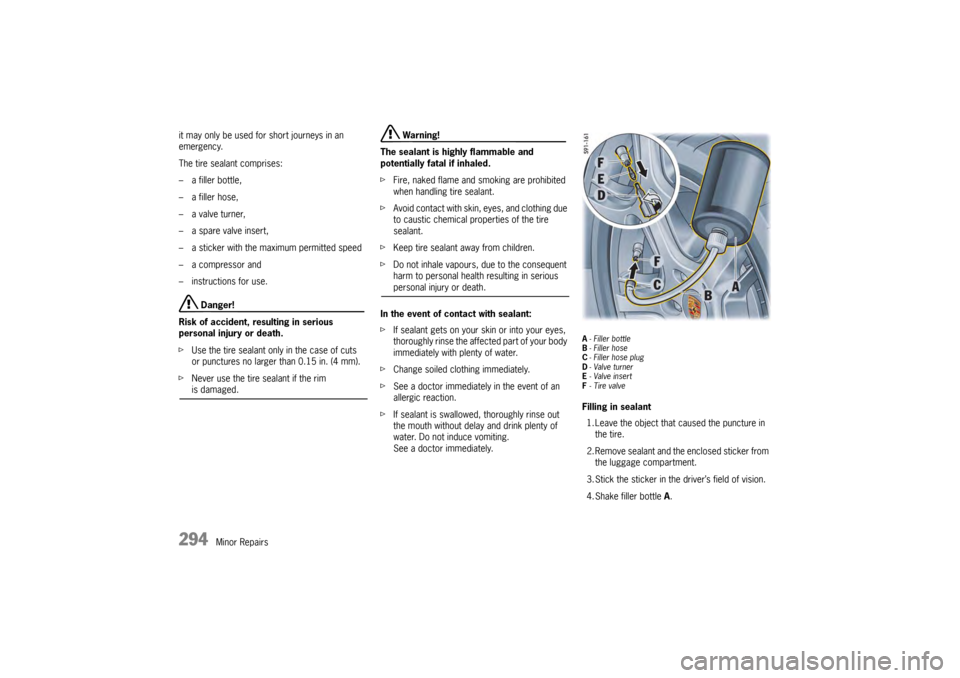
A - Filler bottle
B - Filler hose
C - Filler hose plug
D -Valve turner
E -Valve insert
F - Tire valveFilling in sealant
1. Leave the object that caused the puncture in the tire.
2. Remove sealant and the enclosed sticker from the luggage compartment.
3. Stick the sticker in the driver’s field of vision.
4. Shake filler bottle A .
Page 297 of 343

Minor Repairs
295
5. Screw filler hose B onto the filler bottle.The filler bottle is now open.
6. Unscrew valve cap from the tire valve F.
7. Remove valve insert E from the tire valve with
valve turner D.
Keep the valve insert in a clean, dry place.
8. Remove plug C from the filler hose B.
9. Push filler hose onto the tire valve.
10.Hold the filler bottle higher than the level of the
tire valve and squeeze it forcefully until the
bottle is completely emptied into the tire.
11.Pull filler hose off the tire valve.
12.Twist the valve insert firmly into the tire valve using the valve turner.
13.Connect the compressor to a vehicle plug socket and inflate the tire to at least 37 psi
(2.5 bar).
If this tire pressure cannot be reached, the tire
is too severely damaged. You must not
continue driving with this tire.
14.Screw valve cap onto the tire valve. 15.After driving for approx. 10 minutes, check the
tire pressure.
If the tire pressure is less than 22 psi (1.5 bar),
do not continue driving.
If a value of more than 22 psi (1.5 bar) is
indicated, correct the pressure to the
prescribed value.
f Please see the chapter “TIRE PRESSURE FOR
COLD TIRES (68 °F/20 °C)” on page 326.
16.Please contact a qualified specialist workshop. We recommend that you have an authorized
Porsche dealer to do this work as they have
trained workshop personnel and the necessary
parts and tools.
f Please also make sure to follow the separate
instructions for use for the tire sealant.
Note on operation for vehicles with Tire
Pressure Monitoring
f The settings for Tire Pressure Monitoring must
be updated on the multi-function display after
filling the tire with sealant.
f Please see the chapter “OVERVIEW OF
WARNING MESSAGES” on page 152. Care instructions
After drying, any sealan
t that emerges can be
peeled off like a film.
Warning!
Risk of accidents, resulting in serious
personal injury or death.
f Have the tire replaced by a specialist
workshop as soon as possible.
Inform the specialist workshop that the tire
contains sealant.
f Avoid hard acceleration and high cornering
speeds.
f Observe the maximum speed of 50 mph
(80 km/h).
f Always observe the safety and operating
instructions, which can be found in the
separate operating instructions for the sealant and on the compressor.
Page 298 of 343

296
Minor Repairs
Electrical SystemIn order to avoid damage and faults in electrical or
electronic systems, electrical accessories should
be installed at a qualified specialist workshop. We
recommend that you have an authorized Porsche
dealer to do this work, as they have the trained
workshop personnel and the necessary parts and
tools for this type of work.
fUse only accessories approved by Porsche.
Warning!
Risk of short circuit and fire, resulting in
serious personal injury or death.
Replacing fuses or relays with the engine
running or the ignition on could cause
electrical shock.
f Disconnect the negative terminal on
the battery during all work on the
electrical system.
f Please see the chapter “BATTERY” on page 303.
RelaysRelays should be checked or changed only at an
authorised workshop.
Plug socket in glove compartmentSocketsElectrical accessories can be connected to the
12 V sockets.
You will find sockets in the glove box, in the front
and rear center consoles and in the luggage
compartment, depending on vehicle equipment.
Page 305 of 343

Minor Repairs
303
Battery
Danger!
Risk of short circuit and fire, resulting in
serious personal injury or death.
f Observe all warning notes on the battery.
f Disconnect the negative terminal on the
battery during all work on the electrical
system.
f Do not lay tools or other metal objects on the
battery as they could cause a short circuit
across the battery terminal.
Hydrogen gas generated by the battery
could cause an explosion, resulting in
serious personal injury or death.
f Charge battery in a well vetilated area.
f Never charge a frozen battery. It may explode
because of gas trapped in the ice. Allow a
frozen battery to thaw out first.
f Do not expose the battery to an open flame,
electrical spark or a lit cigarette.
Risk of explosion as a result of static charge,
resulting in serious personal injury or death.
f Do not wipe the battery with a dry cloth.
f Before touching the battery, discharge any
static electricity by touching the vehicle. Risk of serious personal
injury or death and
damage to the fabric, metal or paint.
f Wear eye protection.
f Do not allow battery acid to come in contact
with your skin, eyes, fabric or painted
surfaces.
f If you get electrolyte, which is an acid, in your
eyes or on your skin, immediately rinse with
cold water for several minutes and call a
doctor.
f Spilled electrolyte must be rinsed off at once
with a solution of baki ng soda and water to
neutralize the acid.
Battery posts, terminals and related
accessories contain lead and lead
compounds, chemicals known to the State of
California to cause cancer and reproductive
harm.
f Always protect your skin by washing
thoroughly with soap and water.
The battery is located in the battery box under the
left front seat.
Charge stateA well charged battery will not only prevent
starting problems but will also last longer.
In order to avoid unintended battery
discharge
f Switch off unnecessary electrical loads in city
traffic, on short trips or in a line of traffic.
f Always remove the ignition key from the
ignition switch when leaving the vehicle or
switch ignition off in vehicles with Porsche
Entry & Drive.
f Avoid using the Porsche Communication
Management system and the audio system
when the engine is not running.
Maintenance note
In the cold season, in part icular, or if you mainly
drive only short distances, it may become
necessary to recharge the battery from time to
time.