Page 227 of 343
Storage, Luggage Compartment and Roof Transport System
225
Emptying ashtrays in the doors1. Open the ashtray lid and carefully press it up.
The insert pops up slightly.
2. Remove the insert and empty it.
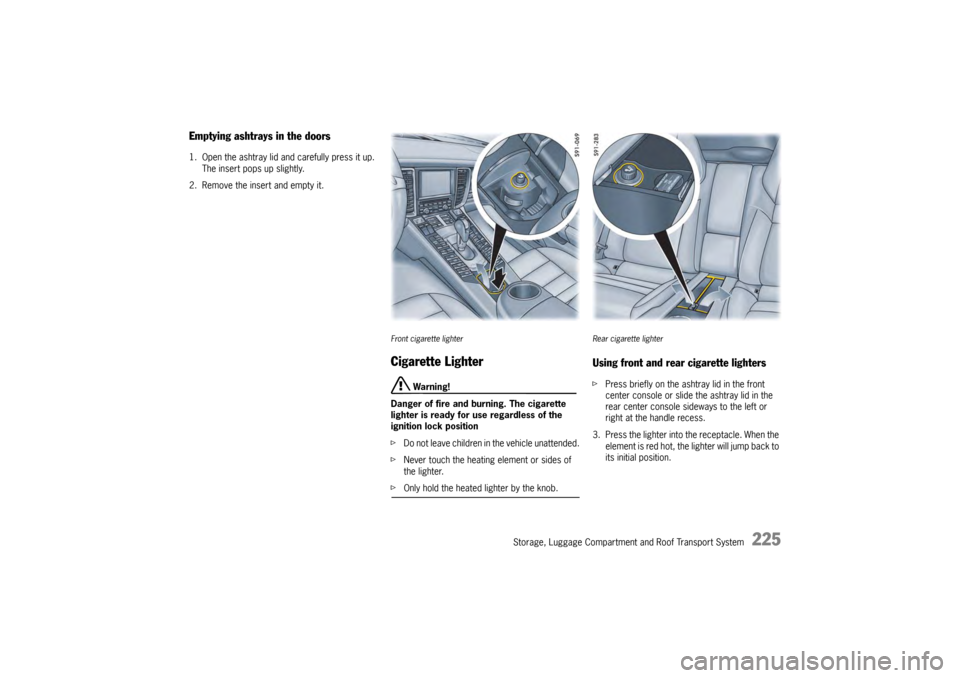
Front cigarette lighterCigarette Lighter
Warning!
Danger of fire and burning. The cigarette
lighter is ready for use regardless of the
ignition lock position
f Do not leave children in the vehicle unattended.
f Never touch the heating element or sides of
the lighter.
fOnly hold the heated lighter by the knob.
Rear cigarette lighterUsing front and rear cigarette lightersf Press briefly on the ashtray lid in the front
center console or slide the ashtray lid in the
rear center console sideways to the left or
right at the handle recess.
3. Press the lighter into the receptacle. When the element is red hot, the lighter will jump back to
its initial position.
Page 229 of 343
Storage, Luggage Compartment and Roof Transport System
227
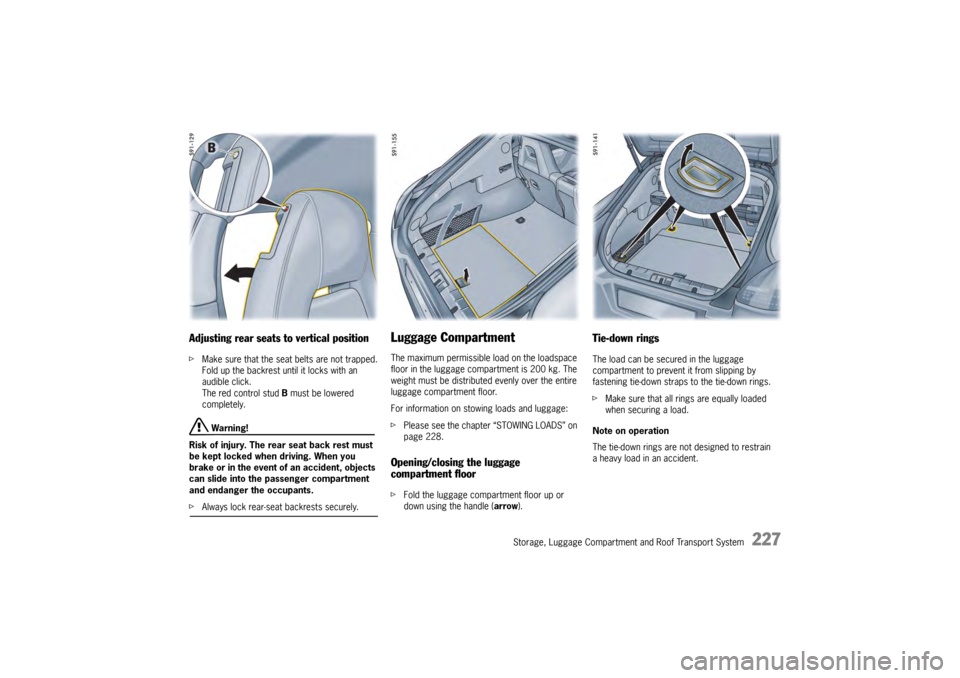
Adjusting rear seats to vertical positionfMake sure that the seat belts are not trapped.
Fold up the backrest until it locks with an
audible click.
The red control stud B must be lowered
completely.
Warning!
Risk of injury. The rear seat back rest must
be kept locked when driving. When you
brake or in the event of an accident, objects
can slide into the passenger compartment
and endanger the occupants.
f Always lock rear-seat backrests securely.
Luggage CompartmentThe maximum permissible load on the loadspace
floor in the luggage compartment is 200 kg. The
weight must be distributed evenly over the entire
luggage compartment floor.
For information on stowing loads and luggage:
fPlease see the chapter “STOWING LOADS” on
page 228.Opening/closing the luggage
compartment floorfFold the luggage compartment floor up or
down using the handle ( arrow).
Tie-down ringsThe load can be secured in the luggage
compartment to prevent it from slipping by
fastening tie-down straps to the tie-down rings.
fMake sure that all ring s are equally loaded
when securing a load.
Note on operation
The tie-down rings are no t designed to restrain
a heavy load in an accident.
Page 230 of 343

228
Storage, Luggage Compartment and Roof Transport System
Stowing Loads
Danger!
Danger of injury. An unsecured or incorrectly
positioned load can slip out of place or
endanger the vehicle occupants during
braking, direction changes or in accidents.
Never transport objects that are not secured.
f Always transport loads in the luggage
compartment, never in the passenger
compartment (e.g. on or in front of the seats).
f Support the load against the seat backrests
wherever possible. Always lock the backrests
into place.
f Only transport heavy objects with the rear seat
backrests upright and engaged.
f Place the load behind unoccupied seats
whenever possible.
f Stow heavy objects as far forward as possible
on the floor, with lightweight objects behind
them.
f Never load the vehicle higher than the top
edge of the seat backrest.
f Always protect the passenger compartment
with a luggage compartment cover. Do not
drive with objects on top of the luggage
compartment cover. f
If the rear seats are not occupied, the
backrests can be addition ally secured with the
seat belts. Simply cro ss the outer seat belts
and insert each into the opposite buckle.
f Make sure that the load cannot damage the
heating filaments and the TV antenna in the
rear window.
Tie-down belts
f Do not use elastic belt s or straps to tie
down a load.
f Do not route belts and straps over
sharp edges.
f Observe the directions for use and information
for the tie-down equipment.
f Use only belts with a tear strength of at least
1543 lbs (700 kg) and a maximum width of
1 in. (25 mm).
f Cross the belts over the load. Driving
f
Vehicle handling changes depending on the
vehicle load. Adapt your driving style to the
changed driving behavior.
f Do not exceed the maximum gross weight
and axle load.
This information can be found under “Technical
data” in this Owner’s Manual:
f Please see the chapter “WEIGHTS” on
page 328.
f Never drive with the tailgate open. Exhaust
gases can enter the passenger compartment.
f Adapt the tire pressure to the load.
After you change the tire pressure, you must
also update the setting for Tire Pressure
Monitoring.
For information on setting Tire Pressure
Monitoring on the multi-function display:
f Please see the chapter “OVERVIEW OF
WARNING MESSAGES” on page 152.
Information on tire pressures for partially and fully
loaded vehicles can be found under “Technical
data” in this Owner’s Manual:
f Please see the chapter “TIRE PRESSURE FOR
COLD TIRES (68 °F/20 °C)” on page 326.
Page 231 of 343
Storage, Luggage Compartment and Roof Transport System
229
Luggage Compartment Cover
Warning!
Risk of injury. In the event of braking,
direction changes or in an accident, objects
can slide into the passenger compartment
and endanger the occupants.
f Do not place objects on the retractable
luggage compartment cover or on the fixed luggage compartment cover.
Retractable luggage compartment coverLuggage can be protected against prying eyes
with the retractable luggage compartment cover.
fAlways pull out the retractable luggage
compartment cover when transporting objects
in the luggage compartment.
The retractable luggage compartment cover is
not designed to carry objects.
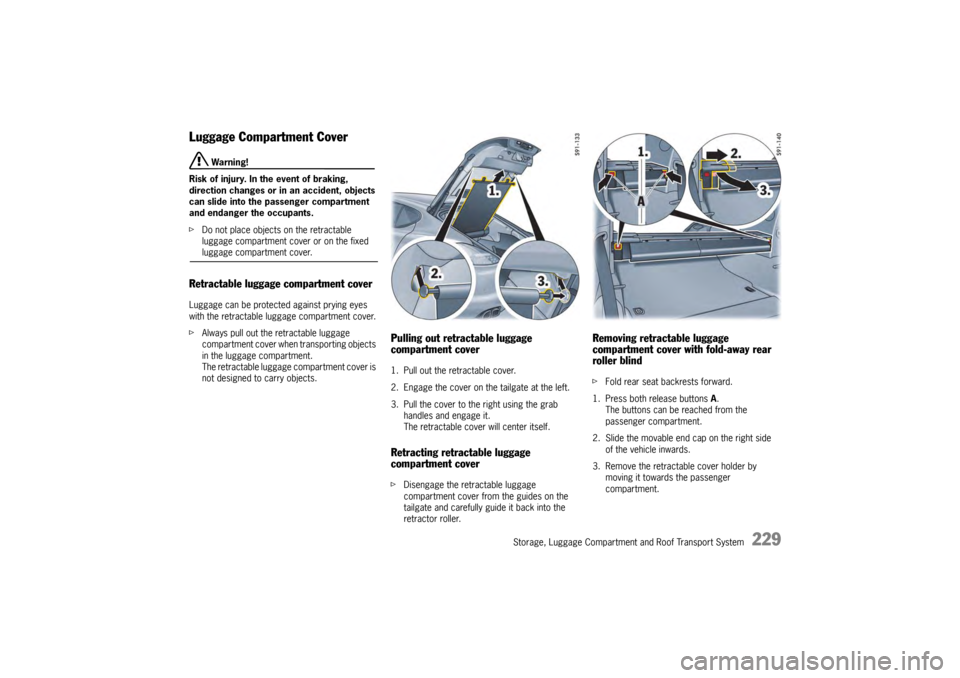
Pulling out retractable luggage
compartment cover1. Pull out the retractable cover.
2. Engage the cover on the tailgate at the left.
3. Pull the cover to the right using the grab
handles and engage it.
The retractable cove r will center itself.Retracting retractable luggage
compartment coverfDisengage the retractable luggage
compartment cover from the guides on the
tailgate and carefully guide it back into the
retractor roller.
Removing retractable luggage
compartment cover with fold-away rear
roller blindf Fold rear seat backrests forward.
1. Press both release buttons A.
The buttons can be reached from the
passenger compartment.
2. Slide the movable end cap on the right side of the vehicle inwards.
3. Remove the retractable cover holder by moving it towards the passenger
compartment.
Page 241 of 343
Parking
239
Warning!
fIf the continuous tone sounds, do not move the
vehicle any close to the obstacle.
Page 242 of 343
240
Parking
Maintenance notes
Warning!
f
Do not reverse any further once a continuous
tone sounds. Risk of collision!
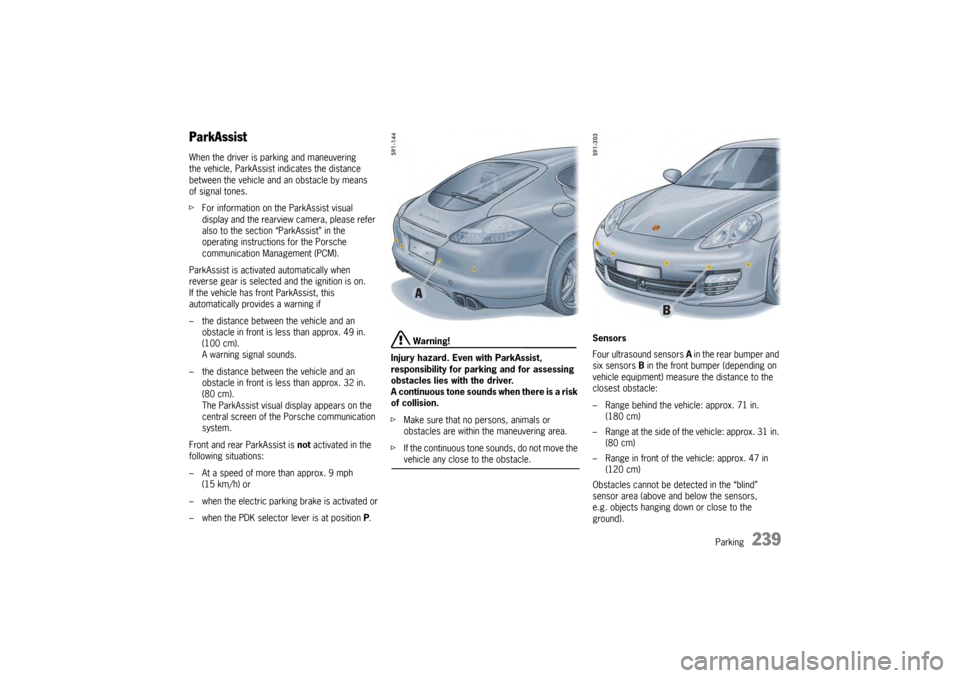
Limits of ultrasonic measurement
Page 245 of 343
Parking
243
Note
Warning!
fObserve the safety no tes for the original
remote control.
Notes on operation
Preconditions
Page 249 of 343

Alarm System and Theft Protection
247
Alarm System and Passenger
Compartment MonitoringThis device complies with:
Part 15 of the FCC Rules
RSS-210 of Industry Canada.
Operation of this device is subject to the following
two conditions:
– It may not cause harmful interference, and
– it must accept any interference received including interference that may cause
undesired operation.
Note
The manufacturer is not responsible for any radio
or TV interference caused by unauthorized
modifications to this equipment.
Such modification could void the user's authority
to operate the equipment.
Warning!
Any changes or modifications not expressly ap-
proved by Porsche could void the user’s authority
to operate this equipment.
The alarm system monitors the following alarm
contacts:
– Alarm contacts in doors, tailgate, engine compartment lid and headlights
– Interior surveillance: Movement in the interior when the vehicle is locked, e.g. attempted
theft after breaking a window.
– Inclination sensor: Tilting of the vehicle (e.g. attempt to tow away the vehicle).
If one of these alarm contacts is interrupted,
the alarm horn sounds for approx. 30 seconds
and the emergency flasher flashes on and off.
After 5 seconds of interruption, the alarm is
triggered again. This cycle is repeated ten times.Switching onf The alarm system is activated when the vehicle
is locked. Switching offfThe alarm system is deactivated when the
vehicle is unlocked. Note on operation
f
If you unlock the vehicle with the emergency
key in the door lock, you must switch the
ignition on (ignition lock position 1) within
10 seconds of opening the door in order to
prevent the alarm system from being
triggered.
The vehicle is locked ag ain automatically after
20 seconds if no doors are opened.
Switching off the alarm system if it is
triggeredf Unlock vehicle doors with the remote control
or
Switch on ignition.Switching off interior surveillance and
inclination sensorIf people or animals are remaining in the locked
vehicle or the vehicle is being transported on
a train or ship, for example, the interior
surveillance system and inclination sensor must
be switched off temporarily.
f Inform any persons remaining in the vehicle
that the alarm system will be triggered if the
door is opened.
USA: KR55WK50138
Canada: 7812D-5WK50138