2009 PONTIAC G8 lock
[x] Cancel search: lockPage 184 of 356

And, of course, actual stopping
distances vary greatly with the
surface of the road, whether it is
pavement or gravel; the condition of
the road, whether it is wet, dry, or icy;
tire tread; the condition of the brakes;
the weight of the vehicle; and the
amount of brake force applied.
Avoid needless heavy
braking. Some people drive in
spurts — heavy acceleration
followed by heavy braking — rather
than keeping pace with traffic.
This is a mistake. The brakes might
not have time to cool between
hard stops. The brakes will wear out
much faster if you do a lot of
heavy braking. If you keep pace
with the traffic and allow realistic
following distances, you will
eliminate a lot of unnecessary
braking. That means better braking
and longer brake life.
If your vehicle’s engine ever stops
while you are driving, brake normally
but do not pump the brakes. If you
do, the pedal could get harder topush down. If the engine stops, you
will still have some power brake
assist. But you will use it when you
brake. Once the power assist is used
up, it can take longer to stop and the
brake pedal will be harder to push.
Adding non-dealer/non-retailer
accessories can affect your vehicle’s
performance. SeeAccessories
and Modifications on page 9-3.
Antilock Brake
System (ABS)
Your vehicle has the Antilock Brake
System (ABS), an advanced
electronic braking system that will
help prevent a braking skid.
When you start the engine and
begin to drive away, ABS will check
itself. You might hear a momentary
motor or clicking noise while this
test is going on, and you might even
notice that the brake pedal moves
a little. This is normal.If there is a problem with ABS, this
warning light will stay on. See
Antilock Brake System (ABS)
Warning Light on page 4-16.
Let us say the road is wet and you
are driving safely. Suddenly, an
animal jumps out in front of you.
You slam on the brakes and continue
braking. Here is what happens
with ABS:
A computer senses that the wheels
are slowing down. If one of the
wheels is about to stop rolling, the
computer will separately work
the brakes at each wheel.
ABS can change the brake pressure
to each wheel, as required, faster
than any driver could. This can help
you steer around the obstacle while
braking hard.
8-18 Driving and Operating
Page 185 of 356

As you brake, the computer keeps
receiving updates on wheel speed
and controls braking pressure
accordingly.
Remember: ABS does not change
the time you need to get your
foot up to the brake pedal or always
decrease stopping distance. If
you get too close to the vehicle in
front of you, you will not have time to
apply the brakes if that vehicle
suddenly slows or stops. Always
leave enough room up ahead
to stop, even though you have ABS.
Using ABS
Do not pump the brakes. Just hold
the brake pedal down rmly and
let antilock work for you. You might
hear the antilock pump or motor
operate, and feel the brake
pedal pulsate, but this is normal.
Braking in Emergencies
With ABS, you can steer and
brake at the same time. In many
emergencies, steering can help
you more than even the very best
braking.
Electronic Stability
Program
The vehicle has the Electronic
Stability Program (ESP®) that assists
with directional control of the vehicle
in difficult driving conditions by
reducing engine power and applying
the brakes to individual wheels. This
is especially useful in slippery road
conditions. The system operates if it
senses that the rear wheels are
spinning too much, are beginning to
lose traction or if it senses that the
vehicle is not moving in its intended
direction. It turns on automatically
every time the vehicle is started.When ESP is working, this light
and the STABILITY CONTROL
ASSISTANCE message will come on
and the ESP CTRL message will be
displayed at the bottom of the DIC.
The STABILITY CONTROL
ASSISTANCE message will remain
on while the system is working
until the
3button is pressed to
display the trip computer. The
ESP CTRL message stays on at the
bottom of the DIC while the
system is working.
Driving and Operating 8-19
Page 188 of 356

Steering
Power Steering
If you lose power steering assist
because the engine stops or the
system is not functioning, you can
steer but it will take much more effort.
Steering Tips
It is important to take curves at a
reasonable speed.
Traction in a curve depends on the
condition of the tires and the
road surface, the angle at which the
curve is banked, and your speed.
While in a curve, speed is the
one factor you can control.
If you need to reduce speed, do it
before you enter the curve, while the
front wheels are straight ahead.
Try to adjust the speed so you can
drive through the curve. Maintain
a reasonable, steady speed. Wait to
accelerate until you are out of the
curve, and then accelerate
gently into the straightaway.
Steering in Emergencies
There are times when steering can
be more effective than braking.
For example, you come over a hill
and nd a truck stopped in your
lane, or a car suddenly pulls
out from nowhere, or a child darts
out from between parked cars
and stops right in front of you.
You can avoid these problems by
braking — if you can stop in
time. But sometimes you cannot;
there is not room. That is the
time for evasive action — steering
around the problem.
Your vehicle can perform very well
in emergencies like these. First
apply the brakes. SeeBraking on
page 8-17. It is better to remove as
much speed as you can from a
possible collision. Then steer around
the problem, to the left or right
depending on the space available.An emergency like this requires
close attention and a quick decision.
If you are holding the steering wheel
at the recommended 9 and 3 o’clock
positions, you can turn it a full
180 degrees very quickly without
removing either hand. But you have
to act fast, steer quickly, and just as
quickly straighten the wheel once
you have avoided the object.
The fact that such emergency
situations are always possible is a
good reason to practice defensive
driving at all times and wear
safety belts properly.
8-22 Driving and Operating
Page 190 of 356

In the steering or cornering skid, too
much speed or steering in a curve
causes tires to slip and lose
cornering force. And in the
acceleration skid, too much throttle
causes the driving wheels to spin.
If your vehicle starts to slide, ease
your foot off the accelerator pedal
and quickly steer the way you want
the vehicle to go. If you start steering
quickly enough, your vehicle may
straighten out. Always be ready for a
second skid if it occurs.
Of course, traction is reduced when
water, snow, ice, gravel, or other
material is on the road. For safety,
you want to slow down and
adjust your driving to these
conditions. It is important to slow
down on slippery surfaces because
stopping distance is longer and
vehicle control more limited.
While driving on a surface with
reduced traction, try your best to
avoid sudden steering, acceleration,
or braking, including reducing vehicle
speed by shifting to a lower gear.Any sudden changes could cause
the tires to slide. You might not
realize the surface is slippery until
your vehicle is skidding. Learn to
recognize warning clues — such as
enough water, ice, or packed snow
on the road to make a mirrored
surface — and slow down when you
have any doubt.
Remember: Any Antilock Brake
System (ABS) helps avoid only the
braking skid.
Driving at Night
Night driving is more dangerous
than day driving because some
drivers are likely to be impaired — by
alcohol or drugs, with night vision
problems, or by fatigue.
Night driving tips include:
Drive defensively.
Do not drink and drive.
Reduce headlamp glare by
adjusting the inside rearview
mirror.
Slow down and keep more space
between you and other vehicles
because headlamps can only
light up so much road ahead.
Watch for animals.
When tired, pull off the road.
Do not wear sunglasses.
Avoid staring directly into
approaching headlamps.
Keep the windshield and all glass
on your vehicle clean — inside
and out.
Keep your eyes moving,
especially during turns or curves.
No one can see as well at night as
in the daytime. But, as we get
older, these differences increase.
A 50-year-old driver might need
at least twice as much light to see
the same thing at night as a
20-year-old.
8-24 Driving and Operating
Page 194 of 356

Try not to break the fragile traction.
If you accelerate too fast, the drive
wheels will spin and polish the
surface under the tires even more.
TheAntilock Brake System (ABS)
on page 8-18improves vehicle
stability during hard stops on
a slippery roads, but apply the
brakes sooner than when on
dry pavement.
Allow greater following distance on
any slippery road and watch for
slippery spots. Icy patches
can occur on otherwise clear roads
in shaded areas. The surface of
a curve or an overpass can remain
icy when the surrounding roads
are clear. Avoid sudden steering
maneuvers and braking while on ice.
Turn off cruise control, if equipped,
on slippery surfaces.Blizzard Conditions
Being stuck in snow can be in a
serious situation. Stay with the
vehicle unless there is help nearby.
If possible, use theRoadside
Assistance Program on page 12-6.
To get help and keep everyone
in the vehicle safe:
Turn on theHazard Warning
Flashers on page 4-4.
Tie a red cloth to an outside
mirror.
{CAUTION
Snow can trap engine exhaust
under the vehicle. This may cause
exhaust gases to get inside.
Engine exhaust contains carbon
monoxide (CO) which cannot be
seen or smelled. It can cause
unconsciousness and even death.
If the vehicle is stuck in the snow:
Clear away snow from
around the base of your
vehicle, especially any that is
blocking the exhaust pipe.
Check again from time to
time to be sure snow does
not collect there.
Open a window about
two inches on the side of the
vehicle that is away from the
wind to bring in fresh air.
(Continued)
8-28 Driving and Operating
Page 195 of 356

CAUTION (Continued)
Fully open the air outlets on
or under the instrument panel.
Adjust the Climate Control
system to a setting that
circulates the air inside the
vehicle and set the fan speed
to the highest setting. See
Climate Control System in the
Index.
For more information about carbon
monoxide, seeEngine Exhaust on
page 8-14.
Snow can trap exhaust gases
under your vehicle. This can cause
deadly CO (carbon monoxide) gas
to get inside. CO could overcome
you and kill you. You cannot see it
or smell it, so you might not know it
is in your vehicle. Clear away snow
from around the base of your
vehicle, especially any that is
blocking the exhaustRun the engine for short periods
only as needed to keep warm,
but be careful.
To save fuel, run the engine for only
short periods as needed to warm
the vehicle and then shut the engine
off and close the window most of
the way to save heat. Repeat
this until help arrives but only when
you feel really uncomfortable
from the cold. Moving about to keep
warm also helps.
If it takes some time for help to
arrive, now and then when you run
the engine, push the accelerator
pedal slightly so the engine
runs faster than the idle speed. This
keeps the battery charged to
restart the vehicle and to signal for
help with the headlamps. Do
this as little as possible to save fuel.
If Your Vehicle is Stuck
in Sand, Mud, Ice,
or Snow
Slowly and cautiously spin the
wheels to free the vehicle when
stuck in sand, mud, ice, or snow.
SeeRocking Your Vehicle to Get It
Out on page 8-30.
{CAUTION
If you let your vehicle’s tires spin
at high speed, they can explode,
and you or others could be
injured. The vehicle can overheat,
causing an engine compartment
re or other damage. Spin the
wheels as little as possible and
avoid going above 35 mph
(55 km/h) as shown on the
speedometer.
For information about using tire
chains on the vehicle, seeTire
Chains on page 9-65.
Driving and Operating 8-29
Page 197 of 356
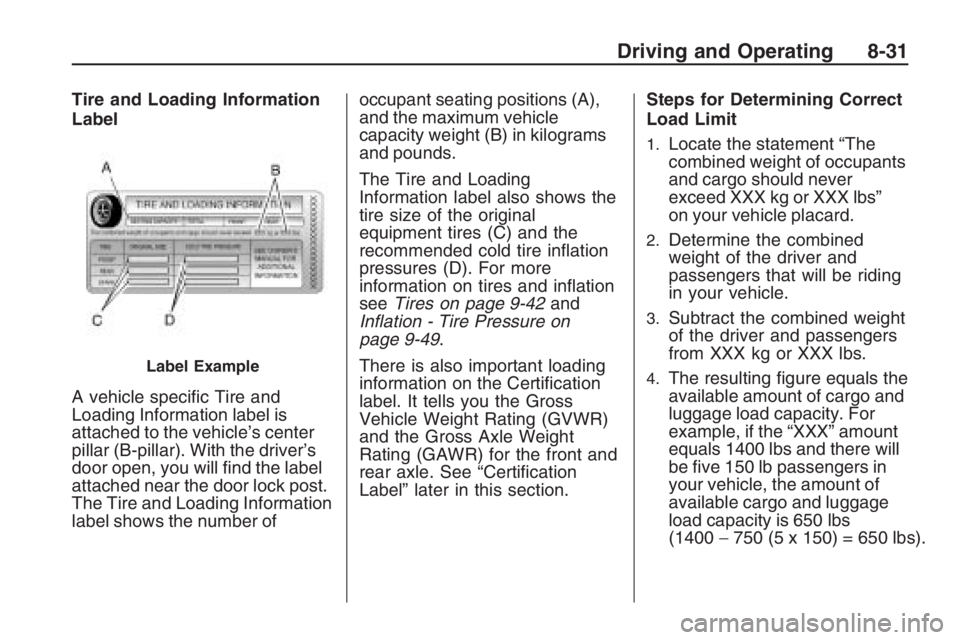
Tire and Loading Information
Label
A vehicle specic Tire and
Loading Information label is
attached to the vehicle’s center
pillar (B-pillar). With the driver’s
door open, you will nd the label
attached near the door lock post.
The Tire and Loading Information
label shows the number ofoccupant seating positions (A),
and the maximum vehicle
capacity weight (B) in kilograms
and pounds.
The Tire and Loading
Information label also shows the
tire size of the original
equipment tires (C) and the
recommended cold tire ination
pressures (D). For more
information on tires and ination
seeTires on page 9-42and
Inflation - Tire Pressure on
page 9-49.
There is also important loading
information on the Certication
label. It tells you the Gross
Vehicle Weight Rating (GVWR)
and the Gross Axle Weight
Rating (GAWR) for the front and
rear axle. See “Certication
Label” later in this section.Steps for Determining Correct
Load Limit
1.Locate the statement “The
combined weight of occupants
and cargo should never
exceed XXX kg or XXX lbs”
on your vehicle placard.
2.Determine the combined
weight of the driver and
passengers that will be riding
in your vehicle.
3.Subtract the combined weight
of the driver and passengers
from XXX kg or XXX lbs.
4.The resulting gure equals the
available amount of cargo and
luggage load capacity. For
example, if the “XXX” amount
equals 1400 lbs and there will
be ve 150 lb passengers in
your vehicle, the amount of
available cargo and luggage
load capacity is 650 lbs
(1400−750 (5 x 150) = 650 lbs).Label Example
Driving and Operating 8-31
Page 203 of 356

Filling the Tank
{CAUTION
Fuel vapor burns violently and a
fuel re can cause bad injuries.
To help avoid injuries to you and
others, read and follow all the
instructions on the pump island.
Turn off the engine when you are
refueling. Do not smoke if you are
near fuel or refueling the vehicle.
Do not use cellular phones. Keep
sparks, ames, and smoking
materials away from fuel. Do not
leave the fuel pump unattended
when refueling the vehicle. This is
against the law in some places.
Do not re-enter the vehicle while
pumping fuel. Keep children away
from the fuel pump; never let
children pump fuel.The fuel cap is located behind a
hinged fuel door on the passenger
side of the vehicle.
To open the fuel door, the vehicle
must be unlocked. Push on the rear
edge of the door to open.
When reinstalling the cap, turn it
clockwise until it clicks, otherwise
the Malfunction Indicator Lamp may
turn on. SeeMalfunction Indicator
Lamp on page 4-18.
{CAUTION
Fuel can spray out on you if you
open the fuel cap too quickly. If
you spill fuel and then something
ignites it, you could be badly
burned. This spray can happen if
the tank is nearly full, and is more
likely in hot weather. Open the
fuel cap slowly and wait for any
hiss noise to stop. Then unscrew
the cap all the way.
Be careful not to spill fuel. Do not
top off or overll the tank and wait a
few seconds after you have nished
pumping before removing the nozzle.
Clean fuel from painted surfaces as
soon as possible. SeeExterior
Cleaning on page 9-98.
When replacing the fuel cap, turn it
clockwise until it clicks. Make
sure the cap is fully installed.
Driving and Operating 8-37