2009 PONTIAC G6 steering
[x] Cancel search: steeringPage 214 of 410

Skidding
In a skid, a driver can lose control of the vehicle.
Defensive drivers avoid most skids by taking reasonable
care suited to existing conditions, and by not overdriving
those conditions. But skids are always possible.
The three types of skids correspond to the vehicle’s
three control systems. In the braking skid, the wheels are
not rolling. In the steering or cornering skid, too much
speed or steering in a curve causes tires to slip and lose
cornering force. And in the acceleration skid, too much
throttle causes the driving wheels to spin.
If the vehicle does not have a traction system, or if the
traction system is off, an acceleration skid is best handled
by easing your foot off the accelerator pedal. See
Traction Control System (TCS) on page 4-7and
StabiliTrak
®System on page 4-6.
If the vehicle starts to slide, ease your foot off the
accelerator pedal and quickly steer the way you want
the vehicle to go. If you start steering quickly enough,
the vehicle may straighten out. Always be ready for
a second skid if it occurs.Of course, traction is reduced when water, snow, ice,
gravel, or other material is on the road. For safety, slow
down and adjust your driving to these conditions. It is
important to slow down on slippery surfaces because
stopping distance will be longer and vehicle control more
limited.
While driving on a surface with reduced traction, try
your best to avoid sudden steering, acceleration, or
braking, including reducing vehicle speed by shifting to a
lower gear. Any sudden changes could cause the tires to
slide. You may not realize the surface is slippery until
the vehicle is skidding. Learn to recognize warning
clues — such as enough water, ice, or packed snow on
the road to make a mirrored surface — and slow down
when you have any doubt.
If the vehicle has the Antilock Brake System (ABS),
remember: It helps avoid only the braking skid. If the
vehicle does not have ABS, then in a braking skid, where
the wheels are no longer rolling, release enough pressure
on the brakes to get the wheels rolling again. This
restores steering control. Push the brake pedal down
steadily when you have to stop suddenly. As long as the
wheels are rolling, you will have steering control.
4-12
Page 219 of 410

Winter Driving
Driving on Snow or Ice
Drive carefully when there is snow or ice between the
tires and the road, creating less traction or grip. Wet ice
can occur at about 32°F (0°C) when freezing rain begins
to fall, resulting in even less traction. Avoid driving on wet
ice or in freezing rain until roads can be treated with salt
or sand.
Drive with caution, whatever the condition. Accelerate
gently so traction is not lost. Accelerating too quickly
causes the wheels to spin and makes the surface
under the tires slick, so there is even less traction.
Try not to break the fragile traction. If you accelerate too
fast, the drive wheels will spin and polish the surface
under the tires even more.If the vehicle has theTraction Control System (TCS) on
page 4-7, it improves the ability to accelerate on slippery
roads, but slow down and adjust your driving to the road
conditions. When driving through deep snow, turn off the
traction control system to help maintain vehicle motion at
lower speeds.
TheAntilock Brake System (ABS) on page 4-5improves
vehicle stability during hard stops on a slippery roads, but
apply the brakes sooner than when on dry pavement.
Allow greater following distance on any slippery road
and watch for slippery spots. Icy patches can occur on
otherwise clear roads in shaded areas. The surface of
a curve or an overpass can remain icy when the
surrounding roads are clear. Avoid sudden steering
maneuvers and braking while on ice.
Turn off cruise control, if equipped, on slippery surfaces.
4-17
Page 222 of 410

Rocking Your Vehicle to Get It Out
Turn the steering wheel left and right to clear the area
around the front wheels. Turn off any traction or stability
system. Shift back and forth between R (Reverse) and a
forward gear, spinning the wheels as little as possible.
To prevent transmission wear, wait until the wheels stop
spinning before shifting gears. Release the accelerator
pedal while shifting, and press lightly on the accelerator
pedal when the transmission is in gear. Slowly spinning
the wheels in the forward and reverse directions causes a
rocking motion that could free the vehicle. If that does not
get the vehicle out after a few tries, it might need to be
towed out. If the vehicle does need to be towed out, see
Towing Your Vehicle on page 4-26.
Loading the Vehicle
It is very important to know how much weight your
vehicle can carry. This weight is called the vehicle
capacity weight and includes the weight of all
occupants, cargo, and all nonfactory-installed
options. Two labels on the vehicle show how much
weight it may properly carry, the Tire and Loading
Information label and the Vehicle Certication label.
{CAUTION:
Do not load the vehicle any heavier than the
Gross Vehicle Weight Rating (GVWR), or
either the maximum front or rear Gross Axle
Weight Rating (GAWR). If you do, parts on the
vehicle can break, and it can change the way
your vehicle handles. These could cause you
to lose control and crash. Also, overloading
can shorten the life of the vehicle.
4-20
Page 231 of 410
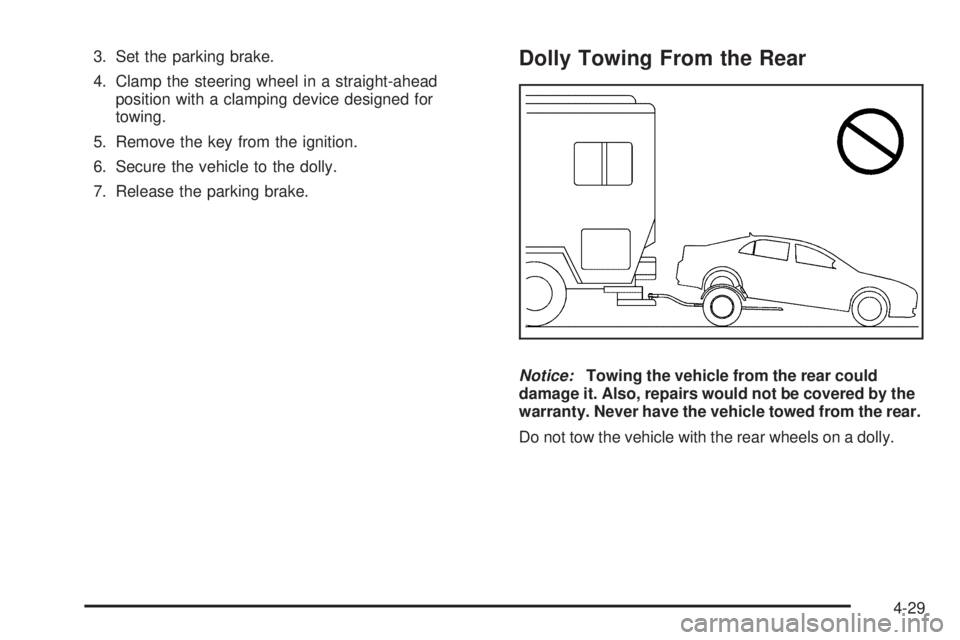
3. Set the parking brake.
4. Clamp the steering wheel in a straight-ahead
position with a clamping device designed for
towing.
5. Remove the key from the ignition.
6. Secure the vehicle to the dolly.
7. Release the parking brake.Dolly Towing From the Rear
Notice:Towing the vehicle from the rear could
damage it. Also, repairs would not be covered by the
warranty. Never have the vehicle towed from the rear.
Do not tow the vehicle with the rear wheels on a dolly.
4-29
Page 236 of 410

Before starting, check all trailer hitch parts and
attachments, safety chains, electrical connectors, lamps,
tires and mirror adjustments. If the trailer has electric
brakes, start the vehicle and trailer moving and then
apply the trailer brake controller by hand to be sure the
brakes are working. This checks the electrical connection
at the same time.
During the trip, check occasionally to be sure that the
load is secure, and that the lamps and any trailer brakes
are still working.
Following Distance
Stay at least twice as far behind the vehicle ahead as
you would when driving the vehicle without a trailer. This
can help to avoid situations that require heavy braking
and sudden turns.
Passing
More passing distance is needed when towing a trailer.
Because the rig is longer, it is necessary to go much
farther beyond the passed vehicle before returning to
the lane.
Backing Up
Hold the bottom of the steering wheel with one hand.
Then, to move the trailer to the left, move that hand
to the left. To move the trailer to the right, move your
hand to the right. Always back up slowly and, if possible,
have someone guide you.
Making Turns
Notice:Making very sharp turns while trailering
could cause the trailer to come in contact with the
vehicle. The vehicle could be damaged. Avoid
making very sharp turns while trailering.
When turning with a trailer, make wider turns than
normal. Do this so the trailer will not strike soft shoulders,
curbs, road signs, trees or other objects. Avoid jerky or
sudden maneuvers. Signal well in advance.
Turn Signals When Towing a Trailer
The arrows on the instrument panel ash whenever
signaling a turn or lane change. Properly hooked up, the
trailer lamps also ash, telling other drivers the vehicle is
turning, changing lanes or stopping.
4-34
Page 239 of 410

Service............................................................5-4
Accessories and Modications..........................5-4
California Proposition 65 Warning.....................5-5
California Perchlorate Materials Requirements.....5-5
Doing Your Own Service Work.........................5-5
Adding Equipment to the Outside of the
Vehicle......................................................5-6
Fuel................................................................5-6
Gasoline Octane............................................5-7
Gasoline Specications....................................5-7
California Fuel...............................................5-7
Additives.......................................................5-8
Fuel E85 (85% Ethanol)..................................5-8
Fuels in Foreign Countries...............................5-9
Filling the Tank............................................5-10
Filling a Portable Fuel Container.....................5-12
Checking Things Under the Hood....................5-12
Hood Release..............................................5-13
Engine Compartment Overview.......................5-14
Engine Oil...................................................5-21
Engine Oil Life System..................................5-24
Engine Air Cleaner/Filter
(3.5 L V6 Engine)......................................5-26Engine Air Cleaner/Filter (All Other Engines).....5-27
Automatic Transmission Fluid
(2.4L L4, 3.5L and 3.6L V6 Engines)............5-29
Automatic Transmission Fluid
(3.9L Engine)............................................5-29
Cooling System............................................5-32
Engine Coolant.............................................5-33
Pressure Cap...............................................5-37
Engine Overheating.......................................5-37
Overheated Engine Protection
Operating Mode........................................5-39
Power Steering Fluid.....................................5-39
Windshield Washer Fluid................................5-40
Brakes........................................................5-42
Battery........................................................5-45
Jump Starting...............................................5-46
Headlamp Aiming...........................................5-51
Bulb Replacement..........................................5-51
Halogen Bulbs..............................................5-51
Headlamps, Front Turn Signal, Sidemarker,
and Parking Lamps....................................5-52
Center High-Mounted Stoplamp (CHMSL)
(Sedan)...................................................5-53
Section 5 Service and Appearance Care
5-1
Page 255 of 410

A.Engine Air Cleaner/Filter (3.5 L V6 Engine) on
page 5-26orEngine Air Cleaner/Filter (All Other
Engines) on page 5-27.
B.Power Steering Fluid on page 5-39.
C. Engine Cooling Fan. SeeCooling System on
page 5-32.
D. Engine Oil Fill Cap. See “When to Add Engine Oil”
underEngine Oil on page 5-21.
E. Engine Oil Dipstick. See “Checking Engine Oil”
underEngine Oil on page 5-21.
F. Engine Coolant Surge Tank. SeeEngine Coolant
on page 5-33.G. Pressure Cap. SeeCooling System on page 5-32.
H. Brake Master Cylinder Reservoir. See “Brake
Fluid” underBrakes on page 5-42.
I.Battery on page 5-45.
J. SeeEngine Compartment Fuse Block on
page 5-112.
K. Windshield Washer Fluid Reservoir. See “Adding
Washer Fluid” underWindshield Washer Fluid
on page 5-40.
5-17
Page 257 of 410

A.Engine Air Cleaner/Filter (3.5 L V6 Engine) on
page 5-26orEngine Air Cleaner/Filter (All Other
Engines) on page 5-27.
B.Power Steering Fluid on page 5-39.
C. Engine Oil Fill Cap. See “When to Add Engine Oil”
underEngine Oil on page 5-21.
D. Engine Oil Dipstick. See “Checking Engine Oil”
underEngine Oil on page 5-21.
E. Electric Engine Cooling Fans (Out of View).
SeeCooling System on page 5-32.
F. Engine Coolant Surge Tank. SeeEngine Coolant on
page 5-33.
G. Pressure Cap. SeeCooling System on page 5-32.H. Brake Master Cylinder Reservoir. See “Brake Fluid”
underBrakes on page 5-42.
I. Automatic Transmission Fluid Cap/Dipstick.
See “Checking the Fluid Level” underAutomatic
Transmission Fluid (2.4L L4, 3.5L and 3.6L V6
Engines) on page 5-29orAutomatic Transmission
Fluid (3.9L Engine) on page 5-29.
J.Battery on page 5-45.
K. Underhood Fuse Block. SeeEngine Compartment
Fuse Block on page 5-112.
L. Windshield Washer Fluid Reservoir. See “Adding
Washer Fluid” underWindshield Washer Fluid
on page 5-40.
5-19