Page 259 of 410

A.Engine Air Cleaner/Filter (3.5 L V6 Engine) on
page 5-26orEngine Air Cleaner/Filter (All Other
Engines) on page 5-27.
B. Engine Coolant Bleed Valve.
C.Power Steering Fluid on page 5-39.
D. Automatic Transmission Fluid Dipstick (Out of View).
See “Checking the Fluid Level” underAutomatic
Transmission Fluid (2.4L L4, 3.5L and 3.6L V6
Engines) on page 5-29orAutomatic Transmission
Fluid (3.9L Engine) on page 5-29.
E. Engine Oil Fill Cap. See “When to Add Engine Oil”
underEngine Oil on page 5-21.
F. Engine Oil Dipstick. See “Checking Engine Oil”
underEngine Oil on page 5-21.
G. Engine Coolant Surge Tank. SeeEngine Coolant on
page 5-33.
H. Pressure Cap. SeeCooling System on page 5-32.
I. Brake Master Cylinder Reservoir. See “Brake
Fluid” underBrakes on page 5-42.
J.Battery on page 5-45.
K. Windshield Washer Fluid Reservoir. See “Adding
Washer Fluid” underWindshield Washer Fluid
on page 5-40.
L.Engine Compartment Fuse Block on page 5-112.Engine Oil
Checking Engine Oil
It is a good idea to check the engine oil every time you
get fuel. In order to get an accurate reading, the oil
must be warm and the vehicle must be on level ground.
The engine oil dipstick handle is a yellow loop. See
Engine Compartment Overview on page 5-14for
the location of the engine oil dipstick.
1. Turn off the engine and give the oil several minutes
to drain back into the oil pan. If you do not do this,
the oil dipstick might not show the actual level.
2. Pull the dipstick and clean it with a paper towel or
cloth, then push it back in all the way. Remove it
again, keeping the tip down and check the level.
5-21
Page 277 of 410

If the warning continues, pull over, stop, and park the
vehicle right away.
If there is no sign of steam, idle the engine for three
minutes while parked. If the warning is still displayed,
turn off the engine until it cools down. Also, see
″Overheated Engine Protection Operating Mode″
next in this section.
Overheated Engine Protection
Operating Mode
This emergency operating mode lets the vehicle be
driven to a safe place in an emergency situation. If an
overheated engine condition exists, an overheat
protection mode which alternates ring groups of
cylinders helps prevent engine damage. In this mode,
there is a signicant loss in power and engine
performance. The temperature gage indicates an
overheat condition exists. Driving extended distances
and/or towing a trailer in the overheat protection
mode should be avoided.Notice:After driving in the overheated engine
protection operating mode, to avoid engine damage,
allow the engine to cool before attempting any
repair. The engine oil will be severely degraded.
Repair the cause of coolant loss, change the oil and
reset the oil life system. SeeEngine Oil on
page 5-21.
Power Steering Fluid
SeeEngine Compartment
Overview on page 5-14for
reservoir location.
5-39
Page 278 of 410

When to Check Power Steering Fluid
Power steering uid is used in all vehicles with
V6 engines. Vehicles with the 4-cylinder engine have
electric power steering and do not use power steering
uid.
It is not necessary to regularly check power steering
uid unless a leak is suspected in the system or
an unusual noise is heard. A uid loss in this system
could indicate a problem. Have the system inspected
and repaired.
How to Check Power Steering Fluid
To check the power steering uid:
1. Turn the key off and let the engine compartment
cool down.
2. Wipe the cap and the top of the reservoir clean.
3. Unscrew the cap and wipe the dipstick with a
clean rag.4. Replace the cap and completely tighten it.
5. Remove the cap again and look at the uid level on
the dipstick
The uid level should be within the crosshatched area
on the dipstick.
If the uid is at or below the ADD mark on the dipstick,
add just enough uid to bring the level within the
crosshatched area.
What to Use
To determine what kind of uid to use, see
Recommended Fluids and Lubricants on page 6-13.
Always use the proper uid. Failure to use the proper
uid can cause leaks and damage hoses and seals.
Windshield Washer Fluid
What to Use
When the vehicle needs windshield washer uid, be
sure to read the manufacturer’s instructions before use.
If the vehicle will be operating in an area where the
temperature may fall below freezing, use a uid that has
sufficient protection against freezing.
5-40
Page 302 of 410

Tire Terminology and Denitions
Air Pressure:The amount of air inside the
tire pressing outward on each square inch of the
tire. Air pressure is expressed in pounds per
square inch (psi) or kilopascal (kPa).
Accessory Weight
:This means the combined
weight of optional accessories. Some examples of
optional accessories are, automatic transmission,
power steering, power brakes, power windows,
power seats, and air conditioning.
Aspect Ratio
:The relationship of a tire’s height
to its width.
Belt
:A rubber coated layer of cords that is located
between the plies and the tread. Cords may be
made from steel or other reinforcing materials.
Bead
:The tire bead contains steel wires wrapped
by steel cords that hold the tire onto the rim.
Bias Ply Tire
:A pneumatic tire in which the plies
are laid at alternate angles less than 90 degrees
to the centerline of the tread.Cold Tire Pressure
:The amount of air pressure in
a tire, measured in pounds per square inch (psi) or
kilopascals (kPa) before a tire has built up heat
from driving. SeeInflation - Tire Pressure on
page 5-67.
Curb Weight
:The weight of a motor vehicle with
standard and optional equipment including the
maximum capacity of fuel, oil, and coolant,
but without passengers and cargo.
DOT Markings
:A code molded into the sidewall
of a tire signifying that the tire is in compliance
with the U.S. Department of Transportation (DOT)
motor vehicle safety standards. The DOT code
includes the Tire Identication Number (TIN),
an alphanumeric designator which can also identify
the tire manufacturer, production plant, brand,
and date of production.
GVWR
:Gross Vehicle Weight Rating. SeeLoading
the Vehicle on page 4-20.
GAWR FRT
:Gross Axle Weight Rating for the
front axle. SeeLoading the Vehicle on page 4-20.
GAWR RR
:Gross Axle Weight Rating for the
rear axle. SeeLoading the Vehicle on page 4-20.
5-64
Page 323 of 410

If a Tire Goes Flat
It is unusual for a tire to blowout while you are driving,
especially if you maintain your vehicle’s tires properly.
If air goes out of a tire, it is much more likely to leak out
slowly. But if you should ever have a blowout, here
are a few tips about what to expect and what to do:
If a front tire fails, the at tire creates a drag that pulls
the vehicle toward that side. Take your foot off the
accelerator pedal and grip the steering wheel rmly.
Steer to maintain lane position, and then gently brake to
a stop well out of the traffic lane.
A rear blowout, particularly on a curve, acts much like a
skid and may require the same correction you would
use in a skid. In any rear blowout remove your foot from
the accelerator pedal. Get the vehicle under control
by steering the way you want the vehicle to go. It may
be very bumpy and noisy, but you can still steer. Gently
brake to a stop, well off the road if possible.{CAUTION:
Lifting a vehicle and getting under it to do
maintenance or repairs is dangerous without the
appropriate safety equipment and training. If a jack
is provided with the vehicle, it is designed only for
changing a at tire. If it is used for anything else,
you or others could be badly injured or killed if the
vehicle slips off the jack. If a jack is provided with
the vehicle, only use it for changing a at tire.
If a tire goes at, the next part shows how to use the
jacking equipment to change a at tire safely.
5-85
Page 349 of 410
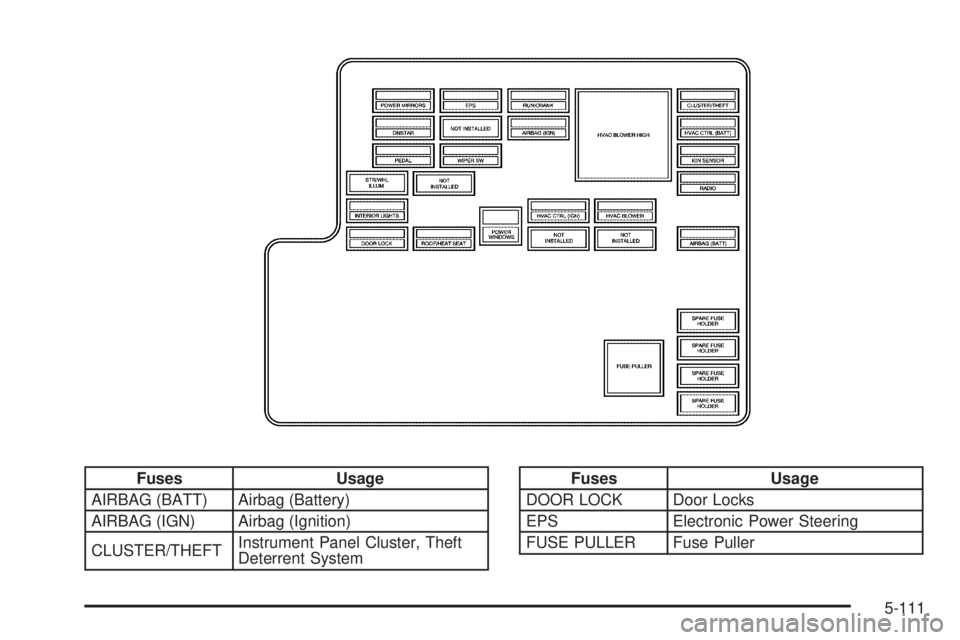
Fuses Usage
AIRBAG (BATT) Airbag (Battery)
AIRBAG (IGN) Airbag (Ignition)
CLUSTER/THEFTInstrument Panel Cluster, Theft
Deterrent SystemFuses Usage
DOOR LOCK Door Locks
EPS Electronic Power Steering
FUSE PULLER Fuse Puller
5-111
Page 350 of 410

Fuses Usage
HVAC BLOWERHeating Ventilation Air
Conditioning Blower Switch
HVAC BLOWER
HIGHHeating Ventilation Air
Conditioning Blower - High Speed
Relay
HVAC CTRL
(BATT)Heating Ventilation Air
Conditioning Control Diagnostic
Link Connector (Battery)
HVAC CTRL (IGN)Heating Ventilation Air
Conditioning Control (Ignition)
IGN SENSOR Ignition Switch
INTERIOR
LIGHTSInterior Lamps
NOT INSTALLED Not Used
NOT INSTALLED Not Used
NOT INSTALLED Not Used
NOT INSTALLED Not Used
ONSTAR OnStar
®
PEDAL Adjustable Pedals
POWER
MIRRORSPower Mirrors
POWER
WINDOWSPower Windows (Sedan)
RADIO Audio System
Fuses Usage
ROOF/HEAT
SEATSunroof, Heated Seat, Power
Windows (Coupe, Retractable
Hardtop), Automatic Dimming
Rearview Mirror, Compass
RUN/CRANKCruise Control Switch, Passenger
Airbag Status Indicator, DSC
Switch
SPARE FUSE
HOLDERSpare Fuse Holder
SPARE FUSE
HOLDERSpare Fuse Holder
SPARE FUSE
HOLDERSpare Fuse Holder
SPARE FUSE
HOLDERSpare Fuse Holder
STR/WHL ILLUMSteering Wheel Controls
Backlighting
WIPER SW Windshield Wiper/Washer Switch
Engine Compartment Fuse Block
The vehicle may not be equipped with all the fuses and
features listed.
The engine compartment fuse block is located on the
driver side of the engine compartment, near the battery.
Notice:Spilling liquid on any electrical components
on the vehicle may damage it. Always keep the
covers on any electrical component.
5-112
Page 352 of 410

Fuses Usage
5 Mass Airow Sensor (LY7)
6 Emission
7 Left Headlamp Low Beam
8 Horn
9 Right Headlamp Low Beam
10 Front Fog Lamps
11 Left Headlamp High Beam
12 Right Headlamp High Beam
13Engine Control Module (Battery)
(LE5, LY7)
14 Windshield Wiper
15 Antilock Brake System (IGN 1)
16Engine Control Module (IGN 1)
(LE5, LY7)
17 Cooling Fan 1
18 Cooling Fan 2
19Run Relay, Heating, Ventilation, Air
Conditioning Blower
20 Body Control Module 1
21 Body Control Module Run/Crank
22 Rear Electrical Center 1
23 Rear Electrical Center 2
24 Antilock Brake System
25 Body Control Module 2Fuses Usage
26 Starter
41 Electric Power Steering
42Transmission Control Module
Battery
43Ignition Module (LE5, LZ4, LZE,
LZ9), Odd Cylinder Injectors/Ignition
Coils (LY7)
44Injectors (LE5, LZ4, LZE, LZ9),
Even Cylinder Injectors/Ignition
Coils (LY7)
45 Rear Oxygen Sensors
46 Daytime Running Lamps
47 Center High-Mounted Stoplamp
50Front Power Windows
Coupe/Retractable Hardtop
51Engine Control Module (Battery)
(LZ4, LZE, LZ9)
52 AIR Solenoid
54 Regulated Voltage Control
55 Antilock Brake System (Battery)
Relays Usage
28 Cooling Fan 1
29 Cooling Fan Series/Parallel
30 Cooling Fan 2
5-114