2009 PEUGEOT 4007 ESP
[x] Cancel search: ESPPage 129 of 230
7
DRIVING
FOUR WHEEL DRIVE SYSTEM
WITH ELECTRONIC CONTROL
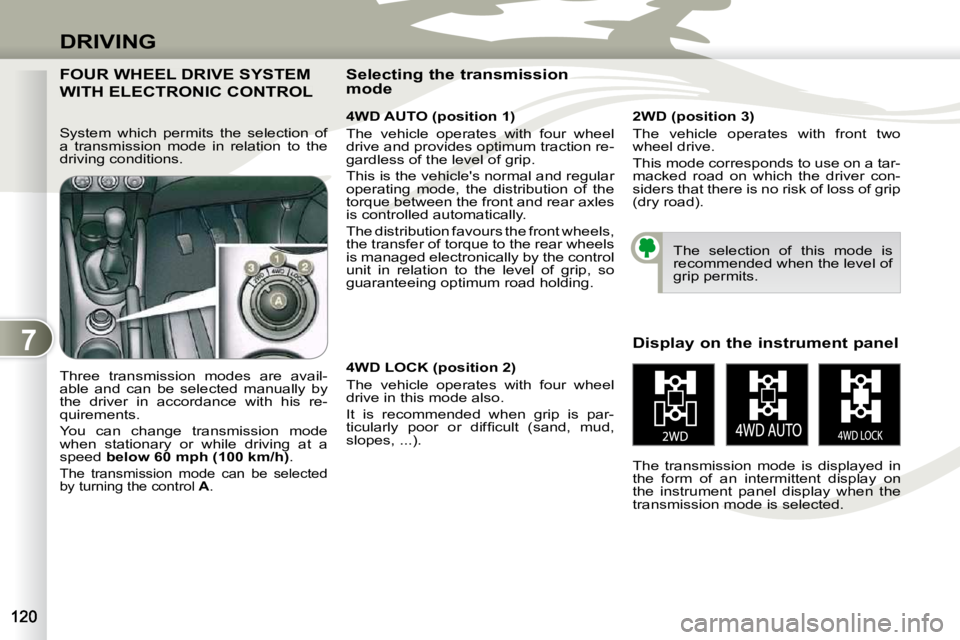
4WD AUTO (position 1)
The vehicle operates with four wheel
drive and provides optimum traction re-
gardless of the level of grip.
This is the vehicle's normal and regular
operating mode, the distribution of the
torque between the front and rear axles
is controlled automatically.
The distribution favours the front wheels,
the transfer of torque to the rear wheels
is managed electronically by the control
unit in relation to the level of grip, so
guaranteeing optimum road holding.
Three transmission modes are avail-
able and can be selected manually by
the driver in accordance with his re-
quirements.
You can change transmission mode
when stationary or while driving at a
speed below 60 mph (100 km/h) .
The transmission mode can be selected
by turning the control A .
Display on the instrument panel
The transmission mode is displayed in
the form of an intermittent display on
the instrument panel display when the
transmission mode is selected.
Selecting the transmission
mode
The selection of this mode is
recommended when the level of
grip permits.
2WD (position 3)
The vehicle operates with front two
wheel drive.
This mode corresponds to use on a tar-
macked road on which the driver con-
siders that there is no risk of loss of grip
(dry road).
4WD LOCK (position 2)
The vehicle operates with four wheel
drive in this mode also.
It is recommended when grip is par-
ticularly poor or diffi cult (sand, mud,
slopes, ...).
System which permits the selection of
a transmission mode in relation to the
driving conditions.
Page 133 of 230
7
DRIVING
AUDIBLE REAR PARKING
ASSISTANCE
It detects any obstacle (person, vehicle,
tree, gate, ...) located behind the vehicle,
but it cannot detect obstacles located
immediately below the bumper. Activation
The parking assistance is activated by
engaging reverse gear.
The proximity information is indicated
by an audible signal which becomes
more frequent as the vehicle approaches
the obstacle.
When a certain distance between the
rear of the vehicle and the obstacle is
reached, the audible signal becomes
continuous:
An object such as a stake, a road
works cone or any other similar
object may be detected at the
beginning of the manoeuvre but
may no longer be detected when
the vehicle moves closer to it.
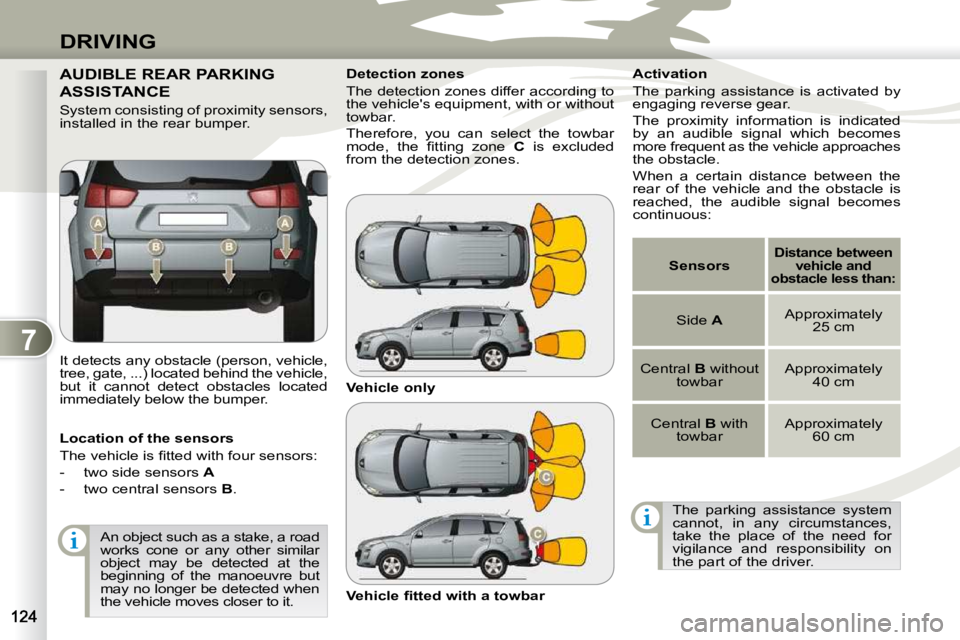
Location of the sensors
The vehicle is fi tted with four sensors:
- two side sensors
A
- two central sensors B . Vehicle only
Vehicle fi tted with a towbar
Detection zones
The detection zones differ according to
the vehicle's equipment, with or without
towbar.
Therefore, you can select the towbar
mode, the fi tting zone
C is excluded
from the detection zones.
The parking assistance system
cannot, in any circumstances,
take the place of the need for
vigilance and responsibility on
the part of the driver.
Sensors
Distance between
vehicle and
obstacle less than:
Side A Approximately
25 cm
Central B without
towbar Approximately
40 cm
Central B with
towbar Approximately
60 cm
System consisting of proximity sensors,
installed in the rear bumper.
Page 139 of 230
8
CHECKS
CHECKING LEVELS CHECKING LEVELS Brake fluid level To avoid any risk of scalding, unscrew
the cap by two turns to allow the pres-
sure to drop. When the pressure has
dropped, remove the cap and top up
the level.
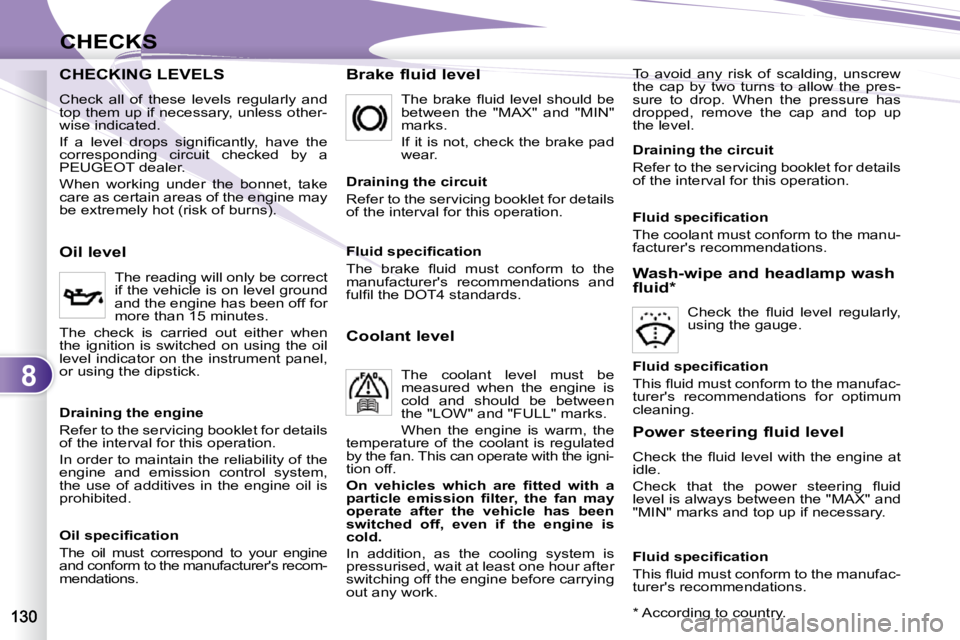
Oil level The reading will only be correct
if the vehicle is on level ground
and the engine has been off for
more than 15 minutes.
The check is carried out either when
the ignition is switched on using the oil
level indicator on the instrument panel,
or using the dipstick. The brake fl uid level should be
between the "MAX" and "MIN"
marks.
If it is not, check the brake pad
wear.
Draining the circuit
Refer to the servicing booklet for details
of the interval for this operation.
Coolant level
The coolant level must be
measured when the engine is
cold and should be between
the "LOW" and "FULL" marks.
When the engine is warm, the
temperature of the coolant is regulated
by the fan. This can operate with the igni-
tion off.
On vehicles which are fi tted with a
particle emission fi lter, the fan may
operate after the vehicle has been
switched off, even if the engine is
cold.
In addition, as the cooling system is
pressurised, wait at least one hour after
switching off the engine before carrying
out any work. Wash-wipe and headlamp wash
fluid*
Check the fl uid level regularly,
using the gauge.
* According to country.
Draining the engine
Refer to the servicing booklet for details
of the interval for this operation.
In order to maintain the reliability of the
engine and emission control system,
the use of additives in the engine oil is
prohibited.
Oil specifi cation
The oil must correspond to your engine
and conform to the manufacturer's recom-
mendations. Fluid specifi cation
The brake fl uid must conform to the
manufacturer's recommendations and
fulfi l the DOT4 standards.
Draining the circuit
Refer to the servicing booklet for details
of the interval for this operation.
Fluid specifi cation
The coolant must conform to the manu-
facturer's recommendations.
Fluid specifi cation
This fl uid must conform to the manufac-
turer's recommendations for optimum
cleaning.
Power steering fluid level
Check the fl uid level with the engine at
idle.
Check that the power steering fl uid
level is always between the "MAX" and
"MIN" marks and top up if necessary.
Fluid specifi cation
This fl uid must conform to the manufac-
turer's recommendations.
Check all of these levels regularly and
top them up if necessary, unless other-
wise indicated.
If a level drops signifi cantly, have the
corresponding circuit checked by a
PEUGEOT dealer.
When working under the bonnet, take
care as certain areas of the engine may
be extremely hot (risk of burns).
Page 155 of 230
9
PRACTICAL INFORMATION
CHANGING A FUSE CHANGING Changing a fuse
Before changing a fuse, the cause
of the failure must be identifi ed and
rectifi ed.
Identify the faulty fuse by checking
the condition of its fi lament.
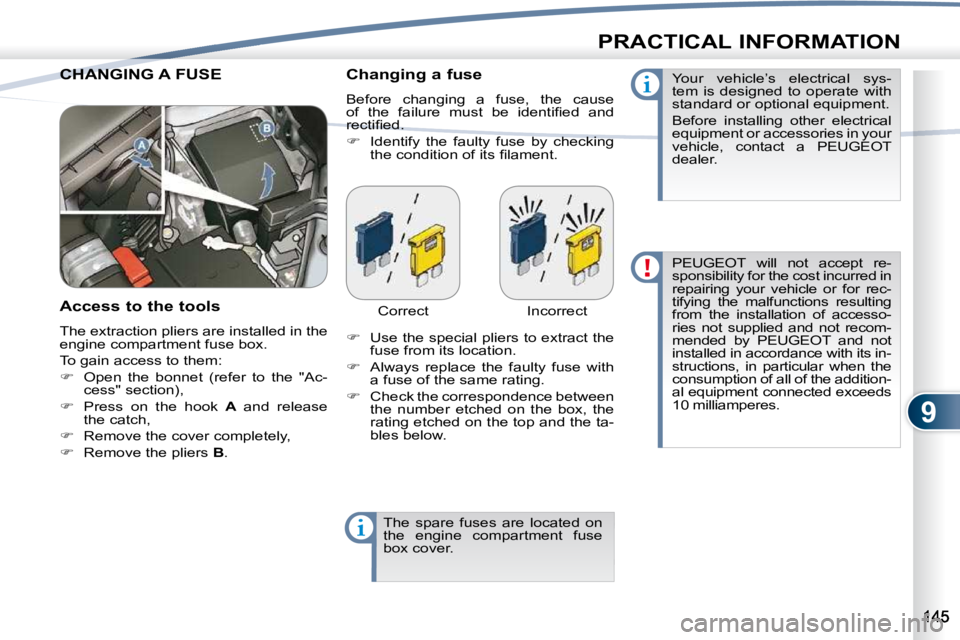
Access to the tools
The extraction pliers are installed in the
engine compartment fuse box.
To gain access to them:
Open the bonnet (refer to the "Ac-
cess" section),
Press on the hook A and release
the catch,
Remove the cover completely,
Remove the pliers B . Correct Incorrect
Use the special pliers to extract the
fuse from its location.
Always replace the faulty fuse with
a fuse of the same rating.
Check the correspondence between
the number etched on the box, the
rating etched on the top and the ta-
bles below.
The spare fuses are located on
the engine compartment fuse
box cover. Your vehicle’s electrical sys-
tem is designed to operate with
standard or optional equipment.
Before installing other electrical
equipment or accessories in your
vehicle, contact a PEUGEOT
dealer.
PEUGEOT will not accept re-
sponsibility for the cost incurred in
repairing your vehicle or for rec-
tifying the malfunctions resulting
from the installation of accesso-
ries not supplied and not recom-
mended by PEUGEOT and not
installed in accordance with its in-
structions, in particular when the
consumption of all of the addition-
al equipment connected exceeds
10 milliamperes.
Page 156 of 230
9
PRACTICAL INFORMATION
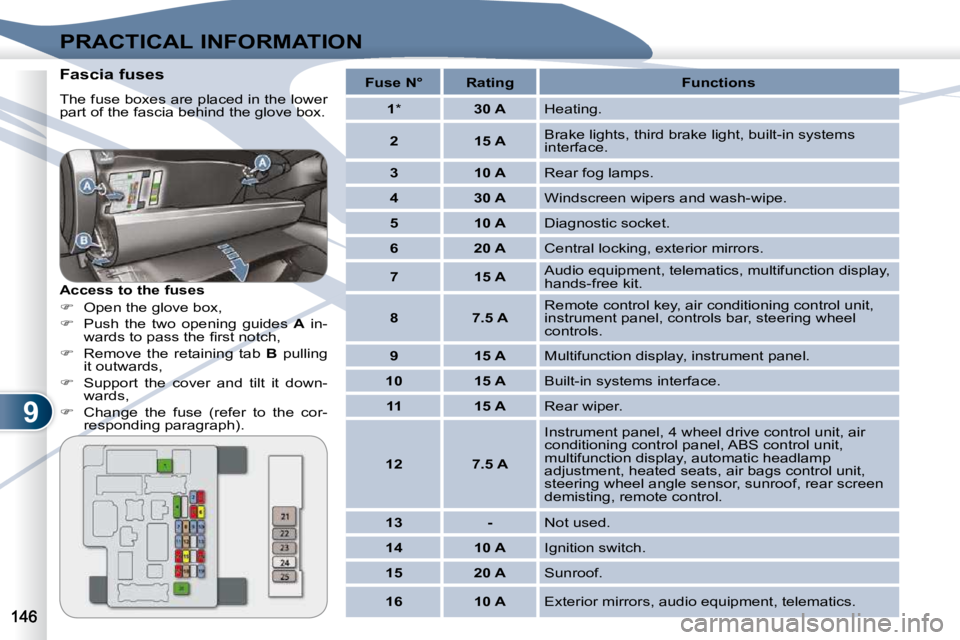
Fascia fuses
The fuse boxes are placed in the lower
part of the fascia behind the glove box.
Access to the fuses
Open the glove box,
Push the two opening guides A in-
wards to pass the fi rst notch,
Remove the retaining tab B pulling
it outwards,
Support the cover and tilt it down-
wards,
Change the fuse (refer to the cor-
responding paragraph).
Fuse N° Rating Functions
1 * 30 A Heating.
2 15 A Brake lights, third brake light, built-in systems
interface.
3 10 A Rear fog lamps.
4 30 A Windscreen wipers and wash-wipe.
5 10 A Diagnostic socket.
6 20 A Central locking, exterior mirrors.
7 15 A Audio equipment, telematics, multifunction display,
hands-free kit.
8 7.5 A Remote control key, air conditioning control unit,
instrument panel, controls bar, steering wheel
controls.
9 15 A Multifunction display, instrument panel.
10 15 A Built-in systems interface.
11 15 A Rear wiper.
12 7.5 A Instrument panel, 4 wheel drive control unit, air
conditioning control panel, ABS control unit,
multifunction display, automatic headlamp
adjustment, heated seats, air bags control unit,
steering wheel angle sensor, sunroof, rear screen
demisting, remote control.
13 - Not used.
14 10 A Ignition switch.
15 20 A Sunroof.
16 10 A Exterior mirrors, audio equipment, telematics.
Page 157 of 230
9
PRACTICAL INFORMATION
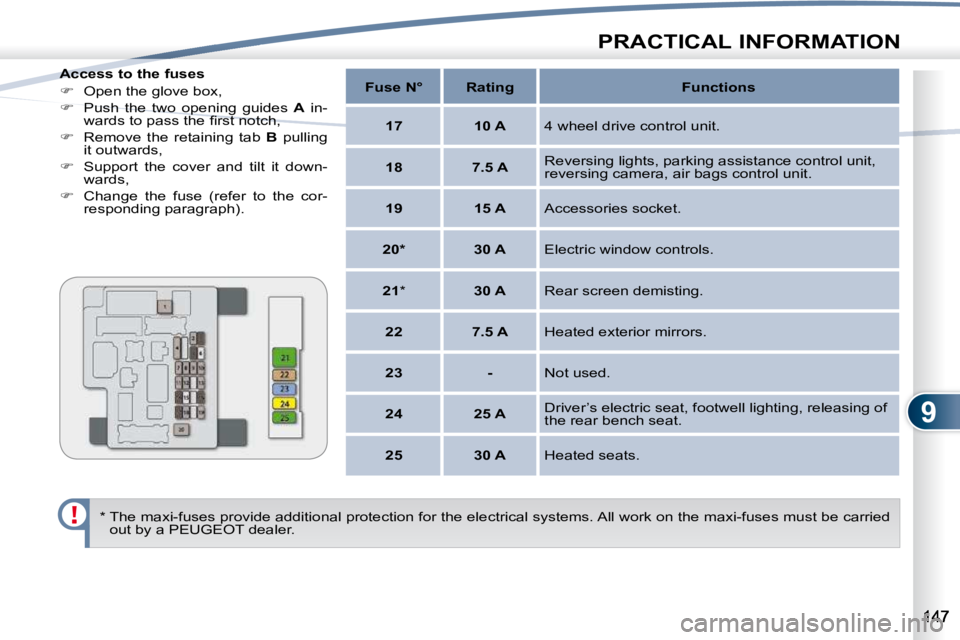
Access to the fuses
Open the glove box,
Push the two opening guides A in-
wards to pass the fi rst notch,
Remove the retaining tab B pulling
it outwards,
Support the cover and tilt it down-
wards,
Change the fuse (refer to the cor-
responding paragraph).
* The maxi-fuses provide additional protection for the elect rical systems. All work on the maxi-fuses must be carried
out by a PEUGEOT dealer.
Fuse N° Rating Functions
17 10 A 4 wheel drive control unit.
18 7.5 A Reversing lights, parking assistance control unit,
reversing camera, air bags control unit.
19 15 A Accessories socket.
20* 30 A Electric window controls.
21 * 30 A Rear screen demisting.
22 7.5 A Heated exterior mirrors.
23 - Not used.
24 25 A Driver’s electric seat, footwell lighting, releasing of
the rear bench seat.
25 30 A Heated seats.
Page 158 of 230
9
PRACTICAL INFORMATION
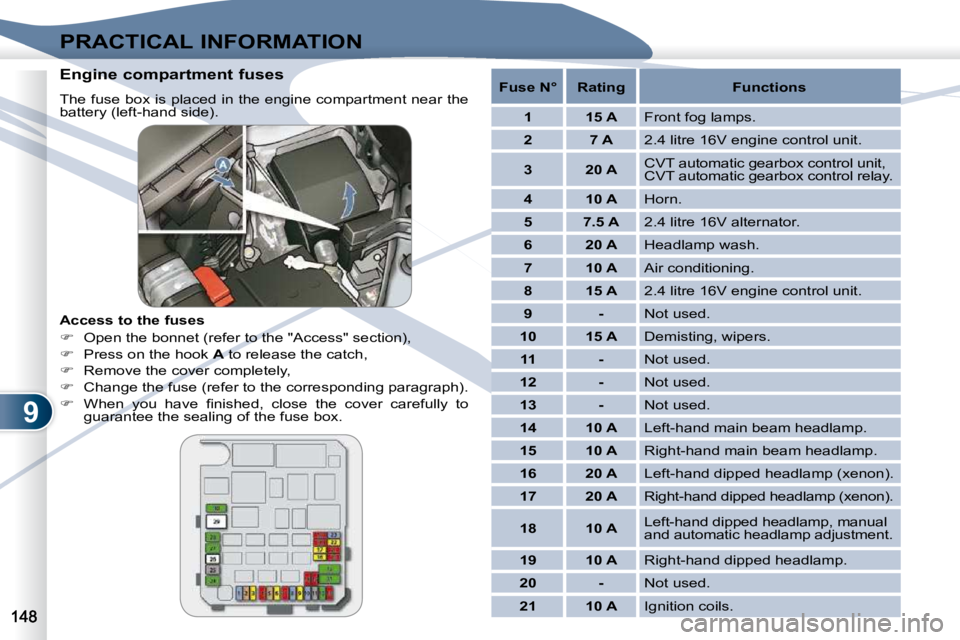
Engine compartment fuses
The fuse box is placed in the engine compartment near the
battery (left-hand side).
Access to the fuses
Open the bonnet (refer to the "Access" section),
Press on the hook A to release the catch,
Remove the cover completely,
Change the fuse (refer to the corresponding paragraph).
When you have fi nished, close the cover carefully to
guarantee the sealing of the fuse box.
Fuse N° Rating Functions
1 15 A Front fog lamps.
2 7 A 2.4 litre 16V engine control unit.
3 20 A CVT automatic gearbox control unit,
CVT automatic gearbox control relay.
4 10 A Horn.
5 7.5 A 2.4 litre 16V alternator.
6 20 A Headlamp wash.
7 10 A Air conditioning.
8 15 A 2.4 litre 16V engine control unit.
9 - Not used.
10 15 A Demisting, wipers.
11 - Not used.
12 - Not used.
13 - Not used.
14 10 A Left-hand main beam headlamp.
15 10 A Right-hand main beam headlamp.
16 20 A Left-hand dipped headlamp (xenon).
17 20 A Right-hand dipped headlamp (xenon).
18 10 A Left-hand dipped headlamp, manual
and automatic headlamp adjustment.
19 10 A Right-hand dipped headlamp.
20 - Not used.
21 10 A Ignition coils.
Page 161 of 230
9
PRACTICAL INFORMATION
The batteries contain harmful
substances such as sulphuric
acid and lead. They must be
disposed of in accordance with
regulations and must not, in any
circumstances, be discarded
with household waste.
Take used remote control bat-
teries and vehicle batteries to a
special collection point.
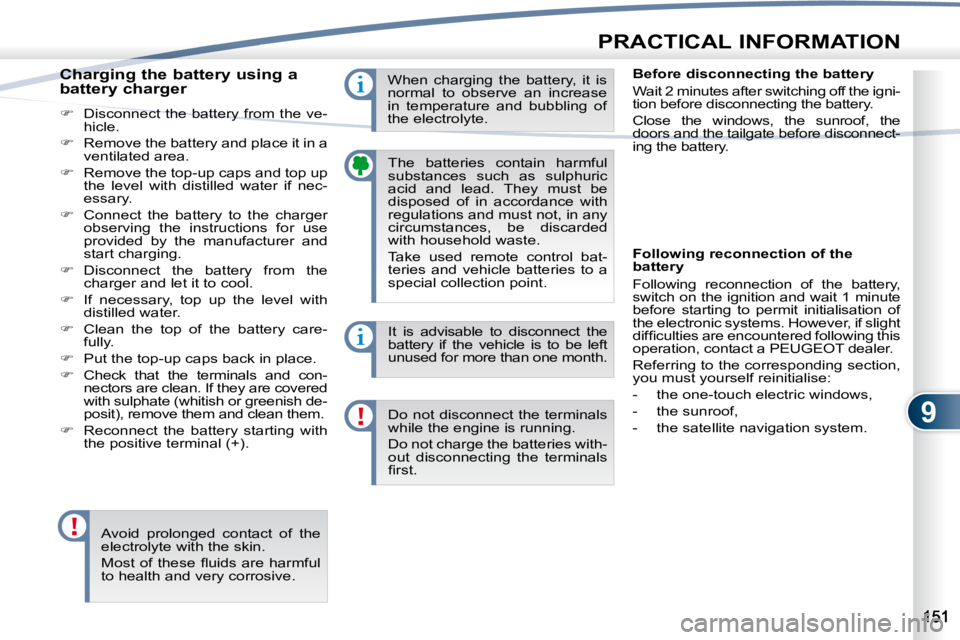
Charging the battery using a
battery charger
Disconnect the battery from the ve-
hicle.
Remove the battery and place it in a
ventilated area.
Remove the top-up caps and top up
the level with distilled water if nec-
essary.
Connect the battery to the charger
observing the instructions for use
provided by the manufacturer and
start charging.
Disconnect the battery from the
charger and let it to cool.
If necessary, top up the level with
distilled water.
Clean the top of the battery care-
fully.
Put the top-up caps back in place.
Check that the terminals and con-
nectors are clean. If they are covered
with sulphate (whitish or greenish de-
posit), remove them and clean them.
Reconnect the battery starting with
the positive terminal (+). It is advisable to disconnect the
battery if the vehicle is to be left
unused for more than one month.
Do not disconnect the terminals
while the engine is running.
Do not charge the batteries with-
out disconnecting the terminals
fi rst.
Avoid prolonged contact of the
electrolyte with the skin.
Most of these fl uids are harmful
to health and very corrosive. When charging the battery, it is
normal to observe an increase
in temperature and bubbling of
the electrolyte.
Before disconnecting the battery
Wait 2 minutes after switching off the igni-
tion before disconnecting the battery.
Close the windows, the sunroof, the
doors and the tailgate before disconnect-
ing the battery.
Following reconnection of the
battery
Following reconnection of the battery,
switch on the ignition and wait 1 minute
before starting to permit initialisation of
the electronic systems. However, if slight
diffi culties are encountered following this
operation, contact a PEUGEOT dealer.
Referring to the corresponding section,
you must yourself reinitialise:
- the one-touch electric windows,
- the sunroof,
- the satellite navigation system.