Page 185 of 228
Vehicle care
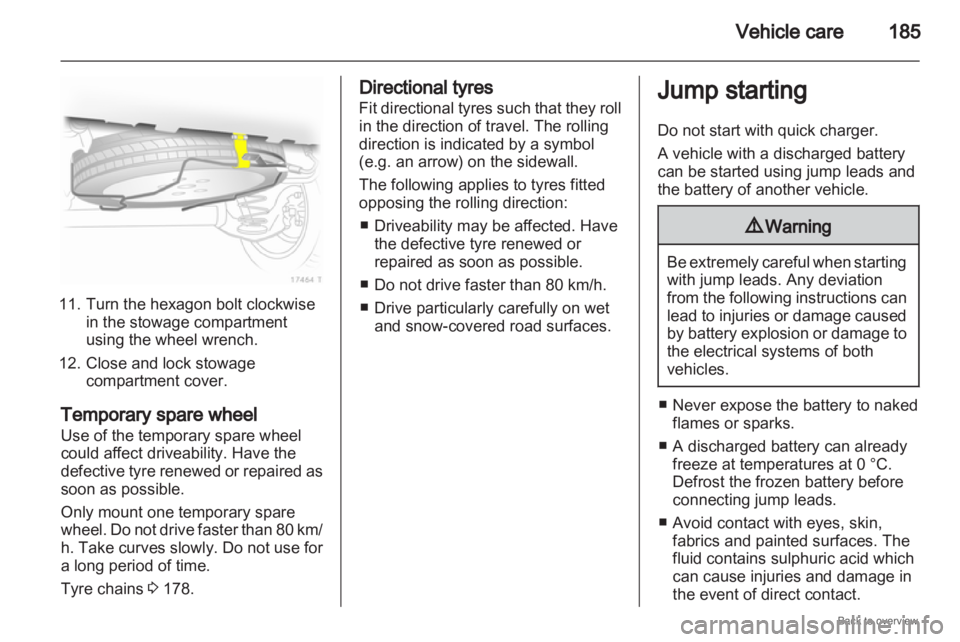
18511. Turn the hexagon bolt clockwise
in the stowage compartment
using the wheel wrench.
12.
Close and lock stowagecompartment cover.
Temporary spare wheel
Use of the temporary spare wheel
could affect driveability. Have the
defective tyre renewed or repaired as
soon as possible.
Only mount one temporary spare
wheel. Do not drive faster than 80 km/
h. Take curves slowly. Do not use for
a long period of time.
Tyre chains 3 178. Directional tyres
Fit
directional tyres such that they roll
in the direction of travel. The rolling
direction is indicated by a symbol
(e.g. an arrow) on the sidewall.
The following applies to tyres fitted
opposing the rolling direction:
■ Driveability may be affected. Have the defective tyre renewed or
repaired as soon as possible.
■ Do not drive faster than 80 km/h.
■ Drive particularly carefully on wet and snow-covered road surfaces. Jump starting
Do not start with quick charger.
A vehicle with a discharged battery
can be started using jump leads and
the battery of another vehicle.
9
Warning Be extremely careful when starting
with jump leads. Any deviation
from
the following instructions can
lead to injuries or damage caused
by battery explosion or damage to
the electrical systems of both
vehicles. ■ Never expose the battery to naked
flames or sparks.
■
A discharged battery can alreadyfreeze at temperatures at 0 °C.
Defrost the frozen battery before
connecting jump leads.
■ Avoid contact with eyes, skin, fabrics and painted surfaces. The
fluid contains sulphuric acid which
can cause injuries and damage in
the event of direct contact.
Page 186 of 228
186
Vehicle care
■ Wear eye protection and protective
clothing when handling a battery.
■ Use a booster battery with the same voltage (12 volts). Its capacity
(Ah) must not be much less than
that of the discharged battery.
■ Use jump leads with insulated terminals and a cross section of at
least 16 mm 2
(25 mm 2
for diesel
engines).
■ Do not disconnect the discharged battery from the vehicle.
■ Switch off all unnecessary electrical consumers.
■ Do not lean over the battery during jump starting.
■ Do not allow the terminals of one lead to touch those of the other
lead.
■ The vehicles must not come into contact with each other during the
jump starting process.
■ Apply the handbrake, transmission in neutral, automatic transmission
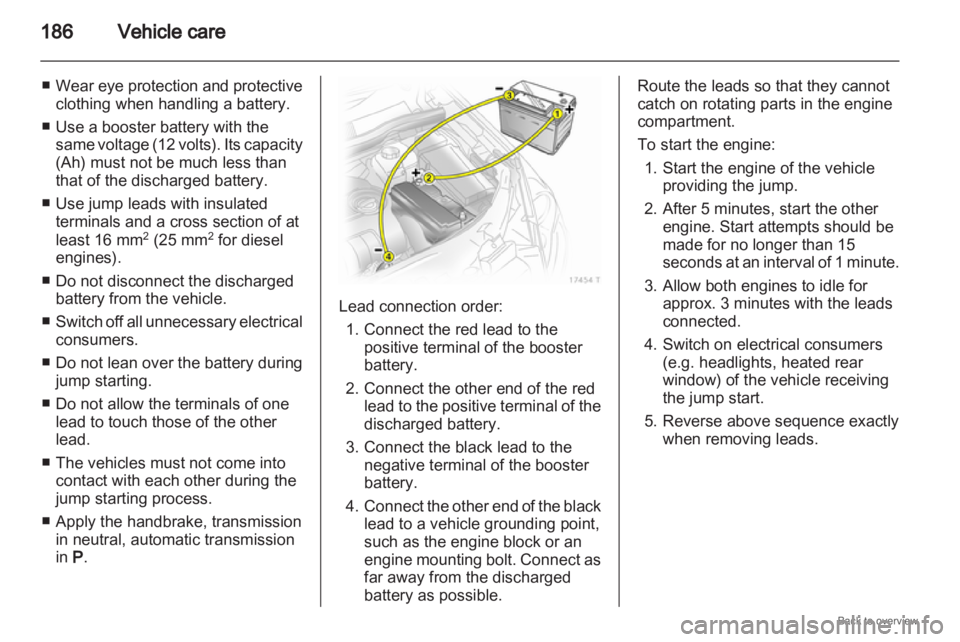
in P. Lead connection order:
1.
Connect the red lead to thepositive terminal of the booster
battery.
2. Connect the other end of the red lead to the positive terminal of the
discharged battery.
3. Connect the black lead to the negative terminal of the booster
battery.
4. Connect the other end of the black lead to a vehicle grounding point,
such as the engine block or an
engine mounting bolt. Connect as
far away from the discharged
battery as possible. Route the leads so that they cannot
catch on rotating parts in the engine
compartment.
To start the engine:
1.
Start the engine of the vehicleproviding the jump.
2. After 5 minutes, start the other engine. Start attempts should be
made for no longer than 15
seconds at an interval of 1 minute.
3. Allow both engines to idle for approx. 3 minutes with the leads
connected.
4. Switch on electrical consumers (e.g. headlights, heated rear
window) of the vehicle receiving
the jump start.
5. Reverse above sequence exactly when removing leads.
Page 195 of 228
Service and maintenance
195Service operations by year
1)
km ( x 1000) 1) 1
30 2
60 3
90 4
120 5
150
Check coolant level, anti-freeze (pale orange)
2)
, correct
Note freeze protection temperature in the Service and Warranty Booklet (confirmation
fields) X X X X X
Check for leaks and correct seating of the coolant hoses X X X X X
Check brake fluid level
2)
, correct X X X
Check battery terminals are firmly located, check battery eye X X X X X
Vehicle system check with TECH2 X X X X X
Replace pollen filter or activated carbon filter X X
+o
If air is badly polluted, has a high dust or sand content, or pollen, smell of the air
conditioning Agreement with customer
Replace air cleaner insert Every 4 years / 60.000 km
+ Replace spark plugs Z 16 XE1, Z 16 XER, Z 18 XER, Z 20 LEH, Z 20 LER Every 4 years / 60.000 km
Z 16 YNG Every 2 years / 30.000 km
Z 22 YH Every 8 years / 120.000 km
2)
In case of too high consumption / leakage, perform additional work with customer's agreement.
Page 199 of 228
Service and maintenance
199
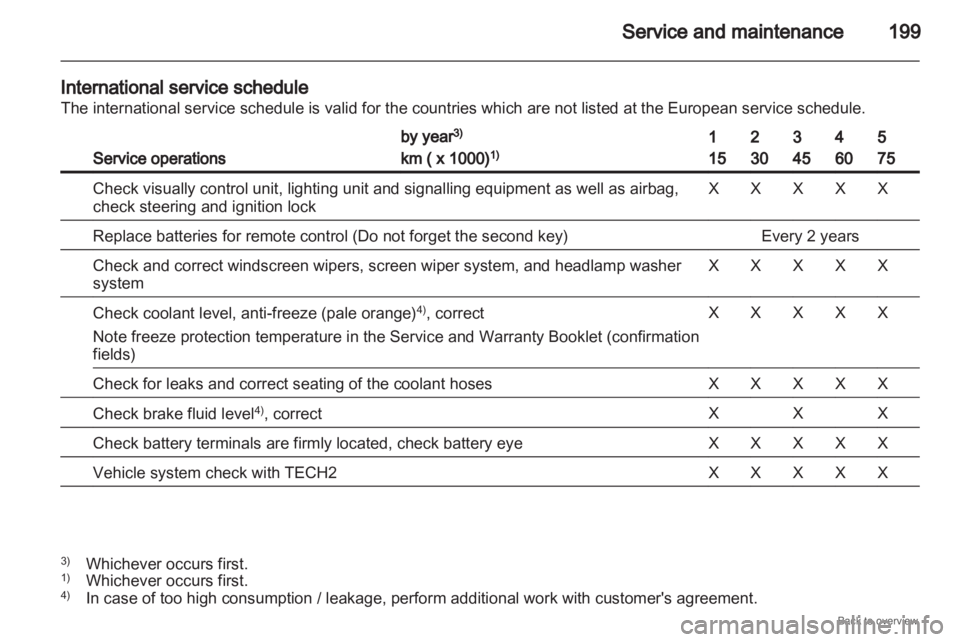
International service schedule
The international service schedule is valid for the countries which are not listed at the European service schedule. Service operations by year
3)
km ( x 1000) 1) 1
15 2
30 3
45 4
60 5
75
Check visually control unit, lighting unit and signalling equipment as well as airbag,
check steering and ignition lock X X X X X
Replace batteries for remote control (Do not forget the second key) Every 2 years
Check and correct windscreen wipers, screen wiper system, and headlamp washer
system X X X X X
Check coolant level, anti-freeze (pale orange)
4)
, correct
Note freeze protection temperature in the Service and Warranty Booklet (confirmation
fields) X X X X X
Check for leaks and correct seating of the coolant hoses X X X X X
Check brake fluid level
4)
, correct X X X
Check battery terminals are firmly located, check battery eye X X X X X
Vehicle system check with TECH2 X X X X X
3)
Whichever occurs first.
1) Whichever occurs first.
4) In case of too high consumption / leakage, perform additional work with customer's agreement.
Page 224 of 228

224
Index
A
Accessories and vehicle
modifications .......................... 154
Active head restraints on front seats .........................................
23
Adaptive Forward Lighting ........ .................................... 25, 92, 110
Additional servicing .................... 204
Adjustable air vents ...................124
Airbag and belt tensioners ...........87
Airbag system .............................. 57
Air conditioning regular operation ................................ 126
Air conditioning system .............. 119
Air intake .................................... 125
Air quality sensor ........................121
Antilock brake system ................ 140
Antilock brake system (ABS) ....... 89
Anti-theft alarm system ........ 36, 101
Anti-theft locking system .............. 36
Apply footbrake ............................ 92
Armrest ........................................ 49
Ashtrays ....................................... 82
Automatic anti-dazzle ..................40
Automatic climate control system .................................... 120
Automatic level control ..............144
Automatic light control ...............108
Automatic transmission .............131 Auxiliary devices
........................116
Auxiliary heater ........................... 124
B
Battery ....................................... 158
Battery discharge protection ......114
Battery voltage ...........................
100
Board-Info-Display .......................93
Bonnet ....................................... 155
Brake and clutch system ............. 89
Brake assist ............................... 142
Brake fluid .................................. 158
Brake light switch ....................... 101
Brakes ............................... 140, 158
Bulb replacement ....................... 160
C
Capacities .................................. 219
Cargo management system ........71
Car Pass ...................................... 27
Catalytic converter .....................130
Central locking system ................32
Centre console lighting ..............114
Changing tyre and wheel size ...178
Charging system .......................... 88
Check control ............................... 23
Child locks ................................... 35
Child restraint installation locations ................................... 63
Page:
< prev 1-8 9-16 17-24
