2009 OPEL AGILA brake
[x] Cancel search: brakePage 91 of 153
9-4Driving and operating
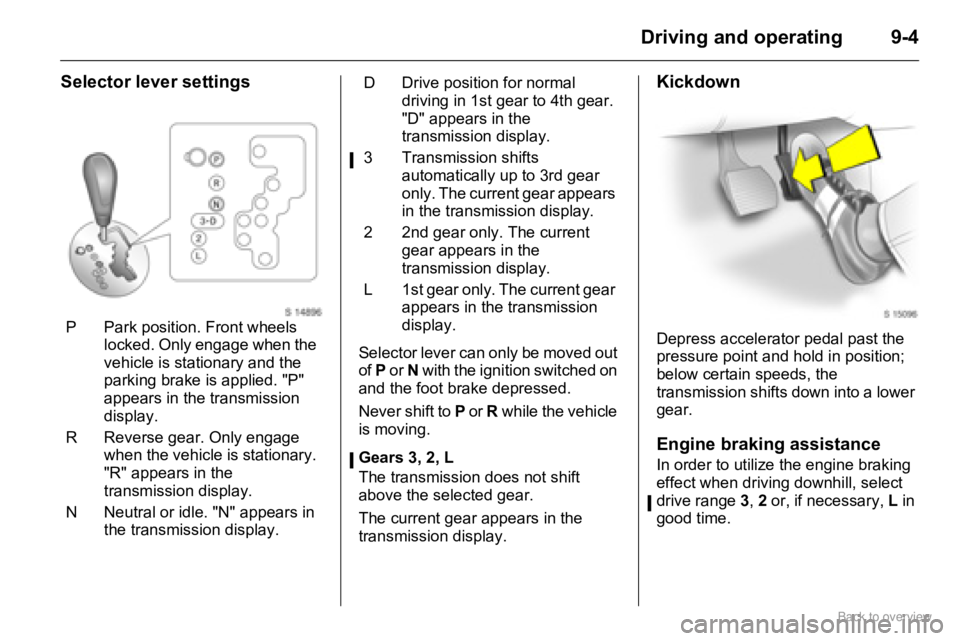
Selector lever settings
Selector lever can only be moved out
of P or N with the ignition switched on
and the foot brake depressed.
Never shift to P or R while the vehicle
is moving.
Gears 3, 2, L
The transmission does not shift
above the selected gear.
The current gear appears in the
transmission display.
Kickdown
Depress accelerator pedal past the
pressure point and hold in position;
below certain speeds, the
transmission shifts down into a lower
gear.
Engine braking assistance
In order to utilize the engine braking
effect when driving downhill, select
drive range 3, 2 or, if necessary, L in
good time. P Park position. Front wheels
locked. Only engage when the
vehicle is stationary and the
parking brake is applied. "P"
appears in the transmission
display.
R Reverse gear. Only engage
when the vehicle is stationary.
"R" appears in the
transmission display.
N Neutral or idle. "N" appears in
the transmission display.
D Drive position for normal
driving in 1st gear to 4th gear.
"D" appears in the
transmission display.
3 Transmission shifts
automatically up to 3rd gear
only. The current gear appears
in the transmission display.
2 2nd gear only. The current
gear appears in the
transmission display.
L 1st gear only. The current gear
appears in the transmission
display.
Page 92 of 153

9-5 Driving and operating
Stopping the vehicle
Engage parking brake and move
selector lever to position P. It will not
be possible to turn the ignition key to
the LOCK position unless the selector
lever is in positionP.
Rocking the vehicle
If it becomes necessary to rock the
vehicle to free it from water, ice, sand,
mud, snow or a dip, observe the
following:
Move the selector lever between R
and a forward gear in a repeat pattern
while applying light pressure to the
accelerator pedal when the vehicle is
in gear.
Do not spin the wheels or race the
engine and avoid sudden
acceleration.
Manoeuvring the vehicle
To manoeuvre the vehicle back and
forth during attempts to park or in
garage entrances, the creeping
movement can be utilized by
releasing the foot brake.
Never actuate the accelerator and
brake pedals simultaneously.
Fault
If there is a problem with the
automatic transmission, control
indicator
s flashes. The transmission
no longer shifts automatically.
Seek the assistance of a workshop to
rectify the cause of the fault.
Interruption of power supply
If the vehicle battery is flat, the
selector lever cannot be moved out of
position P.
Start the vehicle using jump leads 3
10-26.
Page 93 of 153
9-6Driving and operating
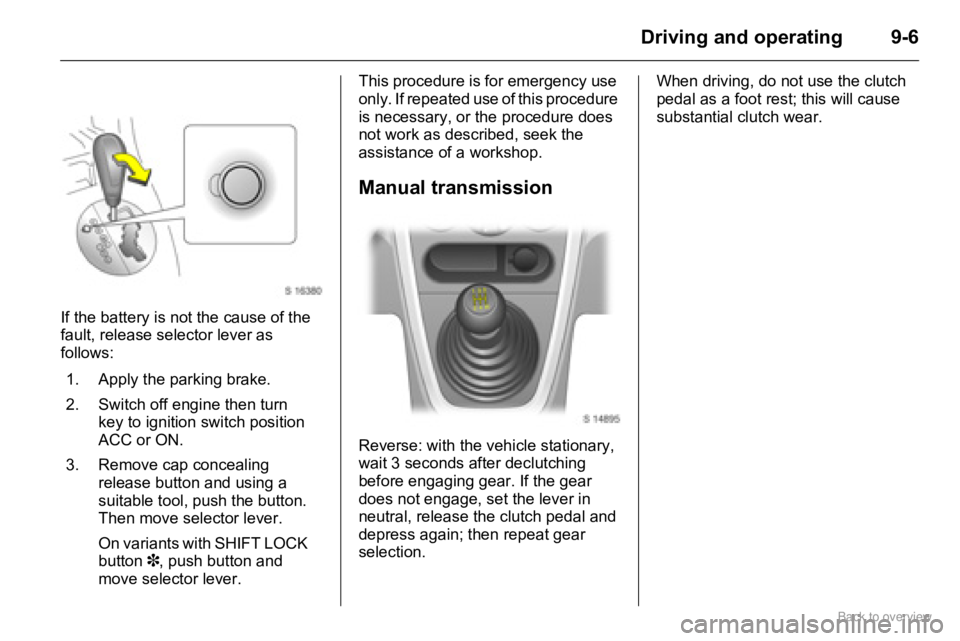
If the battery is not the cause of the
fault, release selector lever as
follows:This procedure is for emergency use
only. If repeated use of this procedure
is necessary, or the procedure does
not work as described, seek the
assistance of a workshop.
Manual transmission
Reverse: with the vehicle stationary,
wait 3 seconds after declutching
before engaging gear. If the gear
does not engage, set the lever in
neutral, release the clutch pedal and
depress again; then repeat gear
selection.When driving, do not use the clutch
pedal as a foot rest; this will cause
substantial clutch wear.
1. Apply the parking brake.
2. Switch off engine then turn
key to ignition switch position
ACC or ON.
3. Remove cap concealing
release button and using a
suitable tool, push the button.
Then move selector lever.
On variants with SHIFT LOCK
button3, push button and
move selector lever.
Page 96 of 153

9-9 Driving and operating
Brakes
Foot brake
The brake system comprises two
separate brake circuits.
If one brake circuit should fail, the
vehicle can still be braked with the
second remaining circuit.
If this happens, the brake pedal must
be fully depressed with greater pedal
pressure. The distance required for
braking will be greater. Seek the
assistance of a workshop.
In order to utilise the full pedal travel,
particularly in the event of a brake
circuit fault, there must be no mats in
the area of the pedals 3 9-1.
With the engine stopped, the brake
servo assistance is discontinued after
the brake pedal has been depressed
once or twice. The braking effect is
not reduced, but increased foot
pressure will be necessary. Take
extra care if the vehicle is being
towed.
Brake system control indicator 3 5-9.
Anti-lock Brake System
(ABS) u
The ABS prevents the wheels from
locking during heavy braking.
It starts to regulate braking pressure
as soon as a wheel shows a tendency
to lock. The vehicle remains
steerable, even during heavy braking,
e.g. on bends or when swerving to
avoid an obstacle. Even in the case of
extreme braking, ABS makes it
possible to drive round obstacles
without releasing the foot brake.
ABS control indicator 3 5-9.
Fault
Have the cause of the fault remedied
by a workshop.
Parking brake
Always apply the parking brake firmly
without actuating the release button.
Apply as fully as possible on uphill or
downhill inclines.
To release the parking brake, press
and hold the button, pull the lever up
slightly and lower lever while holding
the button in.
To reduce the operating forces of the
parking brake, depress the foot brake
at the same time.
Brake system control indicator 3 5-9.
Caution
If there is a fault in the ABS, the
wheels may lock during heavy
braking. This may cause the vehicle
to swerve.
Page 97 of 153

9-10Driving and operating
Brake assist
Rapid powerful application of the
brake pedal automatically applies
maximum brake force amplification to
achieve the shortest possible braking
distance under full braking (brake
assist).
Maintain steady pressure on the
brake pedal for as long as full-on
braking is to continue. When the
brake pedal is released, the
maximum brake force amplification is
taken away.
Ride control systems
Electronic Stability Program
(ESP®) 3
The Electronic Stability Program
improves driving stability when
necessary, independently of the type
of road surface and the tyre grip. It
also prevents the drive wheels from
spinning.
The system monitors vehicle
movements. As soon as the vehicle
starts to swerve (understeers/
oversteers), engine output is reduced
(the sound of the engine changes)
and individual wheels are specifically
braked. This considerably improves
the driving stability of the vehicle on
snow and ice and on wet or slippery
road surfaces.
ESP
® is ready for operation as soon
as the ignition is switched on and the
control indicators
R, ESP and TCSS OFF extinguish.
When the ESP® comes into action,
control indicator
R flashes rapidly in
the instrument cluster. Some noise or
vibration may be apparent.ESP active control indicator 3 5-10.
Interruption of power supply
If the vehicle’s battery has been
disconnected and reconnected,
ESP
® is deactivated and control
indicator R flashes once per second.
Reactivate ESP® by driving in a
straight line at over 15 km/h (9 mph)
for a few seconds until flashing
ceases. Several seconds may lapse
before the control indicator
extinguishes, depending on road
conditions.
Caution
Do not let this special safety feature
tempt you into taking risks when
driving.
Traffic safety can only be achieved
by adopting a responsible driving
style.
Page 101 of 153

10-1Vehicle care
Vehicle care General information
Accessories and vehicle
modifications
We recommend the use of ‘Opel
genuine parts and accessories’
expressly released for your vehicle
type. Do not make any changes to the
vehicle’s electrical systems.
End-of-life vehicle recovery
Information on end-of-life vehicle
recovery centres and the recycling of
end-of-life vehicles is available at
www.opel.com.
Vehicle checks
Bonnet .................................. 10-2
Engine oil .............................. 10-3
Engine coolant ...................... 10-4
Windscreen/rear window
washer fluid ........................ 10-5
Windscreen/rear window
wipers ................................. 10-5
Brakes ................................... 10-6
Battery .................................. 10-6
Diesel fuel system, bleeding . 10-7
Bulb replacement .................. 10-7
Fuses .................................... 10-11
Wheels .................................. 10-15
Tyre repair kit 3 ..................... 10-18
Wheel changing .................... 10-22
Jump starting 3 ..................... 10-26
Towing .................................. 10-28
Interior care........................... 10-29
Exterior care ......................... 10-30
9 Warning
Only carry out engine
compartment checks when the
ignition is switched off.
The cooling fan can start to
operate unexpectedly, even when
the ignition is switched off.
9 Danger
Electronic ignition systems
generate very high voltages. Do
not touch the ignition system; high
voltage can be fatal.
Page 106 of 153

10-6 Vehicle care
Replacing rear window wiper
Lift wiper arm. Disengage wiper blade
as shown in illustration and remove.
Brakes
Brake pads worn to their minimum
thickness may generate a grinding
noise. It is possible to continue
driving.
Have your brake pads replaced as
soon as possible.
Do not brake unnecessarily hard
during the first 200 km (125 miles)
after new brakes have been fitted.Brake/clutch fluid level
The brake fluid level in the reservoir
must not be higher than the MAX
mark or lower than the MIN mark.
Use only approved high performance
brake fluid.Extreme cleanliness is important,
since brake fluid contamination can
lead to brake system malfunctions.
After correcting the brake fluid level,
seek the assistance of a workshop to
rectify the cause of the fluid loss.
Battery
The battery is maintenance-free.
Batteries are not to be treated as
household waste. They should be
disposed of at a designated collection
point for recycling.
Laying up the vehicle for more than
4 weeks can lead to battery
discharge. Disconnect battery from
on-board power supply by detaching
negative terminal.
Ensure that the ignition is switched off
before reconnecting the battery.
Control indicator Z illuminates in the
instrument cluster then extinguishes
after the engine is started when the
system has been correctly calibrated.
9 Warning
Brake fluid is poisonous and
corrosive. Do not allow it to
contact eyes, skin, fabrics or
painted surfaces; direct contact
may cause injuries and damage.
Page 114 of 153

10-14 Vehicle care
Do not store any objects behind the
cover.
Some circuits may be protected by
several fuses.Diesel engines
The fusebox is located behind the
rear of the battery.
To open, disengage cover and lift
upwards.
No. Circuit
1Heater fan
2Fuel injection
3Air conditioning compressor
4Automatic transmission
5Brake lamp switch
6ABS, ESP
7Starter motor
8-
9Power steering control
module
10Ignition switch
11Radiator fan
12-
13ABS, ESP
14-
15Engine electrics
16Front fog lamps
17Headlamp (left)
18Headlamp (right) No. Circuit