2009 NISSAN TIIDA O2 SENSOR
[x] Cancel search: O2 SENSORPage 2119 of 4331
![NISSAN TIIDA 2009 Service Repair Manual DTC P0222, P
0223 TP SENSOR
EC-763
< SERVICE INFOMATION >
[MR TYPE 1] C
D E
F
G H
I
J
K L
M A EC
NP
O
1. Disconnect electric throttle c
ontrol actuator (1) harness connec-
tor.
- : Vehicle front
2. Tu](/manual-img/5/57398/w960_57398-2118.png "NISSAN TIIDA 2009 Service Repair Manual DTC P0222, P
0223 TP SENSOR
EC-763
< SERVICE INFOMATION >
[MR TYPE 1] C
D E
F
G H
I
J
K L
M A EC
NP
O
1. Disconnect electric throttle c
ontrol actuator (1) harness connec-
tor.
- : Vehicle front
2. Tu")
DTC P0222, P
0223 TP SENSOR
EC-763
< SERVICE INFOMATION >
[MR TYPE 1] C
D E
F
G H
I
J
K L
M A EC
NP
O
1. Disconnect electric throttle c
ontrol actuator (1) harness connec-
tor.
- : Vehicle front
2. Turn ignition switch ON.
3. Check voltage between electric throttle control actuator terminal 2 and ground with CONSULT-III or tester.
OK or NG OK >> GO TO 3.
NG >> Repair open circuit or short to ground or short to power in harness connectors. 3.
CHECK THROTTLE POSITI ON SENSOR 1 GROUND CIRCUIT FOR OPEN AND SHORT
1. Turn ignition switch OFF.
2. Disconnect ECM harness connector.
3. Check harness continuity between ECM terminal 36 and electric throttle control actuator terminal 4.
Refer to Wiring Diagram.
4. Also check harness for short to ground or short to power.
OK or NG OK >> GO TO 4.
NG >> Repair open circuit or short to ground or short to power in harness or connectors. 4.
CHECK THROTTLE POSI TION SENSOR 1 INPUT SIGNAL CIRCUIT FOR OPEN AND SHORT
1. Check harness continuity between ECM terminal 33 and electric throttle control actuator terminal 1.
Refer to Wiring Diagram.
2. Also check harness for short to ground and short to power.
OK or NG OK >> GO TO 5.
NG >> Repair open circuit or short to ground or short to power in harness or connectors. 5.
CHECK THROTTLE POSITION SENSOR
Refer to EC-764, " Component Inspection " .
OK or NG OK >> GO TO 7.
NG >> GO TO 6. 6.
REPLACE ELECTRIC THROTTLE CONTROL ACTUATOR
1. Replace the electric throttle control actuator.
2. Perform EC-572, " Throttle Valve Closed Position Learning " .
3. Perform EC-572, " Idle Air Volume Learning " . PBIB3325E
Voltage: Approximately 5V
PBIB3311E
Continuity should exist.
Continuity should exist.
Page 2120 of 4331
![NISSAN TIIDA 2009 Service Repair Manual EC-764< SERVICE INFOMATION >
[MR TYPE 1]
DTC P0222, P0223 TP SENSOR
>> INSPECTION END 7.
CHECK INTERMITTENT INCIDENT
Refer to EC-626 .
>> INSPECTION END
Component Inspection INFOID:0000000004537252
T](/manual-img/5/57398/w960_57398-2119.png "NISSAN TIIDA 2009 Service Repair Manual EC-764< SERVICE INFOMATION >
[MR TYPE 1]
DTC P0222, P0223 TP SENSOR
>> INSPECTION END 7.
CHECK INTERMITTENT INCIDENT
Refer to EC-626 .
>> INSPECTION END
Component Inspection INFOID:0000000004537252
T")
EC-764< SERVICE INFOMATION >
[MR TYPE 1]
DTC P0222, P0223 TP SENSOR
>> INSPECTION END 7.
CHECK INTERMITTENT INCIDENT
Refer to EC-626 .
>> INSPECTION END
Component Inspection INFOID:0000000004537252
THROTTLE POSITION SENSOR
1. Reconnect all harness connectors disconnected.
2. Perform EC-572, " Throttle Valve Closed Position Learning " .
3. Turn ignition switch ON.
4. Set shift lever to D position (A/T, CVT) or 1st position (M/T).
5. Check voltage between ECM terminals 33 (TP sensor 1 signal), 34 (TP sensor 2 signal) and ground under the following condi-
tions.
6. If NG, replace electric throttle control actuator and go to the next step.
7. Perform EC-572, " Throttle Valve Closed Position Learning " .
8. Perform EC-572, " Idle Air Volume Learning " .
Removal and Installation INFOID:0000000004537253
ELECTRIC THROTTLE CONTROL ACTUATOR
Refer to EM-141 .
Terminal Accelerator pedal Voltage
33
(Throttle position sensor 1) Fully released More than 0.36V
Fully depressed Less than 4.75V
34
(Throttle position sensor 2) Fully released Less than 4.75V
Fully depressed More than 0.36V PBIB3038E
Page 2121 of 4331

EC
NP
O
DTC P0300 - P0304 MULTIPLE CYLINDER
MISFIRE, NO. 1 - 4 CYLINDER
MISFIRE
On Board Diagnosis Logic INFOID:0000000004537254
When a misfire occurs, engine speed will fluctuate. If the engine speed fluctuates enough to cause the crank-
shaft position (CKP) sensor (POS) signal to vary , ECM can determine that a misfire is occurring.
The misfire detection logic consists of the following two conditions.
1. One Trip Detection Logic (Three Way Catalyst Damage) On the 1st trip that a misfire condition occurs that can damage the three way catalyst (TWC) due to over-
heating, the MIL will blink.
When a misfire condition occurs, the ECM monitors the CKP sensor (POS) signal every 200 engine revo-
lutions for a change.
When the misfire condition decreases to a level t hat will not damage the TWC, the MIL will turn off.
If another misfire condition occurs that can damage the TWC on a second trip, the MIL will blink.
When the misfire condition decreases to a level t hat will not damage the TWC, the MIL will remain on.
If another misfire condition occurs that can damage the TWC, the MIL will begin to blink again.
2. Two Trip Detection Logic (Exhaust quality deterioration) For misfire conditions that will not damage the TWC (but will affect vehicle emissions), the MIL will only
light when the misfire is detected on a second trip. Du ring this condition, the ECM monitors the CKP sen-
sor signal every 1,000 engine revolutions.
A misfire malfunction can be detected on any one cylinder or on multiple cylinders.
DTC Confirmation Procedure INFOID:0000000004537255
CAUTION:
Always drive vehicle in safe manner according to traf fic conditions and obey all traffic laws when driv-
ing.
NOTE:
If DTC Confirmation Procedure has been previously conduc ted, always turn ignition switch OFF and wait at
least 10 seconds before conducting the next test.
1. Start engine and warm it up to normal operating temperature.
2. Turn ignition switch OFF and wait at least 10 seconds.
3. Restart engine and let it idle for about 15 minutes.
4. Check 1st trip DTC.
5. If 1st trip DTC is detected, go to EC-766, " Diagnosis Procedure " .
NOTE:
If 1st trip DTC is not detected during above proc edure, performing the following procedure is advised.
a. Turn ignition switch OFF and wait at least 10 seconds.
b. Start engine and drive the vehicle under the similar conditi ons to (1st trip) Freeze Frame Data for a certain
time. Refer to table below. Sensor Input Signal to ECM ECM function
Crankshaft position sensor (POS) Engine speed On board diagnosis of misfire DTC No. Trouble diagnosis name DTC detecting condition Possible cause
P0300
0300 Multiple cylinder misfire
detected Multiple cylinder misfire.
• Improper spark plug
• Insufficient compression
• Incorrect fuel pressure
• Fuel injector circuit is open or shorted
• Fuel injector
• Intake air leak
• The ignition signal circuit is open or shorted
• Lack of fuel
• Drive plate or flywheel
• Air fuel ratio (A/F) sensor 1
• Incorrect PCV hose connection
P0301
0301 No.1 cylinder misfire de-
tected No. 1 cylinder misfires.
P0302
0302 No. 2 cylinder misfire
detected No. 2 cylinder misfires.
P0303
0303 No. 3 cylinder misfire
detected No. 3 cylinder misfires.
P0304
0304 No. 4 cylinder misfire
detected No. 4 cylinder misfires.
Page 2125 of 4331
![NISSAN TIIDA 2009 Service Repair Manual DTC P0300 - P0304 MULTIPLE CYLINDER
MISFIRE, NO. 1 - 4 CYLINDER MIS-
FIRE
EC-769
< SERVICE INFOMATION >
[MR TYPE 1] C
D E
F
G H
I
J
K L
M A EC
NP
O
OK or NG OK >> GO TO 13.
NG >> Follow the EC-566,](/manual-img/5/57398/w960_57398-2124.png "NISSAN TIIDA 2009 Service Repair Manual DTC P0300 - P0304 MULTIPLE CYLINDER
MISFIRE, NO. 1 - 4 CYLINDER MIS-
FIRE
EC-769
< SERVICE INFOMATION >
[MR TYPE 1] C
D E
F
G H
I
J
K L
M A EC
NP
O
OK or NG OK >> GO TO 13.
NG >> Follow the EC-566,")
DTC P0300 - P0304 MULTIPLE CYLINDER
MISFIRE, NO. 1 - 4 CYLINDER MIS-
FIRE
EC-769
< SERVICE INFOMATION >
[MR TYPE 1] C
D E
F
G H
I
J
K L
M A EC
NP
O
OK or NG OK >> GO TO 13.
NG >> Follow the EC-566, " Basic Inspection " .
13.
CHECK AIR FUEL RATIO (A/F) SENS OR 1 CIRCUIT FOR OPEN AND SHORT
1. Turn ignition switch OFF.
2. Disconnect air fuel ratio (A/F ) sensor 1 harness connector (1).
- Air fuel ratio (A/F) sensor 1 (2)
3. Disconnect ECM harness connector.
4. Check harness continuity between the following terminals. Refer to Wiring Diagram.
5. Check harness continuity between ECM terminals 49, 53 or A/F sensor 1 terminals 1, 2 and ground.
Refer to Wiring Diagram.
6. Also check harness for short to power.
OK or NG OK >> GO TO 14.
NG >> Repair open circuit or short to ground or short to power in harness or connectors. 14.
CHECK AIR FUEL RATIO (A/F) SENSOR 1 HEATER
Refer to EC-643, " Component Inspection " .
OK or NG OK >> GO TO 16.
NG >> GO TO 15. 15.
REPLACE AIR FUEL RATIO (A/F) SENSOR 1
Replace air fuel ratio (A/F) sensor 1.
CAUTION:
• Discard any A/F sensor which has been dropped from a height of more than 0.5 m (19.7 in) onto a
hard surface such as a concrete floor; use a new one.
• Before installing new A/F senso r, clean exhaust system threads using Oxygen Sensor Thread
Cleaner tool J-43897-18 or J-43897-12 and approved anti-seize lubricant.
>> INSPECTION END 16.
CHECK MASS AIR FLOW SENSOR
With CONSULT-III
1. Start engine and warm it up to normal operating temperature.
2. Check mass air flow sensor signal in “DATA MONITOR” mode with CONSULT-III. Items Specifications
Target idle speed A/T: 700
± 50 rpm (in P or N position)
CVT: 700 ± 50 rpm (in P or N position)
M/T: 700 ± 50 rpm (in Neutral position)
Ignition timing A/T: 13
± 5 ° BTDC (in P or N position)
CVT: 13 ± 5 ° BTDC (in Neutral position)
M/T: 13 ± 5 ° BTDC (in Neutral position) A/F sensor 1 terminal ECM terminal
1 49
2 53
Continuity should exist.
Continuity should not exist. BBIA0699E
Page 2126 of 4331
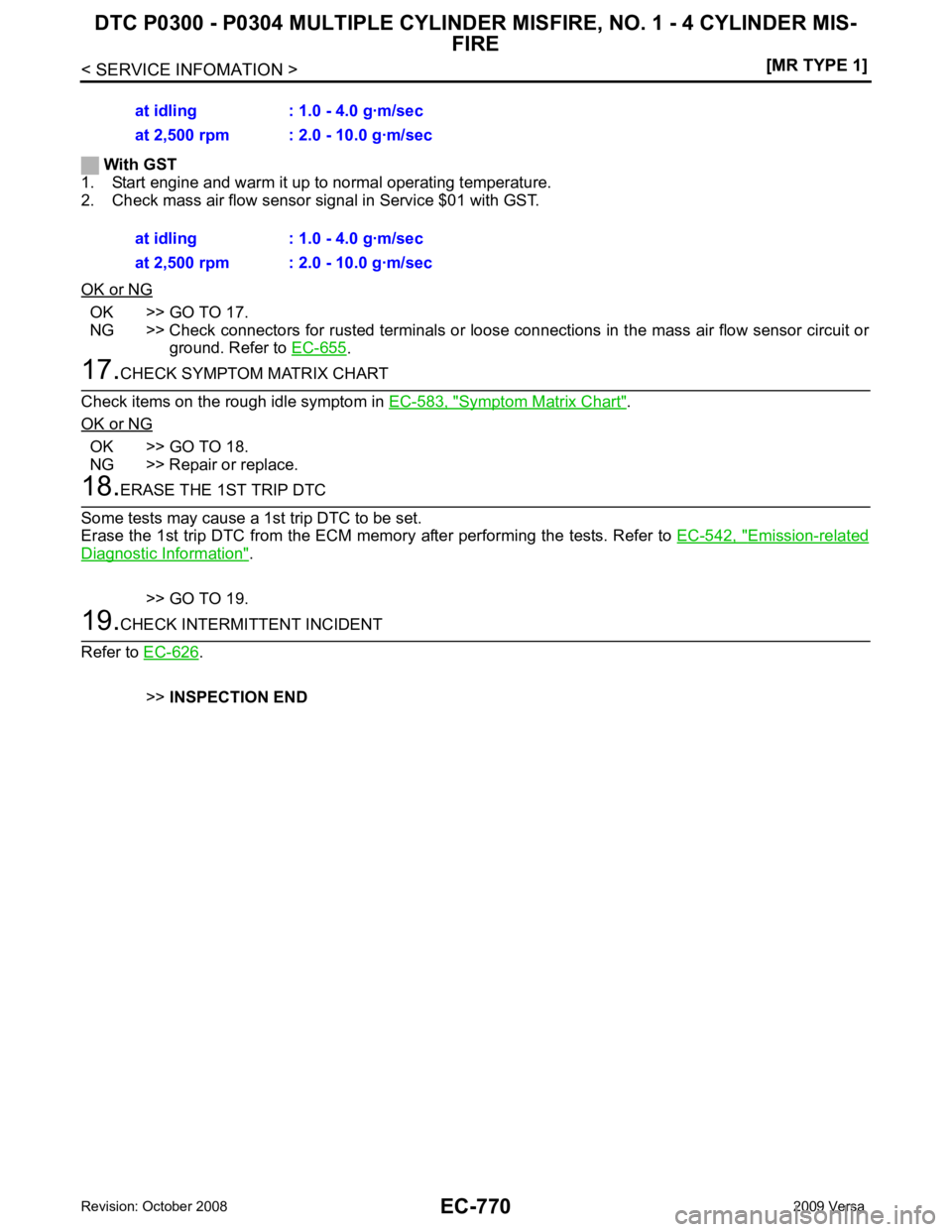
OK >> GO TO 17.
NG >> Check connectors for rusted terminals or loose connections in the mass air flow sensor circuit or ground. Refer to EC-655 .
Symptom Matrix Chart " .
OK or NG OK >> GO TO 18.
NG >> Repair or replace. Emission-related
Diagnostic Information " .
>> GO TO 19. .
>> INSPECTION END
at idling : 1.0 - 4.0 g·m/sec
at 2,500 rpm : 2.0 - 10.0 g·m/sec
at idling : 1.0 - 4.0 g·m/sec
at 2,500 rpm : 2.0 - 10.0 g·m/sec
Page 2127 of 4331
EC
NP
O
DTC P0327, P0328 KS
Component Description INFOID:0000000004537257
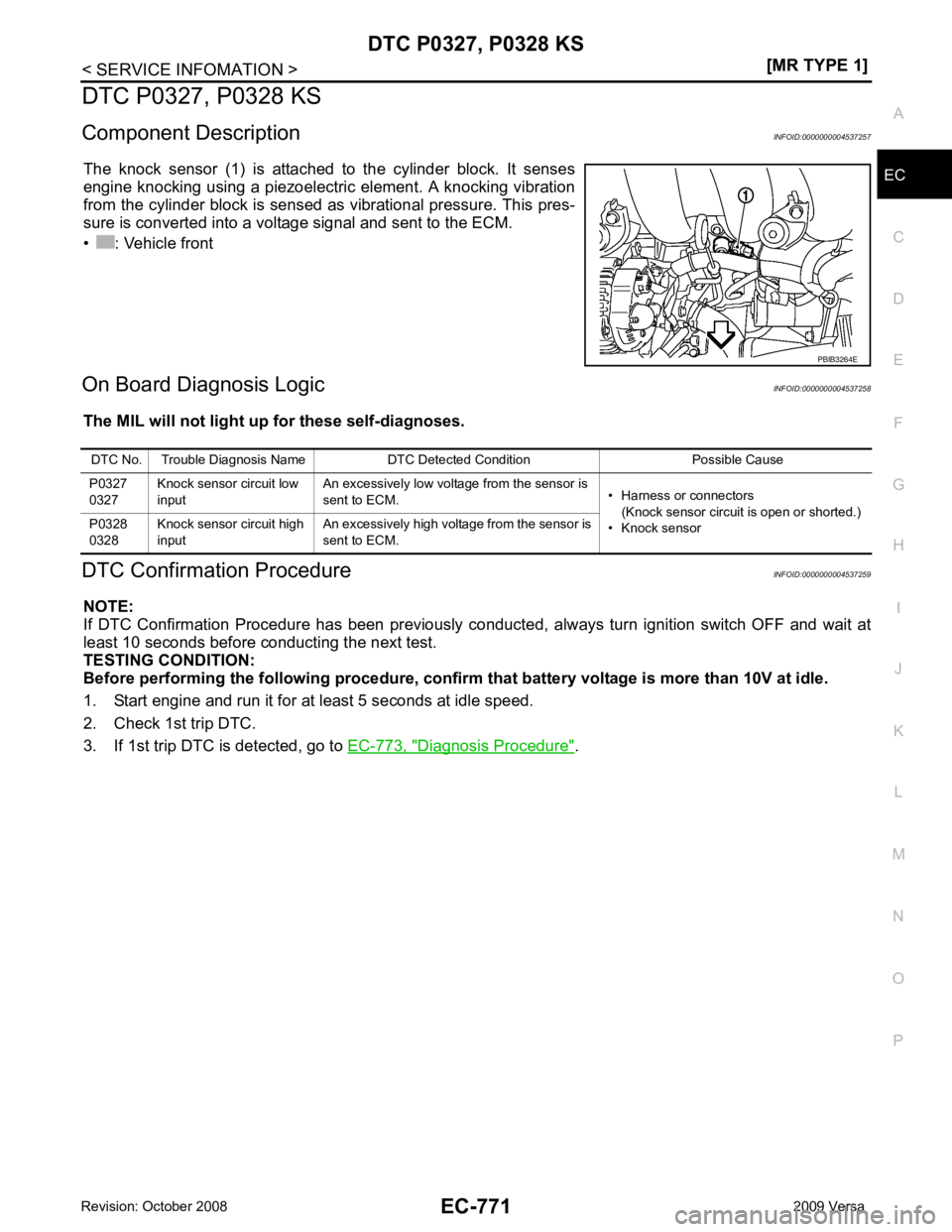
The knock sensor (1) is attached to the cylinder block. It senses
engine knocking using a piezoelectric element. A knocking vibration
from the cylinder block is sensed as vibrational pressure. This pres-
sure is converted into a voltage signal and sent to the ECM.
• : Vehicle front
On Board Diagnosis Logic INFOID:0000000004537258
The MIL will not light up for these self-diagnoses.
DTC Confirmation Procedure INFOID:0000000004537259
NOTE:
If DTC Confirmation Procedure has been previously conduc ted, always turn ignition switch OFF and wait at
least 10 seconds before conducting the next test.
TESTING CONDITION:
Before performing the following procedure, confirm that battery voltage is more than 10V at idle.
1. Start engine and run it for at least 5 seconds at idle speed.
2. Check 1st trip DTC.
3. If 1st trip DTC is detected, go to EC-773, " Diagnosis Procedure " .
Page 2129 of 4331
![NISSAN TIIDA 2009 Service Repair Manual DTC P0327, P0328 KS
EC-773
< SERVICE INFOMATION >
[MR TYPE 1] C
D E
F
G H
I
J
K L
M A EC
NP
O
Diagnosis Procedure
INFOID:00000000045372611.
CHECK KNOCK SENSOR INPUT SIGNAL CIRCUIT-I
1. Turn ignition s](/manual-img/5/57398/w960_57398-2128.png "NISSAN TIIDA 2009 Service Repair Manual DTC P0327, P0328 KS
EC-773
< SERVICE INFOMATION >
[MR TYPE 1] C
D E
F
G H
I
J
K L
M A EC
NP
O
Diagnosis Procedure
INFOID:00000000045372611.
CHECK KNOCK SENSOR INPUT SIGNAL CIRCUIT-I
1. Turn ignition s")
DTC P0327, P0328 KS
EC-773
< SERVICE INFOMATION >
[MR TYPE 1] C
D E
F
G H
I
J
K L
M A EC
NP
O
Diagnosis Procedure
INFOID:00000000045372611.
CHECK KNOCK SENSOR INPUT SIGNAL CIRCUIT-I
1. Turn ignition switch OFF.
2. Disconnect ECM harness connector.
3. Check resistance between ECM terminal 37 and ground. Refer to Wiring Diagram. NOTE:
It is necessary to use an ohmmeter which can measure more than 10 M Ω.
4. Also check harness for short to ground and short to power.
OK or NG OK >> GO TO 4.
NG >> GO TO 2. 2.
CHECK KNOCK SENSOR INPUT SIGNAL CIRCUIT-II
1. Disconnect knock sensor (1) harness connector.
- : Vehicle front
2. Check harness continuity between ECM terminal 37 and knock sensor terminal 1. Refer to Wiring Diagram.
3. Also check harness for short to ground and short to power.
OK or NG OK >> GO TO 3.
NG >> Repair open circuit or short to ground or short to power
in harness or connectors. 3.
CHECK KNOCK SENSOR
Refer to EC-774, " Component Inspection " .
OK or NG OK >> GO TO 6.
NG >> Replace knock sensor. 4.
CHECK GROUND CONNECTIONS
Loosen and retighten ground screws on the body.
Refer to EC-632, " Ground Inspection " .
TERMI-
NAL NO. WIRE
COLOR ITEM CONDITION DATA (DC Voltage)
37 W Knock sensor [Engine is running]
• Idle speed Approximately 2.5V
40 — Sensor ground
(Knock sensor) [Engine is running]
• Warm-up condition
• Idle speed Approximately 0VResistance: Approximately 532 - 588k
Ω [at 20 °C (68 °F)]
Continuity should exist. PBIB3264E
BBIA0698E
Page 2130 of 4331
OK >> GO TO 5.
NG >> Repair or replace ground connections. OK >> GO TO 6.
NG >> Repair open circuit or short to ground or short to power in harness or connectors. .
>> INSPECTION END
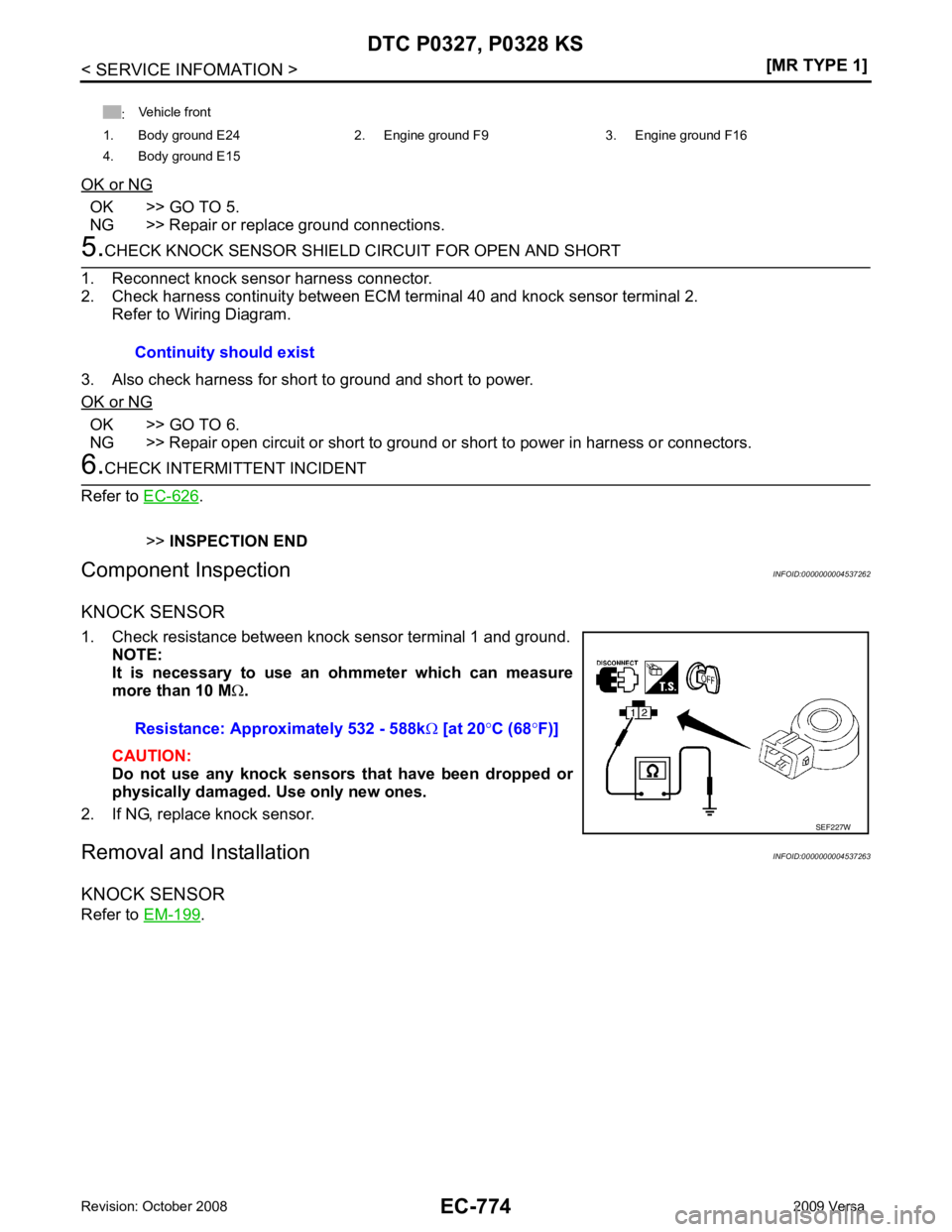
Component Inspection INFOID:0000000004537262
KNOCK SENSOR
1. Check resistance between knock sensor terminal 1 and ground. NOTE:
It is necessary to use an ohmmeter which can measure
more than 10 M Ω.
CAUTION:
Do not use any knock sensors that have been dropped or
physically damaged. Use only new ones.
2. If NG, replace knock sensor.
Removal and Installation INFOID:0000000004537263
KNOCK SENSOR
Refer to EM-199 .
:
Vehicle front
1. Body ground E24 2. Engine ground F9 3. Engine ground F16
4. Body ground E15