2009 NISSAN TIIDA O2 SENSOR
[x] Cancel search: O2 SENSORPage 1964 of 4331
![NISSAN TIIDA 2009 Service Repair Manual Monitored item [Unit] Description Remarks
ENG SPEED
[rpm] • Indicates the engine speed computed from the signals of the
crankshaft position sensor (POS) and camshaft position sen-
sor (PHASE). •](/manual-img/5/57398/w960_57398-1963.png "NISSAN TIIDA 2009 Service Repair Manual Monitored item [Unit] Description Remarks
ENG SPEED
[rpm] • Indicates the engine speed computed from the signals of the
crankshaft position sensor (POS) and camshaft position sen-
sor (PHASE). •")
Monitored item [Unit] Description Remarks
ENG SPEED
[rpm] • Indicates the engine speed computed from the signals of the
crankshaft position sensor (POS) and camshaft position sen-
sor (PHASE). • Accuracy becomes poor if engine speed
drops below the idle rpm.
• If the signal is interrupted while the engine is running, an abnormal value may be indicat-
ed.
MAS A/F SE-B1
[V] • The signal voltage of the mass air flow sensor is displayed. • When the engine is stopped, a certain value
is indicated.
• When engine is running, specification range is indicated in "SPEC".
B/FUEL SCHDL
[msec] • “Base fuel schedule” indicates the fuel injection pulse width
programmed into ECM, prior to any learned on board correc-
tion. • When engine is running, specification range
is indicated in "SPEC".
A/F ALPHA-B1
[%] • The mean value of the air-fuel ratio feedback correction fac-
tor per cycle is indicated. • When the engine is stopped, a certain value
is indicated.
• This data also includes the data for the air/ fuel ratio learning control.
• When engine is running, specification range
is indicated in "SPEC".
COOLAN TEMP/S
[ ° C] or [ °F] • The engine coolant temperature (determined by the signal
voltage of the engine coolant temperature sensor) is dis-
played. • When the engine coolant temperature sen-
sor is open or short-circuited, ECM enters
fail-safe mode. The engine coolant temper-
ature determined by the ECM is displayed.
A/F SEN1 (B1)
[V] • The A/F signal computed from the input signal of the A/F sen-
sor 1 is displayed.
HO2S2 (B1)
[V] • The signal voltage of the heated oxygen sensor 2 is dis-
played.
HO2S2 MNTR (B1)
[RICH/LEAN] • Display of heated oxygen sensor 2 signal:
RICH: means the amount of oxygen after three way catalyst
is relatively small.
LEAN: means the amount of oxygen after three way catalyst
is relatively large. • When the engine is stopped, a certain value
is indicated.
VHCL SPEED SE
[km/h] or [mph] • The vehicle speed computed from the vehicle speed signal is
displayed.
BATTERY VOLT
[V] • The power supply voltage of ECM is displayed.
ACCEL SEN 1
[V] • The accelerator pedal position sensor signal voltage is dis-
played. • ACCEL SEN 2 signal is converted by ECM
internally. Thus, it differs from ECM terminal
voltage signal.
ACCEL SEN 2
[V]
TP SEN 1-B1
[V] • The throttle position sensor signal voltage is displayed. • TP SEN 2-B1 signal is converted by ECM in-
ternally. Thus, it differs from ECM terminal
voltage signal.
TP SEN 2-B1
[V]
Page 1965 of 4331
![NISSAN TIIDA 2009 Service Repair Manual EC
NP
O
FUEL T/TMP SE
[ ° C] or [ °F] • The fuel temperature (determined by the signal voltage of the
fuel tank temperature sensor) is displayed.
INT/A TEMP SE
[ ° C] or [ °F] • The intake ai](/manual-img/5/57398/w960_57398-1964.png "NISSAN TIIDA 2009 Service Repair Manual EC
NP
O
FUEL T/TMP SE
[ ° C] or [ °F] • The fuel temperature (determined by the signal voltage of the
fuel tank temperature sensor) is displayed.
INT/A TEMP SE
[ ° C] or [ °F] • The intake ai")
EC
NP
O
FUEL T/TMP SE
[ ° C] or [ °F] • The fuel temperature (determined by the signal voltage of the
fuel tank temperature sensor) is displayed.
INT/A TEMP SE
[ ° C] or [ °F] • The intake air temperature (determined by the signal voltage
of the intake air temperature sensor) is indicated.
EVAP SYS PRES
[V] • The signal voltage of EVAP control system pressure sensor
is displayed.
FUEL LEVEL SE
[V] • The signal voltage of the fuel level sensor is displayed.
START SIGNAL
[ON/OFF] • Indicates start signal status [ON/OFF] computed by the ECM
according to the signals of engine speed and battery voltage. • After starting the engine, [OFF] is displayed
regardless of the starter signal.
CLSD THL POS
[ON/OFF] • Indicates idle position [ON/OFF] computed by the ECM ac-
cording to the accelerator pedal position sensor signal.
AIR COND SIG
[ON/OFF] • Indicates [ON/OFF] condition of the air conditioner switch as
determined by the air conditioner signal.
P/N POSI SW
[ON/OFF] • Indicates [ON/OFF] condition from the park/neutral position
(PNP) switch signal.
PW/ST SIGNAL
[ON/OFF] • [ON/OFF] condition of the power steering system (deter-
mined by the signal sent from EPS control unit) is indicated.
LOAD SIGNAL
[ON/OFF] • Indicates [ON/OFF] condition from the electrical load signal.
ON: Rear window defogger switch is ON and/or lighting
switch is in 2nd position.
OFF: Both rear window defogger switch and lighting switch
are OFF.
IGNITION SW
[ON/OFF] • Indicates [ON/OFF] condition from ignition switch.
HEATER FAN SW
[ON/OFF] • Indicates [ON/OFF] condition from the heater fan switch sig-
nal.
BRAKE SW
[ON/OFF] • Indicates [ON/OFF] condition from the stop lamp switch sig-
nal.
INJ PULSE-B1
[msec] • Indicates the actual fuel injection pulse width compensated
by ECM according to the input signals. • When the engine is stopped, a certain com-
puted value is indicated.
IGN TIMING
[BTDC] • Indicates the ignition timing computed by ECM according to
the input signals. • When the engine is stopped, a certain value
is indicated.
CAL/LD VALUE
[%] • “Calculated load value” indicates the value of the current air-
flow divided by peak airflow.
MASS AIRFLOW
[g·m/s] • Indicates the mass airflow computed by ECM according to
the signal voltage of the mass air flow sensor.
PURG VOL C/V
[%] • Indicates the EVAP canister purge volume control solenoid
valve control value computed by the ECM according to the in-
put signals.
• The opening becomes larger as the value increases.
INT/V TIM (B1)
[ ° CA] • Indicates [
°CA] of intake camshaft advanced angle.
INT/V SOL (B1)
[%] • The control value of the intake valve timing control solenoid
valve (determined by ECM according to the input signal) is in-
dicated.
• The advance angle becomes larger as the value increases
AIR COND RLY
[ON/OFF] • The air conditioner relay control condition (determined by
ECM according to the input signals) is indicated.
FUEL PUMP RLY
[ON/OFF] • Indicates the fuel pump relay control condition determined by
ECM according to the input signals.
Monitored item [Unit] Description Remarks
Page 1967 of 4331
![NISSAN TIIDA 2009 Service Repair Manual EC
NP
O
NOTE:
Any monitored item that does not match the vehicle being diagnosed is deleted from the display automatically.
ACTIVE TEST MODE
Test Item AT OD CANCEL
[ON/OFF] • Indicates [ON/OFF] cond](/manual-img/5/57398/w960_57398-1966.png "NISSAN TIIDA 2009 Service Repair Manual EC
NP
O
NOTE:
Any monitored item that does not match the vehicle being diagnosed is deleted from the display automatically.
ACTIVE TEST MODE
Test Item AT OD CANCEL
[ON/OFF] • Indicates [ON/OFF] cond")
EC
NP
O
NOTE:
Any monitored item that does not match the vehicle being diagnosed is deleted from the display automatically.
ACTIVE TEST MODE
Test Item AT OD CANCEL
[ON/OFF] • Indicates [ON/OFF] condition of A/T O/D cancel signal sent
from the TCM. • For M/T models always “OFF” is displayed
CRUISE LAMP
[ON/OFF] • Indicates [ON/OFF]
condition of CRUISE lamp determined
by the ECM according to the input signals.
SET LAMP
[ON/OFF] • Indicates [ON/OFF] condition of SET lamp determined by the
ECM according to the input signals.
A/F ADJ-B1 • Indicates the correction factor stored in ECM. The factor is
calculated from the difference between the target air/fuel ratio
stored in ECM and the air/fuel ratio calculated from air fuel ra-
tio (A/F) sensor 1 signal.
Monitored item [Unit] Description Remarks TEST ITEM CONDITION JUDGEMENT CHECK ITEM (REMEDY)
FUEL INJEC-
TION • Engine: Return to the original
trouble condition
• Change the amount of fuel injec- tion using CONSULT-III. If trouble symptom disappears, see
CHECK ITEM. • Harness and connectors
• Fuel injector
• Air fuel ratio (A/F) sensor 1
IGNITION TIM-
ING • Engine: Return to the original
trouble condition
• Timing light: Set
• Retard the ignition timing using
CONSULT-III. If trouble symptom disappears, see
CHECK ITEM. • Perform Idle Air Volume Learning.
POWER BAL-
ANCE • Engine: After warming up, idle the
engine.
• A/C switch OFF
• Shift lever: P or N (A/T, CVT), Neutral (M/T)
• Cut off each fuel injector signal
one at a time using CONSULT-III. Engine runs rough or dies.
• Harness and connectors
• Compression
• Fuel injector
• Power transistor
• Spark plug
• Ignition coil
COOLING FAN* • Ignition switch: ON
• Turn the cooling fan “LOW”, “HI” and “OFF” with CONSULT-III. Cooling fan moves and stops. • Harness and connectors
• Cooling fan relay
• Cooling fan motor
ENG COOLANT
TEMP • Engine: Return to the original
trouble condition
• Change the engine coolant tem- perature using CONSULT-III. If trouble symptom disappears, see
CHECK ITEM. • Harness and connectors
• Engine coolant temperature sen-
sor
• Fuel injector
FUEL PUMP RE-
LAY • Ignition switch: ON
(Engine stopped)
• Turn the fuel pump relay ON and OFF using CONSULT-III and lis-
ten to operating sound. Fuel pump relay makes the operat-
ing sound. • Harness and connectors
• Fuel pump relay
PURG VOL
CONT/V • Engine: After warming up, run en-
gine at 1,500 rpm.
• Change the EVAP canister purge volume control solenoid valve
opening percent using CON-
SULT-III. Engine speed changes according to
the opening percent. • Harness and connectors
• EVAP canister purge volume con- trol solenoid valve
FUEL/T TEMP
SEN • Change the fuel tank temperature using CONSULT-III.
Page 1973 of 4331

EC
NP
O
*: Accelerator pedal position sensor 2 signal and throttle position sensor 2 signal are converted by ECM internally. Thus, they
differ from
ECM terminals voltage signal. SET LAMP
• MAIN switch: ON
• Vehicle speed: Between 40 km/h
(25 MPH) and 144 km/h (89
MPH) ACSD: Operating ON
ASCD: Not operating OFF
MONITOR ITEM CONDITION SPECIFICATION
Page 1980 of 4331
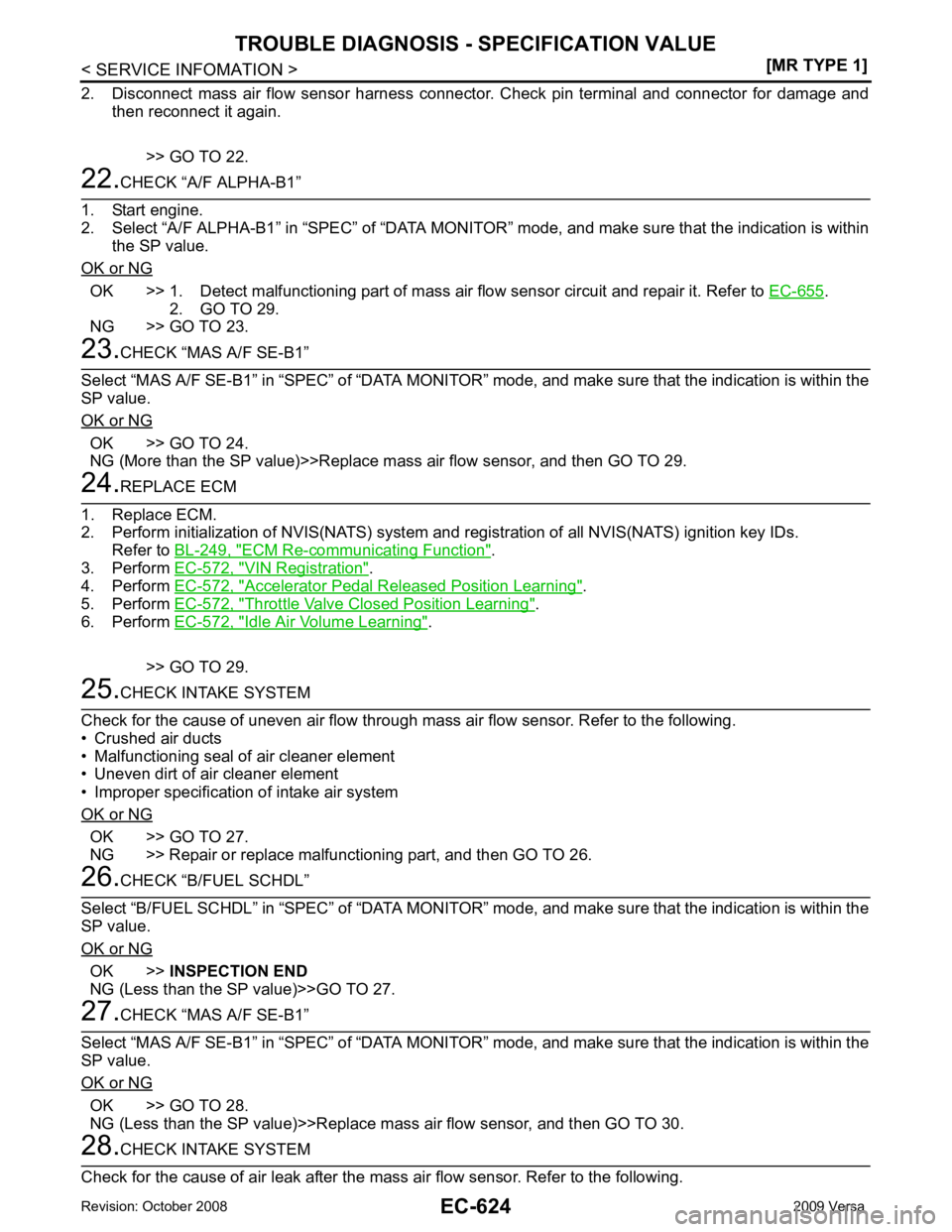
OK >> 1. Detect malfunctioning part of mass air flow sensor circuit and repair it. Refer to
EC-655 .
2. GO TO 29.
NG >> GO TO 23. OK >> GO TO 24.
NG (More than the SP value)>>Replace mass air flow sensor, and then GO TO 29. ECM Re-communicating Function " .
3. Perform EC-572, " VIN Registration " .
4. Perform EC-572, " Accelerator Pedal Released Position Learning " .
5. Perform EC-572, " Throttle Valve Closed Position Learning " .
6. Perform EC-572, " Idle Air Volume Learning " .
>> GO TO 29. OK >> GO TO 27.
NG >> Repair or replace malfunctioning part, and then GO TO 26. OK >>
INSPECTION END
NG (Less than the SP value)>>GO TO 27. OK >> GO TO 28.
NG (Less than the SP value)>>Replace mass air flow sensor, and then GO TO 30.
Page 1993 of 4331
EC
NP
O
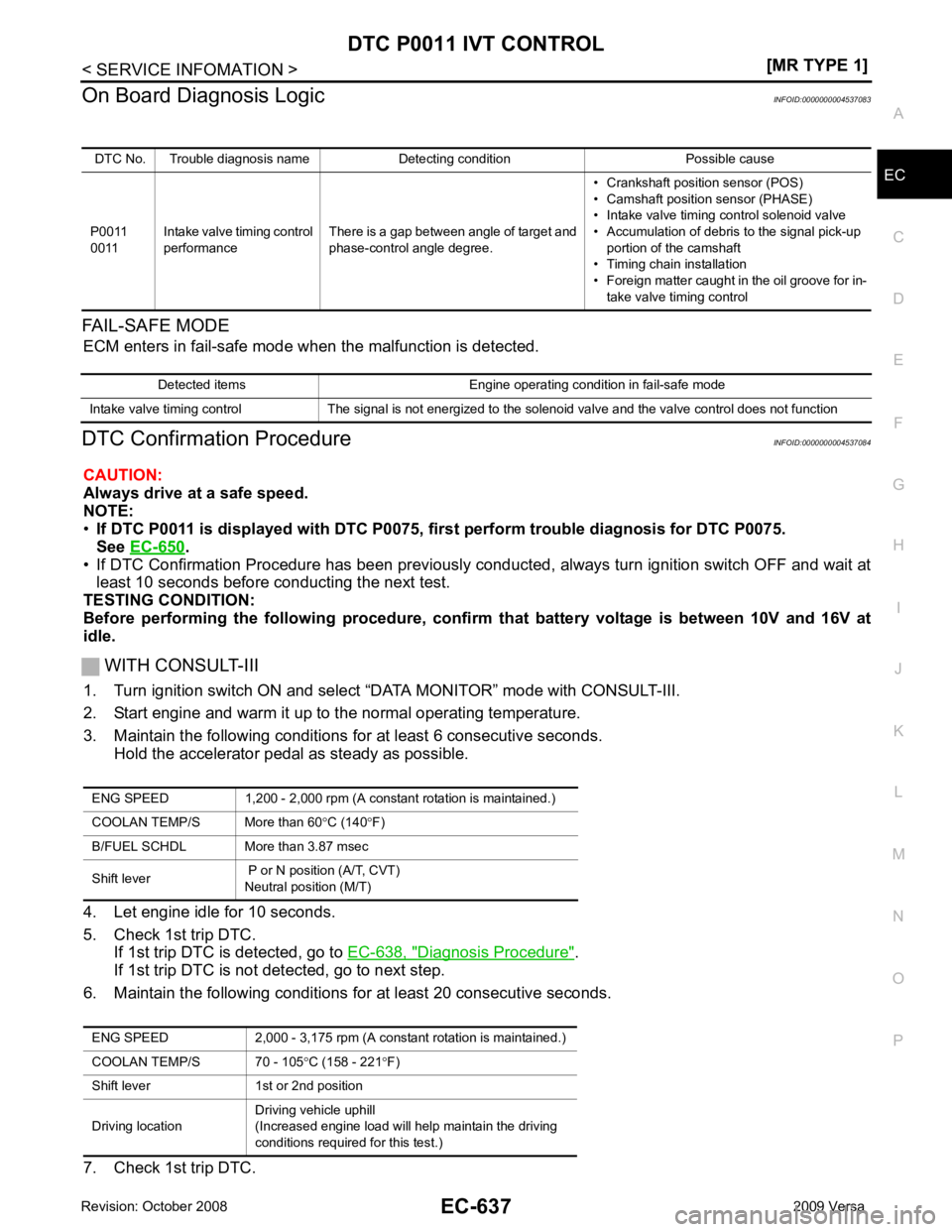
On Board Diagnosis Logic
INFOID:0000000004537083
FAIL-SAFE MODE ECM enters in fail-safe mode w hen the malfunction is detected.
DTC Confirmation Procedure INFOID:0000000004537084
CAUTION:
Always drive at a safe speed.
NOTE:
• If DTC P0011 is displayed with DTC P0075, first perform trouble diagnosis for DTC P0075.
See EC-650 .
• If DTC Confirmation Procedure has been previously conduc ted, always turn ignition switch OFF and wait at
least 10 seconds before conducting the next test.
TESTING CONDITION:
Before performing the following procedure, confi rm that battery voltage is between 10V and 16V at
idle.
WITH CONSULT-III
1. Turn ignition switch ON and select “DATA MONITOR” mode with CONSULT-III.
2. Start engine and warm it up to the normal operating temperature.
3. Maintain the following conditions for at least 6 consecutive seconds. Hold the accelerator pedal as steady as possible.
4. Let engine idle for 10 seconds.
5. Check 1st trip DTC. If 1st trip DTC is detected, go to EC-638, " Diagnosis Procedure " .
If 1st trip DTC is not detected, go to next step.
6. Maintain the following conditions for at least 20 consecutive seconds.
7. Check 1st trip DTC. DTC No. Trouble diagnosis name Detecting condition Possible cause
P0011
0011 Intake valve timing control
performance There is a gap between angle of target and
phase-control angle degree. • Crankshaft position sensor (POS)
• Camshaft position sensor (PHASE)
• Intake valve timing control solenoid valve
• Accumulation of debris to the signal pick-up portion of the camshaft
• Timing chain installation
• Foreign matter caught in the oil groove for in- take valve timing control Detected items Engine operating condition in fail-safe mode
Intake valve timing control The signal is not energized to the solenoid valve and the valve control does not function ENG SPEED 1,200 - 2,000 rpm (A constant rotation is maintained.)
COOLAN TEMP/S More than 60 °C (140 °F)
B/FUEL SCHDL More than 3.87 msec
Shift lever P or N position (A/T, CVT)
Neutral position (M/T)
ENG SPEED 2,000 - 3,175 rpm (A constant rotation is maintained.)
COOLAN TEMP/S 70 - 105 °C (158 - 221 °F)
Shift lever 1st or 2nd position
Driving location Driving vehicle uphill
(Increased engine load will help maintain the driving
conditions required for this test.)
Page 1994 of 4331
![NISSAN TIIDA 2009 Service Repair Manual EC-638< SERVICE INFOMATION >
[MR TYPE 1]
DTC P0011 IVT CONTROL
If 1st trip DTC is detected, go to EC-638, " Diagnosis Procedure " .
WITH GST
Follow the procedure “WITH CONSULT-III” above.
Diagno](/manual-img/5/57398/w960_57398-1993.png "NISSAN TIIDA 2009 Service Repair Manual EC-638< SERVICE INFOMATION >
[MR TYPE 1]
DTC P0011 IVT CONTROL
If 1st trip DTC is detected, go to EC-638, \" Diagnosis Procedure \" .
WITH GST
Follow the procedure “WITH CONSULT-III” above.
Diagno")
EC-638< SERVICE INFOMATION >
[MR TYPE 1]
DTC P0011 IVT CONTROL
If 1st trip DTC is detected, go to EC-638, " Diagnosis Procedure " .
WITH GST
Follow the procedure “WITH CONSULT-III” above.
Diagnosis Procedure INFOID:00000000045370851.
CHECK OIL PRESSURE WARNING LAMP
1. Start engine.
2. Check oil pressure warning lamp and confirm it is not illumi-
nated.
OK or NG OK >> GO TO 2.
NG >> Go to LU-16, " Inspection " .
2.
CHECK INTAKE VALVE TIMING CONTROL SOLENOID VALVE
Refer to EC-639, " Component Inspection " .
OK or NG OK >> GO TO 3.
NG >> Replace intake valve timing control solenoid valve. 3.
CHECK CRANKSHAFT POSI TION SENSOR (POS)
Refer to EC-780, " Component Inspection " .
OK or NG OK >> GO TO 4.
NG >> Replace crankshaft position sensor (POS). 4.
CHECK CAMSHAFT POSITION SENSOR (PHASE)
Refer to EC-785, " Component Inspection " .
OK or NG OK >> GO TO 5.
NG >> Replace camshaft position sensor (PHASE). 5.
CHECK CAMSHAFT (INTAKE)
Check the following.
• Accumulation of debris to the si gnal plate of camshaft (1) rear end
• Chipping signal plate of camshaft rear end
OK or NG OK >> GO TO 6.
NG >> Remove debris and clean the signal plate of camshaft rear end or replace camshaft. 6.
CHECK TIMING CHAIN INSTALLATION
Check service records for any recent repairs that may cause timing chain misaligned.
Are there any service records that may cause timing chain misaligned?
Yes or No Yes >> Check timing chain installation. Refer to
EM-160 .
No >> GO TO 7. PBIA8559J
PBIA9557J
Page 1995 of 4331
![NISSAN TIIDA 2009 Service Repair Manual DTC P0011 IVT CONTROL
EC-639
< SERVICE INFOMATION >
[MR TYPE 1] C
D E
F
G H
I
J
K L
M A EC
NP
O 7.
CHECK LUBRICATION CIRCUIT
Refer to EM-170, " Removal and Installation " .
OK or NG OK >> GO TO 8.
NG](/manual-img/5/57398/w960_57398-1994.png "NISSAN TIIDA 2009 Service Repair Manual DTC P0011 IVT CONTROL
EC-639
< SERVICE INFOMATION >
[MR TYPE 1] C
D E
F
G H
I
J
K L
M A EC
NP
O 7.
CHECK LUBRICATION CIRCUIT
Refer to EM-170, \" Removal and Installation \" .
OK or NG OK >> GO TO 8.
NG")
DTC P0011 IVT CONTROL
EC-639
< SERVICE INFOMATION >
[MR TYPE 1] C
D E
F
G H
I
J
K L
M A EC
NP
O 7.
CHECK LUBRICATION CIRCUIT
Refer to EM-170, " Removal and Installation " .
OK or NG OK >> GO TO 8.
NG >> Clean lubrication line. 8.
CHECK INTERMITTENT INCIDENT
Refer to EC-626 .
For Wiring Diagram, refer to EC-776, " Wiring Diagram " for CKP sensor (POS) and
EC-782, " Wiring Diagram "
for CMP sensor (PHASE).
>>INSPECTION END
Component Inspection INFOID:0000000004537086
INTAKE VALVE TIMING CONTROL SOLENOID VALVE 1. Disconnect intake valve timing control solenoid valve harness connector.
2. Check resistance between intake valve timing control solenoid valve as follows.
If NG, replace intake valve timing control solenoid valve.
If OK, go to next step.
3. Remove intake valve timing control solenoid valve.
4. Provide 12V DC between intake valve timing control solenoid valve terminals and then interrupt it. Make sure that the plunger
moves as shown in the figure.
CAUTION:
Do not apply 12V DC continuously for 5 seconds or more.
Doing so may result in damage to the coil in intake valve
timing control solenoid valve.
If NG, replace intake valve timing control solenoid valve.
NOTE:
Always replace O-ring when intake valve timing control
solenoid valve is removed.
Removal and Installation INFOID:0000000004537087
INTAKE VALVE TIMING CONTROL SOLENOID VALVE Refer to EM-160 .
Terminal Resistance
1 and 2 6.7 - 7.7 Ω [at 20 °C (68 °F)]
1 or 2 and ground ∞Ω
(Continuity should not exist.) PBIB0574E
PBIB2388E