2009 MERCEDES-BENZ CL COUPE ESP
[x] Cancel search: ESPPage 334 of 421

Display messages
Possible causes/consequences and
X
X Solutions # The alternator or vehicle's electrical system is faulty.
The battery is not being charged.
X
Pull over and stop the vehicle safely, paying attention to
road and traffic conditions and leave the engine running.
X Open the bonnet.
X Check whether the poly-V-belt is torn.
If the poly-V-belt is torn:
! Do not continue driving. The engine could otherwise over-
heat.
X Switch off the engine.
X Consult a qualified specialist workshop.
If the poly-V-belt is intact:
X Visit a qualified specialist workshop. ? The engine fan is faulty.
X
Make sure that the coolant temperature does not exceed
120 †.
X Avoid subjecting the engine to heavy loads (e.g. driving in
mountainous terrain) and stop-and-go driving.
X Drive to the nearest qualified specialist workshop. J ABS and
ESP inop‐
erative
See Own‐
er's Man‐
ual
G
Risk of accident
ABS (Anti-lock Braking System), ESP ®
(Electronic Stability
Program), BAS (Brake Assist), PRE-SAFE ®
, HOLD, hill start
assist, the adaptive brake lights and ESP ®
trailer stabilisation
are unavailable due to a malfunction. In addition, the ÷,
å and! warning lamps light up in the instrument clus-
ter. The brake system continues to function normally, but
without the functions listed above.
BAS PLUS* (Brake Assist PLUS) and PRE-SAFE ®
Brake *may
be inoperative as well.
X Drive on carefully.
X Visit a qualified specialist workshop. Display messages
331Practical advice
* optional
216_AKB; 2; 3, en-GB
bjanott,
Version: 2.11.7.7 2009-02-27T14:54:17+01:00 - Seite 331 Z
Dateiname: 6515230602_buchblock.pdf; erzeugt am 04. Mar 2009 11:16:37; WK
Page 335 of 421

Display messages
Possible causes/consequences and
X
X Solutions J ABS and
ESP cur‐
rently
unavaila‐
ble See
Owner's
Manual G
Risk of accident
ABS, ESP ®
, BAS, PRE-SAFE ®
, HOLD, hill start assist, the adap-
tive brake lights and ESP ®
trailer stabilisation are temporarily
unavailable. Self diagnosis is not yet complete. In addition,
the ÷, åand! warning lamps light up in the instru-
ment cluster. The brake system continues to function nor-
mally, but without the functions listed above.
BAS PLUS* and PRE-SAFE ®
Brake* may have failed.
X On a suitable stretch of road, carefully manoeuvre the vehi-
cle slightly to the left and right at a speed above 20 km/h
until the display message disappears. G
Risk of accident
ABS, ESP ®
, BAS, PRE-SAFE ®
, HOLD, hill start assist, the adap-
tive brake lights and ESP ®
trailer stabilisation are temporarily
unavailable. The on-board voltage may, for example, be insuf-
ficient. In addition, the ÷,åand! warning lamps
light up in the instrument cluster. The brake system continues
to function normally, but without the functions listed above.
BAS PLUS* and PRE-SAFE ®
Brake* may have failed.
X Drive on carefully.
X Visit a qualified specialist workshop. ÷ inopera‐
tive See
Owner's
Manual
or
System
Inopera‐
tive
G
Risk of accident
ESP ®
, BAS, PRE-SAFE ®
, HOLD, hill start assist, the adaptive
brake lights and ESP ®
trailer stabilisation are temporarily
unavailable due to a malfunction. BAS PLUS* and PRE-
SAFE ®
Brake* may have failed. In addition, the ÷and
å warning lamps light up in the instrument cluster.
X Drive on carefully.
X Visit a qualified specialist workshop. 332
Display
messagesPractical advice
* optional
216_AKB; 2; 3, en-GB
bjanott
,V ersion: 2.11.7.7
2009-02-27T14:54:17+01:00 - Seite 332
Dateiname: 6515230602_buchblock.pdf; erzeugt am 04. Mar 2009 11:16:37; WK
Page 336 of 421

Display messages
Possible causes/consequences and
X
X Solutions ÷ currently
unavaila‐
ble See
Owner's
Manual
G
Risk of accident
ESP ®
, BAS, PRE-SAFE ®
, HOLD, hill start assist, the adaptive
brake lights and ESP ®
trailer stabilisation are temporarily
unavailable. The self diagnosis function might not be com-
plete, for example. The brake system continues to function
normally, but without the functions listed above. In addition,
the ÷ andå warning lamps light up in the instrument
cluster.
BAS PLUS* and PRE-SAFE ®
Brake* may have failed.
X On a suitable stretch of road, carefully manoeuvre the vehi-
cle slightly to the left and right at a speed above 20 km/h
until the display message disappears. G
Risk of accident
ESP ®
, BAS, PRE-SAFE ®
, HOLD, hill start assist, the adaptive
brake lights and ESP ®
trailer stabilisation are temporarily
unavailable due to undervoltage. The battery might not be
charging, for example. The brake system continues to func-
tion normally, but without the functions listed above.
BAS PLUS* and PRE-SAFE ®
Brake* may have failed.
X Drive on carefully.
X Visit a qualified specialist workshop. The
÷ warning lamp flashes.
G Risk of accident
ETS (Electronic Traction System) is deactivated.
BAS PLUS* and PRE-SAFE ®
Brake* may have failed.
X Let the brakes cool down until the display message disap-
pears and the ÷warning lamp goes out.
ETS is reactivated. J Check
brake
fluid
level
G
Risk of accident
There is insufficient brake fluid in the brake fluid reservoir. In
addition, the Jwarning lamp in the instrument cluster
lights up and a warning tone sounds.
X Pull over and stop the vehicle safely as soon as possible,
paying attention to road and traffic conditions. Do not con-
tinue driving under any circumstances.
X Consult a qualified specialist workshop.
Do not top up the brake fluid. This will not rectify the fault. Display
messages
333Practical advice
* optional
216_AKB; 2; 3, en-GB
bjanott
,V ersion: 2.11.7.7
2009-02-27T14:54:17+01:00 - Seite 333 Z
Dateiname: 6515230602_buchblock.pdf; erzeugt am 04. Mar 2009 11:16:37; WK
Page 337 of 421

Display messages
Possible causes/consequences and
X
X Solutions J EBV, ABS
and ESP
inopera‐
tive See
Owner's
Manual
G
Risk of accident
EBV (electronic brake force distribution), ABS, ESP ®
, BAS,
PRE-SAFE ®
, HOLD, hill start assist, the adaptive brake lights
and ESP ®
trailer stabilisation are unavailable due to a mal-
function. In addition, the ÷,å,J and! warning
lamps in the instrument cluster light up and a warning tone
sounds. The brake system continues to function normally, but
without the functions listed above.
BAS PLUS* and PRE-SAFE ®
Brake* may have failed.
X Drive on carefully.
X Visit a qualified specialist workshop. # Check
brake wear The brake pads/linings have reached their wear limit.
X
Visit a qualified specialist workshop. ! Release
parking
brake !
The indicator lamp (red) flashes and a warning tone
sounds.
You are driving with the electric parking brake applied.
X Release the electric parking brake.
or
X Pull away carefully (Y page 205). !
The indicator lamp (red) flashes and a warning tone
sounds.
You are making an emergency stop using the electric parking
brake (Y page 205).
X After the emergency stop: release the electric parking
brake lever. 334
Display
messagesPractical advice
* optional
216_AKB; 2; 3, en-GB
bjanott
,V ersion: 2.11.7.7
2009-02-27T14:54:17+01:00 - Seite 334
Dateiname: 6515230602_buchblock.pdf; erzeugt am 04. Mar 2009 11:16:37; WK
Page 339 of 421

Display messages
Possible causes/consequences and
X
X Solutions !
The indicator lamp (red) flashes.
The power supply for the electric parking brake was interrup-
ted.
X Pull the electric parking brake handle.
or
X Pull away carefully (Y page 205).
or
X Pull the electric parking brake lever until the display mes-
sage disappears. !
The indicator lamp (red) flashes, the warning lamp (yel-
low) lights up and a warning tone sounds.
The electric parking brake is malfunctioning.
X Switch off the ignition and turn it back on.
X Engage or release the electric parking brake.
or
X Pull away carefully (Y page 205).
X Visit a qualified specialist workshop. !
The warning lamp (yellow) lights up. In addition, the
indicator lamp (red) flashes for about 10 seconds after the
electric parking brake has been engaged or released. It then
goes out or remains lit.
The electric parking brake is malfunctioning, e.g. because of
over- or undervoltage.
X Pull away carefully (Y page 205).
X Visit a qualified specialist workshop.
In case of over- or undervoltage:
X Remove the cause for the over- or undervoltage, e.g. by
charging the battery or restarting the engine.
X Switch the ignition off and on, and then engage or release
the electric parking brake.
If this does not release the electric parking brake:
X Do not drive on.
X Consult a qualified specialist workshop. 336
Display
messagesPractical advice
216_AKB; 2; 3, en-GB
bjanott ,V ersion: 2.11.7.7
2009-02-27T14:54:17+01:00 - Seite 336
Dateiname: 6515230602_buchblock.pdf; erzeugt am 04. Mar 2009 11:16:37; WK
Page 341 of 421

Display messages
Possible causes/consequences and
X
X Solutions ¨ Stop vehi‐
cle Vehi‐
cle too
low
G
Risk of accident
The vehicle level control system* is malfunctioning.
X Do not exceed a maximum speed of 80 km/h.
X Make only slight steering movements. Otherwise, the front
wing or the tyres could be damaged when you drive on.
X Listen for scraping sounds.
X Pull over and stop the vehicle, paying attention to road and
traffic conditions, and select a higher vehicle level.
The vehicle may be raised, depending on the type of mal-
function.
X Visit a qualified specialist workshop. The vehicle level is too low.
X
Pull over and stop the vehicle safely, paying attention to
road and traffic conditions.
After a few seconds, the vehicle level is adjusted and the
display message disappears. ¨ Vehicle
rising
Please
wait
briefly The vehicle level is too low when the vehicle is stationary.
X
Remain stationary.
X Wait until the display message disappears.
The vehicle has reached the level required for driving. ¨ Malfunc‐
tion
G
Risk of accident
The AIRMATIC* function is restricted. The vehicle's handling
characteristics may be affected.
X Do not exceed a maximum speed of 80 km/h.
X Visit a qualified specialist workshop. 6 Restraint
system
malfunc‐
tion Con‐
sult work‐
shop
G
Risk of injury
The restraint system is faulty.
X Visit a qualified specialist workshop. 338
Display
messagesPractical advice
* optional
216_AKB; 2; 3, en-GB
bjanott
,V ersion: 2.11.7.7
2009-02-27T14:54:17+01:00 - Seite 338
Dateiname: 6515230602_buchblock.pdf; erzeugt am 04. Mar 2009 11:16:38; WK
Page 343 of 421

Display messages
Possible causes/consequences and
X
X Solutions 6 Left
windowbag
malfunc‐
tion Con‐
sult work‐
shop
or
Right
windowbag
malfunc‐
tion Con‐
sult work‐
shop
G
Risk of injury
There is a malfunction in the left-hand or right-hand window-
bag.
X Visit a qualified specialist workshop. Â Key does
not
belong to
vehicle You have put the wrong key in the ignition lock.
X
Use the correct key. Â Change
key bat‐
teries The key batteries are discharged.
X
Change the batteries (Y page 367). Replace
key
The KEYLESS GO* key needs to be replaced.
X
Visit a qualified specialist workshop. Â Key being
initial‐
ised
Please
wait
The vehicle is registering the KEYLESS GO* key.
X
Wait until the display message disappears. Â Remove
starting
button,
then
insert key
KEYLESS GO* is temporarily malfunctioning or is defective.
X
Remove the KEYLESS GO* button from the ignition lock
(Y page 183).
X Insert the key into the ignition lock and turn it to the desired
position. Â Key still
in vehicle
The KEYLESS GO key* has been detected inside the vehicle
during locking.
X
Remove the KEYLESS GO key* from the vehicle. 340
Display
messagesPractical advice
* optional
216_AKB; 2; 3, en-GB
bjanott
,V ersion: 2.11.7.7
2009-02-27T14:54:17+01:00 - Seite 340
Dateiname: 6515230602_buchblock.pdf; erzeugt am 04. Mar 2009 11:16:38; WK
Page 345 of 421
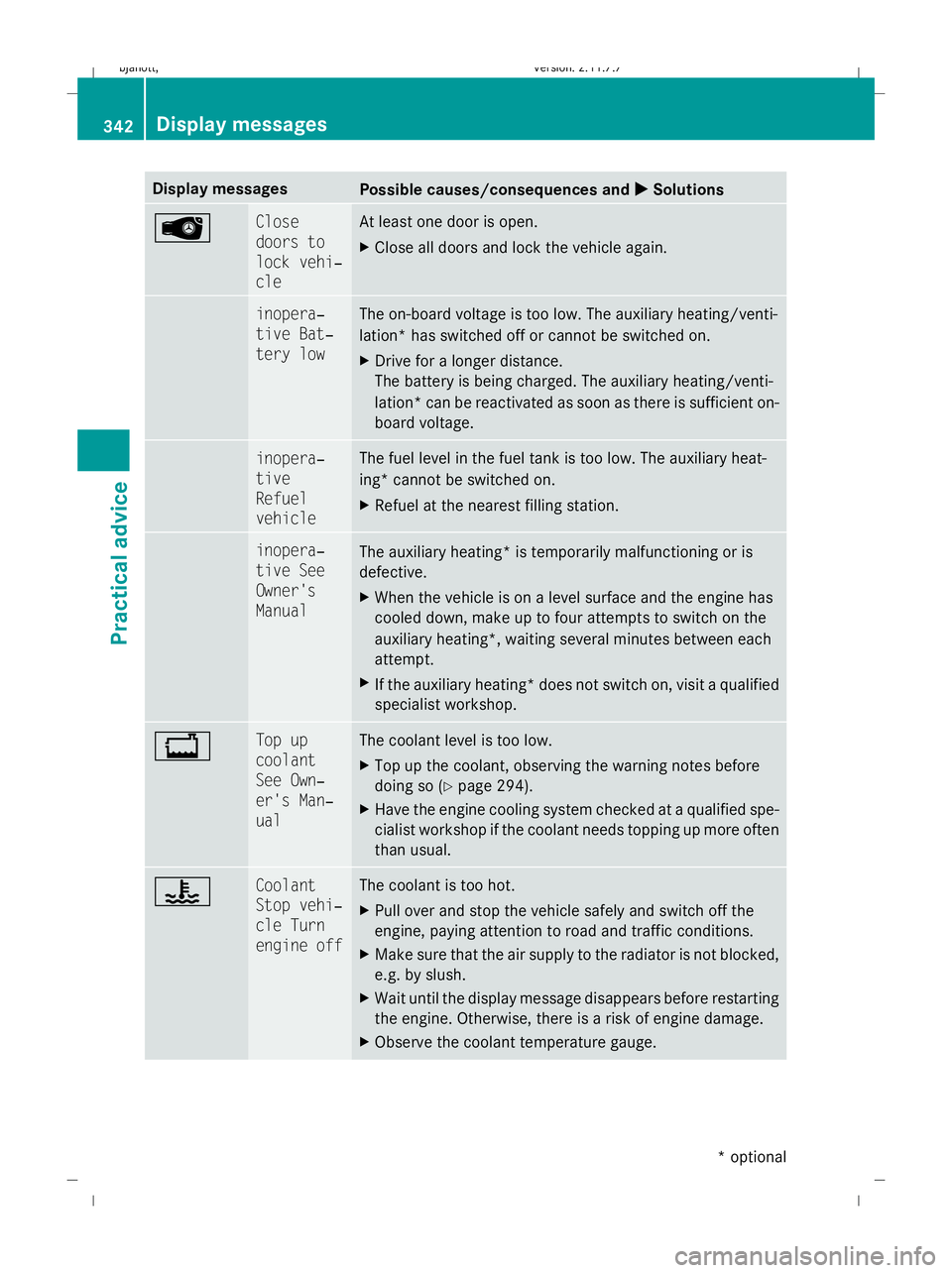
Display messages
Possible causes/consequences and
X
X Solutions  Close
doors to
lock vehi‐
cle At least one door is open.
X
Close all doors and lock the vehicle again. & inopera‐
tive Bat‐
tery low The on-board voltage is too low. The auxiliary heating/venti-
lation* has switched off or cannot be switched on.
X
Drive for a longer distance.
The battery is being charged. The auxiliary heating/venti-
lation *can be reactivated as soon as there is sufficient on-
board voltage. & inopera‐
tive
Refuel
vehicle The fuel level in the fuel tank is too low. The auxiliary heat-
ing* cannot be switched on.
X
Refuel at the nearest filling station. & inopera‐
tive See
Owner's
Manual
The auxiliary heating
*is temporarily malfunctioning or is
defective.
X When the vehicle is on a level surface and the engine has
cooled down, make up to four attempts to switch on the
auxiliary heating*, waiting several minutes between each
attempt.
X If the auxiliary heating* does not switch on, visit a qualified
specialist workshop. + Top up
coolant
See Own‐
er's Man‐
ual The coolant level is too low.
X
Top up the coolant, observing the warning notes before
doing so (Y page 294).
X Have the engine cooling system checked at a qualified spe-
cialist workshop if the coolant needs topping up more often
than usual. ? Coolant
Stop vehi‐
cle Turn
engine off The coolant is too hot.
X
Pull over and stop the vehicle safely and switch off the
engine, paying attention to road and traffic conditions.
X Make sure that the air supply to the radiator is not blocked,
e.g. by slush.
X Wait until the display message disappears before restarting
the engine. Otherwise, there is a risk of engine damage.
X Observe the coolant temperature gauge. 342
Display messagesPractical advice
* optional
216_AKB; 2; 3, en-GB
bjanott
,V ersion: 2.11.7.7
2009-02-27T14:54:17+01:00 - Seite 342
Dateiname: 6515230602_buchblock.pdf; erzeugt am 04. Mar 2009 11:16:38; WK