Page 332 of 375
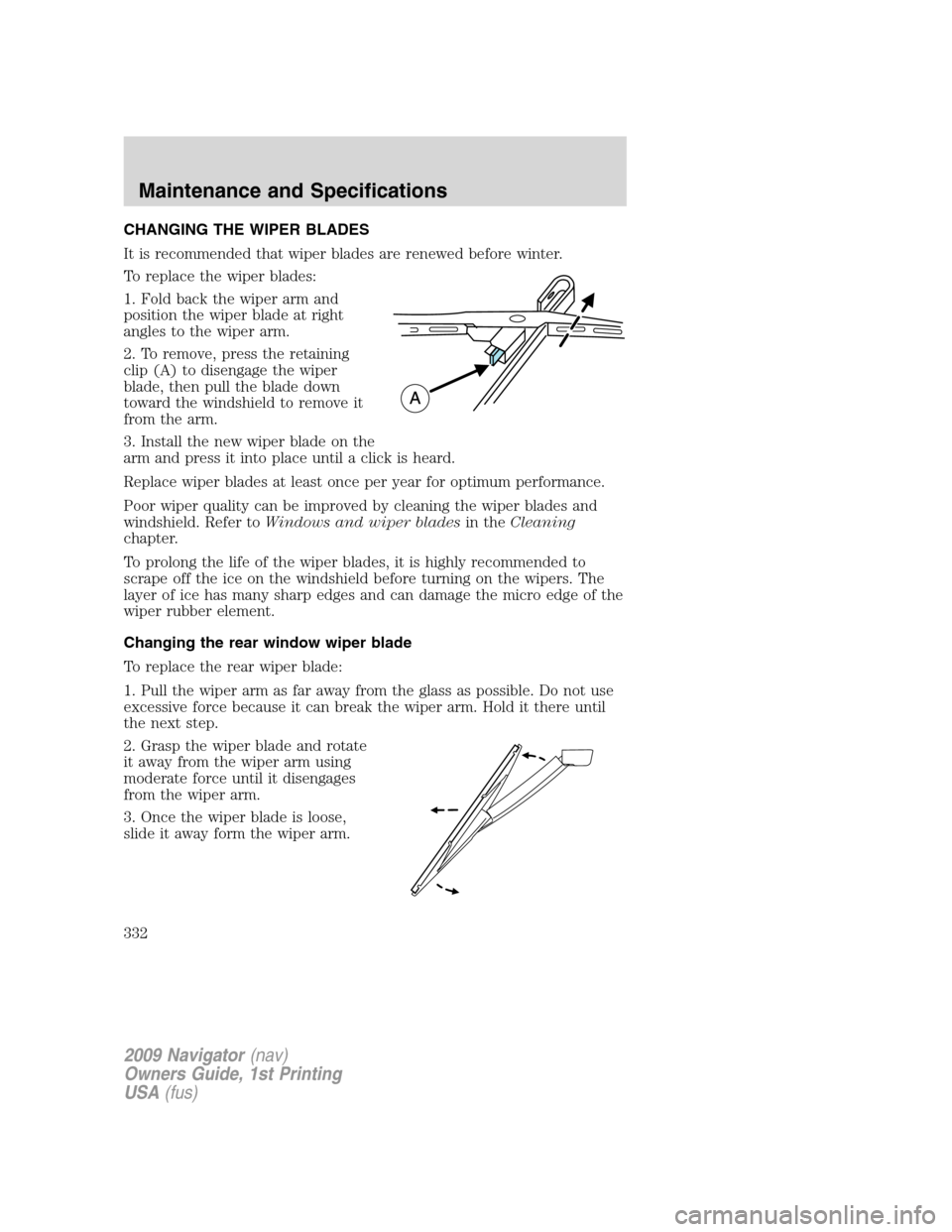
CHANGING THE WIPER BLADES
It is recommended that wiper blades are renewed before winter.
To replace the wiper blades:
1. Fold back the wiper arm and
position the wiper blade at right
angles to the wiper arm.
2. To remove, press the retaining
clip (A) to disengage the wiper
blade, then pull the blade down
toward the windshield to remove it
from the arm.
3. Install the new wiper blade on the
arm and press it into place until a click is heard.
Replace wiper blades at least once per year for optimum performance.
Poor wiper quality can be improved by cleaning the wiper blades and
windshield. Refer toWindows and wiper bladesin theCleaning
chapter.
To prolong the life of the wiper blades, it is highly recommended to
scrape off the ice on the windshield before turning on the wipers. The
layer of ice has many sharp edges and can damage the micro edge of the
wiper rubber element.
Changing the rear window wiper blade
To replace the rear wiper blade:
1. Pull the wiper arm as far away from the glass as possible. Do not use
excessive force because it can break the wiper arm. Hold it there until
the next step.
2. Grasp the wiper blade and rotate
it away from the wiper arm using
moderate force until it disengages
from the wiper arm.
3. Once the wiper blade is loose,
slide it away form the wiper arm.
2009 Navigator(nav)
Owners Guide, 1st Printing
USA(fus)
Maintenance and Specifications
332
Page 350 of 375

If you have run out of fuel:
•You may need to cycle the ignition from off to on several times after
refueling to allow the fuel system to pump the fuel from the tank to
the engine. On restarting, cranking time will take a few seconds longer
than normal.
•Normally, adding 1 gallon (3.8L) of fuel is enough to restart the
engine. If the vehicle is out of fuel and on a steep grade, more than
1 gallon (3.8L) may be required.
•TheService engine soon
indicator may come on. For more
information on the “service engine soon” indicator, refer toWarning
lights and chimesin theInstrument Clusterchapter.
Refilling with a portable fuel container
With the Easy Fuel™ “no cap” fuel system, use the following directions
when filling from a portable fuel container:
WARNING:Do not insert the nozzle of portable fuel containers
or aftermarket funnels into the Easy Fuel™ system. This could
damage the fuel system and its seal, and may cause fuel to run onto
the ground instead of filling the tank, which could result in serious
personal injury.
WARNING:Do not try to pry open or push open the Easy
Fuel™ system with foreign objects. This could damage the fuel
system and its seal and cause injury to you or others.
When filling the vehicle’s fuel tank from a portable fuel container, use the
included funnel.
1. Locate the white plastic funnel. It
is attached to the underside of the
spare tire cover or is included with
the tire changing tools.
2. Slowly insert the funnel into the Easy Fuel™ system.
2009 Navigator(nav)
Owners Guide, 1st Printing
USA(fus)
Maintenance and Specifications
350
Page 353 of 375
![LINCOLN NAVIGATOR 2009 Owners Manual •Sudden or hard accelerations may reduce fuel economy.
•Slow down gradually.
•Driving at reasonable speeds (traveling at 55 mph [88 km/h] uses 15%
less fuel than traveling at 65 mph [105 km/h]).](/manual-img/15/7010/w960_7010-352.png "LINCOLN NAVIGATOR 2009 Owners Manual •Sudden or hard accelerations may reduce fuel economy.
•Slow down gradually.
•Driving at reasonable speeds (traveling at 55 mph [88 km/h] uses 15%
less fuel than traveling at 65 mph [105 km/h]).")
•Sudden or hard accelerations may reduce fuel economy.
•Slow down gradually.
•Driving at reasonable speeds (traveling at 55 mph [88 km/h] uses 15%
less fuel than traveling at 65 mph [105 km/h]).
•Revving the engine before turning it off may reduce fuel economy.
•Using the air conditioner or defroster may reduce fuel economy.
•You may want to turn off the speed control in hilly terrain if
unnecessary shifting between the top gears occurs. Unnecessary
shifting of this type could result in reduced fuel economy.
•Warming up a vehicle on cold mornings is not required and may
reduce fuel economy.
•Resting your foot on the brake pedal while driving may reduce fuel
economy.
•Combine errands and minimize stop-and-go driving.
Maintenance
•Keep tires properly inflated and use only recommended size.
•Operating a vehicle with the wheels out of alignment will reduce fuel
economy.
•Use recommended engine oil. Refer toMaintenance product
specifications and capacitiesin this chapter.
•Perform all regularly scheduled maintenance items. Follow the
recommended maintenance schedule and owner maintenance checks
found inscheduled maintenance information.
Conditions
•Heavily loading a vehicle or towing a trailer may reduce fuel economy
at any speed.
•Carrying unnecessary weight may reduce fuel economy (as much as
1 mpg [0.4 km/L] is lost for every 400 lb [180 kg] of weight carried).
•Adding certain accessories to your vehicle (for example; bug
deflectors, rollbars/light bars, running boards, ski/luggage racks) may
reduce fuel economy.
•Using fuel blended with alcohol may lower fuel economy.
•Fuel economy may decrease with lower temperatures during the first
8–10 miles (12–16 km) of driving.
•Driving on flat terrain offers improved fuel economy as compared to
driving on hilly terrain.
2009 Navigator(nav)
Owners Guide, 1st Printing
USA(fus)
Maintenance and Specifications
353
Page 359 of 375
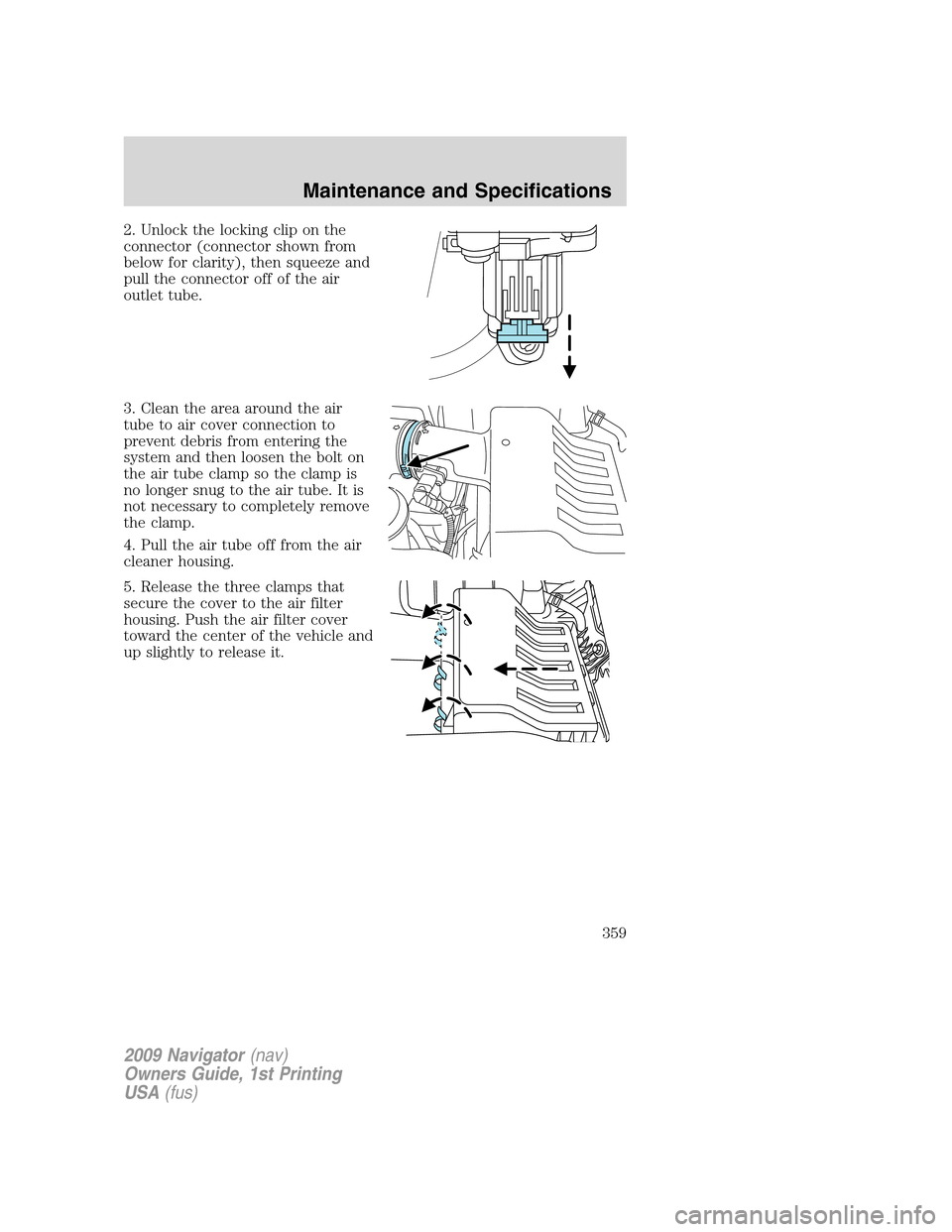
2. Unlock the locking clip on the
connector (connector shown from
below for clarity), then squeeze and
pull the connector off of the air
outlet tube.
3. Clean the area around the air
tube to air cover connection to
prevent debris from entering the
system and then loosen the bolt on
the air tube clamp so the clamp is
no longer snug to the air tube. It is
not necessary to completely remove
the clamp.
4. Pull the air tube off from the air
cleaner housing.
5. Release the three clamps that
secure the cover to the air filter
housing. Push the air filter cover
toward the center of the vehicle and
up slightly to release it.
2009 Navigator(nav)
Owners Guide, 1st Printing
USA(fus)
Maintenance and Specifications
359
Page 362 of 375
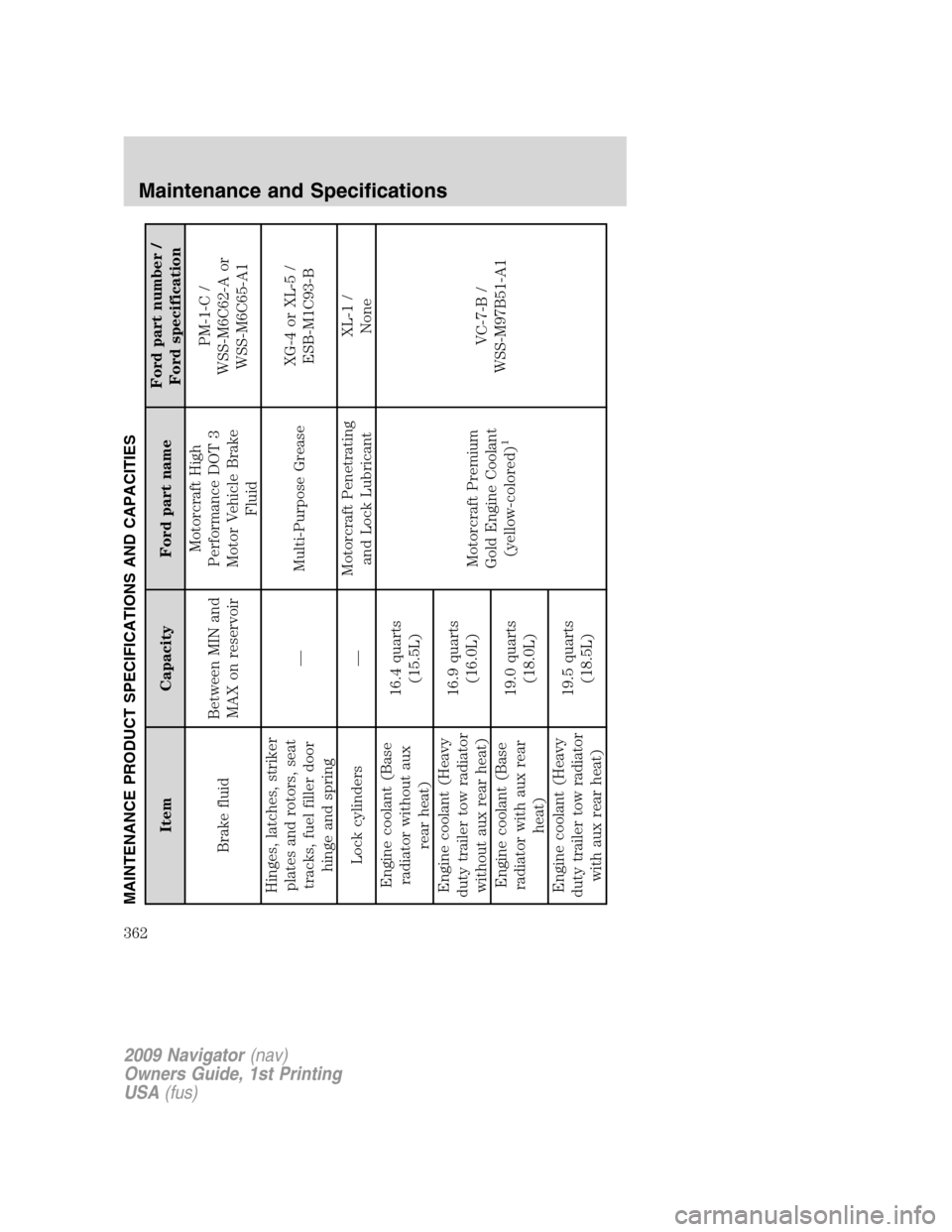
MAINTENANCE PRODUCT SPECIFICATIONS AND CAPACITIES
Item Capacity Ford part nameFord part number /
Ford specification
Brake fluidBetween MIN and
MAX on reservoirMotorcraft High
Performance DOT 3
Motor Vehicle Brake
FluidPM-1-C /
WSS-M6C62-A or
WSS-M6C65-A1
Hinges, latches, striker
plates and rotors, seat
tracks, fuel filler door
hinge and spring— Multi-Purpose GreaseXG-4 or XL-5 /
ESB-M1C93-B
Lock cylinders —Motorcraft Penetrating
and Lock LubricantXL-1 /
None
Engine coolant (Base
radiator without aux
rear heat)16.4 quarts
(15.5L)
Motorcraft Premium
Gold Engine Coolant
(yellow-colored)
1
VC-7-B /
WSS-M97B51-A1 Engine coolant (Heavy
duty trailer tow radiator
without aux rear heat)16.9 quarts
(16.0L)
Engine coolant (Base
radiator with aux rear
heat)19.0 quarts
(18.0L)
Engine coolant (Heavy
duty trailer tow radiator
with aux rear heat)19.5 quarts
(18.5L)
2009 Navigator(nav)
Owners Guide, 1st Printing
USA(fus)
Maintenance and Specifications
362
Page 375 of 375

Starting your vehicle ........250–253
jump starting ..........................305
Steering wheel
controls ....................................104
tilting .........................................88
SYNC ............................................68
T
Tire Pressure Monitoring
System (TPMS)
Driving .....................................281
Tires, Wheels and Loading ....229
Warning Displays ..............12, 119
Tires ...........................214–216, 295
alignment ................................222
care ..........................................219
changing ..........................295, 299
checking the pressure ............219
inflating ...................................217
label .........................................228
replacing ..................................220
rotating ....................................223
safety practices .......................222
sidewall information ...............224
snow tires and chains ............234
spare tire .................................296
terminology .............................216
tire grades ...............................215
treadwear ........................215, 219
Towing .......................................241
recreational towing .................249
trailer towing ..........................241
wrecker ....................................312Transmission .............................266
brake-shift interlock (BSI) ....266
fluid, checking and adding
(automatic) .............................358
fluid, refill capacities ..............362
lubricant specifications ..........362
Turn signal ..................................80
U
USB port ......................................28
V
Vehicle Identification Number
(VIN) ..........................................366
Vehicle loading ..........................235
Ventilating your vehicle ...........254
W
Warning lights (see Lights) .......12
Washer fluid ..............................331
Water, Driving through .............284
Windows
power .........................................94
rear wiper/washer .....................88
Windshield washer fluid and
wipers ..........................................87
checking and adding fluid .....331
liftgate reservoir .....................331
replacing wiper blades ...........332
Wrecker towing .........................312
Index
375