2009 KIA Borrego light
[x] Cancel search: lightPage 282 of 425

Driving your vehicle20
5E170802AHM-EUPart-time 4WD knob operation2H ↔
↔
4H
Turn the transfer knob from the 2H mode
to 4H mode or 4H mode to 2H mode at
the speed below 50 mph (80 km/h). It is
not necessary to put the shift lever into
the N (Neutral) position. Perform this
operation when driving straight. There
will be a few seconds of time delay
before shifting into the desired mode.
If the weather is extremely cold (-15°C/
5°F) and the engine is not heated, trans-
fer from 2H mode to 4H mode when the
vehicle is stopped or at low speed. 4H
↔ ↔
4L
1. Stop the vehicle.
2. Put the shift lever into the N (Neutral) position.
3. Turn the transfer knob to the 4H or 4L position.
4. Before shifting to other ranges from the N (Neutral) position, wait for the
corresponding indicator light to turn on
or off in the cluster.
✽ ✽NOTICEIf the mode is not shifted like the previ-
ous instructions, it will not transfer into
the selected mode and the correspon-
ding indicator light will continuously
blink.
OHM058010N
OHM058011
CAUTION -
4WD
Always check the 4WD shift knob
and cluster to see if the systemhas been activated unintentional-ly.
Do not speed over 80 km/h (50 mph) in the 4H mode and 40 km/h(25 mph) in the 4L mode.
Page 283 of 425

521
Driving your vehicle
Transfer mode Shift knob Indicator lightDescription
This mode is used when driving on normal roads and highway.
The engine power is distributed to all four wheels automatical-
ly without the driver's intervention in accordance with the road
conditions and driving conditions.
This mode is used when driving on slippery roads, such as
snowy and rainy roads at normal speed.
Maximum speed: 80 km/h (50 mph)
This mode is used when increased traction is required, such as
climbing or descending hills, driving off-roads, and towing a
vehicle.
Maximum speed: 40 km/h (25 mph)
4 4 W
W D
D
H
H I
I
4WD HI
4WD
LOW 4
4
W
W D
D
L
L O
O W
W
AUTO
(Automatic
4-wheel drive)
4H
(High-speed
4-wheel drive)
4L
(Low-speed
4-wheel drive) (not illuminated)
✽
✽
NOTICE4WD transfer has a time delay for a few seconds until the actual shift is made after turning the transfer shift knob.
When the 4WD transfer mode is shifted, it may cause mechanical noise. It is not a mechanical f\
ailure but a normal condition.E170900AHM-EUFull-Time 4WD Operation (if equipped)
CAUTION
When you stop the vehicle to transfer the shift knob, wait until the corresponding indicator light turns on or off to
depart. If the vehicle moves before the transfer is completed, the vehicle may be damaged.
(illuminated)
(illuminated)
Page 284 of 425
Driving your vehicle22
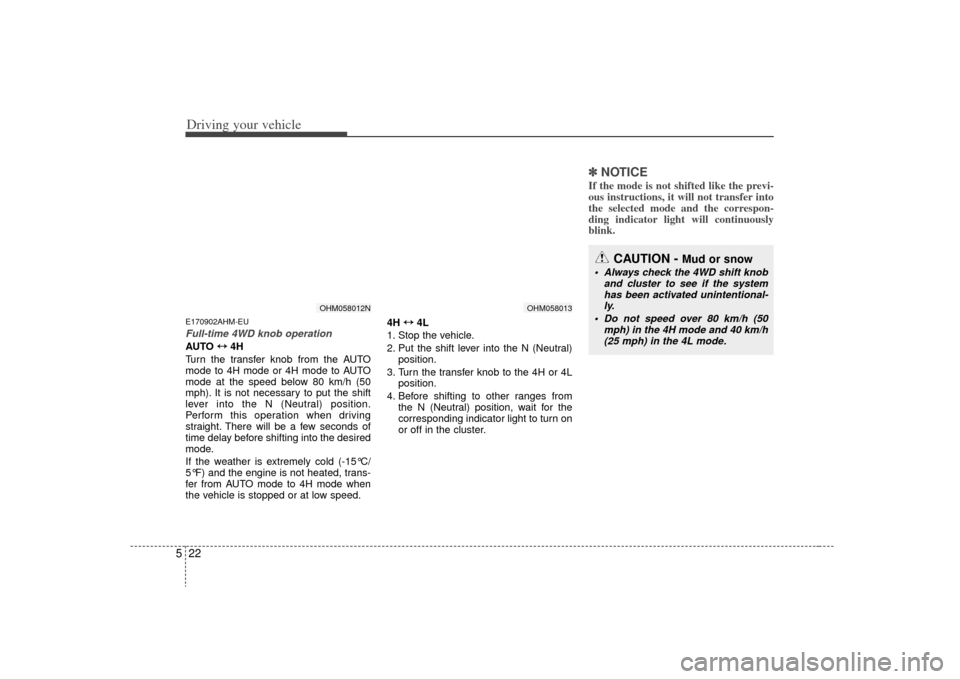
5E170902AHM-EUFull-time 4WD knob operationAUTO ↔
↔
4H
Turn the transfer knob from the AUTO
mode to 4H mode or 4H mode to AUTO
mode at the speed below 80 km/h (50
mph). It is not necessary to put the shift
lever into the N (Neutral) position.
Perform this operation when driving
straight. There will be a few seconds of
time delay before shifting into the desired
mode.
If the weather is extremely cold (-15°C/
5°F) and the engine is not heated, trans-
fer from AUTO mode to 4H mode when
the vehicle is stopped or at low speed. 4H
↔ ↔
4L
1. Stop the vehicle.
2. Put the shift lever into the N (Neutral) position.
3. Turn the transfer knob to the 4H or 4L position.
4. Before shifting to other ranges from the N (Neutral) position, wait for the
corresponding indicator light to turn on
or off in the cluster.
✽ ✽NOTICEIf the mode is not shifted like the previ-
ous instructions, it will not transfer into
the selected mode and the correspon-
ding indicator light will continuously
blink.
OHM058012N
OHM058013
CAUTION -
Mud or snow
Always check the 4WD shift knob
and cluster to see if the systemhas been activated unintentional-ly.
Do not speed over 80 km/h (50 mph) in the 4H mode and 40 km/h(25 mph) in the 4L mode.
Page 285 of 425

523
Driving your vehicle
E170300AHM-ECFor safe four-wheel drive opera-
tion Do not try to drive in deep standingwater or mud since such conditions
can stall your engine and clog your
exhaust pipes. Do not drive down
steep hills since it requires extreme
skill to maintain control of the vehicle. When you are driving up or down hills
drive as straight as possible. Use
extreme caution in going up or down
steep hills, since you may flip your
vehicle over depending on the grade,
terrain and water/mud conditions.
WARNING
- Hills
Driving across the contour of steep
hills can be extremely dangerous.
This danger can come from slight
changes in the wheel angle which
can destabilize the vehicle or, even
if the vehicle is maintaining stabili-
ty under power, it can lose that sta-
bility if the vehicle stops its forward
motion. Your vehicle may roll over
without warning and without time
for you to correct a mistake that
could cause serious injury or
death.
HILL1
HILL2
WARNING
- Four-wheel
driving
The conditions of on-road or off-
road that demand four-wheel drive
mean all functions of your vehicle
are exposed to extreme stress than
under normal road conditions. Slow
down and be ready for changes in
the composition and traction of the
surface under your tires. If you
have any doubt about the safety of
the conditions you are facing, stop
and consider the best way to pro-
ceed. Do not exceed the ability of
yourself or your vehicle to operate
safely.
Page 289 of 425

527
Driving your vehicle
1. Check the tire pressures recommend-ed for your vehicle.
2. Place the rear wheels on the roll tester for a speedometer test as shown in the
illustration.
3. Release the parking brake.
4. Place the front wheels on the tempo- rary free roller as shown in the illustra-
tion.
E070100AHMPower brakesYour vehicle has power-assisted brakes
that adjust automatically through normal
usage.
In the event that the power-assisted
brakes lose power because of a stalled
engine or some other reason, you can
still stop your vehicle by applying greater
force to the brake pedal than you nor-
mally would. The stopping distance, how-
ever, will be longer.
When the engine is not running, the
reserve brake power is partially depleted
each time the brake pedal is applied. Do
not pump the brake pedal when the
power assist has been interrupted.
Pump the brake pedal only when neces-
sary to maintain steering control on slip-
pery surfaces.
WARNING
- Brakes
Do not drive with your foot rest-ing on the brake pedal. This will
create abnormal high brake tem-
peratures, excessive brake lining
and pad wear, and increased
stopping distances.
When descending a long or steep hill, shift to a lower gear and
avoid continuous application of
the brakes. Continuous brake
application will cause the brakes
to overheat and could result in a
temporary loss of braking per-
formance.
Wet brakes may impair the vehi- cle’s ability to safely slow down;
the vehicle may also pull to one
side when the brakes are applied.
Applying the brakes lightly will
indicate whether they have been
affected in this way. Always test
your brakes in this fashion after
driving through deep water. To
dry the brakes, apply them lightly
while maintaining a safe forward
speed until brake performance
returns to normal.
WARNING -
Dynamometer
testing
Keep away from the front of the vehi-
cle while the vehicle is in gear on the
dynamometer. This is very danger-
ous as the vehicle can jump forward
and cause serious injury or death.
OHM058020
Roll tester (speedometer)
Temporary free roller
BRAKE SYSTEM
Page 290 of 425

Driving your vehicle28
5E070101AUNIn the event of brake failure If service brakes fail to operate while the
vehicle is in motion, you can make an
emergency stop with the parking brake.
The stopping distance, however, will be
much greater than normal.
E070102AHMDisc brakes wear indicatorWhen your brake pads are worn and new
pads are required, you will hear a high-
pitched warning sound from your front
brakes or rear brakes. You may hear this
sound come and go or it may occur
whenever you depress the brake pedal.
Please remember that some driving con-
ditions or climates may cause a brake
squeal when you first apply (or lightly
apply) the brakes. This is normal and
does not indicate a problem with your
brakes.
Parking brakeE070201AHMApplying the parking brakeTo engage the parking brake, first apply
the foot brake and then depress the park-
ing brake pedal down as far as possible.
In addition it is recommended that when
parking the vehicle on an incline, the shift
lever should be in the P (Park) position.
WARNING
- Brake wear
This brake wear warning sound
means your vehicle needs service.
If you ignore this audible warning,
you will eventually lose braking
performance, which could lead to a
serious accident.
CAUTION
To avoid costly brake repairs, do
not continue to drive with wornbrake pads.
Always replace the front or rear brake pads as pairs.
CAUTION
Driving with the parking brakeapplied will cause excessive brake pad and brake rotor wear.
OHM058021
WARNING
- Parking brake
Applying the parking brake while
the vehicle is moving at normal
speeds can cause a sudden loss of
control of the vehicle. If you must
use the parking brake to stop the
vehicle, use great caution in apply-
ing the brake.
Page 291 of 425

529
Driving your vehicle
E070202AHMReleasing the parking brakeTo release the parking brake, depress
the parking brake pedal a second time
while applying the foot brake. The pedal
will automatically extend to the fully
released position. If the parking brake
pedal does not release or does not
release all the way, have the system
checked by an authorized KIA dealer.Check the brake warning light by turning
the ignition switch ON (do not start the
engine). This light will be illuminated when
the parking brake is applied with the igni-
tion switch in the START or ON position.
Before driving, be sure the parking brake
is fully released and the brake warning
light is off.
If the brake warning light remains on after
the parking brake is released while the
engine is running, there may be a mal-
function in the brake system. Immediate
attention is necessary.
If at all possible, cease driving the vehi-
cle immediately. If that is not possible,
use extreme caution while operating the
vehicle and only continue to drive the
vehicle until you can reach a safe loca-
tion or repair shop.
WARNING
To prevent unintentional move-
ment when stopped and leaving
the vehicle, do not use the shift
lever in place of the parking
brake. Set the parking brake AND
make sure the shift lever is
securely positioned in P (Park).
Never allow anyone who is unfa- miliar with the vehicle to touch
the parking brake. If the parking
brake is released unintentionally,
serious injury may occur.
All vehicles should always have the parking brake fully engaged
when parking to avoid inadver-
tent movement of the vehicle
which can injure occupants or
pedestrians.
OHM058022
W-75
Page 293 of 425

531
Driving your vehicle
✽
✽NOTICEA click sound may be heard in the
engine compartment when the vehicle
begins to move after the engine is start-
ed. These conditions are normal and
indicate that the anti-lock brake system
is functioning properly. Even with the anti-lock brake system,
your vehicle still requires sufficient
stopping distance. Always maintain a
safe distance from the vehicle in front
of you.
Always slow down when cornering. The anti-lock brake system cannot pre-
vent accidents resulting from exces-
sive speeds.
On loose or uneven road surfaces, operation of the anti-lock brake system
may result in a longer stopping dis-
tance than for vehicles equipped with a
conventional brake system.
✽ ✽ NOTICEWhen you jump start your vehicle
because of a drained battery, the engine
may not run as smoothly and the ABS
warning light may turn on at the same
time. This happens because of low bat-
tery voltage. It does not mean your ABS
is malfunctioned.
• Do not pump your brakes!
• Have the battery recharged before
driving the vehicle.
W-78
CAUTION
If the ABS warning light is on and
stays on, you may have a problemwith the ABS. In this case, howev-er, your regular brakes will worknormally.
The ABS warning light will stay on for approximately 3 seconds afterthe ignition switch is ON. Duringthat time, the ABS will go throughself-diagnosis and the light will gooff if everything is normal. If thelight stays on, you may have aproblem with your ABS. Contactan authorized KIA dealer as soonas possible.
CAUTION
When you drive on a road having poor traction, such as an icy road,and have operated your brakescontinuously, the ABS will be active continuously and the ABSwarning light may illuminate. Pull your car over to a safe place andstop the engine.
Restart the engine. If the ABS warning light goes off, then yourABS system is normal.Otherwise, you may have a prob-lem with the ABS. Contact anauthorized KIA dealer as soon as possible.