Page 86 of 321

Knowing your vehicle74
3Air bag (Supplemental Restraint
System) service Your Supplemental Restraint System is
virtually maintenance-free. There are no
parts which you can service.
You must have the system serviced
under the following circumstances:
If an air bag ever inflates, the air bag
must be replaced. Do not try to remove
or discard the air bag by yourself. This
must be done by an authorized Kia
dealer.
If the air bag warning indicator light alerts you to a problem, have the air
bag system checked as soon as possi-
ble. Otherwise, your air bag system
may be ineffective.
When repairing or scrapping thevehicles Repairing steering wheel, instrument panel, center console or roofs, or
installing car audio around center con-
sole or painting front metal sheet could
disable the air bag system. Have them
checked by an authorized Kia dealer.
When leaving the vehicle at an author- ized Kia dealer, inform the facility that
the vehicle is equipped with an air bag
system, and leave the owner’s manual
in the vehicle.
Since the air bag system contains explosive chemical substances, con-
tact an authorized Kia dealer when
scrapping the vehicle.
WARNING
- No mainte-
nance or repair
Do not modify your steering
wheel, seat or any other part of
the Supplemental Restraint
System. Modification could make
the system inoperable.
Do not work on the system’s com- ponents or wiring. This could
cause the air bags to inflate inad-
vertently, possibly seriously injur-
ing someone. Working on the sys-
tem could also disable the sys-
tem so that the air bags would not
deploy in a collision.
Any work on the SRS system, such as removing, installing,
repairing, or any work on the
steering wheel must be per-
formed by a qualified Kia techni-
cian. Improper handling of the air
bag system may result in serious
personal injury or death.
CAUTION
- No modifica-tion
Do not modify any part of the air
bag system. Modification couldmake the air bag system ineffective or could cause unnecessarydeployment.
Page 87 of 321
375
Knowing your vehicle
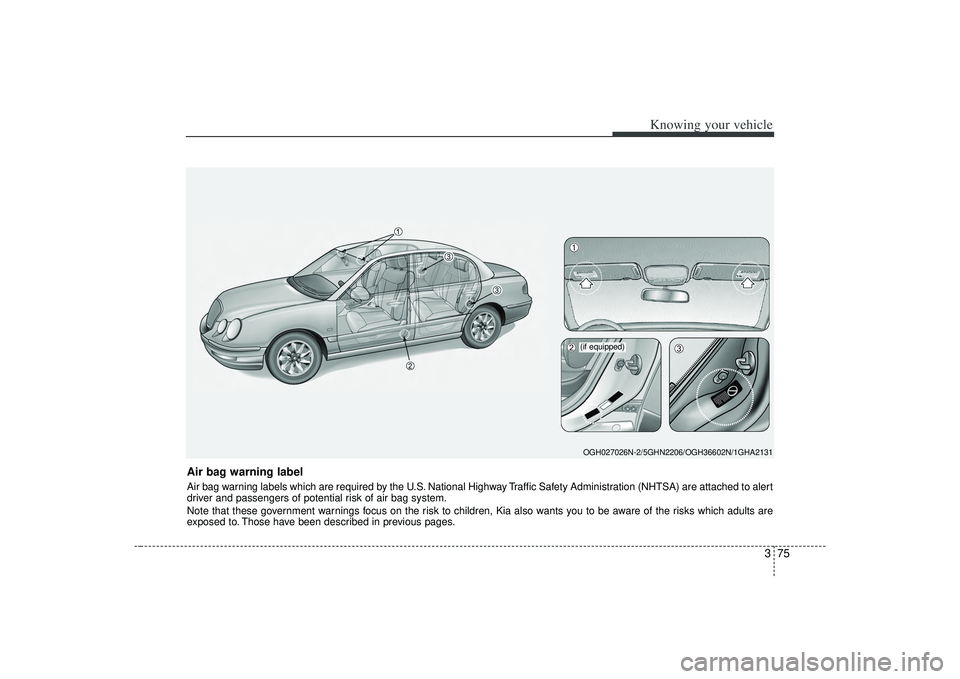
Air bag warning labelAir bag warning labels which are required by the U.S. National Highway Traffic Safety Administration (NHTSA) are attached to alert
driver and passengers of potential risk of air bag system.
Note that these government warnings focus on the risk to children, Kia also wants you to be aware of the risks which adults are
exposed to. Those have been described in previous pages.
OGH027026N-2/5GHN2206/OGH36602N/1GHA2131
➀
➂
➁
(if equipped)
Page 88 of 321

Knowing your vehicle76
3Outside the vehicle To open the trunk, insert the key into
the lock (
➀) and turn it clockwise (
➁).
If the trunk is opened with the key while
all the doors are locked, trunk will be
locked if closed.
To open the trunk, pull up (
➃) the trunk
lid by pressing the button (➂) of the
trunk handle when the trunk is
unlocked. Trunk can be opened by
pressing the button (
➂) of the handle
and pulling up the lid while any door is
unlocked. To close the trunk, use both hands to
push the trunk lid down. Check to see
if the trunk is completely shut. If all the
doors are locked then the trunk will be
locked too.
If the trunk lid control button in the glove box is in the ON position
(depressed), the trunk can be opened
with a transmitter.
If the trunk is opened with the transmit- ter while all the doors are locked, the
trunk will be locked when closed.
Trunk cannot be opened with the sub key.
TRUNK
OGH026007
PROPOSITION 65
WARNING
Engine exhaust and a wide variety
of automobile components and
parts, including components found
in the interior furnishings in a vehi-
cle, contain or emit chemicals
known to the State of California to
cause cancer and birth defects and
reproductive harm. In addition, cer-
tain fluids contained in vehicles
and certain products of component
wear contain or emit chemicals
known to the State of California to
cause cancer and birth defects or
other reproductive harm.
CAUTION
Do not try to open the trunk with thesub key. It may damage the key set.
Page 89 of 321
377
Knowing your vehicle
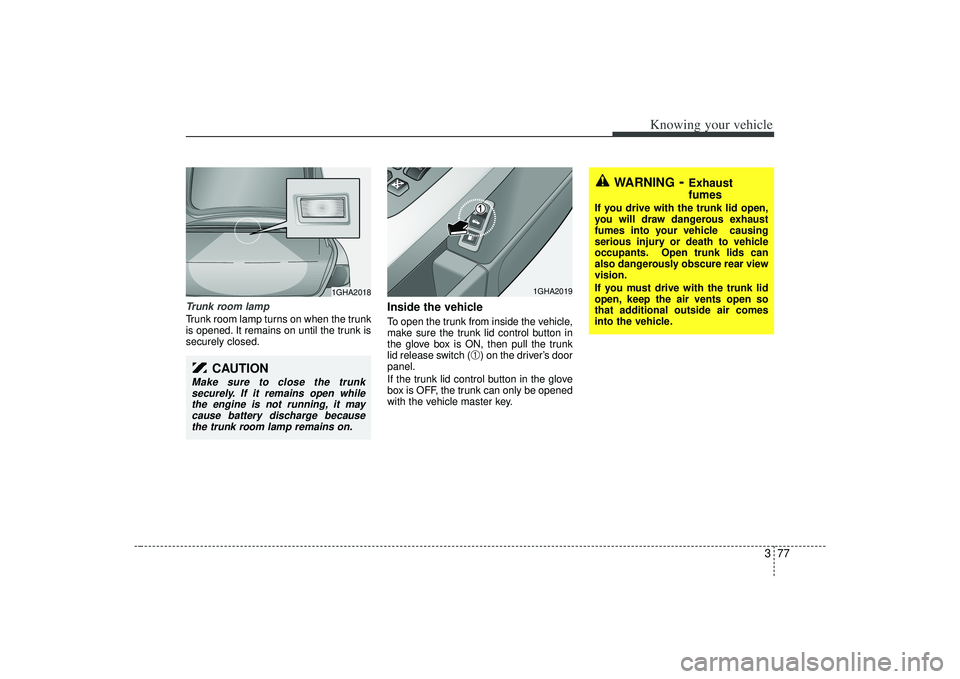
Trunk room lampTrunk room lamp turns on when the trunk
is opened. It remains on until the trunk is
securely closed.
Inside the vehicleTo open the trunk from inside the vehicle,
make sure the trunk lid control button in
the glove box is ON, then pull the trunk
lid release switch (
➀) on the driver’s door
panel.
If the trunk lid control button in the glove
box is OFF, the trunk can only be opened
with the vehicle master key.
WARNING
- Exhaust
fumes
If you drive with the trunk lid open,
you will draw dangerous exhaust
fumes into your vehicle causing
serious injury or death to vehicle
occupants. Open trunk lids can
also dangerously obscure rear view
vision.
If you must drive with the trunk lid
open, keep the air vents open so
that additional outside air comes
into the vehicle.
1GHA2018
CAUTION
Make sure to close the trunk securely. If it remains open while the engine is not running, it maycause battery discharge becausethe trunk room lamp remains on.
1GHA2019
Page 90 of 321
Knowing your vehicle78
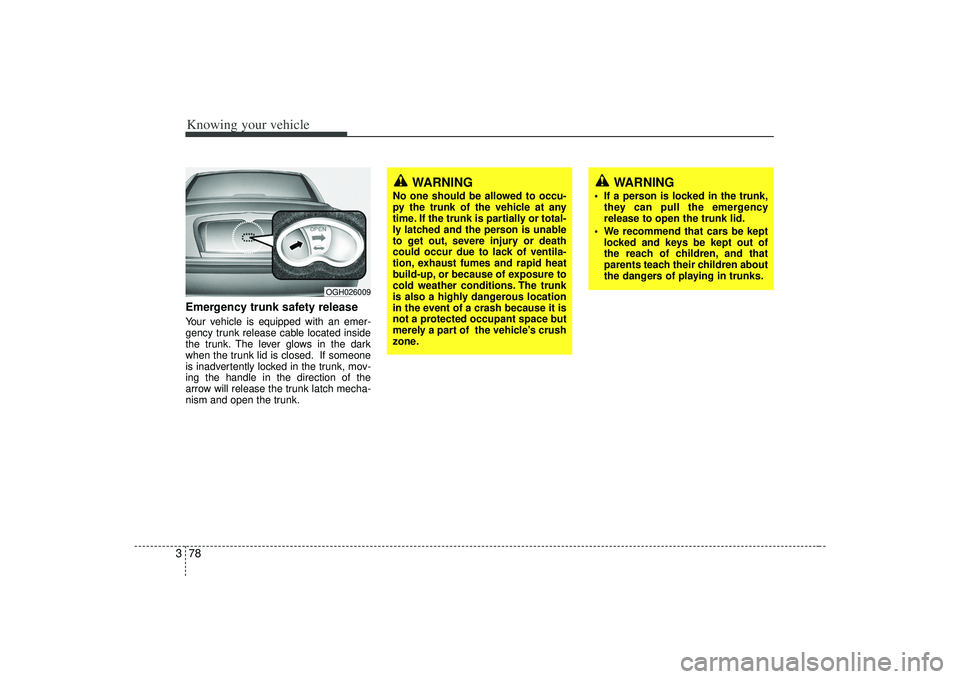
3Emergency trunk safety releaseYour vehicle is equipped with an emer-
gency trunk release cable located inside
the trunk. The lever glows in the dark
when the trunk lid is closed. If someone
is inadvertently locked in the trunk, mov-
ing the handle in the direction of the
arrow will release the trunk latch mecha-
nism and open the trunk.
OGH026009
WARNING
No one should be allowed to occu-
py the trunk of the vehicle at any
time. If the trunk is partially or total-
ly latched and the person is unable
to get out, severe injury or death
could occur due to lack of ventila-
tion, exhaust fumes and rapid heat
build-up, or because of exposure to
cold weather conditions. The trunk
is also a highly dangerous location
in the event of a crash because it is
not a protected occupant space but
merely a part of the vehicle’s crush
zone.
WARNING
If a person is locked in the trunk,
they can pull the emergency
release to open the trunk lid.
We recommend that cars be kept locked and keys be kept out of
the reach of children, and that
parents teach their children about
the dangers of playing in trunks.
Page 92 of 321
Knowing your vehicle80
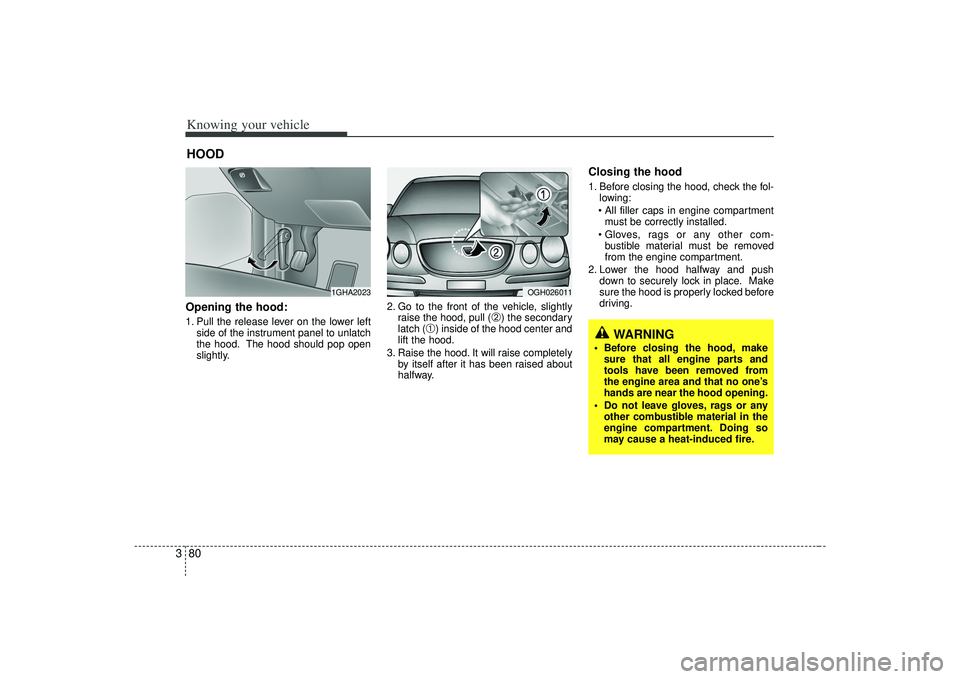
3Opening the hood:1. Pull the release lever on the lower left
side of the instrument panel to unlatch
the hood. The hood should pop open
slightly. 2. Go to the front of the vehicle, slightly
raise the hood, pull (
➁) the secondary
latch (
➀) inside of the hood center and
lift the hood.
3. Raise the hood. It will raise completely by itself after it has been raised about
halfway.
Closing the hood1. Before closing the hood, check the fol-lowing:
must be correctly installed.
bustible material must be removed
from the engine compartment.
2. Lower the hood halfway and push down to securely lock in place. Make
sure the hood is properly locked before
driving.
HOOD
1GHA2023
OGH026011
WARNING
Before closing the hood, makesure that all engine parts and
tools have been removed from
the engine area and that no one’s
hands are near the hood opening.
Do not leave gloves, rags or any other combustible material in the
engine compartment. Doing so
may cause a heat-induced fire.
Page 93 of 321
381
Knowing your vehicle
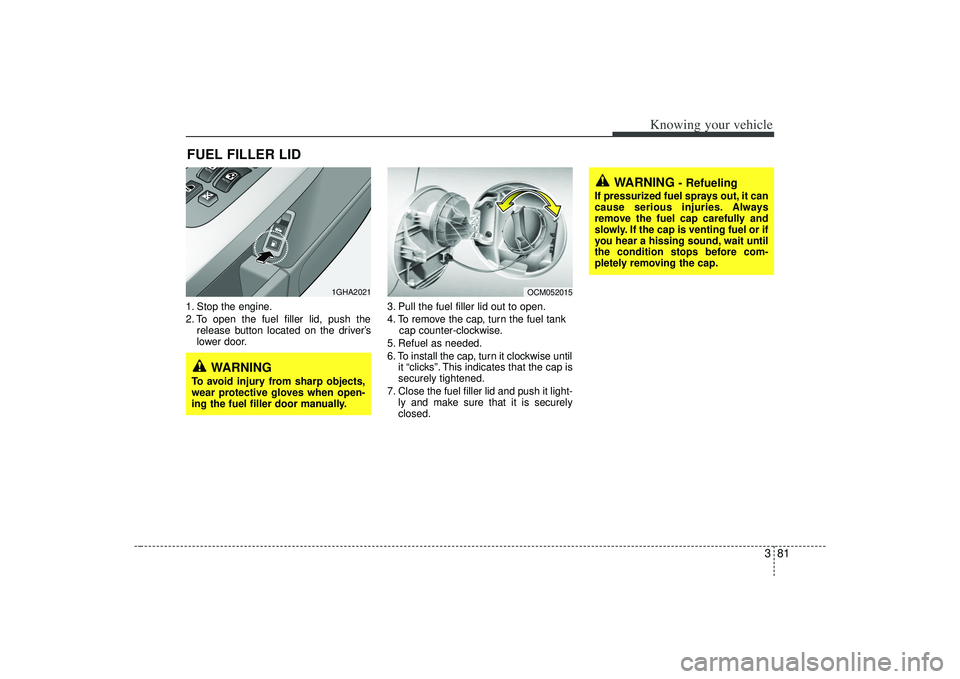
1. Stop the engine.
2. To open the fuel filler lid, push therelease button located on the driver’s
lower door. 3. Pull the fuel filler lid out to open.
4. To remove the cap, turn the fuel tank
cap counter-clockwise.
5. Refuel as needed.
6. To install the cap, turn it clockwise until it “clicks”. This indicates that the cap is
securely tightened.
7. Close the fuel filler lid and push it light- ly and make sure that it is securely
closed.FUEL FILLER LID
1GHA2021
OCM052015
WARNING
To avoid injury from sharp objects,
wear protective gloves when open-
ing the fuel filler door manually.
WARNING
- Refueling
If pressurized fuel sprays out, it can
cause serious injuries. Always
remove the fuel cap carefully and
slowly. If the cap is venting fuel or if
you hear a hissing sound, wait until
the condition stops before com-
pletely removing the cap.
Page 94 of 321
Knowing your vehicle82
3
WARNING
Automotive fuels are flammable/
explosive materials. When refuel-
ing, please note the following
guidelines carefully. Failure to fol-
low these guidelines may result in
severe personal injury, severe
burns or death by fire or explosion.
Before refueling always note the
location of the Emergency
Gasoline Shut-Off, if available, at
the gas station facility.
Note and follow all safety precau-
tions and warning posted at the
facility.
Before touching the fuel nozzle or fuel filler cap, you should elimi-
nate potentially dangerous static
electricity discharge by touching
another metal part of the front of
the vehicle, a safe distance away
from the fuel filler neck, nozzle, or
other gas source.
(Continued)
(Continued)
Do not get back into a vehicleonce you have begun refueling.
Do not touch, rub or slide against
any item or fabric (polyester,
satin, nylon, etc.) capable of pro-
ducing static electricity. Static
electricity discharge can ignite
fuel vapors resulting in explo-
sion. If you must re-enter the
vehicle, you should once again
eliminate potentially dangerous
static electricity discharge by
touching a metal part of the vehi-
cle, away from the fuel filler neck,
nozzle or other gasoline source.
When using a portable fuel con-
tainer be sure to place the contain-
er on the ground prior to refueling.
Static electricity discharge from
the container can ignite fuel vapors
causing a fire. Once refueling has
begun, contact with the vehicle
should be maintained until the fill-
ing is complete. Use only portable
fuel containers designed to carry
and store gasoline.
(Continued)
(Continued)
Do not use cellular phones around a gas station or while
refueling any vehicle. Electric
current and/or electronic interfer-
ence from cellular phones can
potentially ignite fuel vapors
causing a fire. If you must use
your cellular phone use it in a
place away from the gas station.
When refueling always shut the engine off. Sparks produced by
electrical components related to
the engine can ignite fuel vapors
causing a fire. Always insure that
the engine is OFF before and dur-
ing refueling. Once refueling is
complete, check to make sure the
fuel filler cap and door are
securely closed, before starting
the engine.
(Continued)