Page 428 of 506
When adding engine coolant (antifreeze):
•The manufacturer recommends using MOPAR�
Antifreeze/Coolant 5 Year/100,000 Mile Formula
HOAT (Hybrid Organic Additive Technology).
•Mix a minimum solution of 50% HOAT engine coolant
(antifreeze) and distilled water. Use higher concentra-
tions (not to exceed 70%) if temperatures below �34°F
(�37°C) are anticipated.
•Use only high purity water such as distilled or deion-
ized water when mixing the water/engine coolant
(antifreeze) solution. The use of lower quality water
will reduce the amount of corrosion protection in the
engine cooling system. Please note that it is the owner’s responsibility to main-
tain the proper level of protection against freezing ac-
cording to the temperatures occurring in the area where
the vehicle is operated.
NOTE:
Mixing engine coolant (antifreeze) types will
decrease the life of the engine coolant (antifreeze) and
will require more frequent engine coolant (antifreeze)
changes.Cooling System Pressure Cap
The cap must be fully tightened to prevent loss of
coolant, and to ensure that coolant will return to the
radiator from the coolant recovery bottle.
The cap should be inspected and cleaned if there is any
accumulation of foreign material on the sealing surfaces.
426 MAINTAINING YOUR VEHICLE
Page 438 of 506
•If insects, tar, or other similar deposits have accumu-
lated on your vehicle, use MOPAR�Super Kleen Bug
and Tar Remover to remove.
•Use MOPAR� Cleaner Wax to remove road film,
stains, and to protect your paint finish. Take care never
to scratch the paint.
•Avoid using abrasive compounds and power buffing
that may diminish the gloss or thin out the paint
finish.
CAUTION!
•Do not use abrasive or strong cleaning materials
such as steel wool or scouring powder, which will
scratch metal and painted surfaces.
•Use of power washers exceeding 1,200 psi
(8 274 kPa) can result in damage or removal of
paint and decals.
Special Care
•
If you drive on salted or dusty roads or if you drive
near the ocean, hose off the undercarriage at least once
a month.
•It is important that the drain holes in the lower edges
of the doors, rocker panels, and tailgate must be kept
clear and open.
•If you detect any stone chips or scratches in the paint,
touch them up immediately. The cost of such repairs is
considered the responsibility of the owner.
•If your vehicle is damaged due to an accident or
similar cause, which destroys the paint and protective
coating, have your vehicle repaired as soon as pos-
sible. The cost of such repairs is considered the respon-
sibility of the owner.
436 MAINTAINING YOUR VEHICLE
Page 439 of 506
•If you carry special cargo such as chemicals, fertilizers,
de-icer salt, etc., assure that such materials are well
packaged and sealed.
•If a lot of driving is done on gravel roads, consider
mud or stone shields behind each wheel.
•Use MOPAR�Touch Up Paint or equivalent on
scratches or chips as soon as possible. Your authorized
dealer has touch up paint to match the color of your
vehicle.
Wheel and Wheel Trim Care
All wheels and wheel trim, especially aluminum and
chrome-plated wheels should be cleaned regularly with
mild soap and water to prevent corrosion. To remove
heavy soil and/or excessive brake dust, use MOPAR �
Wheel Cleaner or select a nonabrasive, non-acidic
cleaner. Do not use scouring pads, steel wool, a bristle
brush, or metal polishes. Only MOPAR� cleaners are
recommended. Do not use oven cleaner. Avoid automatic car washes that use acidic solutions or harsh brushes that
may damage the wheels’ protective finish.
Stain Repel Fabric Cleaning Procedure — If
Equipped
You can identify if your vehicle has Stain Repel Seat
Fabric that makes spills easy to clean, reduces odor from
spills and reduces static by the presence of a tag on the
side of the seat.
Stain Repel seats may be cleaned in the following man-
ner:
•Remove as much of the stain as possible by blotting
with a clean, dry towel.
•Blot any remaining stain with a clean, damp towel.
•For tough stains, apply MOPAR�
Total Clean or a mild
soap solution to a clean, damp cloth and remove the
stain. Use a fresh, damp towel to remove soap residue.
MAINTAINING YOUR VEHICLE 437
7
Page 441 of 506
WARNING!
Do not use volatile solvents for cleaning purposes.
Many are potentially flammable, and if used in
closed areas they may cause respiratory harm.
Cleaning Headlights
Your vehicle has plastic headlights that are lighter and
less susceptible to stone breakage than glass headlights.
Plastic is not as scratch resistant as glass and therefore
different lens cleaning procedures must be followed.
To minimize the possibility of scratching the lenses and
reducing light output, avoid wiping with a dry cloth. To
remove road dirt, wash with a mild soap solution fol-
lowed by rinsing.
Do not use abrasive cleaning components, solvents, steel
wool or other aggressive material to clean the lenses.
Glass Surfaces
All glass surfaces should be cleaned on a regular basis
with MOPAR�Glass Cleaner or any commercial
household-type glass cleaner. Never use an abrasive type
cleaner. Use caution when cleaning the inside rear win-
dow equipped with electric defrosters or the right rear
quarter window equipped with the radio antenna. Do
not use scrapers or other sharp instruments, which may
scratch the elements.
When cleaning the rear view mirror, spray cleaner on the
towel or rag that you are using. Do not spray cleaner
directly on the mirror.
Cleaning Plastic Instrument Cluster Lenses
The lenses in front of the instruments in this vehicle are
molded in clear plastic. When cleaning the lenses, care
must be taken to avoid scratching the plastic.
MAINTAINING YOUR VEHICLE 439
7
Page 443 of 506
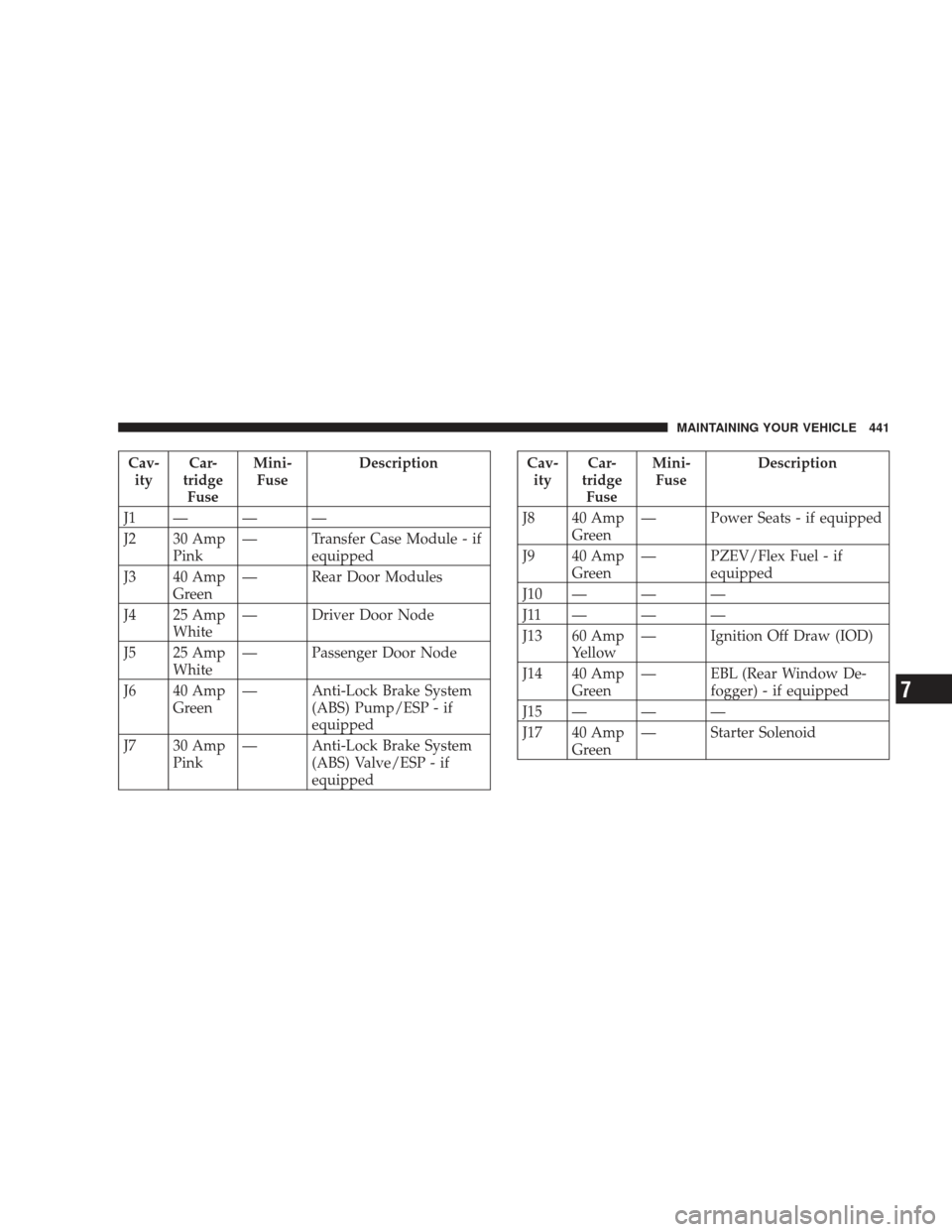
Cav-ity Car-
tridge Fuse Mini-
Fuse Description
J1 — — —
J2 30 Amp Pink — Transfer Case Module - if
equipped
J3 40 Amp Green — Rear Door Modules
J4 25 Amp White — Driver Door Node
J5 25 Amp White — Passenger Door Node
J6 40 Amp Green — Anti-Lock Brake System
(ABS) Pump/ESP - if
equipped
J7 30 Amp Pink — Anti-Lock Brake System
(ABS) Valve/ESP - if
equippedCav-ity Car-
tridge Fuse Mini-
Fuse Description
J8 40 Amp Green — Power Seats - if equipped
J9 40 Amp Green — PZEV/Flex Fuel - if
equipped
J10 — — —
J11 — — —
J13 60 Amp Yellow — Ignition Off Draw (IOD)
J14 40 Amp Green — EBL (Rear Window De-
fogger) - if equipped
J15 — — —
J17 40 Amp Green — Starter Solenoid
MAINTAINING YOUR VEHICLE 441
7
Page 447 of 506
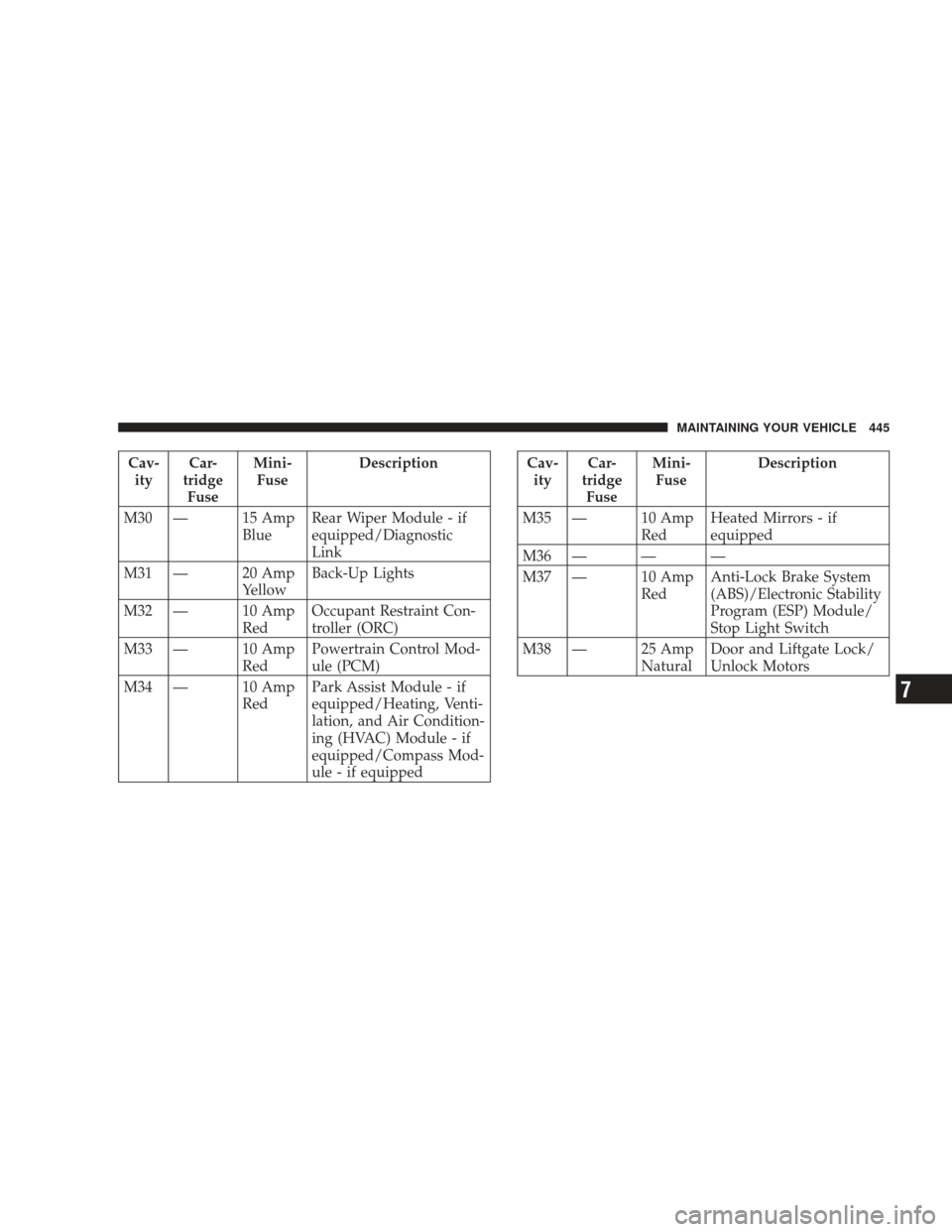
Cav-ity Car-
tridge Fuse Mini-
Fuse Description
M30 — 15 Amp BlueRear Wiper Module - if
equipped/Diagnostic
Link
M31 — 20 Amp YellowBack-Up Lights
M32 — 10 Amp RedOccupant Restraint Con-
troller (ORC)
M33 — 10 Amp RedPowertrain Control Mod-
ule (PCM)
M34 — 10 Amp RedPark Assist Module - if
equipped/Heating, Venti-
lation, and Air Condition-
ing (HVAC) Module - if
equipped/Compass Mod-
ule - if equippedCav-
ity Car-
tridge Fuse Mini-
Fuse Description
M35 — 10 Amp RedHeated Mirrors - if
equipped
M36 — — —
M37 — 10 Amp RedAnti-Lock Brake System
(ABS)/Electronic Stability
Program (ESP) Module/
Stop Light Switch
M38 — 25 Amp NaturalDoor and Liftgate Lock/
Unlock Motors
MAINTAINING YOUR VEHICLE 445
7
Page 475 of 506
Customer Assistance For The Hearing Or Speech
Impaired (TDD/TTY)
To assist customers who have hearing difficulties, the
manufacturer has installed special TDD (Telecommuni-
cation Devices for the Deaf) equipment at its customer
center. Any hearing or speech impaired customer, who
has access to a TDD or a conventional teletypewriter
(TTY) in the United States, can communicate with the
manufacturer by dialing 1–800–380–CHRY.
Service Contract
You may have purchased a service contract for a vehicle
to help protect you from the high cost of unexpected
repairs after the manufacturer’s New Vehicle Limited
Warranty expires. The manufacturer stands behind only
the manufacturer’s service contracts. If you purchased a
manufacturer’s service contract, you will receive Plan
Provisions and an Owner Identification Card in the mail
within three weeks of the vehicle delivery date. If youhave any questions about the service contract, call the
manufacturer’s Service Contract National Customer Hot-
line at 1-800-521-9922.
The manufacturer will not stand behind any service
contract that is not the manufacturer’s service contract. It
is not responsible for any service contract other than the
manufacturer’s service contract. If you purchased a ser-
vice contract that is not a manufacturer’s service contract,
and you require service after the manufacturer’s New
Vehicle Limited Warranty expires, please refer to the
contract documents, and contact the person listed in
those documents.
We appreciate that you have made a major investment
when you purchased the vehicle. An authorized dealer
has also made a major investment in facilities, tools, and
training to assure that you are absolutely delighted with
IF YOU NEED CONSUMER ASSISTANCE 473
9
Page 480 of 506
Temperature Grades
The temperature grades are A (the highest), B, and C,
representing the tire’s resistance to the generation of heat
and its ability to dissipate heat, when tested under
controlled conditions on a specified indoor laboratory
test wheel. Sustained high temperature can cause the
material of the tire to degenerate and reduce tire life, and
excessive temperature can lead to sudden tire failure. The
grade C corresponds to a level of performance, which all
passenger car tires must meet under the Federal Motor
Vehicle Safety Standard No. 109. Grades B and A repre-
sent higher levels of performance on the laboratory test
wheel, than the minimum required by law.WARNING!
The temperature grade for this tire is established for
a tire that is properly inflated and not overloaded.
Excessive speed, under-inflation, or excessive load-
ing, either separately or in combination, can cause
heat buildup and possible tire failure.
478 IF YOU NEED CONSUMER ASSISTANCE