Page 54 of 506
WARNING!
•The belt and retractor assembly must be replaced
if the seat belt assembly “automatic locking retrac-
tor” feature or any other seat belt function is not
working properly when checked according to the
procedures in the Service Manual.
•Failure to replace the belt and retractor assembly
could increase the risk of injury in collisions.
Seat Belts and Pregnant Women
We recommend that pregnant women use the seat belts
throughout their pregnancy. Keeping the mother safe is
the best way to keep the baby safe.
Pregnant women should wear the lap part of the belt
across the thighs and as snug across the hips as possible.
Keep the belt low so that it does not come across the
abdomen. That way the strong bones of the hips will take
the force if there is a collision.
Seat Belt Extender
If a seat belt is too short, even when fully extended, and
when the adjustable upper shoulder belt anchorage (if so
equipped) is in its lowest position, your authorized
dealer can provide you with a seat belt extender. This
extender should be used only if the existing belt is not
long enough. When it is not required, remove the ex-
tender, and store it.
WARNING!
Using a seat belt extender when not needed can
increase the risk of injury in a collision. Only use
when the lap belt is not long enough when it is worn
low and snug, and in the recommended seating
positions. Remove and store the extender when not
needed.
52 THINGS TO KNOW BEFORE STARTING YOUR VEHICLE
Page 57 of 506
WARNING!
•Do not put anything on or around the front and
side curtain airbag covers or attempt to manually
open them. You may damage the airbags and you
could be injured because the airbags are no longer
functional. These protective covers for the airbag
cushions are designed to open only when the
airbags are inflating.
•Do not stack luggage or other cargo up high
enough to block the location of the side curtain
airbag. The area where the side curtain airbag is
located should remain free from any obstructions.(Continued)
WARNING! (Continued)
•Do not have any accessory items installed which
will alter the roof, including adding a sunroof to
your vehicle. Do not add roof racks that require
permanent attachments (bolts or screws) for instal-
lation on the vehicle roof. Do not drill into the roof
of the vehicle for any reason.
•Do not cover or place items on the airbag covers.
These items may cause serious injury during
inflation.
Along with the seat belts, the front airbags provide
improved protection for the driver and front passenger.
Side Curtain Airbags also work with seat belts to im-
prove occupant protection.
The seat belts are designed to protect you in many types
of collisions. The front airbags deploy in moderate-to-
severe collisions. The Side Curtain Airbag will also
THINGS TO KNOW BEFORE STARTING YOUR VEHICLE 55
2
Page 61 of 506
The ORC also monitors the readiness of the electronic
parts of the system whenever the ignition switch is in
the START or ON position. These include all of the
items listed above except the Passenger Airbag Disable
(PAD) Indicator Light, the instrument panel, and the
steering wheel and column. If the key is in the LOCK
position, in the ACC position, or not in the ignition,
the airbags are not on and they will not inflate.
•The ORC also turns on the “Airbag Warning
Light” and “PAD Indicator Light” for six to
eight seconds as a self-check when the igni-
tion is first turned ON. After the self-check,
the “Airbag Warning Light” will turn off. The “PAD
Indicator Light” will function normally (refer to infor-
mation on Passenger Airbag Disable (PAD) Indicator
Light in this section). If the ORC detects a malfunction
in any part of the system, it turns on the “Airbag Warning Light” either momentarily or continuously. A
single chime will sound if the light comes on again
after initial startup.
WARNING!
Ignoring the “Airbag Warning Light” in your instru-
ment panel could mean you won’t have the airbags to
protect you in a collision. If the light does not come
on, stays on after you start the vehicle, or if it comes
on as you drive, have the airbag system checked right
away.
•The
Occupant Classification System (OCS) is part of
a Federally regulated safety system required for this
vehicle. It is designed to turn off the front passenger
airbag for an empty seat and for occupants classified
in a category other than that of an adult. This could be
a child, teenager, or even a small size adult.
THINGS TO KNOW BEFORE STARTING YOUR VEHICLE 59
2
Page 68 of 506
throat irritation, move to fresh air. If the irritation
continues, see your doctor. If these particles settle on
your clothing, follow the garment manufacturer’s in-
structions for cleaning.
•It is not advisable to drive your vehicle after the
airbags have deployed. If you are involved in another
collision, the airbags will not be in place to protect you.
WARNING!
Deployed airbags and seat belt pretensioners cannot
protect you in another collision. Have the airbags,
seat belt pretensioner, and seat belt retractor assem-
bly replaced by an authorized dealer as soon as
possible. Also, have the Occupant Classification Sys-
tem serviced as well.
Enhanced Accident Response System
In the event of an impact that causes airbag deployment,
with the vehicle stopped, the vehicle communication
network intact, and the power intact, the Enhanced
Accident Response System performs the following func-
tions:
•Cuts off fuel to the engine.
•Flashes hazard lights.
•Turns on the interior lights, which remain on as long as
the battery has power or until the ignition key is
removed.
•Unlocks the doors automatically.
NOTE: The interior lights can only be deactivated if the
key is removed from the ignition switch or the vehicle is
driven.
66 THINGS TO KNOW BEFORE STARTING YOUR VEHICLE
Page 80 of 506
WARNING!
Improper installation of a child restraint to the
LATCH anchorages can lead to failure of an infant or
child restraint. The child could be badly injured or
killed. Follow the manufacturer’s directions exactly
when installing an infant or child restraint.
Installing Child Restraints Using the Vehicle Seat
Belt
The passenger seat belts are equipped with either cinch-
ing latch plates or automatic locking retractors, which are
designed to keep the lap portion tight around the child
restraint so that it is not necessary to use a locking clip. If
the seat belt has a cinching latch plate, pulling up on the
shoulder portion of the lap/shoulder belt will tighten the
belt. However, any seat belt system may loosen with
time, so check the belt occasionally, and pull it tight if
necessary.If the seat belt has an automatic locking retractor, pull the
belt from the retractor until there is enough slack to allow
you to pass the belt through the child restraint and slide
the latch plate into the buckle. Then, pull the belt until it
is all extracted from the retractor. Allow the belt to return
to the retractor, pulling on the excess webbing to tighten
the lap portion around the child restraint. Refer to
“Automatic Locking Mode” earlier in this section.
In the rear seat, you may have trouble tightening the
lap/shoulder belt on the child restraint because the
buckle or latch plate is too close to the belt path opening
on the restraint. Disconnect the latch plate from the
buckle and twist the short buckle-end belt several times
to shorten it. Insert the latch plate into the buckle with the
RELEASE button facing out.
If the belt still can’t be tightened, or if pulling and
pushing on the restraint loosens the belt, you may need
to do something more. Disconnect the latch plate from
78 THINGS TO KNOW BEFORE STARTING YOUR VEHICLE
Page 85 of 506
Airbag Warning Light
The light should come on and remain on for six to eight
seconds as a bulb check when the ignition switch is first
turned ON. If the light is not lit during starting, see your
authorized dealer. If the light stays on, flickers, or comes
on while driving, have the system checked by an autho-
rized dealer.
Defroster
Check operation by selecting the defrost mode and place
the blower control on high speed. You should be able to
feel the air directed against the windshield. See your
authorized dealer for service if your defroster is
inoperable.
Periodic Safety Checks You Should Make Outside
the Vehicle
Tires
Examine tires for excessive tread wear and uneven wear
patterns. Check for stones, nails, glass, or other objectslodged in the tread. Inspect the tread and sidewall for
cuts and cracks. Check the wheel nuts for tightness.
Check the tires (including spare) for proper pressure.
Lights
Have someone observe the operation of exterior lights
while you work the controls. Check turn signal and high
beam indicator lights on the instrument panel.
Door Latches
Check for positive closing, latching, and locking.
Fluid Leaks
Check area under vehicle after overnight parking for fuel,
engine coolant, oil, or other fluid leaks. Also, if gasoline
fumes are detected or if fuel, power steering fluid, or
brake fluid leaks are suspected, the cause should be
located and corrected immediately.
THINGS TO KNOW BEFORE STARTING YOUR VEHICLE 83
2
Page 95 of 506
Heated Mirrors — If Equipped
These mirrors are heated to melt frost or ice. This
feature is activated whenever you turn on the rear
window defroster. Refer to “Rear Window Features” in
this section, for further information.
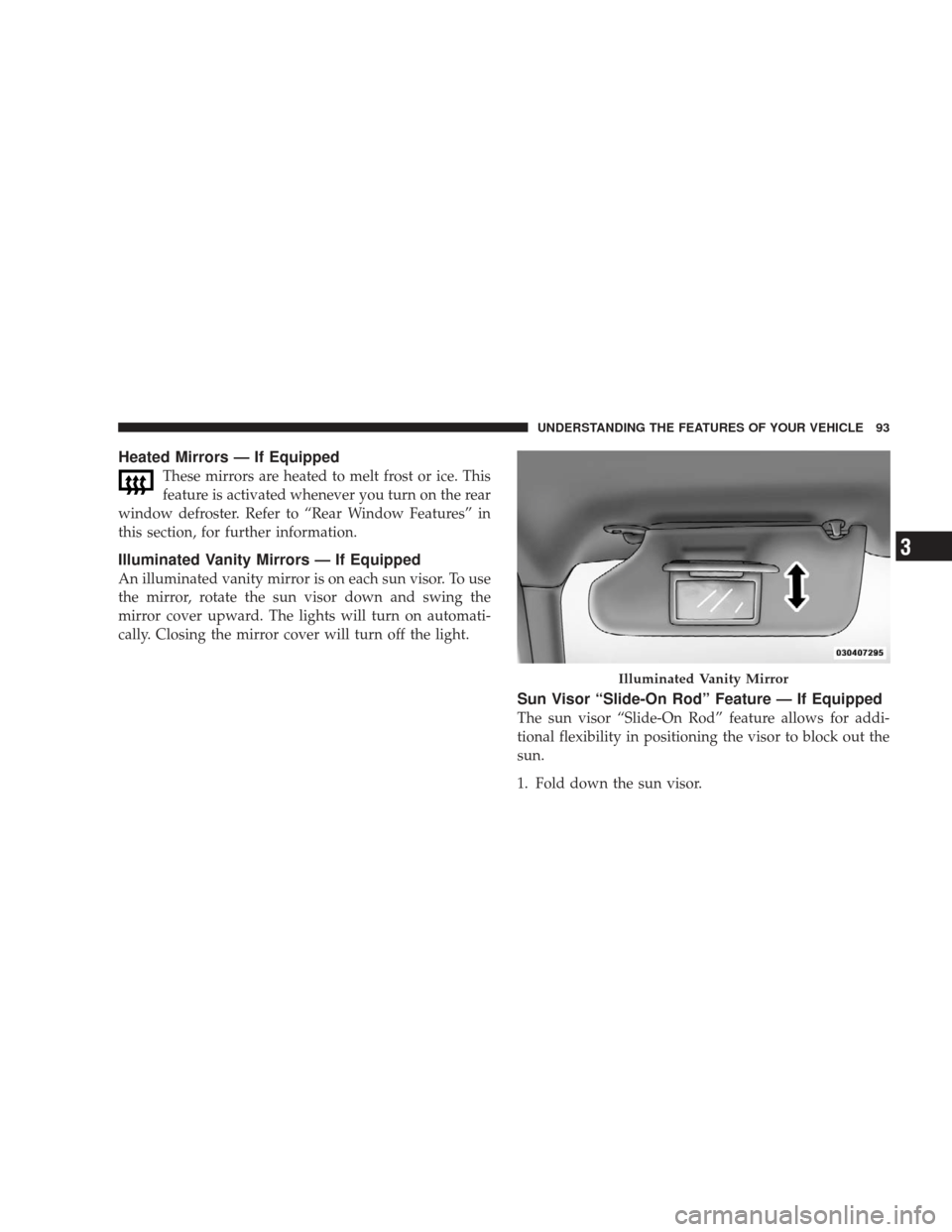
Illuminated Vanity Mirrors — If Equipped
An illuminated vanity mirror is on each sun visor. To use
the mirror, rotate the sun visor down and swing the
mirror cover upward. The lights will turn on automati-
cally. Closing the mirror cover will turn off the light.
Sun Visor “Slide-On Rod” Feature — If Equipped
The sun visor “Slide-On Rod” feature allows for addi-
tional flexibility in positioning the visor to block out the
sun.
1. Fold down the sun visor.
Illuminated Vanity Mirror
UNDERSTANDING THE FEATURES OF YOUR VEHICLE 93
3
Page 133 of 506
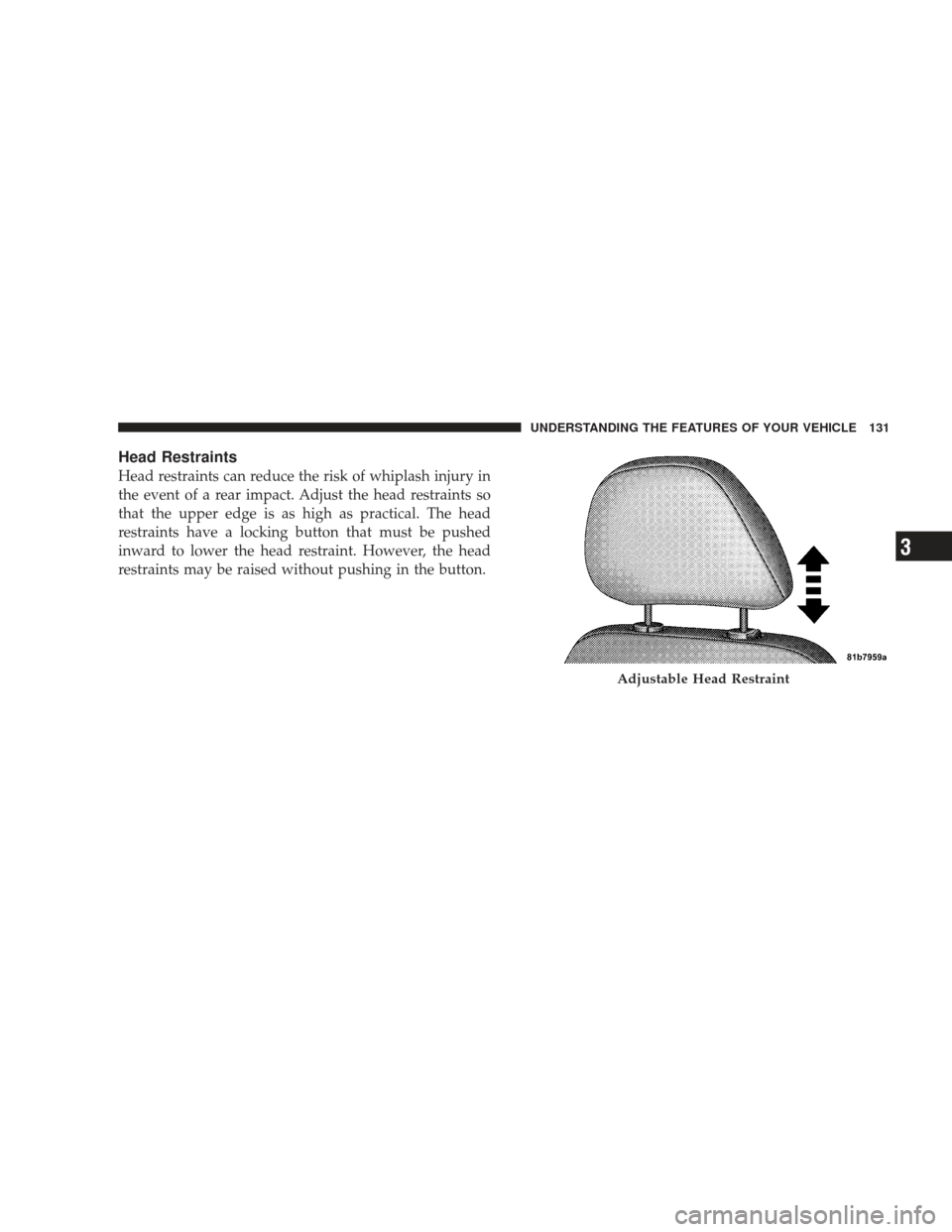
Head Restraints
Head restraints can reduce the risk of whiplash injury in
the event of a rear impact. Adjust the head restraints so
that the upper edge is as high as practical. The head
restraints have a locking button that must be pushed
inward to lower the head restraint. However, the head
restraints may be raised without pushing in the button.
Adjustable Head Restraint
UNDERSTANDING THE FEATURES OF YOUR VEHICLE 131
3