Page 39 of 506
For vehicles not equipped with the Electronic Vehicle
Information Center (EVIC), the power window switches
will remain active for 45 seconds after the ignition switch
is turned to the LOCK position. Opening either front
door will cancel this feature.
For vehicles equipped with the EVIC, the power window
switches will remain active for up to 10 minutes after the
ignition switch is turned to the LOCK position. Opening
either front door will cancel this feature. The time is
programmable. For details, refer to “Delay Power Off to
Accessories Until Exit,” under “Personal Settings
(Customer-Programmable Features)” in the “Electronic
Vehicle Information Center (EVIC),” in Section 4 of this
manual.NOTE:
•If the window runs into any obstacle during auto-
closure, it will reverse direction and then go back
down. Remove the obstacle and use the window
switch again to close the window.
•Any impact due to rough road conditions may trigger
the auto reverse function unexpectedly during auto-
closure. If this happens, pull the switch lightly to the
first detent and hold to close window manually.
WARNING!
There is no anti-pinch protection when the window
is almost closed. Be sure to clear all objects from the
window before closing.
THINGS TO KNOW BEFORE STARTING YOUR VEHICLE 37
2
Page 40 of 506
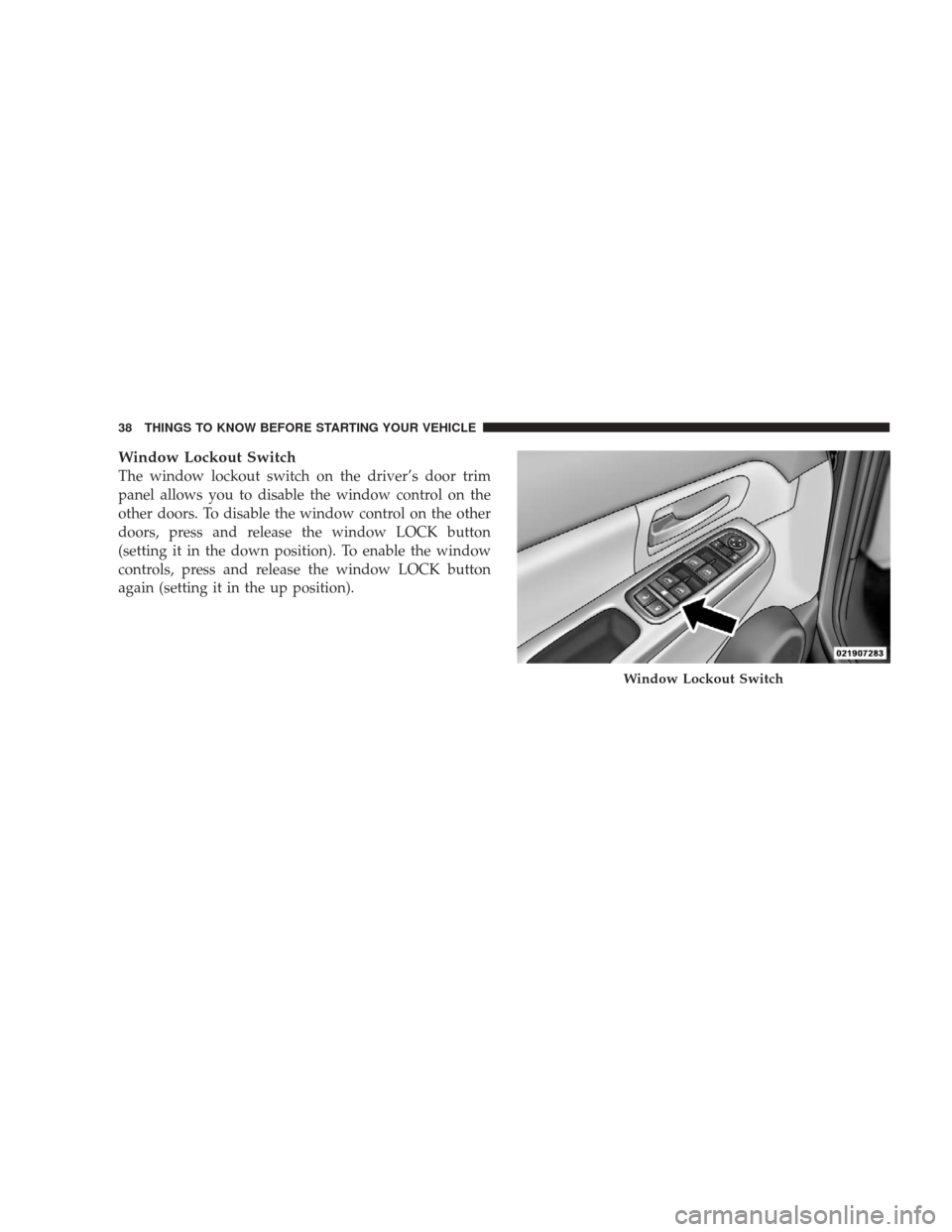
Window Lockout Switch
The window lockout switch on the driver’s door trim
panel allows you to disable the window control on the
other doors. To disable the window control on the other
doors, press and release the window LOCK button
(setting it in the down position). To enable the window
controls, press and release the window LOCK button
again (setting it in the up position).
Window Lockout Switch
38 THINGS TO KNOW BEFORE STARTING YOUR VEHICLE
Page 42 of 506
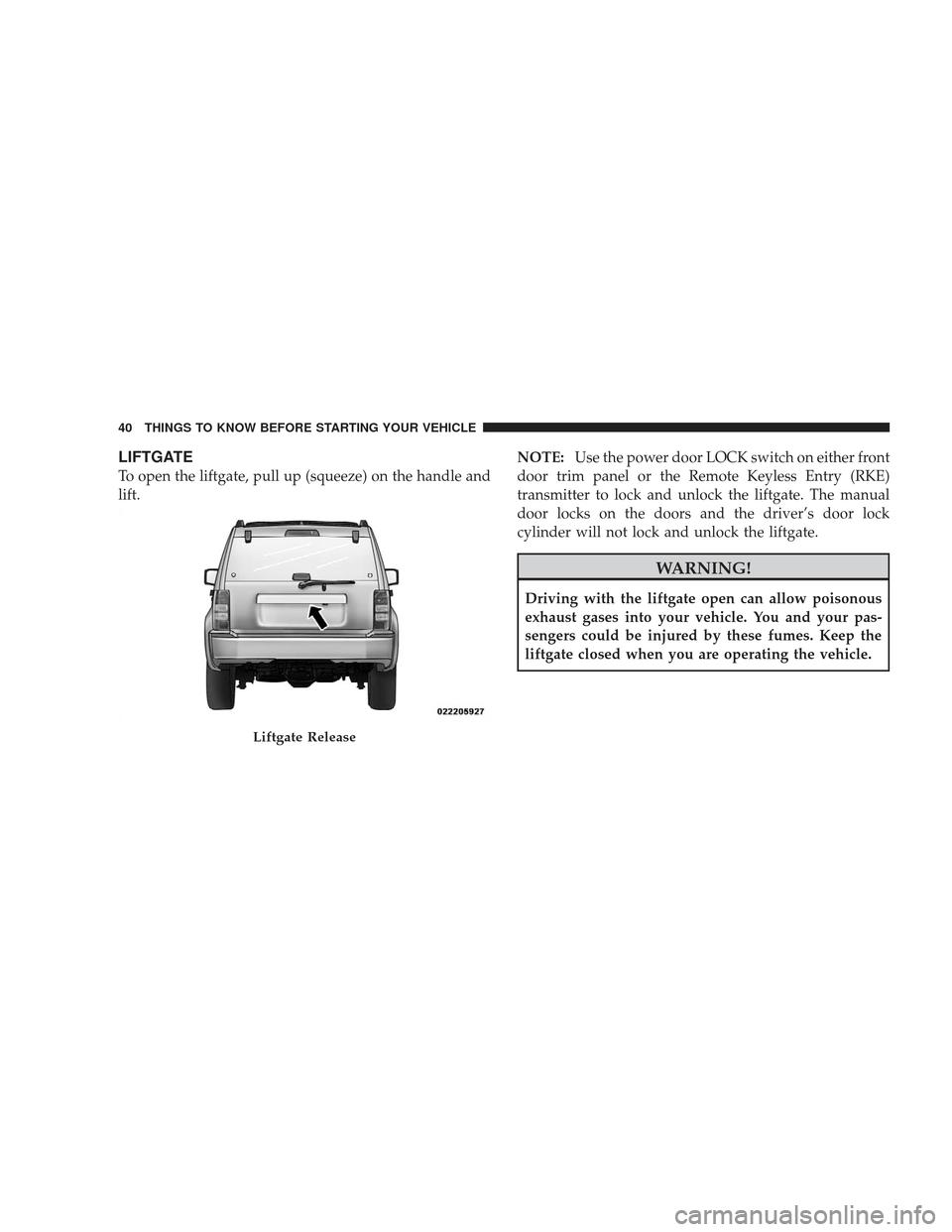
LIFTGATE
To open the liftgate, pull up (squeeze) on the handle and
lift.NOTE:
Use the power door LOCK switch on either front
door trim panel or the Remote Keyless Entry (RKE)
transmitter to lock and unlock the liftgate. The manual
door locks on the doors and the driver’s door lock
cylinder will not lock and unlock the liftgate.
WARNING!
Driving with the liftgate open can allow poisonous
exhaust gases into your vehicle. You and your pas-
sengers could be injured by these fumes. Keep the
liftgate closed when you are operating the vehicle.
Liftgate Release
40 THINGS TO KNOW BEFORE STARTING YOUR VEHICLE
Page 43 of 506
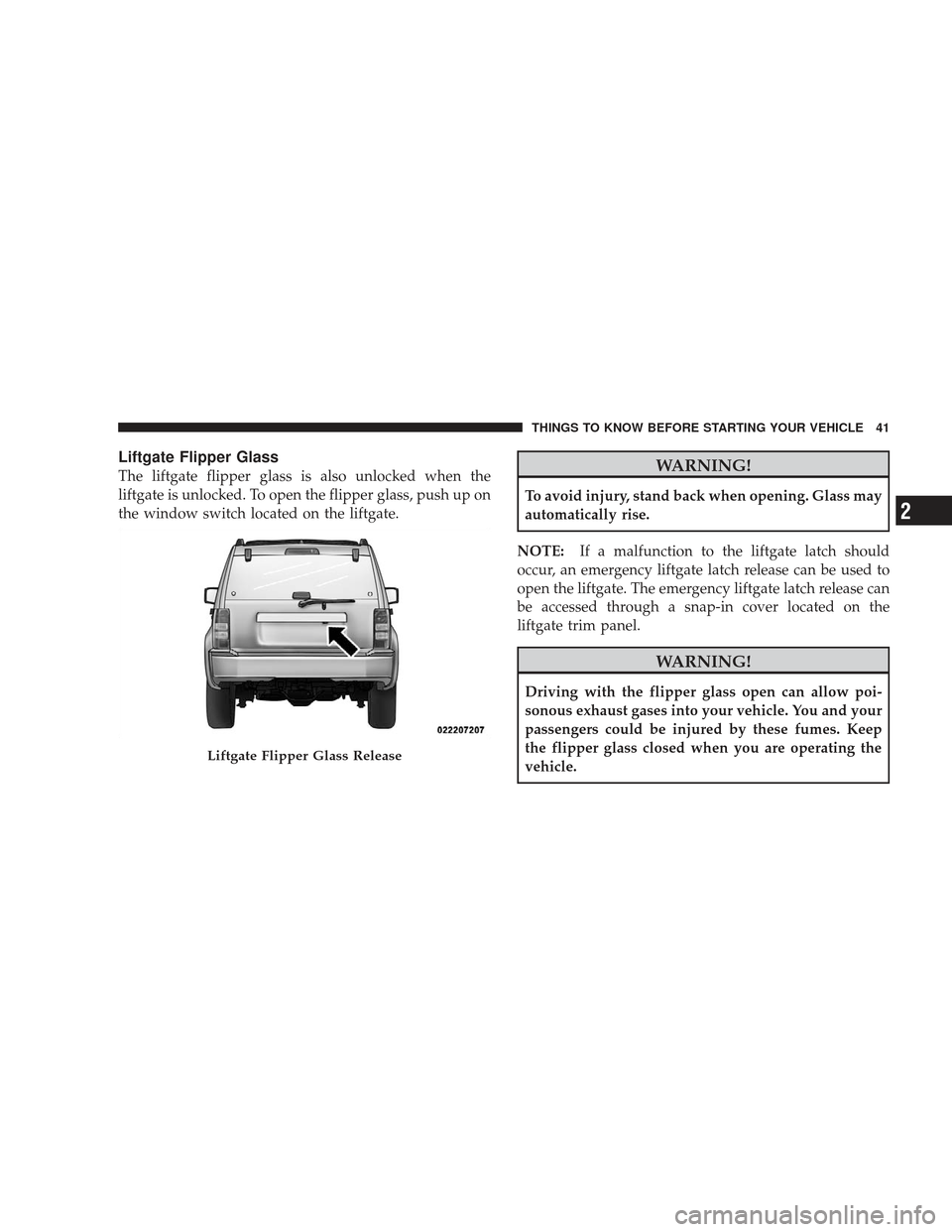
Liftgate Flipper Glass
The liftgate flipper glass is also unlocked when the
liftgate is unlocked. To open the flipper glass, push up on
the window switch located on the liftgate.WARNING!
To avoid injury, stand back when opening. Glass may
automatically rise.
NOTE: If a malfunction to the liftgate latch should
occur, an emergency liftgate latch release can be used to
open the liftgate. The emergency liftgate latch release can
be accessed through a snap-in cover located on the
liftgate trim panel.
WARNING!
Driving with the flipper glass open can allow poi-
sonous exhaust gases into your vehicle. You and your
passengers could be injured by these fumes. Keep
the flipper glass closed when you are operating the
vehicle.
Liftgate Flipper Glass Release
THINGS TO KNOW BEFORE STARTING YOUR VEHICLE 41
2
Page 45 of 506
inside of the vehicle.Everyonein a motor vehicle should
be belted at all times to reduce or prevent injuries.
Lap/Shoulder Belts
All seating positions in your vehicle have combination
lap/shoulder belts. The belt webbing retractor is de-
signed to lock during very sudden stops or collisions.
This feature allows the shoulder part of the belt to move
freely with you under normal conditions. However, in a
collision, the belt will lock and reduce your risk of
striking the inside of the vehicle or being thrown out.
WARNING!
•It is extremely dangerous to ride in a cargo area,
inside or outside of a vehicle. In a collision, people
riding in these areas are more likely to be seri-
ously injured or killed.
(Continued)
WARNING! (Continued)
•Do not allow people to ride in any area of your
vehicle that is not equipped with seats and seat
belts.
•Be sure everyone in your vehicle is in a seat and
using a seat belt properly.
•Wearing a seat belt incorrectly is dangerous. Seat
belts are designed to go around the large bones of
your body. These are the strongest parts of your
body and can take the forces of a collision the best.
•Wearing your belt in the wrong place could make
your injuries in a collision much worse. You might
suffer internal injuries, or you could even slide out
of part of the belt. Follow these instructions to
wear your seat belt safely and to keep your pas-
sengers safe, too.(Continued)
THINGS TO KNOW BEFORE STARTING YOUR VEHICLE 43
2
Page 50 of 506
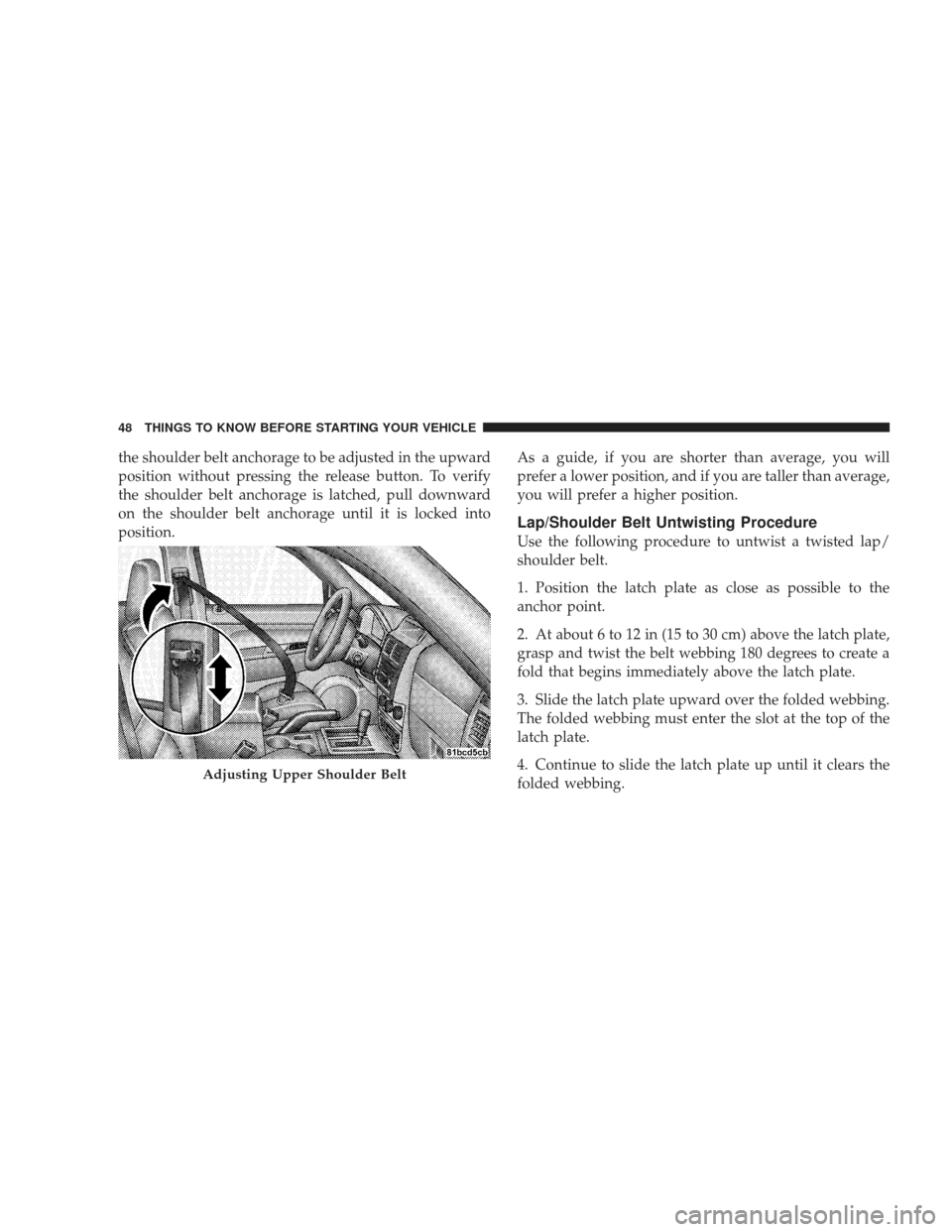
the shoulder belt anchorage to be adjusted in the upward
position without pressing the release button. To verify
the shoulder belt anchorage is latched, pull downward
on the shoulder belt anchorage until it is locked into
position.As a guide, if you are shorter than average, you will
prefer a lower position, and if you are taller than average,
you will prefer a higher position.
Lap/Shoulder Belt Untwisting Procedure
Use the following procedure to untwist a twisted lap/
shoulder belt.
1. Position the latch plate as close as possible to the
anchor point.
2. At about 6 to 12 in (15 to 30 cm) above the latch plate,
grasp and twist the belt webbing 180 degrees to create a
fold that begins immediately above the latch plate.
3. Slide the latch plate upward over the folded webbing.
The folded webbing must enter the slot at the top of the
latch plate.
4. Continue to slide the latch plate up until it clears the
folded webbing.
Adjusting Upper Shoulder Belt
48 THINGS TO KNOW BEFORE STARTING YOUR VEHICLE
Page 52 of 506
BeltAlert�Programming
BeltAlert�can be enabled or disabled by your authorized
dealer or by performing the following steps:
NOTE: Chrysler LLC does not recommend deactivating
BeltAlert�.
1. With all doors closed, and the ignition switch in any
position except ON or START, buckle the driver’s seat
belt.
2. Turn the ignition switch to the ON position, but do not
start the engine. Wait for the Seat Belt Reminder Light to
turn off and then proceed to the next step.
NOTE: You must perform the following steps within
60 seconds of turning the ignition switch to the ON
position. 3. Within 60 seconds of turning the ignition switch to the
ON position, unbuckle and then re-buckle the driver’s
seat belt at least three times within 10 seconds, ending
with the seat belt buckled.
NOTE:
Watch for the Seat Belt Reminder Light to turn
on while unbuckling the seat belt and turn off while
re-buckling the seat belt. It may be necessary to retract
the seat belt.
4. Turn the ignition switch to the LOCK position. A
single chime will sound to signify that you have success-
fully completed the programming.
BeltAlert� can be reactivated by repeating this procedure.
NOTE: When BeltAlert� is deactivated, the Seat Belt
Reminder Light will continue to illuminate as long as the
driver’s seat belt is unbuckled.
50 THINGS TO KNOW BEFORE STARTING YOUR VEHICLE
Page 53 of 506
Automatic Locking Mode — If Equipped
In this mode, the shoulder belt is automatically pre-
locked. However, the belt will still retract to remove any
slack in the shoulder belt.
When To Use The Automatic Locking Mode
Use the Automatic Locking Mode anytime a child safety
seat is installed in the rear outboard seating position.
Children 12 years old and younger should be properly
restrained in the rear seat whenever possible.
How To Use The Automatic Locking Mode
1. Buckle the combination lap and shoulder belt.
2. Grasp the shoulder portion and pull downward until
the entire belt is extracted.
3. Allow the belt to retract. As the belt retracts, you will
hear a clicking sound. This indicates the safety belt is
now in the Automatic Locking Mode.
How to Disengage The Automatic Locking Mode
Disconnect the combination lap/shoulder belt from the
buckle and allow it to retract completely to disengage the
Automatic Locking Mode and activate the vehicle sensi-
tive (emergency) locking mode.
Energy Management Feature
This vehicle has a safety belt system with an energy
management feature in the front seating positions to help
further reduce the risk of injury in the event of a head-on
collision.
This safety belt system has a retractor assembly that is
designed to release webbing in a controlled manner. This
feature is designed to help reduce the belt force acting on
the occupant’s chest.
THINGS TO KNOW BEFORE STARTING YOUR VEHICLE 51
2