Page 138 of 506
DRIVER MEMORY SEAT — IF EQUIPPED
This feature allows the driver to store up to two different
memory profiles, for easy recall through a memory
switch. Each memory profile contains desired position
settings for the driver seat and side mirrors, and a set of
desired radio station presets.
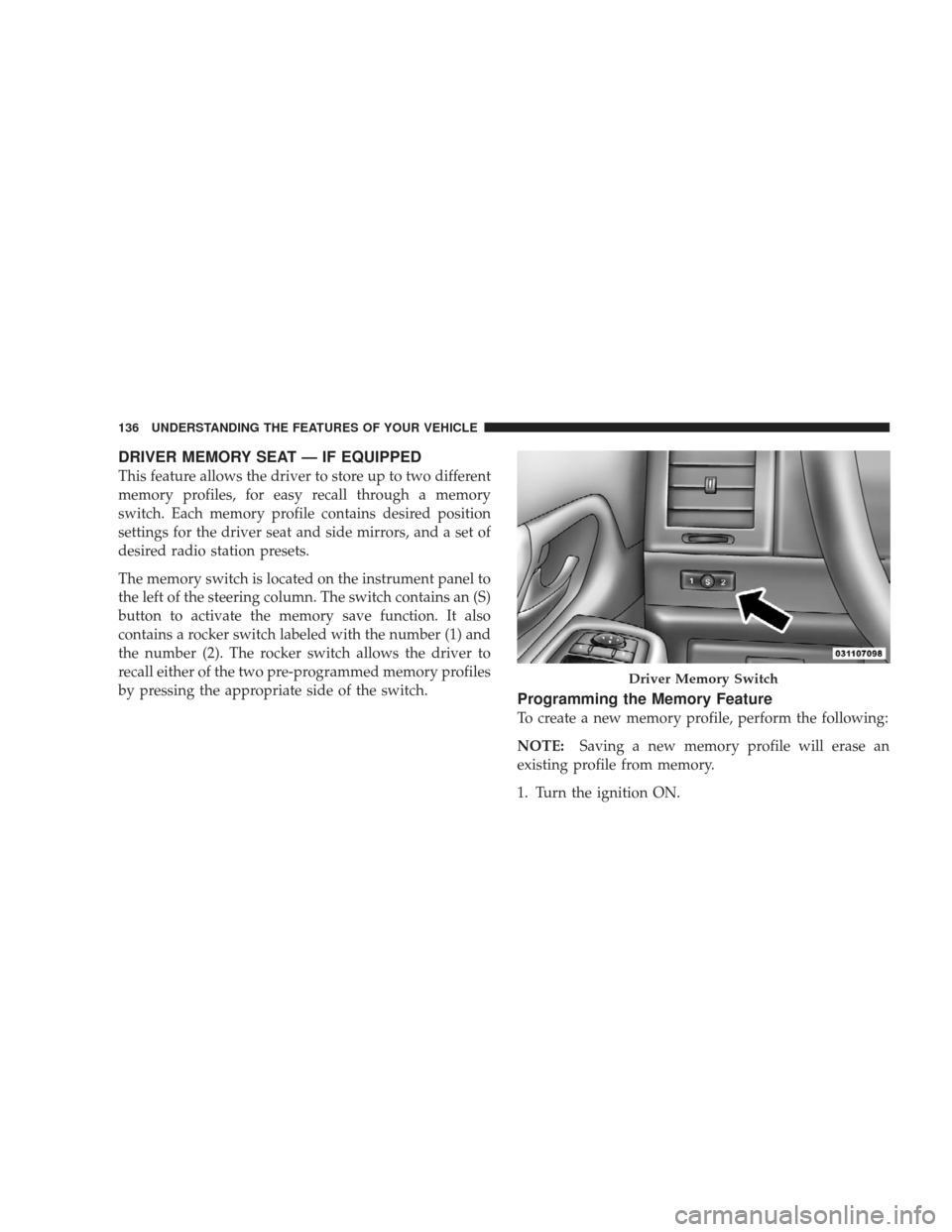
The memory switch is located on the instrument panel to
the left of the steering column. The switch contains an (S)
button to activate the memory save function. It also
contains a rocker switch labeled with the number (1) and
the number (2). The rocker switch allows the driver to
recall either of the two pre-programmed memory profiles
by pressing the appropriate side of the switch.
Programming the Memory Feature
To create a new memory profile, perform the following:
NOTE:Saving a new memory profile will erase an
existing profile from memory.
1. Turn the ignition ON.
Driver Memory Switch
136 UNDERSTANDING THE FEATURES OF YOUR VEHICLE
Page 139 of 506
2. Adjust all memory profile settings to desired prefer-
ences (i.e., seat, side mirror, and radio station presets).
3. Press and release the SET (S) button on the memory
switch, then press the side of the rocker switch labeled (1)
within five seconds. The Electronic Vehicle Information
Center (EVIC), if equipped, will display which memory
position is being set.
If desired, a second memory profile can be stored into
memory as follows:
1. Turn the ignition ON.
2. Adjust all memory profile settings to desired prefer-
ences (i.e., seat, side mirror, and radio station presets).
3. Press and release the SET (S) button on the memory
switch, then press the side of the rocker switch labeled (2)
within five seconds. The EVIC, if equipped, will display
which memory position is being set.NOTE:
•For vehicles equipped with an automatic transmission,
memory profiles can be set without the vehicle in
PARK, but the vehicle must be in PARK to recall a
memory profile.
•For vehicles equipped with a manual transmission, the
vehicle speed must be at 0 mph (0 km/h) to recall a
memory profile.
•The Recall Memory with Remote Key Unlock feature
can be turned on and off through the EVIC, if
equipped. For details, refer to “Personal Settings
(Customer-Programmable Features)” under “Elec-
tronic Vehicle Information Center (EVIC)” in Section 4
of this manual.
UNDERSTANDING THE FEATURES OF YOUR VEHICLE 137
3
Page 151 of 506
Parade Mode (Daytime Brightness Feature)
Rotate the dimmer control to the first detent to brighten
the odometer and radio display when the parking lights
or headlights are on during daylight conditions.
Interior Light On
Rotate the dimmer control completely upward to the
second detent to turn on the interior lights. The interior
lights will remain on when the dimmer control is in this
position.
Interior Light Defeat Off
Rotate the dimmer control completely downward to the
(O) OFF position. The interior lights will remain off when
the doors are open.
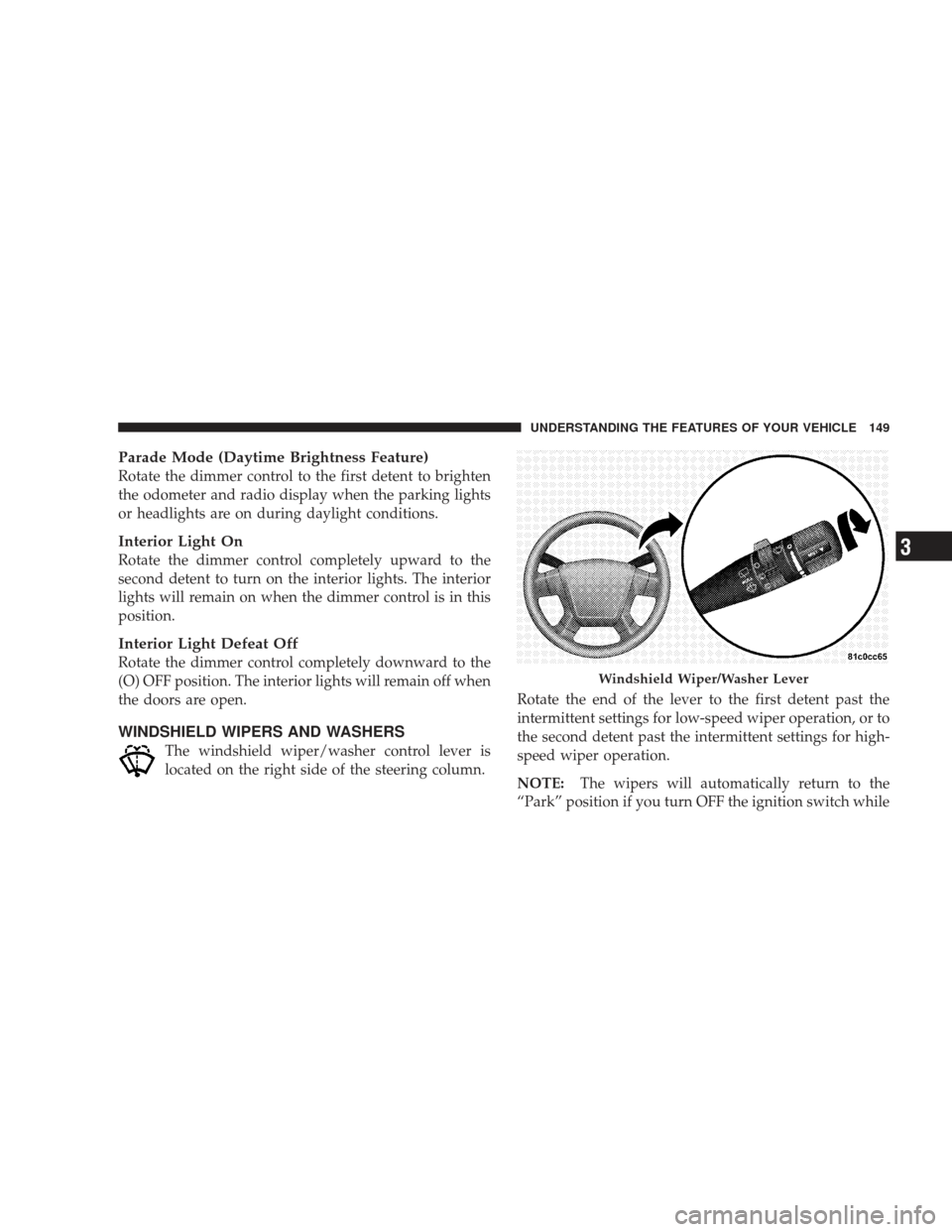
WINDSHIELD WIPERS AND WASHERS
The windshield wiper/washer control lever is
located on the right side of the steering column.Rotate the end of the lever to the first detent past the
intermittent settings for low-speed wiper operation, or to
the second detent past the intermittent settings for high-
speed wiper operation.
NOTE:
The wipers will automatically return to the
“Park” position if you turn OFF the ignition switch while
Windshield Wiper/Washer Lever
UNDERSTANDING THE FEATURES OF YOUR VEHICLE 149
3
Page 161 of 506

System Usage Precautions
NOTE:
•Ensure that the rear bumper is free of dirt and debris
to keep the Rear Park Assist System operating prop-
erly.
•Jackhammers, large trucks, and other vibrations could
affect the performance of the Rear Park Assist System.
•When you turn off the Rear Park Assist System, the
instrument cluster will display “PARK ASSIST DIS-
ABLED.” Furthermore, once you turn off the Rear
Park Assist System, it remains off until you turn it on
again, even if you cycle the ignition key.
•When you move the shift lever to the REVERSE
position and the Rear Park Assist System is turned off,
a single chime will sound once per ignition cycle and
the instrument cluster will display “PARK ASSIST
DISABLED.”
•The Rear Park Assist System, when on, will MUTE the
radio when it is sounding a tone.
•If a Rear Park Assist System malfunction occurs, a
single chime will sound once per ignition cycle. In
addition, the Electronic Vehicle Information Center
(EVIC) will display “SERVICE PARK ASSIST SYS-
TEM” and the LED in the Rear Park Assist switch will
illuminate. If this occurs, see your authorized dealer
for service.
CAUTION!
•The Rear Park Assist System is only a parking aid
and it is unable to recognize every obstacle, in-
cluding small obstacles. Parking curbs might be
temporarily detected or not detected at all. Ob-
stacles located above or below the sensors will not
be detected when they are in close proximity.(Continued)
UNDERSTANDING THE FEATURES OF YOUR VEHICLE 159
3
Page 168 of 506
WARNING!
•Your motorized door or gate will open and close
while you are training the Universal Transceiver.
Do not train the transceiver if people or pets are in
the path of the door or gate. Only use this trans-
ceiver with a garage door opener that has a “stop
and reverse” feature as required by Federal safety
standards. This includes most garage door opener
models manufactured after 1982. Do not use a
garage door opener without these safety features.
Call toll-free 1–800–355–3515 or, on the Internet at
www.HomeLink.com for safety information or as-
sistance.
•Vehicle exhaust contains carbon monoxide, a dan-
gerous gas. Do not run your vehicle in the garage
while training the transceiver. Exhaust gas can
cause serious injury or death.
Programming HomeLink�
Before You Begin
If you have not trained any of the HomeLink� buttons,
erase all channels before you begin training.
To do this, press and hold the two outside buttons for
20 seconds until the red indicator flashes.
It is recommended that a new battery be placed in the
hand-held transmitter of the device being programmed
to HomeLink� for more efficient training and accurate
transmission of the radio-frequency signal.
Your vehicle should be parked outside of the garage
when programming.
1. Turn the ignition switch to the ON/RUN position.
2. Hold the battery side of the hand-held transmitter
away from the HomeLink� button you wish to program.
166 UNDERSTANDING THE FEATURES OF YOUR VEHICLE
Page 171 of 506
Gate Operator/Canadian Programming
Canadian radio-frequency laws require transmitter sig-
nals to “time-out” (or quit) after several seconds of
transmission – which may not be long enough for
HomeLink�to pick up the signal during programming.
Similar to this Canadian law, some U.S. gate operators are
designed to “time-out” in the same manner.
It may be helpful to unplug the device during the cycling
process to prevent possible overheating of the garage
door or gate motor.
If you are having difficulties programming a garage door
opener or a gate operator, replace “Programming
HomeLink�” Step 3 with the following:
3. Continue to press and hold the HomeLink� button
while you press and release - every two seconds
(“cycle”) your hand-held transmitter until HomeLink �has successfully accepted the frequency signal. The
indicator light will flash slowly and then rapidly when
fully trained.
If you unplugged the device for training, plug it back in
at this time.
Then proceed with Step 4 under “Programming
HomeLink�” earlier in this section.
Using HomeLink�
To operate, simply press and release the programmed
HomeLink�
button. Activation will now occur for the
trained device (i.e., garage door opener, gate operator,
Security system, entry door lock, home/office lighting,
etc. The hand-held transmitter of the device may also be
used at any time.
UNDERSTANDING THE FEATURES OF YOUR VEHICLE 169
3
Page 199 of 506
UNDERSTANDING YOUR INSTRUMENT PANEL
CONTENTS
�Instrument Panel Features ............... 200
� Instrument Cluster .................... 201
� Instrument Cluster Descriptions ........... 202
� Electronic Vehicle Information Center (EVIC) —
If Equipped .......................... 215
▫ Electronic Vehicle Information Center (EVIC)
Displays ........................... 217
▫ Oil Change Required .................. 218
▫ Trip Functions ...................... 219
▫ Compass Display .................... 221 ▫
Personal Settings (Customer-Programmable
Features) .......................... 223
� Sales Code REQ — AM/FM Stereo Radio And
6–Disc CD/DVD Changer (MP3/WMA AUX
Jack) ............................... 227
▫ Operating Instructions - Radio Mode ...... 227
▫ Operation Instructions - (Disc Mode For CD
And MP3/WMA Audio Play, DVD-Video) . . . 235
▫ Notes On Playing MP3/WMA Files ....... 238
▫ List Button
(Disc Mode For MP3/WMA Play) ......... 2404
Page 200 of 506
▫Info Button (Disc Mode For MP3/WMA
Play) ............................. 240
� AM/FM/CD/DVD Radio (RER/REN) – If
Equipped ............................ 243
▫ Operating Instructions — Voice Recognition
System (VR) — If Equipped ............. 243
▫ Operating Instructions — uconnect� phone
— If Equipped ...................... 243
▫ Clock Setting Procedure ............... 243
� Sales Code RES — AM/FM Stereo Radio With
CD Player (MP3 AUX Jack) ............... 245
▫ Operating Instructions — Radio Mode ..... 246
▫ Operation Instructions — CD Mode For CD
And MP3 Audio Play ................. 249
▫ Notes On Playing MP3 Files ............ 251▫
Operation Instructions - Auxiliary Mode .... 253
� Sales Code RES/RSC — AM/FM Stereo Radio
With CD Player (MP3 AUX Jack) And Sirius
Radio ............................... 254
▫ Operating Instructions — Radio Mode ..... 254
▫ Operation Instructions — CD Mode For CD
And MP3 Audio Play ................. 260
▫ Notes On Playing MP3 Files ............ 262
▫ List Button (CD Mode For MP3 Play) ...... 264
▫ Info Button (CD Mode For MP3 Play) ...... 264
� uconnect� studios (Satellite Radio) — If
Equipped (REN/REQ/RER/RES/REU Radios
Only) ............................... 266
▫ System Activation .................... 266
198 UNDERSTANDING YOUR INSTRUMENT PANEL