Page 370 of 506
of gasoline may not be indicated on the gasoline pump;
therefore, you should ask your gasoline retailer whether
the gasoline contains MMT. It is even more important to
look for gasolines without MMT in Canada, because
MMT can be used at levels higher than those allowed in
the United States. MMT is prohibited in Federal and
California reformulated gasoline.
Materials Added To Fuel
All gasoline sold in the United States is required to
contain effective detergent additives. Use of additional
detergents or other additives is not needed under normal
conditions and they would result in additional cost.
Therefore, you should not have to add anything to the
fuel.
Fuel System Cautions
CAUTION!
Use the following guidelines to maintain your vehi-
cle’s performance:
•The use of leaded gas is prohibited by Federal law.
Using leaded gasoline can impair engine performance,
and damage the emission control system.
•An out-of-tune engine, or certain fuel or ignition
malfunctions, can cause the catalytic converter to
overheat. If you notice a pungent burning odor or
some light smoke, your engine may be out of tune or
malfunctioning and may require immediate service.
Contact your authorized dealer for service assistance.
368 STARTING AND OPERATING
Page 392 of 506
CAUTION! (Continued)
•Before recreational towing, perform the procedure
outlined under “Shifting into NEUTRAL” to be
certain that the transfer case is fully in NEUTRAL.
Otherwise, internal damage will result.
•Do not use a bumper mounted clamp-on tow bar on
your vehicle. The bumper face bar will be damaged.
WARNING!
You or others could be injured if you leave the
vehicle unattended with the transfer case in the
NEUTRAL position without first fully engaging the
parking brake. The transfer case NEUTRAL position
disengages both the front driveshaft and rear drive-
shaft from the powertrain and it will allow the
vehicle to move despite the transmission position.
The parking brake should always be applied when
the driver is not in the vehicle.
Shifting into NEUTRAL
Perform the following procedure to prepare your vehicle
for recreational towing:
1. Bring the vehicle to a complete stop.
2. Turn OFF the engine.
3. Turn the ignition switch to the ON position.
4. Press the brake pedal.
5. Shift the transmission into NEUTRAL.
6. Use the point of a ballpoint pen or similar object to
press the recessed transfer case NEUTRAL button for
four seconds. After the shift is complete, and the NEU-
TRAL light turns on, release the NEUTRAL button.
7. Start the engine.
8. Shift the transmission into REVERSE.
9. Release the brake pedal for five seconds and ensure
that there is no vehicle movement.
390 STARTING AND OPERATING
Page 393 of 506
10. Repeat Steps 8 and 9 with the transmission in DRIVE.
11. Turn OFF the engine.
12. Turn the ignition switch to the unlocked OFF posi-
tion.
13. Shift the transmission into PARK.
14. Attach the vehicle to a tow vehicle with a tow bar.
15. Disconnect the battery negative cable.
NOTE:Steps 1 through 5 are requirements for shifting
the transfer case. If these requirements are not met prior
to depressing the NEUTRAL selection button or while
the shift attempt is in process, then the NEUTRAL
indicator light will flash continuously until all require-
ments are met or until the NEUTRAL button is released.
The ignition switch must be in the ON position for a shift
to take place and for the position indicator lights to be operable. If the ignition switch is not in the ON position,
the shift will not take place and no position indicator
lights will be on or flashing.
Flashing NEUTRAL position indicator light indicates
that shift requirements have not been met.
CAUTION!
Damage to the transmission may occur if the trans-
mission is shifted into PARK with the transfer case in
NEUTRAL and the engine RUNNING. With the
transfer case in NEUTRAL, ensure that the engine is
OFF prior to shifting the transmission into PARK.
Shifting Out of NEUTRAL
Perform the following procedure to prepare your vehicle
for normal usage:
1. Bring the vehicle to a complete stop.
STARTING AND OPERATING 391
5
Page 394 of 506
2. Reconnect the battery negative cable.
3. Place the ignition switch in the LOCK position (if it
has been moved or the engine has been started).
4. Turn the ignition switch to the ON position, but do not
start the engine.
5. Press the brake pedal.
6. Shift the transmission into NEUTRAL.
7. Use the point of a ballpoint pen or similar object to
press the recessed transfer case NEUTRAL button. Re-
lease the NEUTRAL button after the NEUTRAL indicator
light turns off (approximately one second). After the
NEUTRAL button is released, the transfer case will shift
to the position identified by the selector switch.
8. Start the engine.
9. Shift the transmission into DRIVE.10. Set the parking brake.
11. Shift the transmission into PARK.
NOTE:
Steps 1 through 6 are requirements for shifting
the transfer case. If these requirements are not met prior
to depressing the NEUTRAL selection button or while
the shift attempt is in process, then all of the mode
position indicator lights will flash continuously until all
requirements are met or until the NEUTRAL button is
released.
The ignition switch must be in the ON position for a shift
to take place and for the position indicator lights to be
operable. If the ignition switch in not in the ON position,
the shift will not take place and no position indicator
lights will be on or flashing.
Flashing NEUTRAL position indicator light indicates
that shift requirements have not been met.
392 STARTING AND OPERATING
Page 396 of 506
HAZARD WARNING FLASHER
The Hazard Warning flasher switch is located in the
switch bank below the climate controls.Press the switch to turn on the Hazard Warning
flasher. When the switch is activated, all directional
turn signals will flash on and off to warn oncoming
traffic of an emergency. Press the switch a second time to
turn off the Hazard Warning flasher.
This is an emergency warning system and it should not
be used when the vehicle is in motion. Use it when your
vehicle is disabled and it is creating a safety hazard for
other motorists.
When you must leave the vehicle to seek assistance, the
Hazard Warning flasher will continue to operate even
though the ignition switch is in the LOCK position.
NOTE: With extended use, the Hazard Warning flasher
may wear down your battery.
IF YOUR ENGINE OVERHEATS
In any of the following situations, you can reduce the
potential for overheating your engine by taking the
appropriate action.
•On the highways — slow down.
•In city traffic — while stopped, put transmission in
NEUTRAL, but do not increase engine idle speed.
CAUTION!
Driving with a hot cooling system could damage
your vehicle. If the temperature gauge reads “H,”
pull over and stop the vehicle. Idle the vehicle with
the air conditioner turned off until the pointer drops
back into the normal range. If the pointer remains on
the “H” and you hear continuous chimes, turn the
engine off immediately and call for service.
394 WHAT TO DO IN EMERGENCIES
Page 399 of 506
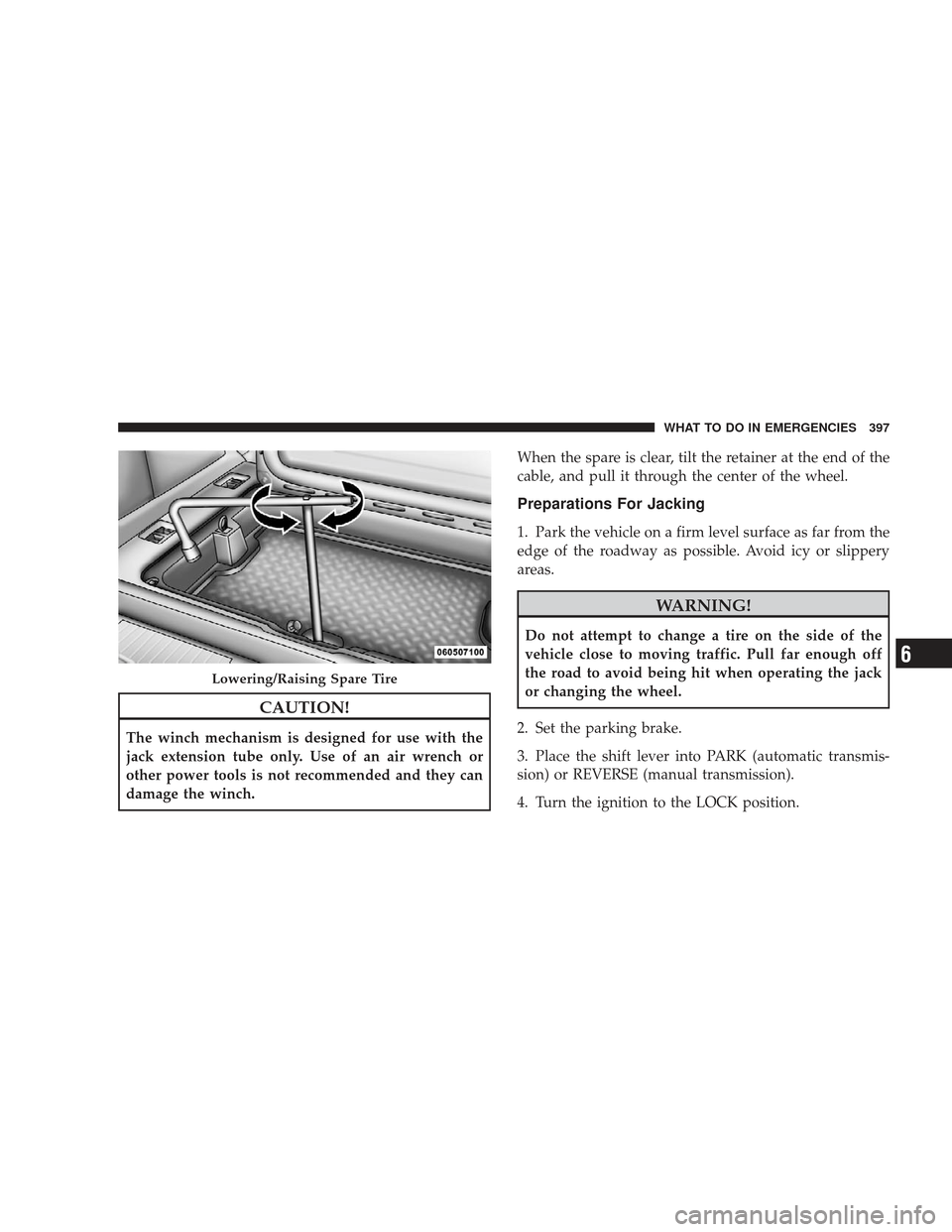
CAUTION!
The winch mechanism is designed for use with the
jack extension tube only. Use of an air wrench or
other power tools is not recommended and they can
damage the winch.When the spare is clear, tilt the retainer at the end of the
cable, and pull it through the center of the wheel.
Preparations For Jacking
1. Park the vehicle on a firm level surface as far from the
edge of the roadway as possible. Avoid icy or slippery
areas.
WARNING!
Do not attempt to change a tire on the side of the
vehicle close to moving traffic. Pull far enough off
the road to avoid being hit when operating the jack
or changing the wheel.
2. Set the parking brake.
3. Place the shift lever into PARK (automatic transmis-
sion) or REVERSE (manual transmission).
4. Turn the ignition to the LOCK position.
Lowering/Raising Spare Tire
WHAT TO DO IN EMERGENCIES 397
6
Page 404 of 506
JUMP-STARTING
WARNING!
•Take care to avoid the radiator cooling fan when-
ever the hood is raised. It can start anytime the
ignition switch is on. You can be hurt by the fan.
•Do not attempt to push or tow your vehicle to get
it started. Vehicles equipped with an automatic
transmission cannot be started this way. Unburned
fuel could enter the catalytic converter and once
the engine has started, ignite and damage the
converter and vehicle. If the vehicle has a dis-
charged battery, booster cables may be used to
obtain a start from another vehicle. This type of
start can be dangerous if done improperly, so
follow this procedure carefully.(Continued)
WARNING! (Continued)
•Battery fluid is a corrosive acid solution; do not
allow battery fluid to contact eyes, skin, or cloth-
ing. Don’t lean over battery when attaching
clamps or allow the clamps to touch each other. If
acid splashes in eyes or on skin, flush contami-
nated area immediately with large quantities of
water.
•A battery generates hydrogen gas, which is flam-
mable and explosive. Keep flame or spark away
from the vent holes.
•Do not use a booster battery or any other booster
source with an output that exceeds 12-Volts.
1. Wear eye protection and remove all metal jewelry such
as watchbands or bracelets that might make an unin-
tended electrical contact.
402 WHAT TO DO IN EMERGENCIES
Page 405 of 506
2. When boosting from a battery in another vehicle, park
that vehicle within booster cable reach, but without
allowing the vehicles to touch.
WARNING!
Do not permit vehicles to touch each other as this
could establish a ground connection and personal
injury could result.
3. Set the parking brake, place the automatic transmis-
sion in PARK (or NEUTRAL for manual transmission),
and turn the ignition OFF for both vehicles.
4. Turn off the heater, radio and all unnecessary electrical
loads.
5. Connect one end of the jumper cable to the positive
battery post. Connect the other end of the same cable to
the positive terminal of the booster battery. 6. Connect the other cable, first to the negative terminal
of the booster battery and then to the engine ground of
the vehicle with the discharged battery. Make sure you
have a good contact on the engine ground.WARNING!
•You should not try to start your vehicle by pushing
or towing.
•Do not connect the cable to the negative post of the
discharge battery. The resulting electrical spark
could cause the battery to explode.
•During cold weather when temperatures are be-
low the freezing point, electrolyte in a discharged
battery may freeze. Do not attempt jump-starting
because the battery could rupture or explode. The
battery temperature must be brought up above the
freezing point before attempting jump-start.
WHAT TO DO IN EMERGENCIES 403
6