Page 299 of 506
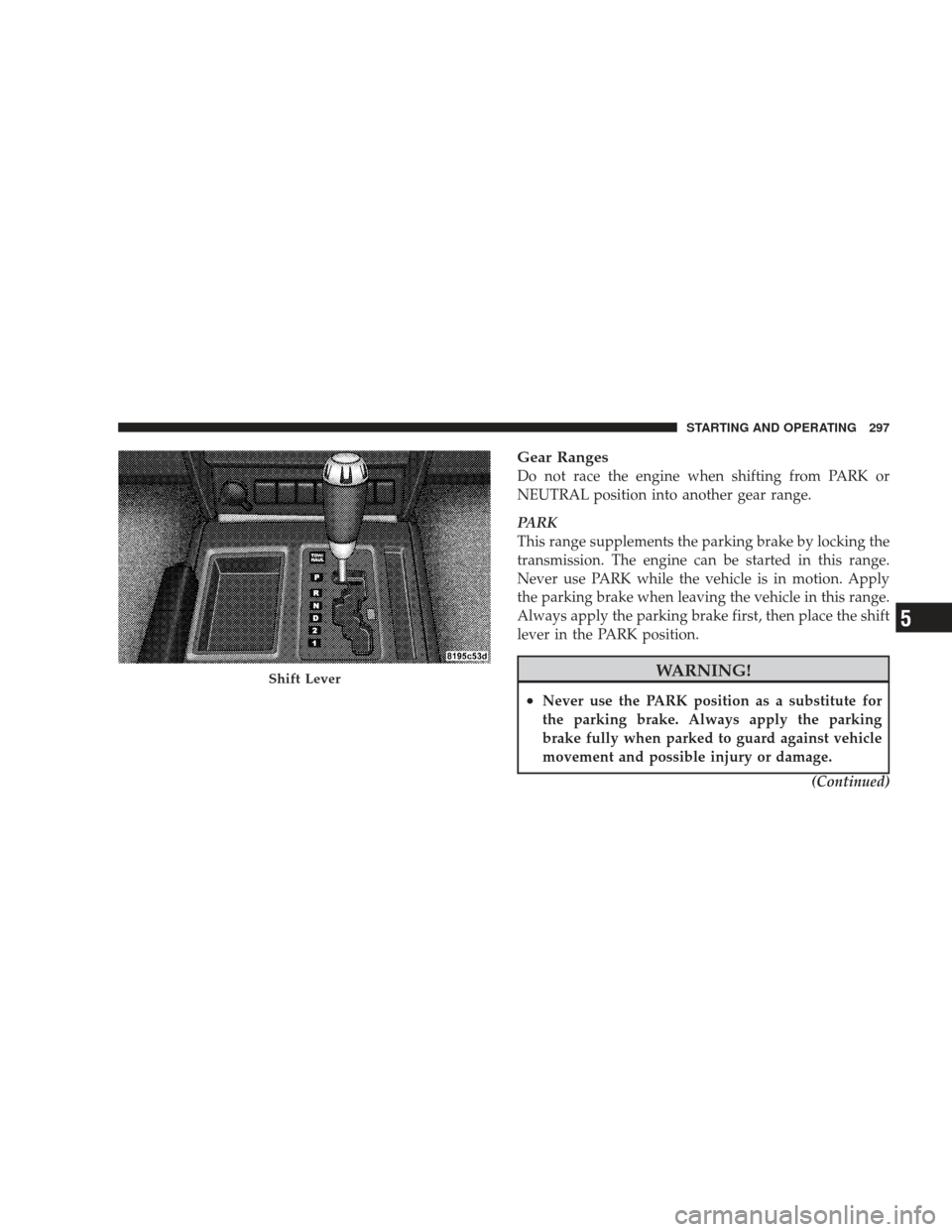
Gear Ranges
Do not race the engine when shifting from PARK or
NEUTRAL position into another gear range.
PARK
This range supplements the parking brake by locking the
transmission. The engine can be started in this range.
Never use PARK while the vehicle is in motion. Apply
the parking brake when leaving the vehicle in this range.
Always apply the parking brake first, then place the shift
lever in the PARK position.
WARNING!
•Never use the PARK position as a substitute for
the parking brake. Always apply the parking
brake fully when parked to guard against vehicle
movement and possible injury or damage.(Continued)
Shift Lever
STARTING AND OPERATING 297
5
Page 300 of 506
WARNING! (Continued)
•It is dangerous to move the shift lever out of PARK
or NEUTRAL if the engine speed is higher than
idle speed. If your foot is not firmly on the brake
pedal, the vehicle could accelerate quickly forward
or in reverse. You could lose control of the vehicle
and hit someone or something. Only shift into
gear when the engine is idling normally and when
your right foot is firmly on the brake pedal.
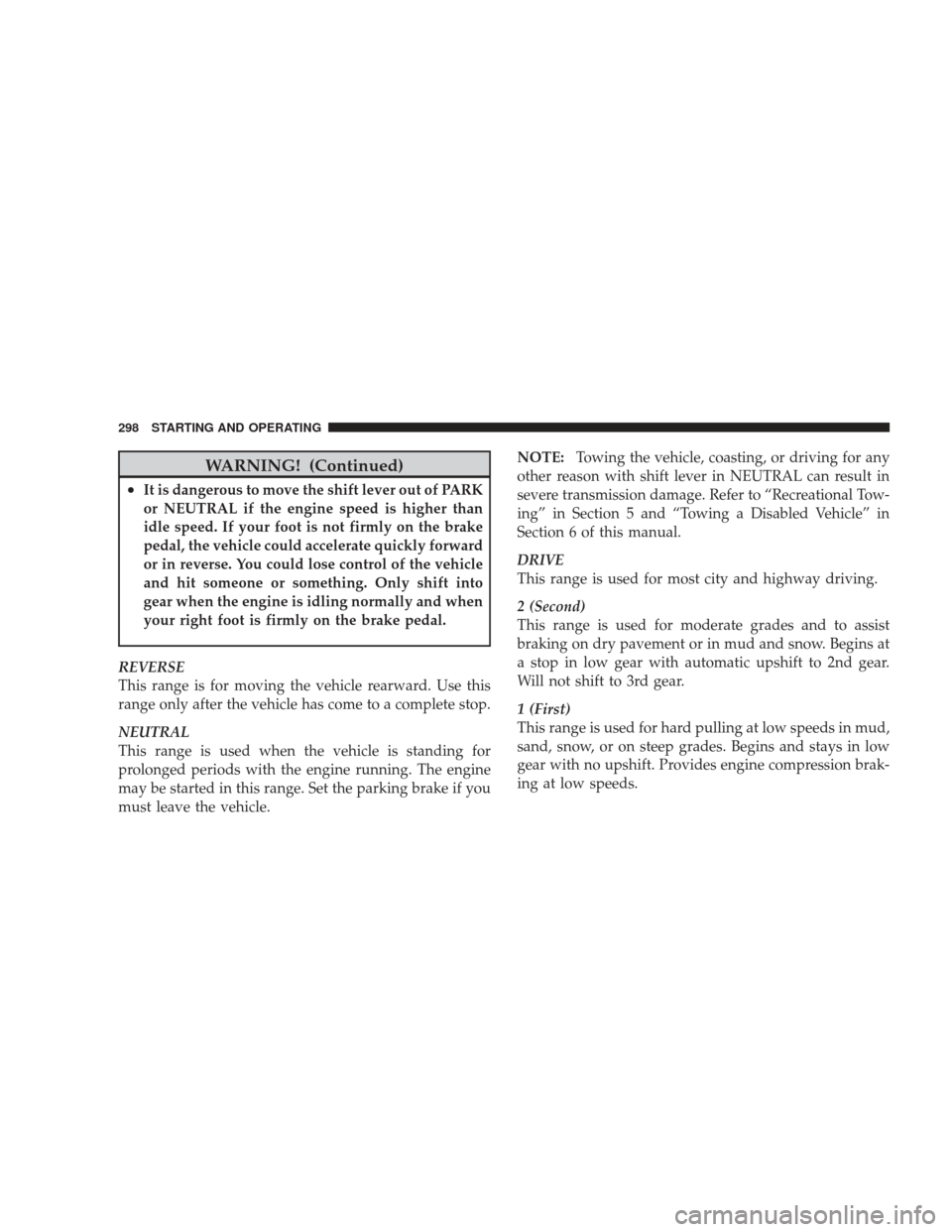
REVERSE
This range is for moving the vehicle rearward. Use this
range only after the vehicle has come to a complete stop.
NEUTRAL
This range is used when the vehicle is standing for
prolonged periods with the engine running. The engine
may be started in this range. Set the parking brake if you
must leave the vehicle. NOTE:
Towing the vehicle, coasting, or driving for any
other reason with shift lever in NEUTRAL can result in
severe transmission damage. Refer to “Recreational Tow-
ing” in Section 5 and “Towing a Disabled Vehicle” in
Section 6 of this manual.
DRIVE
This range is used for most city and highway driving.
2 (Second)
This range is used for moderate grades and to assist
braking on dry pavement or in mud and snow. Begins at
a stop in low gear with automatic upshift to 2nd gear.
Will not shift to 3rd gear.
1 (First)
This range is used for hard pulling at low speeds in mud,
sand, snow, or on steep grades. Begins and stays in low
gear with no upshift. Provides engine compression brak-
ing at low speeds.
298 STARTING AND OPERATING
Page 301 of 506
Overdrive Operation
The overdrive automatic transmission contains an elec-
tronically controlled 4th speed (OVERDRIVE). The trans-
mission will automatically shift from 3rd gear to OVER-
DRIVE if the following conditions are present:
•the shift lever is in DRIVE
•the engine coolant has reached normal operating tem-
perature
•vehicle speed is above approximately 30 mph
(48 km/h)
•the TOW/HAUL button has not been activated
•the transmission has reached normal operating
temperature
NOTE:
•If the vehicle is started in extremely cold temperatures,
the transmission may not shift into OVERDRIVE and will automatically select the most desirable gear for
operation at this temperature. Normal operation will
resume when the transmission fluid temperature has
risen to a suitable level. Refer to the “Note” under
“Torque Converter Clutch” in this section.
•If the transmission temperature gets extremely hot, the
transmission will automatically select the most desir-
able gear for operation at this temperature. If the
transmission temperature becomes hot enough, the
“Transmission Temperature Warning Light” may illu-
minate and the transmission may downshift out of
OVERDRIVE until the transmission cools down. After
the transmission cools down, the transmission will
resume normal operation.
The transmission will downshift from OVERDRIVE to
DRIVE if the accelerator pedal is fully pressed at vehicle
speeds above approximately 35 mph (56 km/h).
STARTING AND OPERATING 299
5
Page 305 of 506
CAUTION! (Continued)
•The 4WD LOCK position and 4WD LOW position
are intended for loose or slippery road surfaces
only. Driving in these positions on dry hard-
surfaced roads may cause increased tire wear and
damage to the driveline components.
•When operating your vehicle in 4WD LOW, the
engine speed is approximately three times that of
the 2WD position or 4WD LOCK position at a
given road speed. Take care not to over-speed the
engine and do not exceed 25 mph (40 km/h).
•Proper operation of four-wheel drive vehicles de-
pends on tires of equal size, type, and circumfer-
ence on each wheel. Any difference in tire size can
cause damage to the transfer case.
WARNING!
•You or others could be injured if you leave the
vehicle unattended with the transfer case in the
NEUTRAL position without first fully engaging
the parking brake. The transfer case NEUTRAL
position disengages both the front driveshaft and
rear driveshaft from the powertrain and it will
allow the vehicle to move even if the transmission
is in PARK. The parking brake should always be
applied when the driver is not in the vehicle.
•Always engage the parking brake when powering
down the vehicle if the “SERV 4WD Warning
Light” is illuminated. Not engaging the parking
brake may allow the vehicle to roll, which may
cause personal injury.(Continued)
STARTING AND OPERATING 303
5
Page 306 of 506
WARNING! (Continued)
•Since four-wheel drive provides improved trac-
tion, there is a tendency to exceed safe turning and
stopping speeds. Do not go faster than road con-
ditions permit. You or others could be injured.
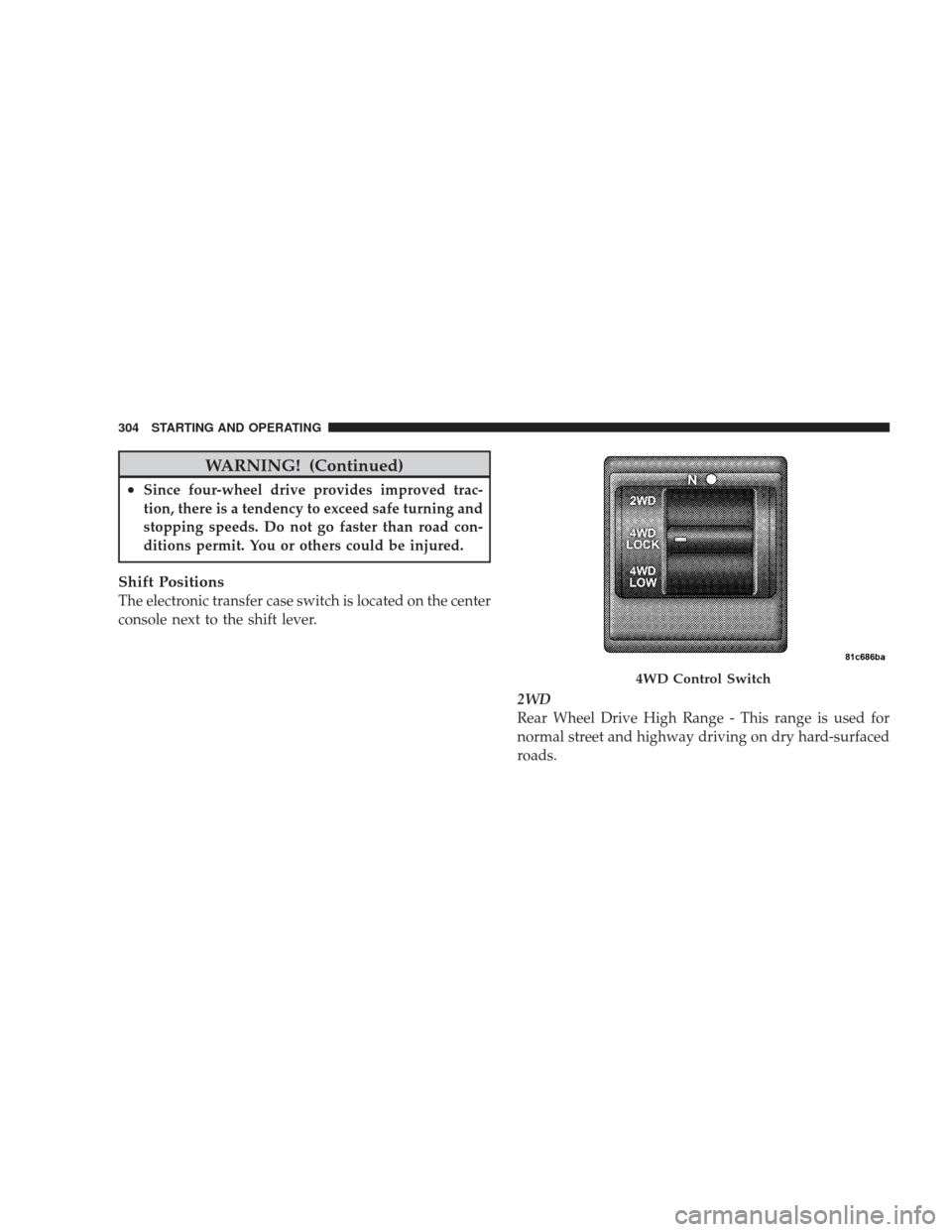
Shift Positions
The electronic transfer case switch is located on the center
console next to the shift lever.2WD
Rear Wheel Drive High Range - This range is used for
normal street and highway driving on dry hard-surfaced
roads.
4WD Control Switch
304 STARTING AND OPERATING
Page 307 of 506
4WD Lock
4-Wheel Drive High Range - This range locks the front
driveshaft and rear driveshaft together forcing the front
and rear wheels to rotate at the same speed. Additional
traction for loose or slippery road surfaces only.
4WD Low
4-Wheel Drive Low Range - This range provides low
speed four-wheel drive. Locks the front driveshaft and
rear driveshaft together forcing the front and rear wheels
to rotate at the same speed. Additional traction and
maximum pulling power for loose or slippery road
surfaces only. Do not exceed 25 mph (40 km/h).
N
Neutral - This range disengages both the front driveshaft
and rear driveshaft from the powertrain. To be used for
flat towing behind another vehicle. Refer to “Recreational
Towing” in this section for more information.Transfer Case Position Indicator Lights
The four-wheel drive indicator lights (4WD and 4 LOW)
are located in the instrument cluster. The NEUTRAL
indicator light is located on the 4WD Control Switch. If
there is no indicator light on or flashing, the transfer case
position is two-wheel drive (2WD). If the indicator light
is on, the desired position (4WD LOCK, 4WD LOW, or
NEUTRAL) has been obtained.
If one or more shift requirements are not met:
•An indicator light will flash.
•The transfer casewill notshift.
NOTE: The “SERV 4WD Warning Light” monitors the
electric shift four-wheel drive system. If this light re-
mains on after engine start up, or it illuminates during
driving, it means that the four-wheel drive system is not
functioning properly and that service is required.
STARTING AND OPERATING 305
5
Page 311 of 506
CAUTION! (Continued)
•When operating your vehicle in 4WD LOW, the
engine speed is approximately three times that of
the 2WD position or 4WD AUTO position at a
given road speed. Take care not to over-speed the
engine and do not exceed 25 mph (40 km/h).
•Proper operation of four-wheel drive vehicles de-
pends on tires of equal size, type, and circumfer-
ence on each wheel. Any difference in tire size can
cause damage to the transfer case.
WARNING!
•You or others could be injured if you leave the
vehicle unattended with the transfer case in the
NEUTRAL position without first fully engaging
the parking brake. The transfer case NEUTRAL
position disengages both the front driveshaft and
rear driveshaft from the powertrain and it will
allow the vehicle to move despite the transmission
position. The parking brake should always be
applied when the driver is not in the vehicle.
•Always engage the parking brake when powering
down the vehicle if the “SERV 4WD Warning
Light” is illuminated. Not engaging the parking
brake may allow the vehicle to roll, which may
cause personal injury.(Continued)
STARTING AND OPERATING 309
5
Page 312 of 506
WARNING! (Continued)
•Since four-wheel drive provides improved trac-
tion, there is a tendency to exceed safe turning and
stopping speeds. Do not go faster than road con-
ditions permit. You or others could be injured.
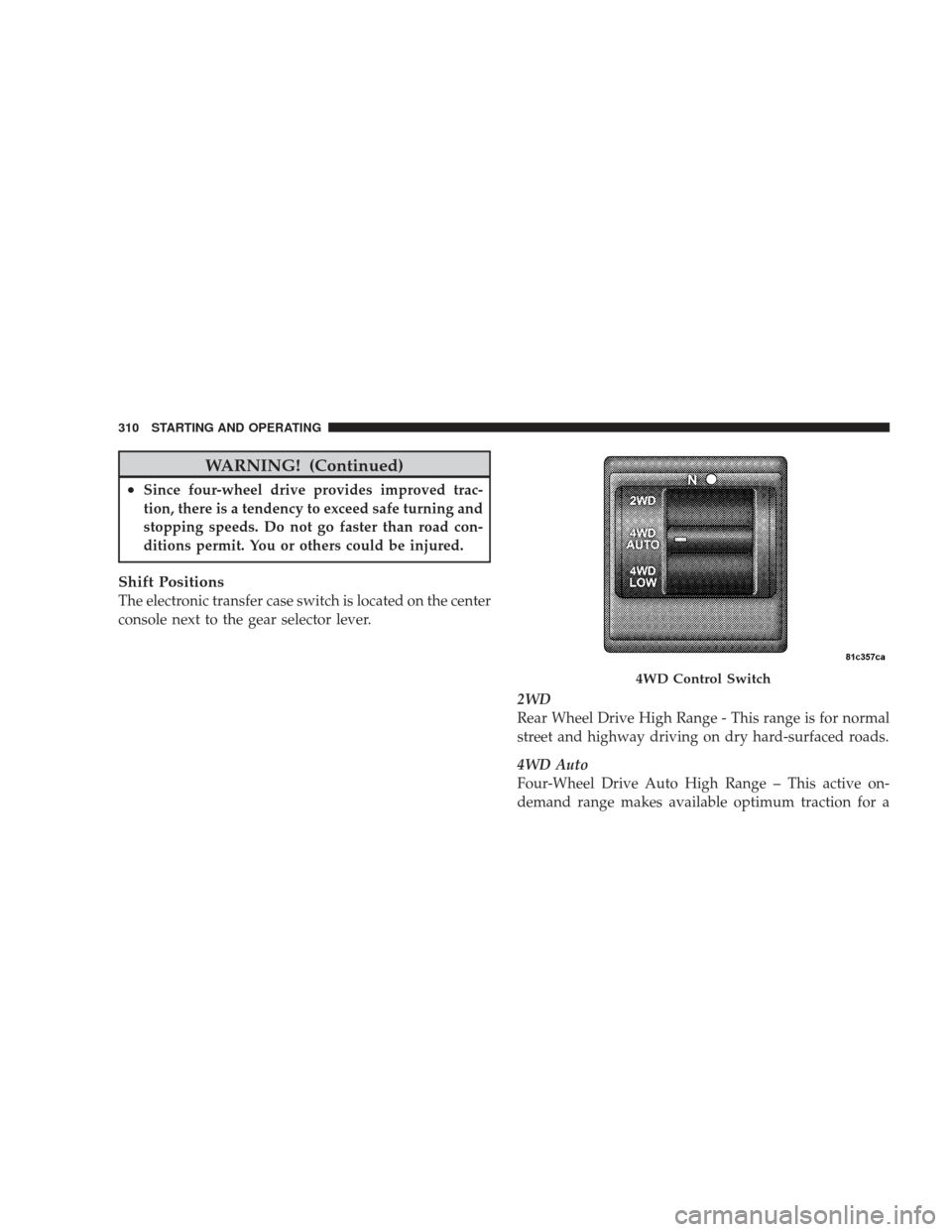
Shift Positions
The electronic transfer case switch is located on the center
console next to the gear selector lever.2WD
Rear Wheel Drive High Range - This range is for normal
street and highway driving on dry hard-surfaced roads.
4WD Auto
Four-Wheel Drive Auto High Range – This active on-
demand range makes available optimum traction for a
4WD Control Switch
310 STARTING AND OPERATING