Page 182 of 506
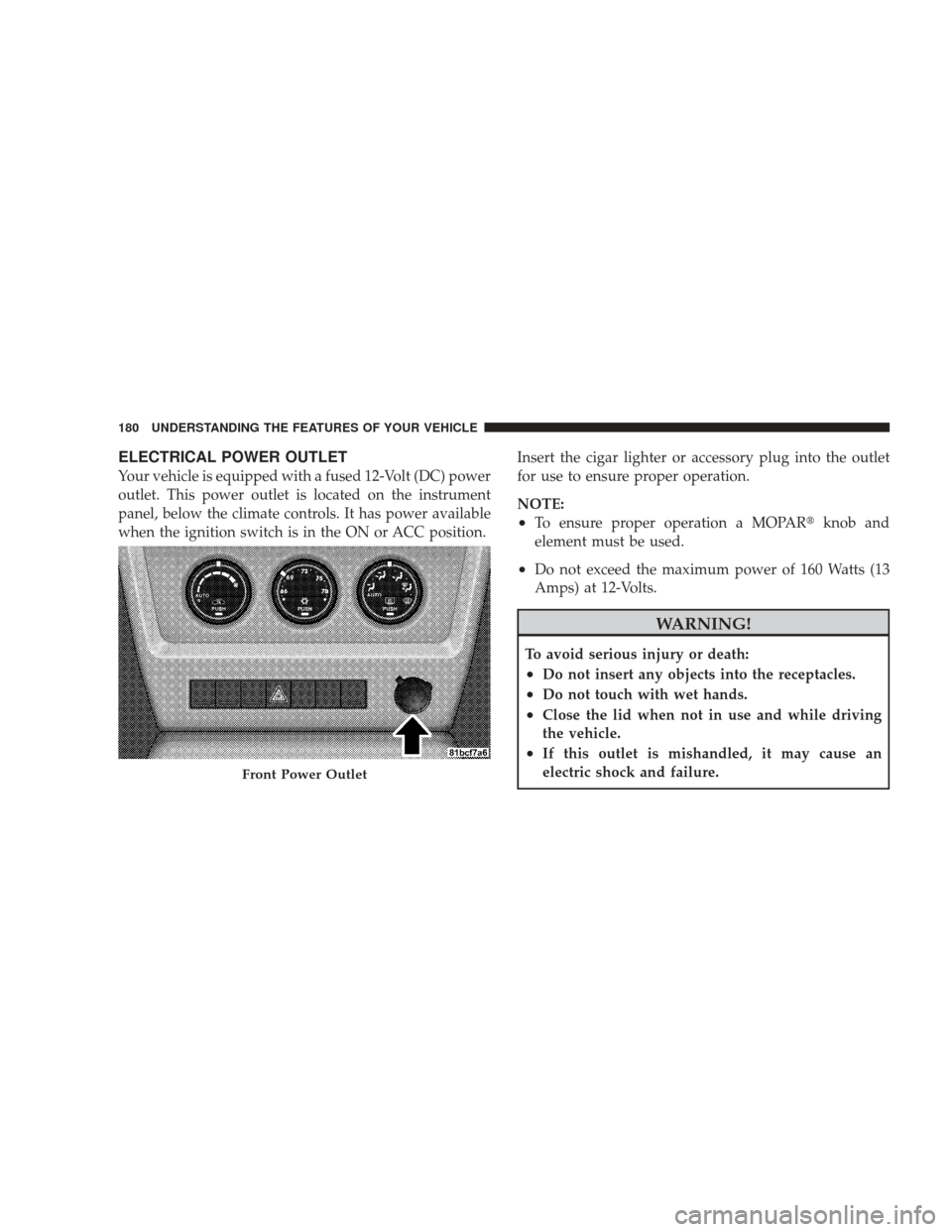
ELECTRICAL POWER OUTLET
Your vehicle is equipped with a fused 12-Volt (DC) power
outlet. This power outlet is located on the instrument
panel, below the climate controls. It has power available
when the ignition switch is in the ON or ACC position.Insert the cigar lighter or accessory plug into the outlet
for use to ensure proper operation.
NOTE:
•To ensure proper operation a MOPAR�
knob and
element must be used.
•Do not exceed the maximum power of 160 Watts (13
Amps) at 12-Volts.
WARNING!
To avoid serious injury or death:
•Do not insert any objects into the receptacles.
•Do not touch with wet hands.
•Close the lid when not in use and while driving
the vehicle.
•If this outlet is mishandled, it may cause an
electric shock and failure.
Front Power Outlet
180 UNDERSTANDING THE FEATURES OF YOUR VEHICLE
Page 185 of 506
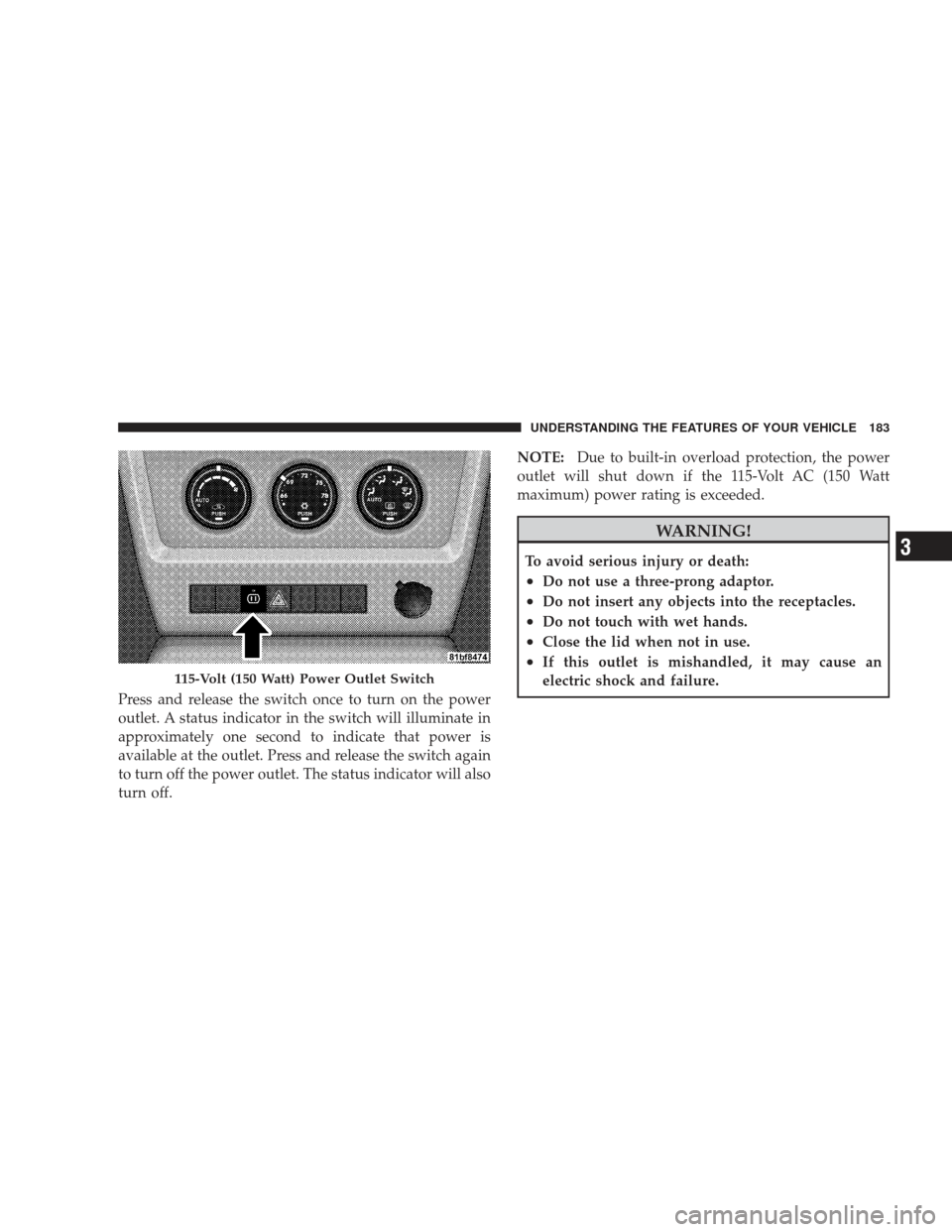
Press and release the switch once to turn on the power
outlet. A status indicator in the switch will illuminate in
approximately one second to indicate that power is
available at the outlet. Press and release the switch again
to turn off the power outlet. The status indicator will also
turn off.NOTE:
Due to built-in overload protection, the power
outlet will shut down if the 115-Volt AC (150 Watt
maximum) power rating is exceeded.
WARNING!
To avoid serious injury or death:
•Do not use a three-prong adaptor.
•Do not insert any objects into the receptacles.
•Do not touch with wet hands.
•Close the lid when not in use.
•If this outlet is mishandled, it may cause an
electric shock and failure.
115-Volt (150 Watt) Power Outlet Switch
UNDERSTANDING THE FEATURES OF YOUR VEHICLE 183
3
Page 189 of 506
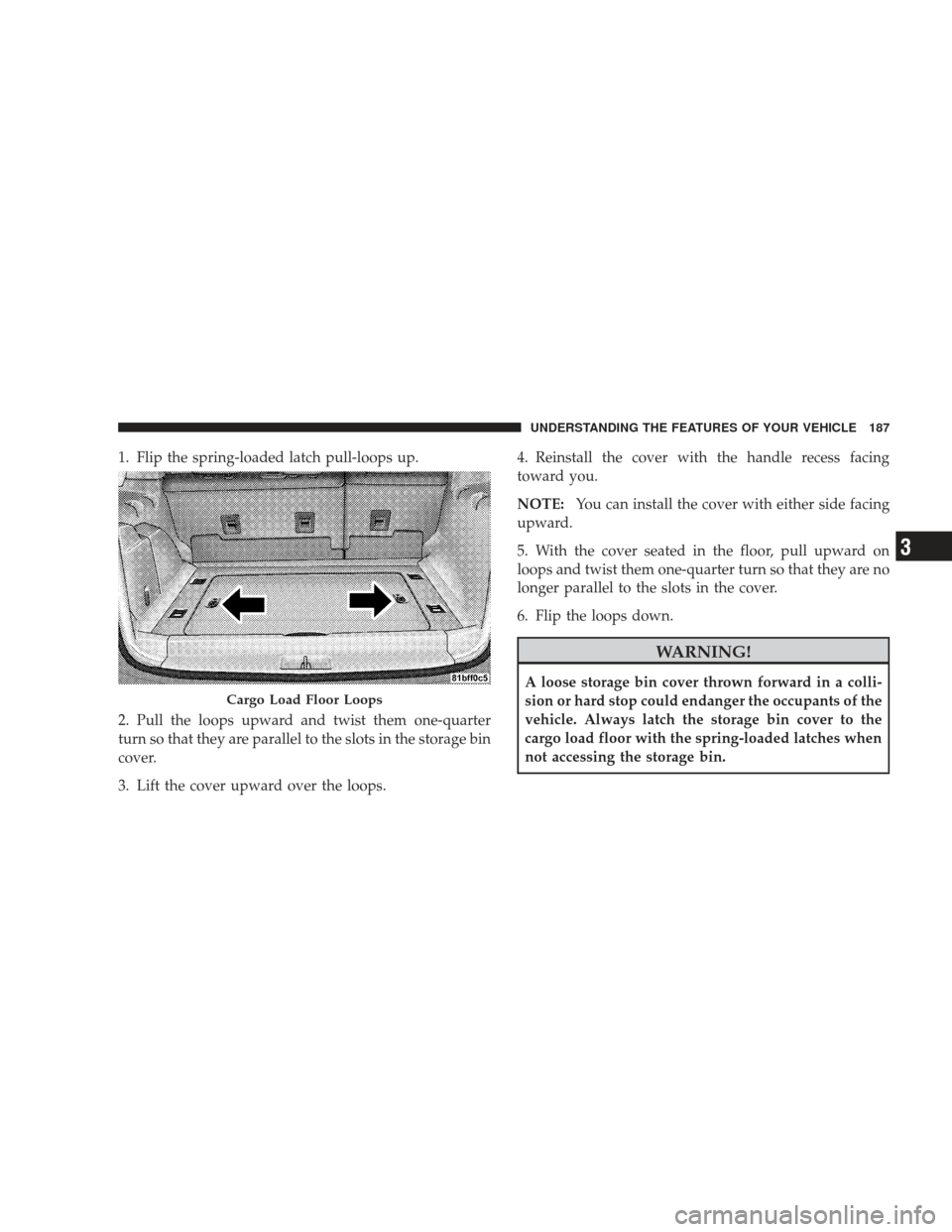
1. Flip the spring-loaded latch pull-loops up.
2. Pull the loops upward and twist them one-quarter
turn so that they are parallel to the slots in the storage bin
cover.
3. Lift the cover upward over the loops.4. Reinstall the cover with the handle recess facing
toward you.
NOTE:
You can install the cover with either side facing
upward.
5. With the cover seated in the floor, pull upward on
loops and twist them one-quarter turn so that they are no
longer parallel to the slots in the cover.
6. Flip the loops down.
WARNING!
A loose storage bin cover thrown forward in a colli-
sion or hard stop could endanger the occupants of the
vehicle. Always latch the storage bin cover to the
cargo load floor with the spring-loaded latches when
not accessing the storage bin.
Cargo Load Floor Loops
UNDERSTANDING THE FEATURES OF YOUR VEHICLE 187
3
Page 191 of 506
WARNING!
•Cargo tie-downs are not safe anchors for a child
seat tether strap. In a sudden stop or collision, a
tie-down could pull loose and allow the child seat
to come loose. A child could be badly injured. Use
only the anchors provided for child seat tethers.
•To help protect against personal injury, passengers
should not be seated in the rear cargo area. The
rear cargo space is intended for load carrying
purposes only, not for passengers, who should sit
in seats and use seat belts.
WARNING!
The weight and position of cargo and passengers can
change the vehicle center of gravity and vehicle
handling. To avoid loss of control resulting in per-
sonal injury, follow these guidelines for loading your
vehicle:
•Do not carry loads that exceed the load limits
described on the label attached to the left door or
left door center pillar.
•Always place cargo evenly on the cargo floor. Put
heavier objects as low and as far forward as
possible.
•Place as much cargo as possible in front of the rear
axle. Too much weight or improperly placed
weight over or behind the rear axle can cause the
vehicle to sway.(Continued)
UNDERSTANDING THE FEATURES OF YOUR VEHICLE 189
3
Page 192 of 506
WARNING! (Continued)
•Do not pile luggage or cargo higher than the top of
the seatback. This could impair visibility or be-
come a dangerous projectile in a sudden stop or
collision.
Retractable Cargo Area Cover — If Equipped
NOTE:The purpose of this cover is for privacy, not to
secure loads. It will not prevent cargo from shifting or
protect passengers from loose cargo.
The removable retractable cargo area cover mounts in the
cargo area behind the top of the rear seats. The cover, when extended, covers the cargo area to keep
items out of sight. Notches in the trim panels near the
liftgate opening secure the extended cover in place.
The cover rolls away neatly inside its housing when not
in use. You can also remove the cover from the vehicle to
make more room in the cargo area.
To install the cover, position it in the vehicle so that the
flat side of the housing faces upward. Then, insert either
the left or the right spring-loaded post (located on the
ends of the cover housing) into either of the left or the
right attachment points shown.
190 UNDERSTANDING THE FEATURES OF YOUR VEHICLE
Page 194 of 506
WARNING!
In an accident, a cargo cover loose in the vehicle
could cause injury. It could fly around in a sudden
stop and strike someone in the vehicle. Do not store
the cargo cover on the cargo floor or in the passenger
compartment. Remove the cover from the vehicle
when taken from its mounting. Do not store in the
vehicle.
REAR WINDOW FEATURES
Rear Window Wiper/Washer — If Equipped
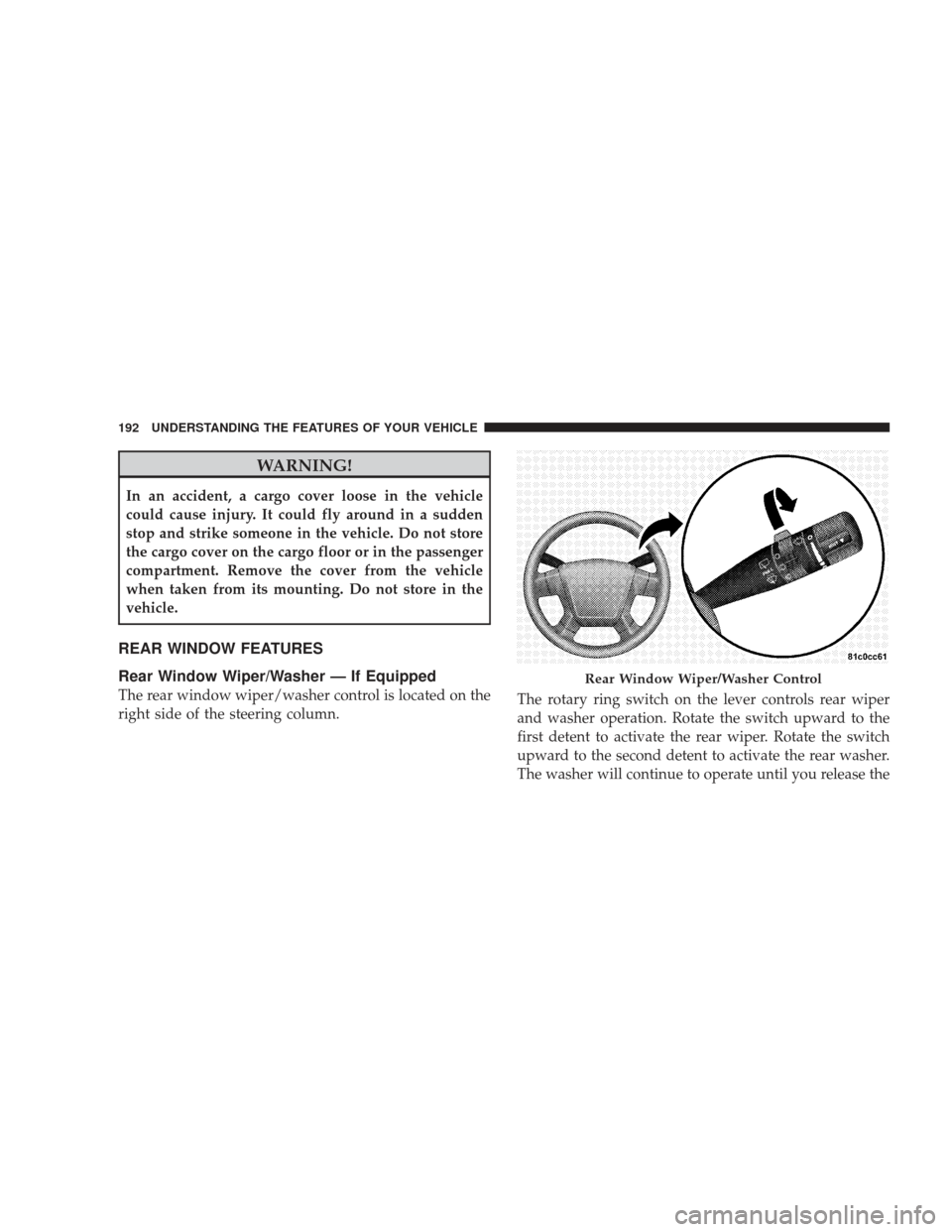
The rear window wiper/washer control is located on the
right side of the steering column.The rotary ring switch on the lever controls rear wiper
and washer operation. Rotate the switch upward to the
first detent to activate the rear wiper. Rotate the switch
upward to the second detent to activate the rear washer.
The washer will continue to operate until you release the
Rear Window Wiper/Washer Control
192 UNDERSTANDING THE FEATURES OF YOUR VEHICLE
Page 197 of 506
External racks do not increase the total load carrying
capacity of the vehicle. Be sure that the total occupant
and luggage load inside the vehicle, plus the load on the
luggage rack, do not exceed the maximum vehicle load
capacity.
CAUTION!
•To avoid damage to the roof rack and vehicle, do
not exceed the maximum roof rack load capacity.
Always distribute heavy loads as evenly as pos-
sible and secure the load appropriately.
•Long loads, which extend over the windshield,
such as wood panels or surfboards, should be
secured to both the front and rear of the vehicle.
•Place a blanket or other protection between the
surface of the roof and the load.(Continued)
CAUTION! (Continued)
•Travel at reduced speeds and turn corners care-
fully when carrying large or heavy loads on the
roof rack. Wind forces, due to natural causes or
nearby truck traffic, can add sudden upward loads.
This is especially true on large flat loads and may
result in damage to the cargo or your vehicle.
WARNING!
Cargo must be securely tied down before driving
your vehicle. Improperly secured loads can fly off the
vehicle, particularly at high speeds, resulting in per-
sonal injury or property damage. Follow the roof rack
cautions when carrying cargo on your roof rack.
UNDERSTANDING THE FEATURES OF YOUR VEHICLE 195
3
Page 205 of 506

maintain correct tire pressure, even if under-inflation has
not reached the level to trigger illumination of the TPMS
low tire pressure telltale.
Your vehicle has also been equipped with a TPMS
malfunction indicator to indicate when the system is not
operating properly. The TPMS malfunction indicator is
combined with the low tire pressure telltale. When the
system detects a malfunction, the telltale will flash for
approximately one minute and then remain continuously
illuminated. This sequence will continue upon subse-
quent vehicle start-ups as long as the malfunction exists.
When the malfunction indicator is illuminated, the sys-
tem may not be able to detect or signal low tire pressure
as intended. TPMS malfunctions may occur for a variety
of reasons, including the installation of replacement or
alternate tires or wheels on the vehicle that prevent the
TPMS from functioning properly. Always check the
TPMS malfunction telltale after replacing one or moretires or wheels on your vehicle, to ensure that the
replacement or alternate tires and wheels allow the TPMS
to continue to function properly.
CAUTION!
The TPMS has been optimized for the original
equipment tires and wheels. TPMS pressures and
warning have been established for the tire size
equipped on your vehicle. Undesirable system opera-
tion or sensor damage may result when using re-
placement equipment that is not of the same size,
type, and/or style. Aftermarket wheels can cause
sensor damage. Do not use tire sealant from a can, or
balance beads if your vehicle is equipped with a
TPMS, as damage to the sensors may result.
UNDERSTANDING YOUR INSTRUMENT PANEL 203
4