Page 383 of 506
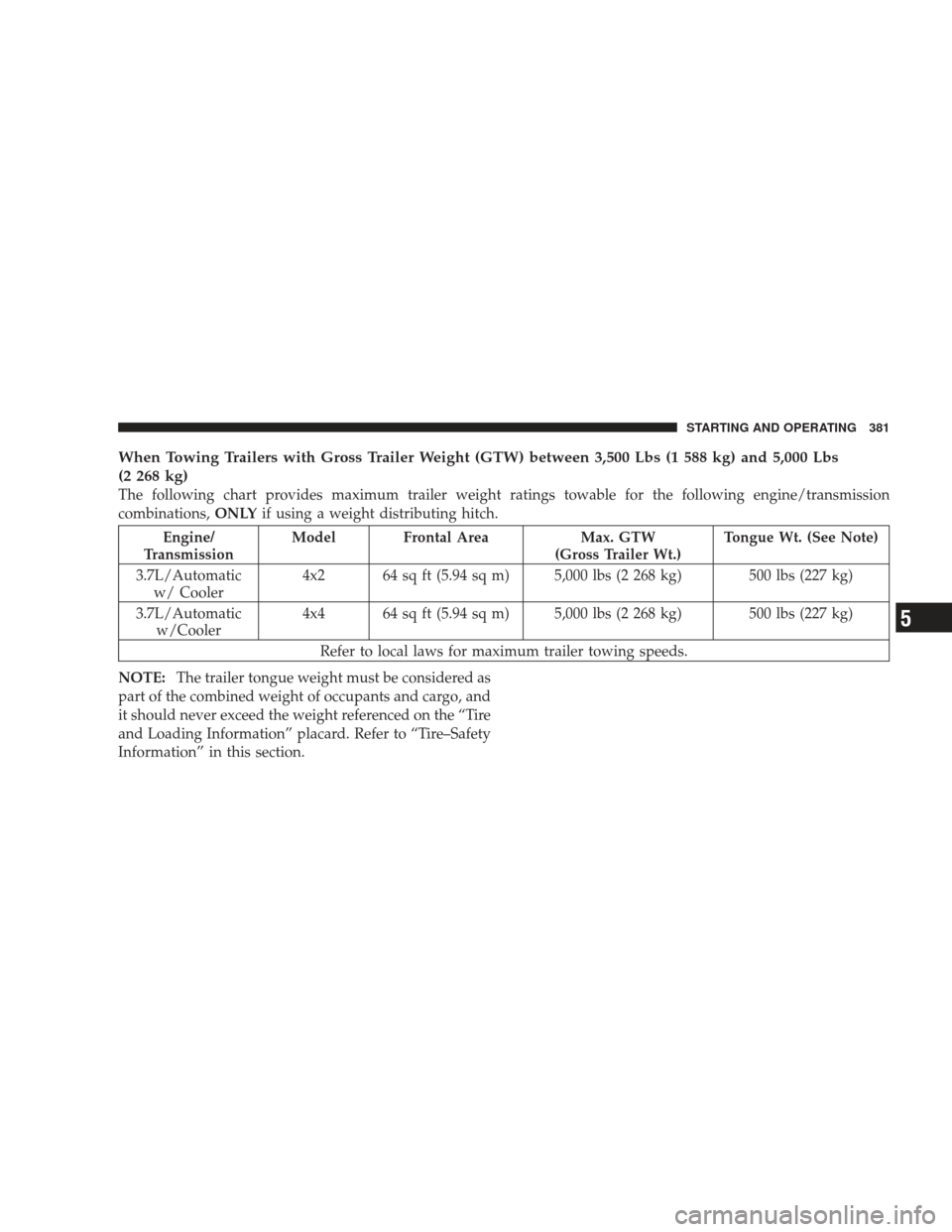
When Towing Trailers with Gross Trailer Weight (GTW) between 3,500 Lbs (1 588 kg) and 5,000 Lbs
(2 268 kg)
The following chart provides maximum trailer weight ratings towable for the following engine/transmission
combinations,ONLYif using a weight distributing hitch.
Engine/
Transmission Model Frontal Area
Max. GTW
(Gross Trailer Wt.) Tongue Wt. (See Note)
3.7L/Automatic w/ Cooler 4x2 64 sq ft (5.94 sq m) 5,000 lbs (2 268 kg) 500 lbs (227 kg)
3.7L/Automatic w/Cooler 4x4 64 sq ft (5.94 sq m) 5,000 lbs (2 268 kg) 500 lbs (227 kg)
Refer to local laws for maximum trailer towing speeds.
NOTE: The trailer tongue weight must be considered as
part of the combined weight of occupants and cargo, and
it should never exceed the weight referenced on the “Tire
and Loading Information” placard. Refer to “Tire–Safety
Information” in this section.
STARTING AND OPERATING 381
5
Page 385 of 506
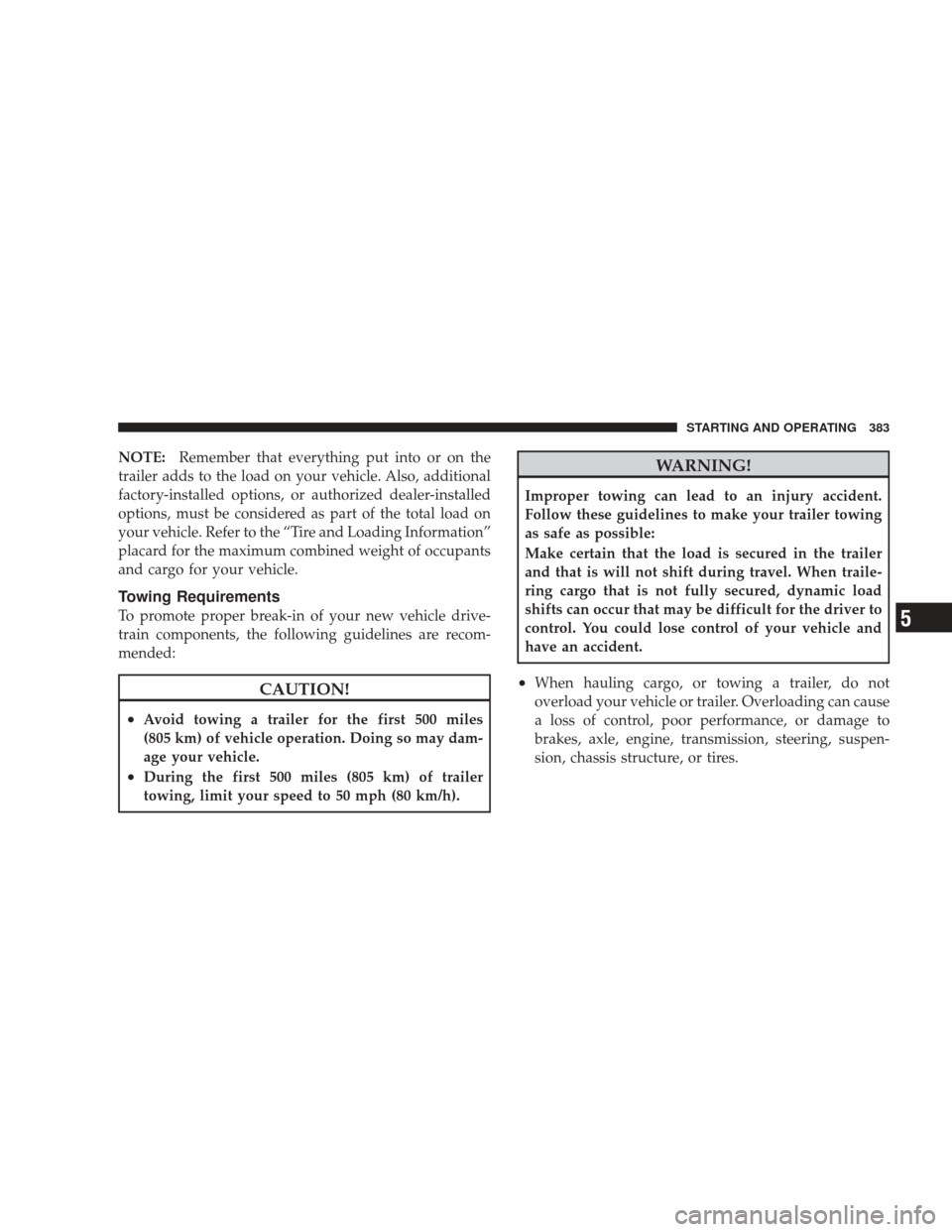
NOTE:Remember that everything put into or on the
trailer adds to the load on your vehicle. Also, additional
factory-installed options, or authorized dealer-installed
options, must be considered as part of the total load on
your vehicle. Refer to the “Tire and Loading Information”
placard for the maximum combined weight of occupants
and cargo for your vehicle.
Towing Requirements
To promote proper break-in of your new vehicle drive-
train components, the following guidelines are recom-
mended:
CAUTION!
•Avoid towing a trailer for the first 500 miles
(805 km) of vehicle operation. Doing so may dam-
age your vehicle.
•During the first 500 miles (805 km) of trailer
towing, limit your speed to 50 mph (80 km/h).
WARNING!
Improper towing can lead to an injury accident.
Follow these guidelines to make your trailer towing
as safe as possible:
Make certain that the load is secured in the trailer
and that is will not shift during travel. When traile-
ring cargo that is not fully secured, dynamic load
shifts can occur that may be difficult for the driver to
control. You could lose control of your vehicle and
have an accident.
•When hauling cargo, or towing a trailer, do not
overload your vehicle or trailer. Overloading can cause
a loss of control, poor performance, or damage to
brakes, axle, engine, transmission, steering, suspen-
sion, chassis structure, or tires.
STARTING AND OPERATING 383
5
Page 390 of 506
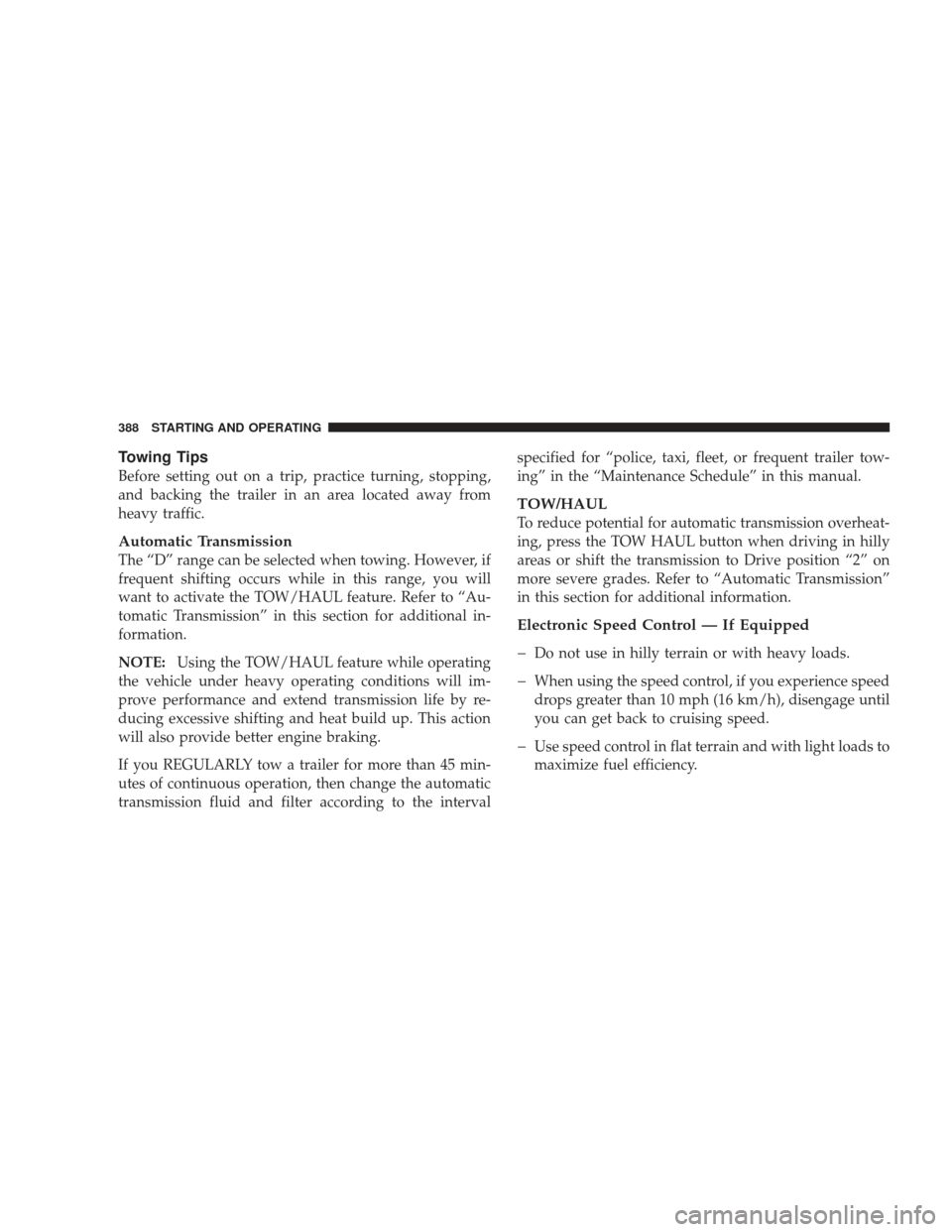
Towing Tips
Before setting out on a trip, practice turning, stopping,
and backing the trailer in an area located away from
heavy traffic.
Automatic Transmission
The “D” range can be selected when towing. However, if
frequent shifting occurs while in this range, you will
want to activate the TOW/HAUL feature. Refer to “Au-
tomatic Transmission” in this section for additional in-
formation.
NOTE:Using the TOW/HAUL feature while operating
the vehicle under heavy operating conditions will im-
prove performance and extend transmission life by re-
ducing excessive shifting and heat build up. This action
will also provide better engine braking.
If you REGULARLY tow a trailer for more than 45 min-
utes of continuous operation, then change the automatic
transmission fluid and filter according to the interval specified for “police, taxi, fleet, or frequent trailer tow-
ing” in the “Maintenance Schedule” in this manual.
TOW/HAUL
To reduce potential for automatic transmission overheat-
ing, press the TOW HAUL button when driving in hilly
areas or shift the transmission to Drive position “2” on
more severe grades. Refer to “Automatic Transmission”
in this section for additional information.
Electronic Speed Control — If Equipped
Do not use in hilly terrain or with heavy loads.
When using the speed control, if you experience speed
drops greater than 10 mph (16 km/h), disengage until
you can get back to cruising speed.
Use speed control in flat terrain and with light loads to
maximize fuel efficiency.
388 STARTING AND OPERATING
Page 391 of 506
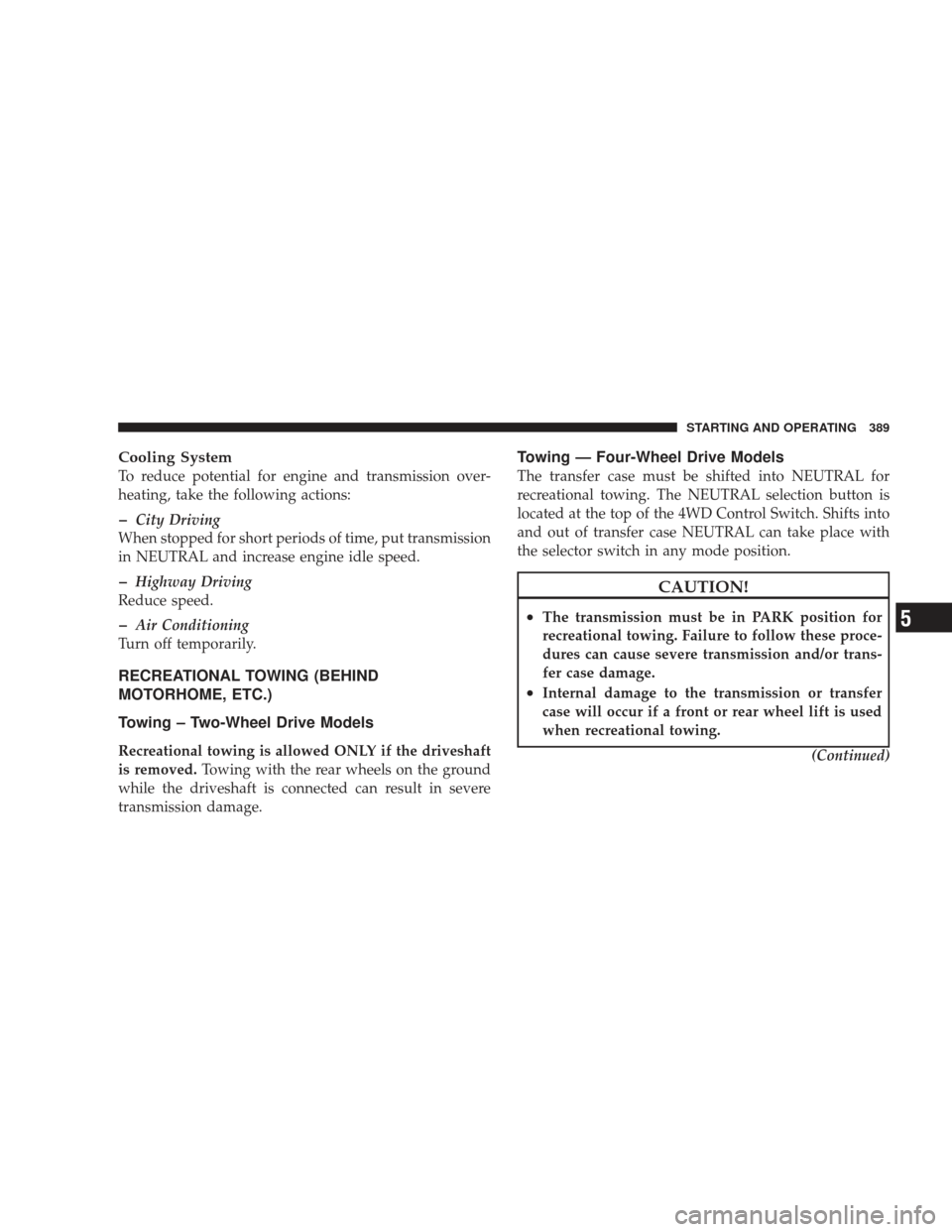
Cooling System
To reduce potential for engine and transmission over-
heating, take the following actions:
City Driving
When stopped for short periods of time, put transmission
in NEUTRAL and increase engine idle speed.
Highway Driving
Reduce speed.
Air Conditioning
Turn off temporarily.
RECREATIONAL TOWING (BEHIND
MOTORHOME, ETC.)
Towing – Two-Wheel Drive Models
Recreational towing is allowed ONLY if the driveshaft
is removed. Towing with the rear wheels on the ground
while the driveshaft is connected can result in severe
transmission damage.
Towing — Four-Wheel Drive Models
The transfer case must be shifted into NEUTRAL for
recreational towing. The NEUTRAL selection button is
located at the top of the 4WD Control Switch. Shifts into
and out of transfer case NEUTRAL can take place with
the selector switch in any mode position.
CAUTION!
•The transmission must be in PARK position for
recreational towing. Failure to follow these proce-
dures can cause severe transmission and/or trans-
fer case damage.
•Internal damage to the transmission or transfer
case will occur if a front or rear wheel lift is used
when recreational towing.
(Continued)
STARTING AND OPERATING 389
5
Page 392 of 506
CAUTION! (Continued)
•Before recreational towing, perform the procedure
outlined under “Shifting into NEUTRAL” to be
certain that the transfer case is fully in NEUTRAL.
Otherwise, internal damage will result.
•Do not use a bumper mounted clamp-on tow bar on
your vehicle. The bumper face bar will be damaged.
WARNING!
You or others could be injured if you leave the
vehicle unattended with the transfer case in the
NEUTRAL position without first fully engaging the
parking brake. The transfer case NEUTRAL position
disengages both the front driveshaft and rear drive-
shaft from the powertrain and it will allow the
vehicle to move despite the transmission position.
The parking brake should always be applied when
the driver is not in the vehicle.
Shifting into NEUTRAL
Perform the following procedure to prepare your vehicle
for recreational towing:
1. Bring the vehicle to a complete stop.
2. Turn OFF the engine.
3. Turn the ignition switch to the ON position.
4. Press the brake pedal.
5. Shift the transmission into NEUTRAL.
6. Use the point of a ballpoint pen or similar object to
press the recessed transfer case NEUTRAL button for
four seconds. After the shift is complete, and the NEU-
TRAL light turns on, release the NEUTRAL button.
7. Start the engine.
8. Shift the transmission into REVERSE.
9. Release the brake pedal for five seconds and ensure
that there is no vehicle movement.
390 STARTING AND OPERATING
Page 393 of 506
10. Repeat Steps 8 and 9 with the transmission in DRIVE.
11. Turn OFF the engine.
12. Turn the ignition switch to the unlocked OFF posi-
tion.
13. Shift the transmission into PARK.
14. Attach the vehicle to a tow vehicle with a tow bar.
15. Disconnect the battery negative cable.
NOTE:Steps 1 through 5 are requirements for shifting
the transfer case. If these requirements are not met prior
to depressing the NEUTRAL selection button or while
the shift attempt is in process, then the NEUTRAL
indicator light will flash continuously until all require-
ments are met or until the NEUTRAL button is released.
The ignition switch must be in the ON position for a shift
to take place and for the position indicator lights to be operable. If the ignition switch is not in the ON position,
the shift will not take place and no position indicator
lights will be on or flashing.
Flashing NEUTRAL position indicator light indicates
that shift requirements have not been met.
CAUTION!
Damage to the transmission may occur if the trans-
mission is shifted into PARK with the transfer case in
NEUTRAL and the engine RUNNING. With the
transfer case in NEUTRAL, ensure that the engine is
OFF prior to shifting the transmission into PARK.
Shifting Out of NEUTRAL
Perform the following procedure to prepare your vehicle
for normal usage:
1. Bring the vehicle to a complete stop.
STARTING AND OPERATING 391
5
Page 394 of 506
2. Reconnect the battery negative cable.
3. Place the ignition switch in the LOCK position (if it
has been moved or the engine has been started).
4. Turn the ignition switch to the ON position, but do not
start the engine.
5. Press the brake pedal.
6. Shift the transmission into NEUTRAL.
7. Use the point of a ballpoint pen or similar object to
press the recessed transfer case NEUTRAL button. Re-
lease the NEUTRAL button after the NEUTRAL indicator
light turns off (approximately one second). After the
NEUTRAL button is released, the transfer case will shift
to the position identified by the selector switch.
8. Start the engine.
9. Shift the transmission into DRIVE.10. Set the parking brake.
11. Shift the transmission into PARK.
NOTE:
Steps 1 through 6 are requirements for shifting
the transfer case. If these requirements are not met prior
to depressing the NEUTRAL selection button or while
the shift attempt is in process, then all of the mode
position indicator lights will flash continuously until all
requirements are met or until the NEUTRAL button is
released.
The ignition switch must be in the ON position for a shift
to take place and for the position indicator lights to be
operable. If the ignition switch in not in the ON position,
the shift will not take place and no position indicator
lights will be on or flashing.
Flashing NEUTRAL position indicator light indicates
that shift requirements have not been met.
392 STARTING AND OPERATING
Page 395 of 506
WHAT TO DO IN EMERGENCIES
CONTENTS
�Hazard Warning Flasher ................ 394
� If Your Engine Overheats ................ 394
� Jacking And Tire Changing ............... 395
▫ Jack Location ....................... 396
▫ Spare Tire Stowage ................... 396 ▫
Spare Tire Removal ................... 396
▫ Preparations For Jacking ............... 397
▫ Jacking Instructions ................... 398
� Jump-Starting ........................ 402
� Towing A Disabled Vehicle ............... 404
6