Page 3 of 521
TABLE OF CONTENTSSECTIONPAGE
1INTRODUCTION.............................................................3
2THINGS TO KNOW BEFORE STARTING YOUR VEHICLE..............................11
3UNDERSTANDING THE FEATURES OF YOUR VEHICLE...............................73
4UNDERSTANDING YOUR INSTRUMENT PANEL................................... 177
5STARTING AND OPERATING................................................. 275
6WHAT TO DO IN EMERGENCIES...............................................389
7MAINTAINING YOUR VEHICLE............................................... 403
8MAINTENANCE SCHEDULES.................................................. 461
9IF YOU NEED CONSUMER ASSISTANCE..........................................487
10INDEX....................................................................497
1
2
3
4
5
6
7
8
9
10
Page 200 of 521
•PRESS BRAKE TO START
•INSERT KEY
•TURN TO ON
Engine Oil Change Indicator System
Oil Change Required (Gasoline Engines Only)
Your vehicle is equipped with an engine oil change
indicator system. The “Oil Change Required” message
will flash in the EVIC display for approximately 10 sec-
onds after a single chime has sounded, to indicate the
next scheduled oil change interval. The engine oil change
indicator system is duty cycle based, which means the
engine oil change interval may fluctuate, dependent
upon your personal driving style.
Unless reset, this message will continue to display each
time you turn the ignition switch to the ON/RUN
position. To turn off the message temporarily, press andrelease the MENU button. To reset the oil change indica-
tor system (after performing the scheduled maintenance)
refer to the following procedure.
1. Turn the ignition switch to the ON position (Do not
start the engine).
2. Fully depress the accelerator pedal, slowly, three times
within 10 seconds.
3. Turn the ignition switch to the OFF/LOCK position.
NOTE:If the indicator message illuminates when you
start the vehicle, the oil change indicator system did not
reset. If necessary, repeat this procedure.
Trip Functions
Press and release the MENU button until one of the
following Trip Functions displays in the EVIC:
•Average Fuel Economy
•Distance To Empty
198 UNDERSTANDING YOUR INSTRUMENT PANEL
Page 346 of 521
TIRE ROTATION RECOMMENDATIONS
Tires on the front and rear axles of vehicles operate at
different loads and perform different steering, handling,
and braking functions. For these reasons, they wear at
unequal rates and develop irregular wear patterns.
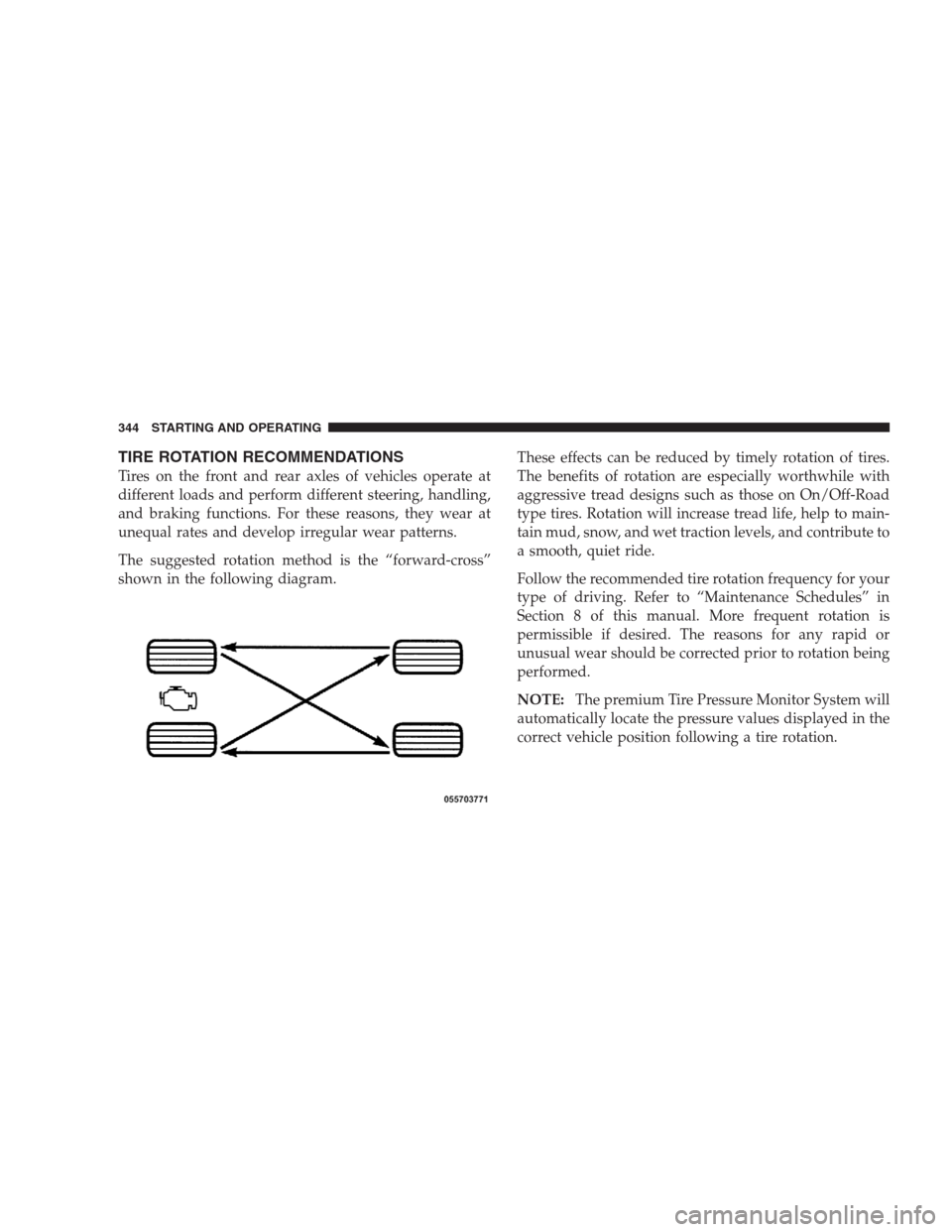
The suggested rotation method is the “forward-cross”
shown in the following diagram.These effects can be reduced by timely rotation of tires.
The benefits of rotation are especially worthwhile with
aggressive tread designs such as those on On/Off-Road
type tires. Rotation will increase tread life, help to main-
tain mud, snow, and wet traction levels, and contribute to
a smooth, quiet ride.
Follow the recommended tire rotation frequency for your
type of driving. Refer to “Maintenance Schedules” in
Section 8 of this manual. More frequent rotation is
permissible if desired. The reasons for any rapid or
unusual wear should be corrected prior to rotation being
performed.
NOTE:The premium Tire Pressure Monitor System will
automatically locate the pressure values displayed in the
correct vehicle position following a tire rotation.
344 STARTING AND OPERATING
Page 378 of 521
NOTE:Remember that everything put into or on the
trailer adds to the load on your vehicle. Also, additional
factory-installed options, or authorized dealer-installed
options, must be considered as part of the total load on
your vehicle. Refer to the Tire and Loading Information
placard in the “Tire Safety Information” section of this
manual for the maximum combined weight of occupants
and cargo for your vehicle.
Towing Requirements
To promote proper break-in of your new vehicle driv-
etrain components, the following guidelines are recom-
mended.
CAUTION!
•Avoid towing a trailer for the first 500 miles
(805 km) of vehicle operation. Doing so may dam-
age your vehicle.
(Continued)
CAUTION! (Continued)
•During the first 500 miles (805 km) of trailer
towing, limit your speed to 50 mph (80 km/h).
Perform the maintenance listed in the “Maintenance
Schedule.” Refer to Section 8 of this manual for the
proper maintenance intervals. When towing a trailer,
never exceed the GAWR, or GCWR, ratings.
WARNING!
•Make certain that the load is secured in the trailer
and will not shift during travel. When trailering
cargo that is not fully secured, dynamic load shifts
can occur that may be difficult for the driver to
control. You could lose control of your vehicle and
have an accident.
(Continued)
376 STARTING AND OPERATING
Page 383 of 521
Towing Tips
Before setting out on a trip, practice turning, stopping
and backing the trailer in an area away from heavy
traffic.
Automatic Transmission
The DRIVE range can be selected when towing. How-
ever, if frequent shifting occurs while in this range, the
TOW/HAUL mode (if equipped), or a lower gear range,
should be selected.
NOTE:Using the TOW/HAUL mode (if equipped), or a
lower gear range while operating the vehicle under
heavy operating conditions, will improve performance
and extend transmission life by reducing excessive shift-
ing and heat buildup. This action will also provide better
engine braking.The transmission fluid and filter should be changed if
you REGULARLY tow a trailer for more than 45 minutes
of continuous operation. Refer to the “Maintenance
Schedule” in Section 8 of this manual for proper mainte-
nance intervals.
NOTE:Check the transmission fluid level before towing
(4.7L and 5.7L engines).
Electronic Speed Control — If Equipped
Do not use in hilly terrain or with heavy loads.
When using the speed control, if you experience speed
drops greater than 10 mph (16 km/h), disengage until
you can get back to cruising speed.
Use speed control in flat terrain and with light loads to
maximize fuel efficiency.
STARTING AND OPERATING 381
5
Page 415 of 521
before going to the I/M station. The I/M station can fail
your vehicle because the MIL is on with the engine
running.
REPLACEMENT PARTS
Use of genuine MOPAR�parts for normal/scheduled
maintenance and repairs is highly recommended to en-
sure the designed performance. Damage or failures
caused by the use of non-MOPAR�parts for maintenance
and repairs will not be covered by the manufacturer’s
warranty.
DEALER SERVICE
Your authorized dealer has the qualified service person-
nel, special tools, and equipment to perform all service
operations in an expert manner. Service Manuals are
available which include detailed service information for
your vehicle. Refer to these manuals before attempting
any procedure yourself.NOTE:Intentional tampering with emissions control
systems can result in civil penalties being assessed
against you.
WARNING!
You can be badly injured working on or around a
motor vehicle. Only do service work for which you
have the knowledge and the proper equipment. If
you have any doubt about your ability to perform a
service job, take your vehicle to a competent me-
chanic.
MAINTENANCE PROCEDURES
The pages that follow contain therequiredmaintenance
services determined by the engineers who designed your
vehicle.
Besides the maintenance items for which there are fixed
maintenance intervals, there are other items that should
MAINTAINING YOUR VEHICLE 413
7
Page 416 of 521
operate satisfactorily without periodic maintenance.
However, if a malfunction of these items does occur, it
could adversely affect the engine or vehicle performance.
These items should be inspected if a malfunction is
observed or suspected.
Engine Oil
Checking Oil Level
To assure proper engine lubrication, the engine oil must
be maintained at the correct level. Check the oil level at
regular intervals, such as every fuel stop. The best time to
check the engine oil level is about five minutes after a
fully warmed engine is shut off, or before starting the
engine after it has sat overnight.
Checking the oil while the vehicle is on level ground will
improve the accuracy of the oil level readings. Maintain
the oil level in the SAFE level range. Adding 1 U.S. Quart(0.95L) of oil when the level is at the bottom of the SAFE
range will result in the level being at the top of the SAFE
range.
CAUTION!
Overfilling or underfilling the crankcase will cause
aeration or loss of oil pressure. This could damage
your engine.
3.0L Diesel Engine Only
Before checking the engine oil level, turn the engine off
and wait 15 minutes to allow for the oil to return to the oil
pan.
Change Engine Oil
Refer to the “Maintenance Schedule” in Section 8 for
proper maintenance intervals.
414 MAINTAINING YOUR VEHICLE
Page 419 of 521
The engine oil filler cap also shows the recommended
engine oil viscosity for your vehicle. For information on
engine oil filler cap location, refer to “Engine Compart-
ment” in this section.
Synthetic Engine Oils
You may use synthetic engine oils if the recommended oil
quality requirements are met, and the recommended
maintenance intervals for oil and filter changes are
followed.
Materials Added to Engine Oils
The manufacturerstrongly recommendsagainst the ad-
dition of any additives (other than leak detection dyes) to
the engine oil. Engine oil is an engineered product and its
performance may be impaired by supplemental
additives.
Disposing of Used Engine Oil and Oil Filters
Care should be taken in disposing of used engine oil and
oil filters from your vehicle. Used oil and oil filters,indiscriminately discarded, can present a problem to the
environment. Contact your local authorized dealer, ser-
vice station, or governmental agency for advice on how
and where used oil and oil filters can be safely discarded
in your area.
Engine Oil Filter
The engine oil filter should be replaced with a new filter
at every oil change.
Engine Oil Filter Selection
The manufacturer’s engines have a full-flow type dispos-
able oil filter. Use a filter of this type for replacement. The
quality of replacement filters varies considerably. Only
high-quality filters should be used to assure most effi-
cient service. MOPAR�engine oil filters are high-quality
oil filters and are recommended.
Engine Air Cleaner Filter
Refer to the “Maintenance Schedule” in Section 8 for the
proper maintenance interval.
MAINTAINING YOUR VEHICLE 417
7
