Page 198 of 521
•LIFTGATE/HOOD OPEN (with graphic)
•HOOD/GLASS/DOOR OPEN (with graphic)
•HOOD/GLASS/DOORS OPEN (with graphic)
•HOOD/GATE/DOOR OPEN (with graphic)
•HOOD/GATE/DOORS OPEN (with graphic)
•LIFTGLASS/DOOR OPEN (with graphic)
•LIFTGLASS/DOORS OPEN (with graphic)
•LIFTGLASS/HOOD OPEN (with graphic)
•WASHER FLUID LOW (with graphic)
•COOLANT LOW (with graphic)
•OIL CHANGE REQUIRED
•OIL CHANGE RESET
•CHECK GAUGES
•AUTO HIGH BEAMS ON
•AUTO HIGH BEAMS OFF
•PARK ASSIST DISABLED
•SERVICE SUSPENSION
•SERVICE PARK ASSIST SYSTEM
•TRANSMISSION OVER TEMP
•CHECK SHIFT PROCEDURE
•SERVICE 4WD SYSTEM
•4WD SYSTEM IN NEUTRAL
•LOW BRAKE FLUID LEVEL
•WARNING! LIMIT SPEED
•CHECK GASCAP
•ESP OFF
196 UNDERSTANDING YOUR INSTRUMENT PANEL
Page 294 of 521
left “D(-)” and hold it there. The transmission will shift to
the range from which the vehicle can best be slowed
down.
Overdrive Operation
The automatic transmission includes an electronically
controlled Overdrive (5th gear for 3.7L and 3.0L diesel
engine, 4th and 5th gears for 4.7L and 5.7L engines). The
transmission will automatically shift to Overdrive, if the
following conditions are present:
•the transmission selector is in DRIVE;
•the engine coolant has reached normal operating tem-
perature;
•vehicle speed is above approximately 30 mph
(48 km/h);
•the TOW/HAUL switch has not been activated;
•transmission has reached normal operating
temperature.
NOTE:If the vehicle is started in extremely cold tem-
peratures, the transmission may not shift into Overdrive
and will automatically select the most desirable gear for
operation at this temperature. Normal operation will
resume when the transmission fluid temperature has
risen to a suitable level. Refer also to the Note under
torque converter clutch, later in this section.
During cold temperature operation you may notice de-
layed upshifts, depending on engine and transmission
temperature. This feature improves the warmup time of
the engine and transmission.
If the transmission temperature gets extremely hot, the
transmission will automatically select the most desirable
gear for operation at this temperature. If the transmission
temperature becomes hot enough, the “TRANSMISSION
292 STARTING AND OPERATING
Page 429 of 521
•Mix a minimum solution of 50% HOAT engine coolant
(antifreeze) and distilled water. Use higher concentra-
tions (not to exceed 70%) if temperatures below -34°F
(-37°C) are anticipated.
•Use only high purity water such as distilled or deion-
ized water when mixing the water/engine coolant
(antifreeze) solution. The use of lower quality water
will reduce the amount of corrosion protection in the
engine cooling system.
Please note that it is the owner’s responsibility to main-
tain the proper level of protection against freezing ac-
cording to the temperatures occurring in the area where
the vehicle is operated.NOTE:Mixing engine coolant (antifreeze) types will
decrease the life of the engine coolant (antifreeze) and
will require more frequent engine coolant (antifreeze)
changes.Cooling System Pressure Cap
The cap must be fully tightened to prevent loss of engine
coolant (antifreeze), and to ensure that engine coolant
(antifreeze) will return to the radiator from the coolant
recovery tank.
The cap should be inspected and cleaned if there is any
accumulation of foreign material on the sealing surfaces.
MAINTAINING YOUR VEHICLE 427
7
Page 430 of 521
WARNING!
•The warning words DO NOT OPEN HOT on the
cooling system pressure cap are a safety precau-
tion. Never add engine coolant (antifreeze) when
the engine is overheated. Do not loosen or remove
the cap to cool an overheated engine. Heat causes
pressure to build up in the cooling system. To
prevent scalding or injury, do not remove the
pressure cap while the system is hot or under
pressure.
•Do not use a pressure cap other than the one
specified for your vehicle. Personal injury or en-
gine damage may result.
Disposal of Used Engine Coolant
Used ethylene glycol-based engine coolant (antifreeze) is
a regulated substance requiring proper disposal. Check
with your local authorities to determine the disposalrules for your community. To prevent ingestion by ani-
mals and children, do not store ethylene glycol-based
engine coolant (antifreeze) in open containers or allow it
to remain in puddles on the ground. If ingested by a
child, contact a physician immediately. Clean up any
ground spills immediately.
Coolant Level
The coolant bottle provides a quick visual method for
determining that the engine coolant (antifreeze) level is
adequate. With the engine idling, and warm to normal
operating temperature, the level of the engine coolant
(antifreeze) in the bottle should be between the ranges
indicated on the bottle.
The radiator normally remains completely full, so there is
no need to remove the radiator cap, unless checking for
engine coolant (antifreeze) freeze point or replacing en-
gine coolant (antifreeze). Advise your service attendant
428 MAINTAINING YOUR VEHICLE
Page 431 of 521
of this. As long as the engine operating temperature is
satisfactory, the coolant bottle need only be checked once
a month.
When additional engine coolant (antifreeze) is needed to
maintain the proper level, it should be added to the
coolant bottle. Do not overfill.
Points To Remember
NOTE:When the vehicle is stopped after a few miles
(kilometers) of operation, you may observe vapor coming
from the front of the engine compartment. This is nor-
mally a result of moisture from rain, snow, or high
humidity accumulating on the radiator and being vapor-
ized when the thermostat opens, allowing hot engine
coolant (antifreeze) to enter the radiator.
If an examination of your engine compartment shows no
evidence of radiator or hose leaks, the vehicle may be
safely driven. The vapor will soon dissipate.
•Do not overfill the coolant recovery bottle.
•Check engine coolant (antifreeze) freeze point in the
radiator and in the coolant recovery bottle. If engine
coolant (antifreeze) needs to be added, contents of
coolant recovery bottle must also be protected against
freezing.
•If frequent engine coolant (antifreeze) additions are
required, or if the level in the coolant recovery bottle
does not drop when the engine cools, the cooling
system should be pressure tested for leaks.
•Maintain engine coolant (antifreeze) concentration at
50% HOAT engine coolant (antifreeze) (minimum)
and distilled water for proper corrosion protection of
your engine, which contains aluminum components.
•Make sure that the radiator and coolant recovery
bottle hoses are not kinked or obstructed.
MAINTAINING YOUR VEHICLE 429
7
Page 459 of 521
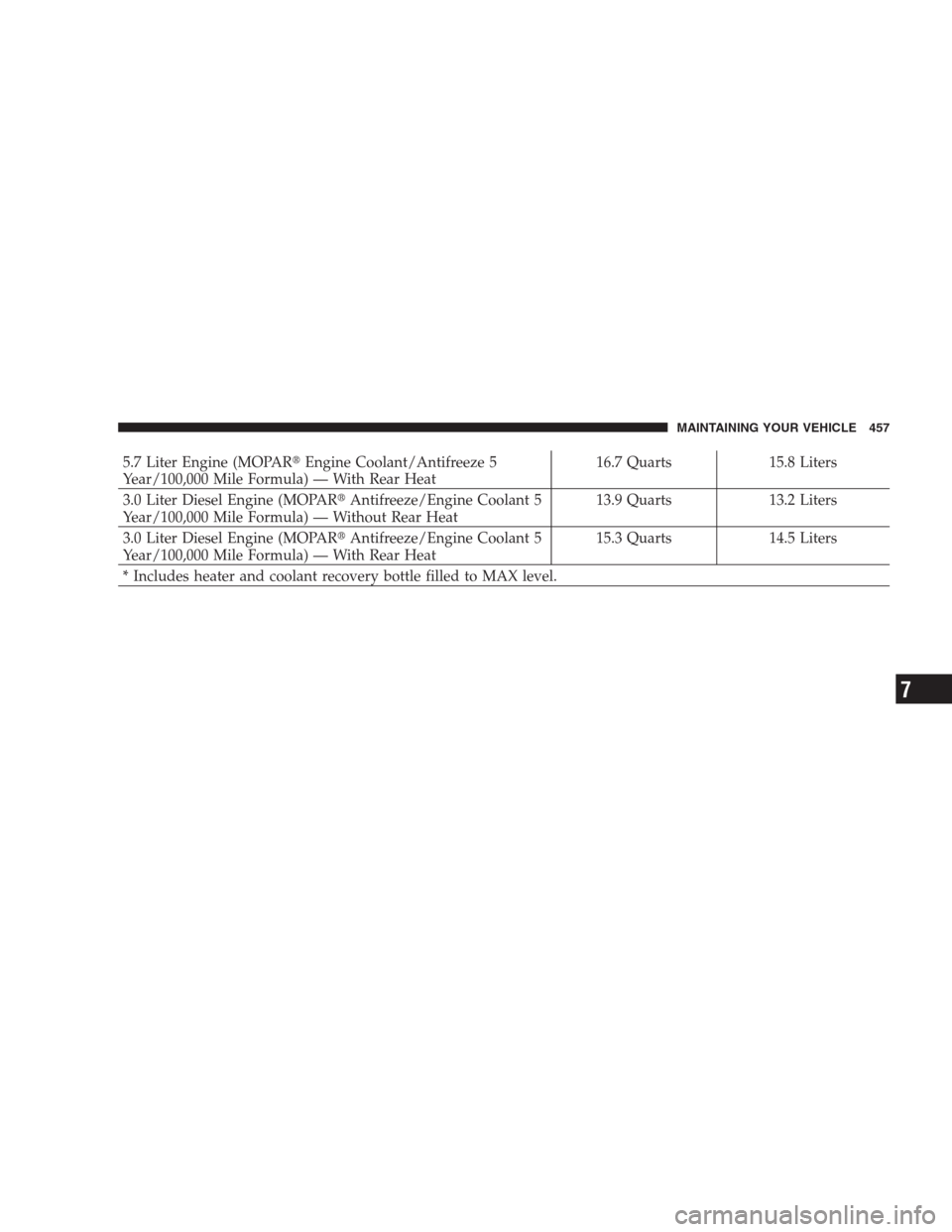
5.7 Liter Engine (MOPAR�Engine Coolant/Antifreeze 5
Year/100,000 Mile Formula) — With Rear Heat16.7 Quarts 15.8 Liters
3.0 Liter Diesel Engine (MOPAR�Antifreeze/Engine Coolant 5
Year/100,000 Mile Formula) — Without Rear Heat13.9 Quarts 13.2 Liters
3.0 Liter Diesel Engine (MOPAR�Antifreeze/Engine Coolant 5
Year/100,000 Mile Formula) — With Rear Heat15.3 Quarts 14.5 Liters
* Includes heater and coolant recovery bottle filled to MAX level.
MAINTAINING YOUR VEHICLE 457
7
Page 465 of 521
if it has been 6 months since your last oil change even
if the oil change indicator message is NOT illumi-
nated.
•Change your engine oil more often if you drive your
vehicle off-road for an extended period of time.
•Under no circumstances should oil change intervals
exceed 6,000 miles (10,000 km) or 6 months, whichever
comes first.
Your authorized dealer will reset the oil change indicator
message after completing the scheduled oil change. If this
scheduled oil change is performed by someone other
than your authorized dealer the message can be reset by
referring to the steps described under ”Electronic Vehicle
Information Center” in Section 4 of this manual.
At Each Stop for Fuel
•Check the engine oil level about 5 minutes after a fully
warmed engine is shut off. Checking the oil level whilethe vehicle is on level ground will improve the accu-
racy of the oil level reading. Add oil only when the
level is at or below the ADD or MIN mark.
•Check the windshield washer solvent and add if
required.
Once a Month
•Check tire pressure and look for unusual wear or
damage.
•Inspect the battery and clean and tighten the terminals
as required.
•Check the fluid levels of the coolant reservoir, brake
master cylinder, power steering and transmission
(4.7L and 5.7L only) and add as needed.
•Check all lights and other electrical items for correct
operation.
MAINTENANCE SCHEDULES 463
8
M
A
I
N
T
E
N
A
N
C
E
S
C
H
E
D
U
L
E
S
Page 479 of 521
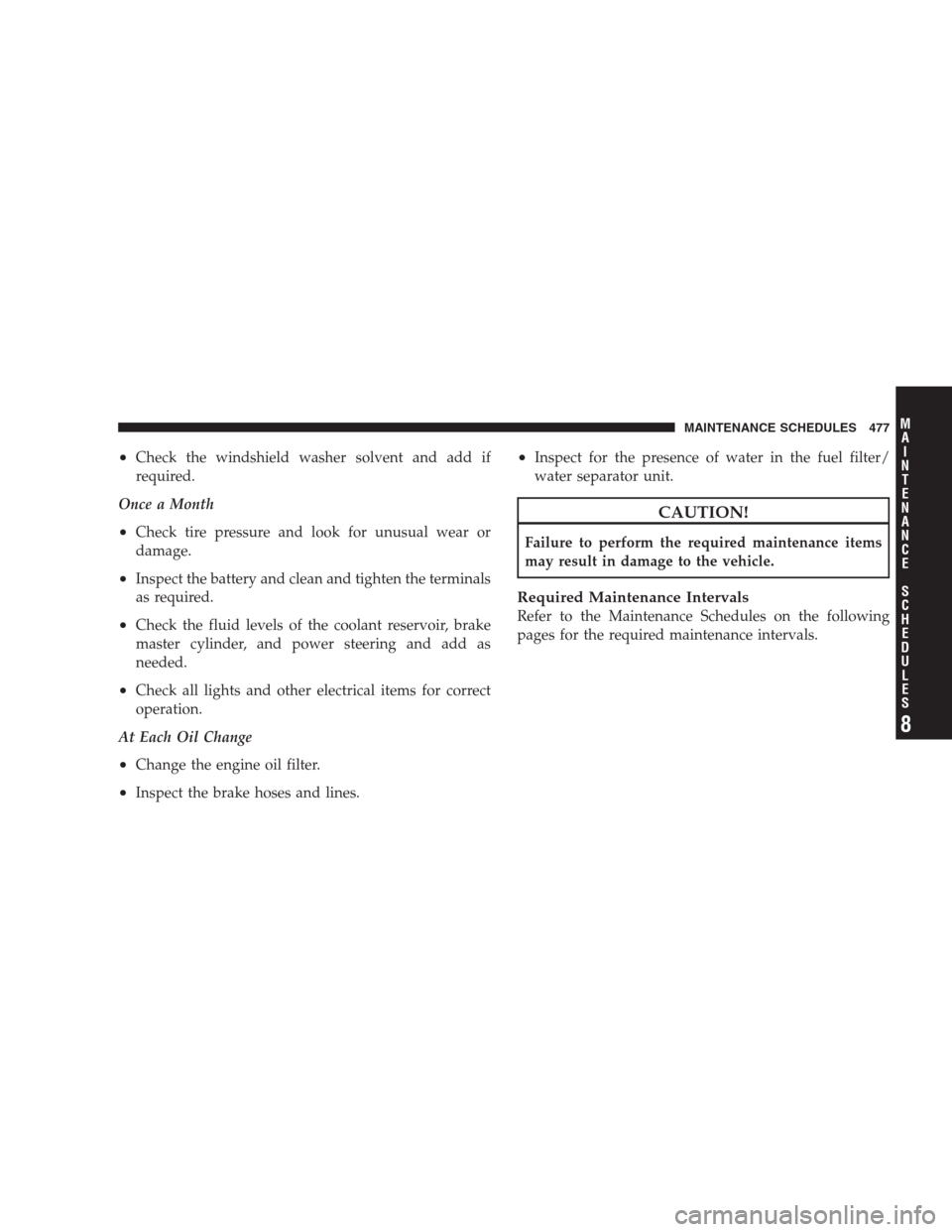
•Check the windshield washer solvent and add if
required.
Once a Month
•Check tire pressure and look for unusual wear or
damage.
•Inspect the battery and clean and tighten the terminals
as required.
•Check the fluid levels of the coolant reservoir, brake
master cylinder, and power steering and add as
needed.
•Check all lights and other electrical items for correct
operation.
At Each Oil Change
•Change the engine oil filter.
•Inspect the brake hoses and lines.
•Inspect for the presence of water in the fuel filter/
water separator unit.
CAUTION!
Failure to perform the required maintenance items
may result in damage to the vehicle.
Required Maintenance Intervals
Refer to the Maintenance Schedules on the following
pages for the required maintenance intervals.
MAINTENANCE SCHEDULES 477
8
M
A
I
N
T
E
N
A
N
C
E
S
C
H
E
D
U
L
E
S