Page 44 of 519

WARNING!
•Driving with the liftgate open can allow poison-
ous exhaust gases into your vehicle. You and your
passengers could be injured by these fumes. Keep
the liftgate closed when you are operating the
vehicle.
•If you are required to drive with the liftgate open,
make sure that all windows are closed, and the
climate control blower switch is set at high speed.
DO NOT use the recirculation mode.
Gas props support the liftgate in the open position.
However, because the gas pressure drops with tempera-
ture, it may be necessary to assist the props when
opening the liftgate in cold weather.
OCCUPANT RESTRAINTS
Some of the most important safety features in your
vehicle are the restraint systems. These include the front
and rear seat belts for the driver and all passengers, front
airbags for both the driver and right front passenger, and,
window bags for the driver and passengers seated next to
a window. If you will be carrying children too small for
adult-size belts, your seat belts also can be used to hold
infant and child restraint systems.
NOTE:The front airbags have a multistage inflator
design. This allows the airbag to have different rates of
inflation that are based on collision severity.
Please pay close attention to the information in this
section. It tells you how to use your restraint system
properly to keep you and your passengers as safe as
possible.
42 THINGS TO KNOW BEFORE STARTING YOUR VEHICLE
Page 197 of 519

12. Tire Pressure Monitoring Telltale Light
Each tire, including the spare (if provided),
should be checked monthly, when cold and in-
flated to the inflation pressure recommended by
the vehicle manufacturer on the vehicle placard or
tire inflation pressure label. (If your vehicle has tires of a
different size than the size indicated on the vehicle placard
or tire inflation pressure label, you should determine the
proper tire inflation pressure for those tires.)
As an added safety feature, your vehicle has been
equipped with a Tire Pressure Monitoring System
(TPMS) that illuminates a low tire pressure telltale when
one or more of your tires is significantly under-inflated.
Accordingly, when the low tire pressure telltale illumi-
nates, you should stop and check your tires as soon as
possible, and inflate them to the proper pressure. Driving
on a significantly under-inflated tire causes the tire to
overheat and can lead to tire failure. Under-inflation alsoreduces fuel efficiency and tire tread life, and may affect
the vehicle’s handling and stopping ability.
Please note that the TPMS is not a substitute for proper
tire maintenance, and it is the driver ’s responsibility to
maintain correct tire pressure, even if under-inflation has
not reached the level to trigger illumination of the TPMS
low tire pressure telltale.
Your vehicle has also been equipped with a TPMS
malfunction indicator to indicate when the system is not
operating properly. The TPMS malfunction indicator is
combined with the low tire pressure telltale. When the
system detects a malfunction, the telltale will flash for
approximately one minute and then remain continuously
illuminated. This sequence will continue upon subse-
quent vehicle start-ups as long as the malfunction exists.
When the malfunction indicator is illuminated, the sys-
tem may not be able to detect or signal low tire pressure
as intended. TPMS malfunctions may occur for a variety
of reasons, including the installation of replacement or
UNDERSTANDING YOUR INSTRUMENT PANEL 195
4
Page 219 of 519
•Tire Pressure Monitor System (Shows the current
pressure of all four road tires.) For additional informa-
tion, refer to “Tire Pressure Monitor System” in Sec-
tion 5 of this manual.NOTE:
•Tires heat up during normal driving conditions. Heat
will cause the tire pressure to increase from 2 to 6 psi
(14 to 41 kPa) during normal driving conditions. Refer
to “Tire Inflation Pressures” in Section 5 for additional
information.
•Your system can be set to display pressure units in PSI,
kPa, or BAR.
Tire Pressure Display
UNDERSTANDING YOUR INSTRUMENT PANEL 217
4
Page 291 of 519

▫HSA (Hill Start Assist) (4WD Models With
NV245 Two–Speed Transfer Case Only)..... 332
▫HDC (Hill Descent Control) (4WD Models
With NV245 Two–Speed
Transfer Case Only)................... 334
▫ESP/BAS Warning Light And ESP/TCS
Indicator Light...................... 336
�Tire Safety Information.................. 337
▫Tire Markings....................... 337
▫Tire Identification Number (TIN).......... 341
▫Tire Loading And Tire Pressure........... 342
�Tires — General Information.............. 346
▫Tire Pressure........................ 346
▫Tire Inflation Pressures................. 347▫Tire Pressures For High Speed Operation.... 348
▫Radial-Ply Tires...................... 349
▫Compact Spare Tire — If Equipped........ 349
▫Limited-Use Spare — If Equipped......... 350
▫Tire Spinning....................... 351
▫Tread Wear Indicators................. 352
▫Life Of Tire......................... 352
▫Replacement Tires.................... 353
�Tire Chains.......................... 354
�Tire Rotation Recommendations............ 355
�Tire Pressure Monitor System (TPMS)....... 356
▫Base System........................ 359
▫Premium System — If Equipped.......... 361
STARTING AND OPERATING 289
5
Page 322 of 519

WARNING! (Continued)
•Be sure the parking brake is fully disengaged
before driving, failure to do so can lead to brake
problems due to excessive heating of the rear
brakes.
When parking on a hill, turn the front wheels toward the
curb on a downhill grade, and away from the curb on an
uphill grade.
The parking brake should always be applied whenever
the driver is not in the vehicle.
ANTI-LOCK BRAKE SYSTEM
The Anti-Lock Brake System (ABS) is designed to aid the
driver in maintaining vehicle control under adverse
braking conditions. The system operates with a separatecomputer to modulate hydraulic pressure, to prevent
wheel lock-up and help avoid skidding on slippery
surfaces.
All vehicle wheels and tires must be the same size and
type, and tires must be properly inflated, to produce
accurate signals for the computer.
WARNING!
Significant over or under-inflation of tires or mixing
sizes of tires or wheels on the vehicle can lead to loss
of braking effectiveness.
The ABS conducts a low-speed self-test at about 12 mph
(20 km/h). If you have your foot lightly on the brake
while this test is occurring, you may feel slight pedal
movement. The movement can be more apparent on ice
and snow. This is normal.
320 STARTING AND OPERATING
Page 342 of 519
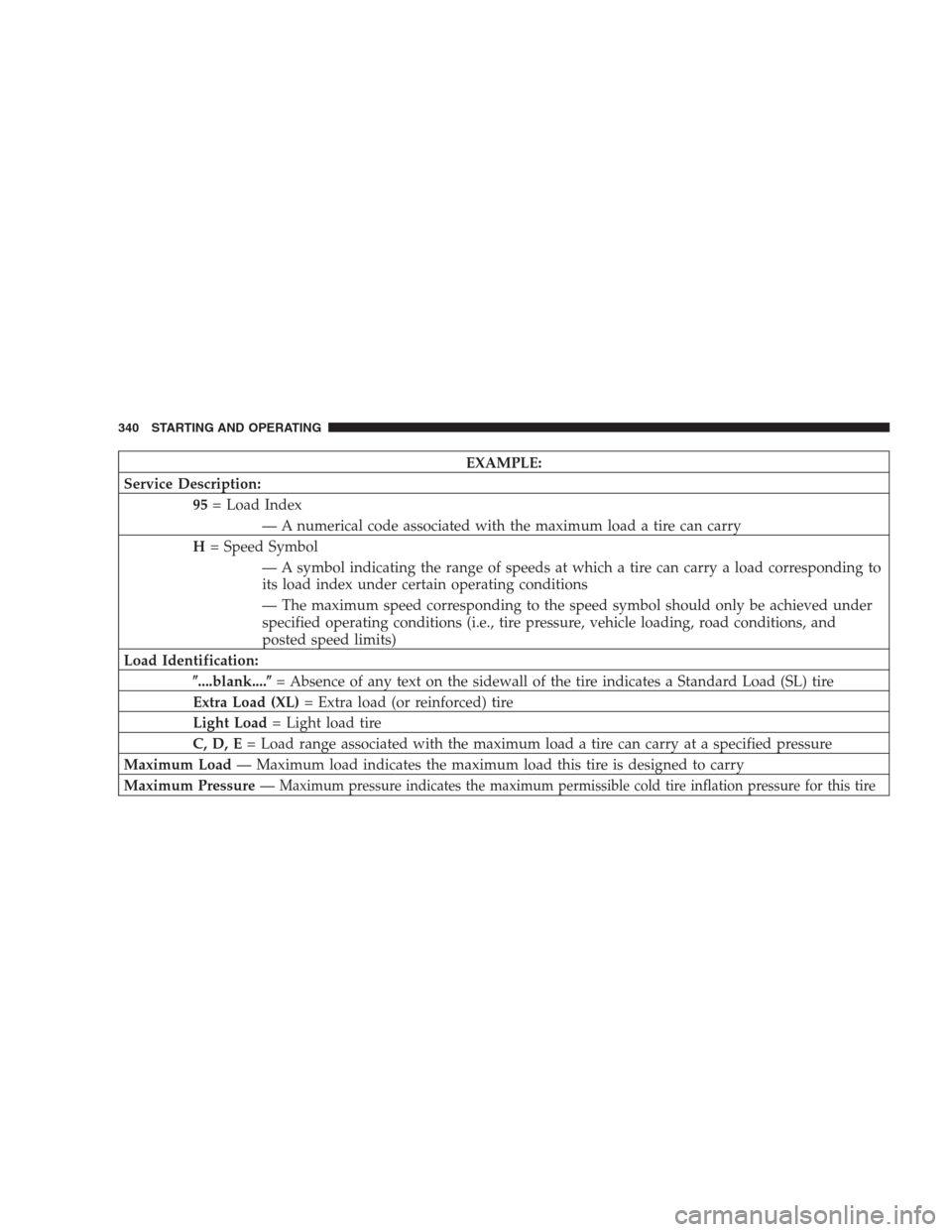
EXAMPLE:
Service Description:
95= Load Index
— A numerical code associated with the maximum load a tire can carry
H= Speed Symbol
— A symbol indicating the range of speeds at which a tire can carry a load corresponding to
its load index under certain operating conditions
— The maximum speed corresponding to the speed symbol should only be achieved under
specified operating conditions (i.e., tire pressure, vehicle loading, road conditions, and
posted speed limits)
Load Identification:
�....blank....�= Absence of any text on the sidewall of the tire indicates a Standard Load (SL) tire
Extra Load (XL)= Extra load (or reinforced) tire
Light Load= Light load tire
C, D, E= Load range associated with the maximum load a tire can carry at a specified pressure
Maximum Load— Maximum load indicates the maximum load this tire is designed to carry
Maximum Pressure—
Maximum pressure indicates the maximum permissible cold tire inflation pressure for this tire
340 STARTING AND OPERATING
Page 344 of 519

Tire Loading and Tire Pressure
Tire Placard Location
NOTE:The proper cold tire inflation pressure is listed
on the driver’s side B-Pillar.
Tire and Loading Information Placard
This placard tells you important information about the:
1) number of people that can be carried in the vehicle
2) total weight your vehicle can carry
3) tire size designed for your vehicle
4) cold tire inflation pressures for the front, rear, and
spare tires.
Loading
The vehicle maximum load on the tire must not exceed the
load carrying capacity of the tire on your vehicle. You will
not exceed the tire’s load carrying capacity if you adhere to
the loading conditions, tire size, and cold tire inflation
pressures specified on the Tire and Loading Information
placard and in the “Vehicle Loading” section of this manual.
NOTE:Under a maximum loaded vehicle condition,
gross axle weight ratings (GAWRs) for the front and rear
axles must not be exceeded. For further information on
GAWRs, vehicle loading, and trailer towing, refer to
“Vehicle Loading” in this section.
Tire and Loading Information Placard
342 STARTING AND OPERATING
Page 348 of 519

WARNING!
Overloading of your tires is dangerous. Overloading can
cause tire failure, affect vehicle handling, and increase
your stopping distance. Use tires of the recommended
load capacity for your vehicle. Never overload them.
TIRES — GENERAL INFORMATION
Tire Pressure
Proper tire inflation pressure is essential to the safe and
satisfactory operation of your vehicle. Three primary
areas are affected by improper tire pressure:
Safety
WARNING!
•Improperly inflated tires are dangerous and can
cause accidents.
(Continued)
WARNING! (Continued)
•Underinflation increases tire flexing and can result
in tire failure.
•Overinflation reduces a tire’s ability to cushion
shock. Objects on the road and chuckholes can cause
damage that result in tire failure.
•Unequal tire pressures can cause steering prob-
lems. You could lose control of your vehicle.
•Overinflated or underinflated tires can affect ve-
hicle handling and can fail suddenly, resulting in
loss of vehicle control.
•Unequal tire pressures from one side of the vehicle
to the other can cause the vehicle to drift to the right
or left.
•Always drive with each tire inflated to the recom-
mended cold tire inflation pressure.
346 STARTING AND OPERATING